World Heritage Identification Number: 1066
World Heritage since: 2002
Category: Cultural Heritage
WHE Type: Cultural Landscapes
Transboundary Heritage: No
Endangered Heritage: No
Country: 🇩🇪 Germany
Continent: Europe
UNESCO World Region: Europe and North America
Map
The Upper Middle Rhine Valley: A Cultural Landscape of Beauty, History, and European Significance
The Upper Middle Rhine Valley, a 65-kilometer stretch of the Middle Rhine River between Koblenz and Rüdesheim/Bingen in Germany, is a captivating testament to the intricate interplay of human ingenuity and natural beauty. Inscribed as a UNESCO World Heritage Site in 2002, this region is celebrated for its striking landscapes, rich history, and enduring cultural significance.
The Upper Middle Rhine Valley's allure lies in its harmonious blend of natural wonders and architectural marvels. The river, shaped by a combination of tectonic uplift and river incision, cuts through a dramatic and varied terrain, carving out a narrow, steep-sided gorge that is home to lush vineyards, picturesque villages, and imposing castles. This geological formation has shaped the valley's character, providing the ideal conditions for human settlement and development.
Historically, the Upper Middle Rhine Valley served as a vital transportation route across Europe. The Romans recognized its strategic value, establishing important roads and fortifications along the riverbanks. Later, during the Middle Ages, the region became a key trade hub, linking northern Europe to the central regions of the continent via interconnected land routes and waterways. This commercial activity led to the establishment of numerous towns, castles and settlements, many of which continue to define the region’s character today.
One of the most notable aspects of the Upper Middle Rhine Valley is the way in which its buildings and terraces have been adapted to the steep slopes of the gorge. This unique architectural response to the challenging topography is evident in the region's iconic structures, such as Rheinfels Castle above St. Goar, Marksburg Castle, Stolzenfels Castle and the countless vineyard terraces that cling precariously to the valley walls. These structures not only reflect the ingenuity of their builders but also contribute to the visual appeal of the landscape.
The Upper Middle Rhine Valley is also deeply rooted in legend and folklore. One such tale revolves around the Lorelei Rock, a massive boulder located near the town of St. Goarshausen. According to local myth, a beautiful enchantress named Loreley lived on the rock and lured sailors to their doom with her seductive singing. This legend has inspired generations of poets, painters, and musicians, further cementing the Upper Middle Rhine Valley's place in European cultural history.
Today, the Upper Middle Rhine Valley attracts millions of visitors each year, who come to enjoy its panoramic views, to marvel at its breathtaking vistas, explore its historic towns, and sample its renowned Riesling wines. The region's enduring allure is a testament to the power of human creativity and the indelible mark it leaves upon the natural world.
To sum it up, the Upper Middle Rhine Valley stands as a remarkable example of human adaptation to a challenging environment, a vital historical crossroads, and a source of endless inspiration for artists, writers, and musicians. Its designation as a UNESCO World Heritage Site is well deserved, as it offers a glimpse into the rich tapestry of European history and culture, where nature and culture coexist in a uniquely compelling way.
UNESCO Description of the World Heritage Site
The 65km-stretch of the Middle Rhine Valley, with its castles, historic towns and vineyards, graphically illustrates the long history of human involvement with a dramatic and varied natural landscape. It is intimately associated with history and legend and for centuries has exercised a powerful influence on writers, artists and composers.
UNESCO Justification of the World Heritage Site
Criterion (ii): As one of the most important transport routes in Europe, the Middle Rhine Valley has for two millennia facilitated the exchange of culture between the Mediterranean region and the north.
Criterion (iv): The Middle Rhine Valley is an outstanding organic cultural landscape, the present-day character of which is determined both by its geomorphological and geological setting and by the human interventions, such as settlements, transport infrastructure, and land use, that it has undergone over two thousand years.
Criterion (v): The Middle Rhine Valley is an outstanding example of an evolving traditional way of life and means of communication in a narrow river valley. The terracing of its steep slopes in particular has shaped the landscape in many ways for more than two millennia. However, this form of land use is under threat from the socio-economic pressures of the present day.
Encyclopedia Record: Rhine Gorge
Upper Middle Rhine Valley is the 65 km (40 mi) southern section of the Middle Rhine between Koblenz and Rüdesheim in the states of Rhineland-Palatinate and Hesse in Germany. It was added to the UNESCO list of World Heritage Sites in June 2002 because of its beauty as a cultural landscape, its importance as a route of transport across Europe, and the unique adaptations of the buildings and terraces to the steep slopes of the gorge.Additional Site Details
Area: 27,250 hectares
Number of Components: 1
(iv) — Outstanding example of a type of building or landscape
(v) — Outstanding example of traditional human settlement
Coordinates: 50.17361111 , 7.694166667
Image
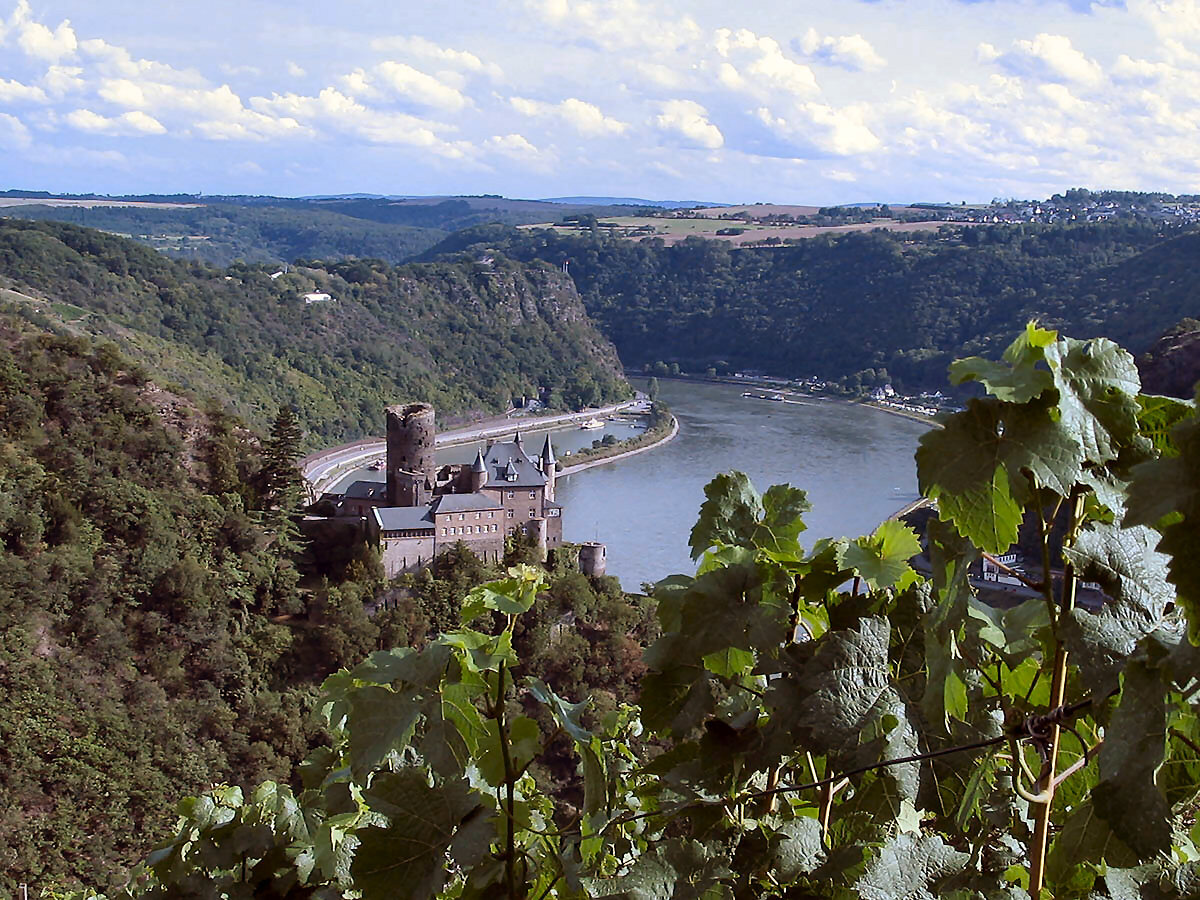
© King (Felix Koenig), CC BY-SA 3.0 Resized from original. (This derivative is under the same CC BY-SA license.)