World Heritage Identification Number: 709
World Heritage since: 1996
Category: Cultural Heritage
WHE Type: Cultural Landscapes
Transboundary Heritage: No
Endangered Heritage: No
Country: 🇬🇪 Georgia
Continent: Asia
UNESCO World Region: Europe and North America
Map
Upper Svaneti: A Medieval Mountain Landscape in the Caucasus
Upper Svaneti, inscribed as a UNESCO World Heritage Site in 1996, is a captivating region nestled within the rugged landscapes of the Greater Caucasus Mountains in northwestern Georgia. This remote and isolated highland area offers a unique blend of breathtaking natural beauty, rich cultural heritage, and architectural ingenuity that transports visitors back to medieval times.
More to come…UNESCO Description of the World Heritage Site
Preserved by its long isolation, the Upper Svaneti region of the Caucasus is an exceptional example of mountain scenery with medieval-type villages and tower-houses. The village of Chazhashi still has more than 200 of these very unusual houses, which were used both as dwellings and as defence posts against the invaders who plagued the region.
UNESCO Justification of the World Heritage Site
Criterion (iv): The region of Upper Svaneti is an outstanding example of an exceptional mountain landscape composed of highly preserved villages with unique defensive tower houses, examples of ecclesiastical architecture and arts of medieval origin.
Criterion (v): The region of Upper Svaneti is an outstanding landscape that has preserved to a remarkable degree its original medieval appearance notable for its fragile traditional human settlements and land-use patterns.
Encyclopedia Record: Svaneti
Svaneti is a province in the northwestern part of Georgia. Running along the Greater Caucasus range, Svaneti is one of the most mountainous regions of Georgia. It is largely inhabited by the Svans, an ethnic subgroup of Georgians.Additional Site Details
Area: 1.06 hectares
Number of Components: 1
(v) — Outstanding example of traditional human settlement
Coordinates: 42.914 , 43.009
Image
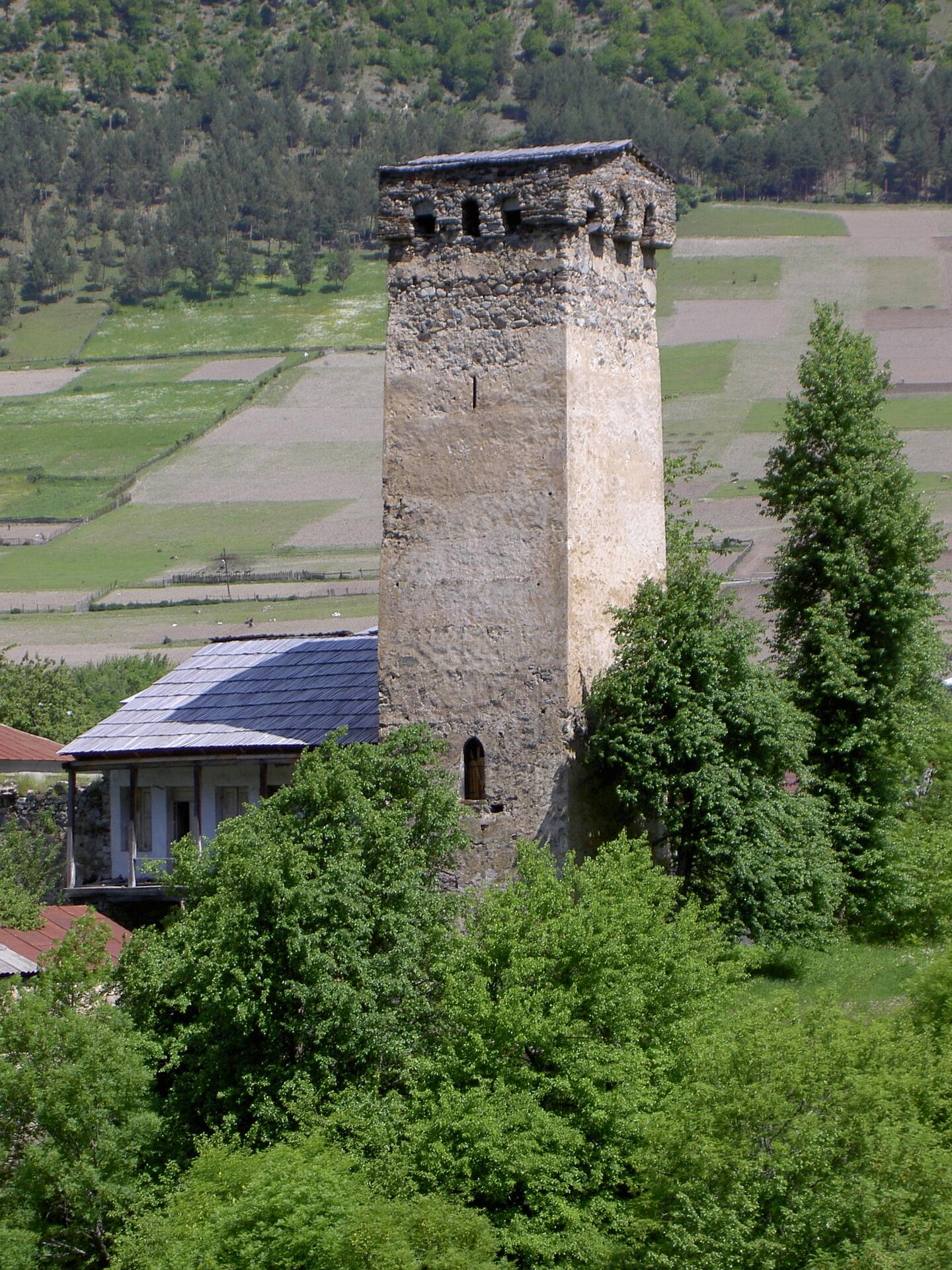
© Unknown, CC BY-SA 3.0 Resized from original. (This derivative is under the same CC BY-SA license.)
World Heritage Research
Discover scientific research and academic studies that deepen our understanding of Upper Svaneti from its history and significance to its conservation, management, and contemporary challenges.
-
Interaction of Images in Sacred Space: A Case Study: The Church of St Barbara in Khe, Upper Svaneti
A detailed analysis of the Church of St Barbara in Khe, Upper Svaneti, reveals how diverse Christian images interact within sacred space to create a meaningful liturgical environment. The study focuses on the fresco-icons of the Church Fathers in the sanctuary apse, demonstrating their role in adding new semantic content and reinforcing the church's symbolic significance. These images, attributed to a local workshop from the 13th and 14th centuries, reflect a blend of Byzantine cultural formulas with local artistic traditions. The research highlights the stylistic and iconographic features that illustrate this 'translation' process, providing insights into how sacred spaces are constructed through visual narratives.
Chichinadze, N. (2023). Interaction of Images in Sacred Space: A Case Study: The Church of St Barbara in Khe, Upper Svaneti. Medieval Svaneti: Objects, Images, and Bodies in Dialogue with Built and Natural Spaces, 86–99. https://doi.org/10.1484/m.convisup-eb.5.136732
View Publication Record | Read Publication -
Painted Chancel Screens in Upper Svaneti: The Evidence from Early Monuments
Painted chancel screens in Upper Svaneti's medieval churches reveal a distinct artistic and iconographic tradition, blending Byzantine influences with local Svaneti beliefs. These screens, found in early monuments like St George in Nak'ipari, the Mother of God in Zhibiani, and Lagurk'a St Cyricus, feature geometric patterns engraved in plaster and accentuated with red, white, and black paint. Unlike other regions, Upper Svaneti's decoration is highly selective, focusing only on specific interior sections and façades. The study highlights how these screens incorporate both pure ornamentation and scenes of saints, reflecting a synthesis of broader Byzantine iconography and indigenous traditions, such as hunting deities and domestic spatial arrangements.
Meladze, S. (2023). Painted Chancel Screens in Upper Svaneti: The Evidence from Early Monuments. Medieval Svaneti: Objects, Images, and Bodies in Dialogue with Built and Natural Spaces, 66–85. https://doi.org/10.1484/m.convisup-eb.5.136731
View Publication Record | Read Publication -
Crises around Concepts of Hospitality in the Mountainous Region of Svaneti in the North of Georgia
Tourists' online expectations and reviews significantly impact local communities in Ushguli, Georgia, creating intense competitive pressure on villagers. This study highlights the challenges faced by the UNESCO-listed region as tourism grows rapidly since 2010, often outpacing its preparedness for modern lifestyles. The research, conducted from 2017 to 2022, critically examines how this shift affects regional values and social organization. By analyzing clashes between villagers' economic goals—centered on increasing visitor numbers—and tourists' diverse needs, the study explores tourism as both a potential solution and a disruptor of local structures. It reveals that while tourism offers economic opportunities, it also introduces complex pressures that reshape material and immaterial aspects of life in Ushguli.
Applis, S. (2022). Crises around Concepts of Hospitality in the Mountainous Region of Svaneti in the North of Georgia. Tourism and Hospitality, 3(2), 416–434. https://doi.org/10.3390/tourhosp3020027
View Publication Record | Read Publication -
Sustaining Rural Livelihoods in Upper Svaneti, Republic of Georgia
State-led development in Upper Svaneti, Georgia, threatens rural livelihoods and biodiversity conservation by prioritizing commercial tourism and timber concessions over local resource access. Research reveals that low-income households and remote villages are disproportionately dependent on common pool resources (CPRs), which cannot be easily replaced by wage income from new industries. Traditional governance structures and diversified livelihood strategies are critical for risk management, but current development pathways risk environmental degradation and increased wealth inequality. Institutional analysis shows that while forest users exhibit traits conducive to community forest management (CFM), legal frameworks and financial incentives hinder decentralization. An alternative approach—such as ecotourism with protected areas—could better sustain subsistence practices, support small-scale businesses, and ensure equitable opportunities, offering a more socially desirable development model.
Kemkes, R. J. (2013). Sustaining Rural Livelihoods in Upper Svaneti, Republic of Georgia [University of Massachusetts Amherst]. https://doi.org/10.7275/M3EX-X616
View Publication Record | Read Publication -
Multidisciplinary Analysis of the Vernacular Settlements in Ushguli (Upper Svaneti, Georgia)
A multidisciplinary analysis reveals that the vernacular settlements of Ushguli, located at the highest point of human occupation before the permanent snowed highlands separating Georgia from Russia, exhibit unique urban morphological features distinct from classical urban elements. These settlements, inscribed as a UNESCO World Heritage Site since 1996, display an overlapping of private and public spaces without a standard concept of streets or squares, significantly influencing their vernacular architecture. The study, conducted under the Project 3D Past, employs a combination of architectural analysis, urban morphology, and historical research to elucidate these original features, which are shaped by the Svan's history of conflict and isolation.
Sousa, G., Carlos, G., Florentino, R., & Bermudez, T. (2020). MULTIDISCIPLINARY ANALYSIS OF THE VERNACULAR SETTLEMENTS IN USHGULI (UPPER SVANETI, GEORGIA). The International Archives of the Photogrammetry, Remote Sensing and Spatial Information Sciences, XLIV-M-1-2020, 189–193. https://doi.org/10.5194/isprs-archives-xliv-m-1-2020-189-2020
View Publication Record | Read Publication -
“King’s Painter” Tevdore and his inscriptions
A study of the inscriptions by 'King’s Painter' Tevdore in three churches of Upper Svaneti, dating from the 11th and 12th centuries, reveals his elevated status tied to monarchic power. The analysis of textual and visual data shows that Tevdore’s title and spatial placement of inscriptions were strategic, aiming to extend 'royal presence' in this highland region of Georgia. This research provides insights into the social hierarchy and political context of medieval Svaneti, highlighting how artistic embellishment served as a tool for asserting authority. The study combines epigraphic analysis with an examination of spatial constructs to evaluate Tevdore’s role within the broader societal framework.
Chichinadze, N. (2018). “King’s Painter” Tevdore and his inscriptions. Zograf, (42), 25–36. https://doi.org/10.2298/zog1842025c
View Publication Record | Read Publication -
Mountain environment and population in Georgia: case study of Upper Svaneti
A survey of Upper Svaneti's population in Georgia revealed significant insights into local perceptions and priorities regarding ecological challenges. Residents identified critical environmental issues, often ranking them above socio-economic concerns, demonstrating a strong awareness of ecological problems. The study found varying levels of trust in environmental information sources and limited knowledge about national environmental policies, despite active participation in conservation efforts. These findings underscore the importance of fostering community engagement to enhance decision-making for sustainable development in mountainous regions. The research employed stratified-cluster sampling and statistical analysis using SPSS, providing a robust framework for understanding local ecological perceptions.
Elizbarashvili, M., Khardziani, T., Maisuradze, R., & Tatishvili, M. (2017). Mountain environment and population in Georgia: case study of Upper Svaneti. International Journal of Sustainable Development & World Ecology, 25(4), 362–370. https://doi.org/10.1080/13504509.2017.1417182
View Publication Record | Read Publication -
Ethno-ecological contexts of the Skhalta Gorge and the Upper Svaneti (Georgia, the Caucasus)
A comparative analysis of the Skhalta Gorge and Upper Svaneti, two high mountain regions in Georgia, reveals that rapid depopulation can lead to ecological degradation if local culture and traditions are not actively preserved. The study demonstrates that sustainable development requires intervention rather than abstention, with tourism emerging as a key mechanism for restoring ethno-ecological balance by supporting traditional agriculture. This research leverages political ecology and the concept of socio-ecological systems (SES) to highlight the interplay between social and ecological dynamics under varying historical, political, and climatic conditions.
Shmelev, S., & Kikvidze, Z. (2016). Ethno-ecological contexts of the Skhalta Gorge and the Upper Svaneti (Georgia, the Caucasus). Journal of Political Ecology, 23(1). https://doi.org/10.2458/v23i1.20212
View Publication Record | Read Publication -
Original wall paintings at the church of the Saviour in Chvabiani (Upper Svaneti, Georgia) and Byzantine art at the turn of the tenth to eleventh centuries
A rare ensemble of wall paintings at the Church of the Saviour in Chvabiani, Upper Svaneti, Georgia, has been confirmed to date back to 978-1001, challenging prior assumptions about their origins. Through meticulous analysis of technique and style, researchers demonstrated that both the Theophany in the conch and the Apostles in the lower zone are original works from the turn of the tenth to eleventh century, showing no traces of later repainting. These paintings exhibit exceptional quality and strong affinities with Byzantine art, suggesting they may have been created by a visiting artist, likely Georgian-trained at a major Byzantine center. The findings provide new insights into the artistic exchange between Georgia and Byzantium during this formative period.
Zakharova, A., & Sverdlova, S. (2015). Original wall paintings at the church of the Saviour in Chvabiani (Upper Svaneti, Georgia) and Byzantine art at the turn of the tenth to eleventh centuries. Zograf, (39), 11–23. https://doi.org/10.2298/zog1539011z
View Publication Record | Read Publication -
Fresco-Icons on Façades of Churches in Upper Svaneti (Georgia)
Fresco-icons on the south facades of 13th-century churches in Upper Svaneti, Georgia—specifically the Church of the Archangels in Iprari and St. George church in Ipkhi—serve as liminal markers, functioning as visual references to the chancel barrier (templon) and addressing the space in front of them. These exterior murals, depicting the Deesis iconography, play a crucial role in the spatial and symbolic organization of Christian churches, bridging the gap between the sanctuary and the laity. The study interprets the facade fresco-icons as templon imagery, highlighting their significance in religious architecture and ritual practice.
Chichinadze, N. (2014). Fresco-Icons on Façades of Churches in Upper Svaneti (Georgia). Kadmos, 6, 50–94. https://doi.org/10.32859/kadmos/6/50-94
View Publication Record | Read Publication