World Heritage Identification Number: 900
World Heritage since: 1999
Category: Natural Heritage
WHE Type: Protected Areas & National Parks
Transboundary Heritage: No
Endangered Heritage: No
Country: 🇷🇺 Russian Federation
Continent: Europe
UNESCO World Region: Europe and North America
Map
The Western Caucasus: A Unique Mountainous Region in Southern Russia
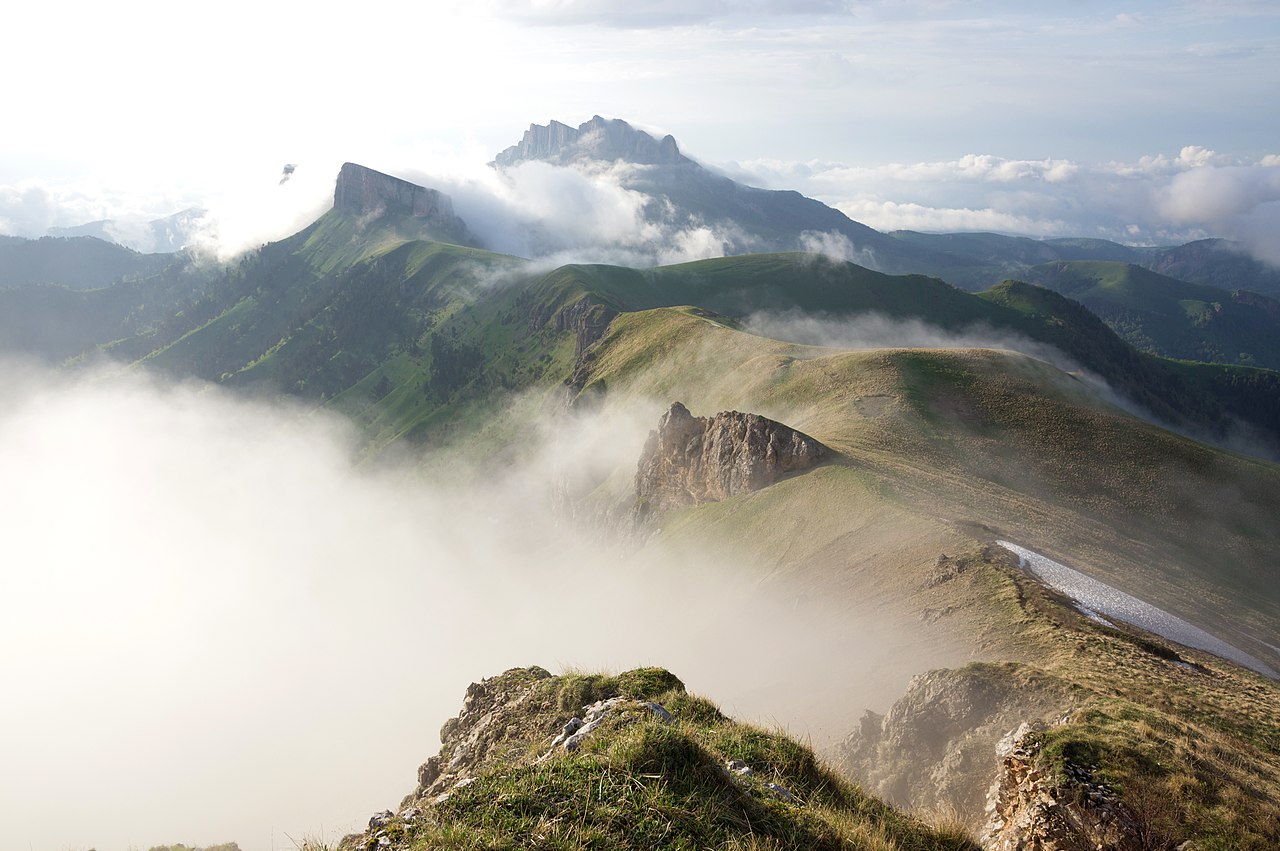
The Western Caucasus, a vast mountainous region spanning approximately 275,000 hectares, lies at the far west end of the larger Caucasus Mountains in southern Russia. Situated just 50 kilometers northeast of the Black Sea, this area is one of the few substantial mountain regions in Europe that has remained relatively untouched by human activity. This UNESCO World Heritage Site, inscribed in 1999, boasts an exceptional array of diverse ecosystems, unique endemic plant species, and abundant wildlife, making it a significant conservation priority.
More to come…UNESCO Description of the World Heritage Site
The Western Caucasus, extending over 275,000 ha of the extreme western end of the Caucasus mountains and located 50 km north-east of the Black Sea, is one of the few large mountain areas of Europe that has not experienced significant human impact. Its subalpine and alpine pastures have only been grazed by wild animals, and its extensive tracts of undisturbed mountain forests, extending from the lowlands to the subalpine zone, are unique in Europe. The site has a great diversity of ecosystems, with important endemic plants and wildlife, and is the place of origin and reintroduction of the mountain subspecies of the European bison.
UNESCO Justification of the World Heritage Site
The Western Caucasus has a remarkable diversity of geology, ecosystems and species. It is of global significance as a centre of plant diversity. Along with the Virgin Komi World Heritage site, it is the only large mountain area in Europe that has not experienced significant human impact, containing extensive tracts of undisturbed mountain forests unique on the European scale.
Encyclopedia Record: Western Caucasus
The Western Caucasus is a western region of the North Caucasus in Southern Russia, extending from the Black Sea to Mount Elbrus.Additional Site Details
Area: 298,903 hectares
Number of Components: 1
(x) — Contains most important habitats for biodiversity
Coordinates: 44 , 40
IUCN World Heritage Outlook
The 2025 Conservation Outlook on Western Caucasus reports the following assessment:
Source: International Union for Conservation of Nature (IUCN) · View assessment
World Heritage Research
Discover scientific research and academic studies that deepen our understanding of Western Caucasus from its history and significance to its conservation, management, and contemporary challenges.
-
Lichens and allied non-lichenized fungi of virgin forests in the Caucasus State Nature Biosphere Reserve (Western Caucasus, Russia)
A comprehensive survey of lichens and allied fungi in the Caucasus State Nature Biosphere Reserve revealed 659 species, including 149 new to the Northern Caucasus and 50 previously unknown in Russia. The study, conducted across seven one-hectare plots along an altitudinal gradient, identified a diverse range of epiphytic and epixylic species, with macrolichens comprising 26.5–40% of the total. Notably, the research found negligible effects of acidification or nitrogen emissions on lichen diversity, with cyanolichens remaining abundant across all plots. Beech and fir trees were the most preferred substrates, though most lichen species exhibited low substrate specificity. The highest species richness was observed in a plot outside the reserve, prompting recommendations for its inclusion to expand protected areas.
Urbanavichus, G., Vondrák, J., Urbanavichene, I., Palice, Z., & Malíček, J. (2020). Lichens and allied non-lichenized fungi of virgin forests in the Caucasus State Nature Biosphere Reserve (Western Caucasus, Russia). Herzogia, 33(1), 90. https://doi.org/10.13158/heia.33.1.2020.90
View Publication Record | Read Publication -
Elevational Distribution of Alien Plant Species in the Western Caucasus
Alien plant species in the Western Caucasus exhibit a distinct elevational distribution, with maximum richness concentrated in lower, more climatically favorable zones where human activity is highest. Of 100 alien species studied—comprising herbaceous (59%) and arboreous (41%) plants—most originate from North America and East Asia, and 57% are cultivated. Species diversity declines with elevation, with only 17 species found above 1000 m a.s.l., primarily accidental annual herbs of North American origin. Notably, Matricaria suaveolens is the sole alien species recorded above the timberline (2000 m a.s.l.). The study highlights differences between southern and northern macroslopes, attributing the penetration of aliens into upper belts to human activities such as road construction and tourist infrastructure development.
Akatova, T. V., & Akatov, V. V. (2019). Elevational Distribution of Alien Plant Species in the Western Caucasus. Russian Journal of Biological Invasions, 10(3), 205–219. https://doi.org/10.1134/s2075111719030044
View Publication Record | Read Publication -
Environment of Viewpoint Geosites: Evidence from the Western Caucasus
Viewpoint geosites, which offer panoramic views of unique geological features and landscapes, are significantly influenced by their environmental context. This study introduces a new framework to evaluate the environment of such sites using three components: standpoint environment, transitional environment, and target environment. Each component is assessed based on criteria like the presence of geological elements, vegetation cover, anthropogenic intervention, fragmentation, and contrast. Analyzing three geosites in the Western Caucasus, researchers found that environmental differences between these sites had a more substantial impact than variations in their displayed geoheritage features. This innovative approach to evaluating viewpoint geosites provides a broader application and justification for future environmental assessments.
Mikhailenko, A. V., & Ruban, D. A. (2019). Environment of Viewpoint Geosites: Evidence from the Western Caucasus. Land, 8(6), 93. https://doi.org/10.3390/land8060093
View Publication Record | Read Publication -
Robinia pseudoacacia L. in the Western Caucasus
Robinia pseudoacacia L., commonly known as black locust, does not reduce arboreal species diversity in riparian forests of the Western Caucasus despite its increasing dominance over native tree species. The study, conducted by Akatov et al. (2016), reveals that while R. pseudoacacia is most abundant where native dominants hold a middle-level presence, its proliferation does not negatively impact overall forest diversity. Researchers analyzed distribution, age structure, and population dynamics across the region, finding that most individuals are under 20 years old, suggesting rapid colonization but limited long-term persistence. The study highlights the resilience of riparian forests to invasive species, offering insights into ecological succession and conservation strategies for UNESCO World Heritage Sites like those in the Western Caucasus.
Akatov, V. V., Akatova, T. V., & Shadzhe, A. E. (2016). Robinia pseudoacacia L. in the Western Caucasus. Russian Journal of Biological Invasions, 7(2), 105–118. https://doi.org/10.1134/s2075111716020028
View Publication Record | Read Publication -
Calibration of a mathematical model of Marukh Glacier, Western Caucasus
A three-dimensional mathematical model of Marukh Glacier in the Western Caucasus has been developed and calibrated, offering a robust tool for predicting glacier evolution under changing climatic conditions. The model integrates field data from radio-echo-sounding, topographic and gravimetrical measurements, alongside meteorological observations from Klukhorsky Pereval station. Calibration focused on optimizing parameters to minimize deviations between calculated and observed flow velocities and surface mass balance, ensuring high accuracy. This approach provides a foundation for future prognostic calculations of glacier dynamics in the Caucasus region, addressing critical questions about glacial response to climate change.
Rybak, О. О., Rybak, Е. А., Kutuzov, S. S., Lavrentiev, I. I., & Morozova, P. А. (2015). Calibration of a mathematical model of Marukh Glacier, Western Caucasus. Ice and Snow, 130(2), 9. https://doi.org/10.15356/2076-6734-2015-2-9-20
View Publication Record | Read Publication -
The world's deepest subterranean community - Krubera-Voronja Cave (Western Caucasus)
An expedition to Krubera-Voronja Cave, the world's deepest cave at over 2140 meters, uncovered a previously unknown subterranean community of arthropods, including more than 12 species, some of which are new to science. This discovery challenges the notion that deep subterranean ecosystems are evolutionary dead ends, instead highlighting their role as shelters for epigean species during harsh surface conditions. The study also revealed the vertical distribution of invertebrate fauna, from the cave entrance to its deepest reaches, and identified the world's deepest dwelling arthropod. The research suggests that these deep ecosystems rely heavily on allochthonous organic carbon sources, such as water percolation and sinking streams, for their survival.
Sendra, A., & Reboleira, A. (2012). The world’s deepest subterranean community - Krubera-Voronja Cave (Western Caucasus). International Journal of Speleology, 41(2), 221–230. https://doi.org/10.5038/1827-806x.41.2.9
View Publication Record | Read Publication -
Upper Jurassic Reefs from the Russian Western Caucasus: Implications for the Eastern Black Sea
Upper Jurassic reefs in the Russian Western Caucasus reveal diverse and structurally controlled reef complexes that serve as potential analogues for exploration targets in the eastern Black Sea. These reefs, categorized into coral-dominated, siliceous sponge-microbialite, and microbialite types, developed on two Late Jurassic carbonate platforms: the North Caucasus platform to the north and the South Adler platform to the south. Coral-dominated reefs, found at shallow-water platform margins and deeper mid-shelf settings, exhibit varying diversity levels, while siliceous sponge- and microbialite-dominated reefs were restricted to deeper-water environments. The study suggests that these outcrops could provide critical insights for understanding seismic-imaged reef complexes on the Shatskiy Ridge, depending on their palaeowater depth.
GUO, L., VINCENT, S. J., & LAVRISHCHEV, V. (2011). Upper Jurassic Reefs from the Russian Western Caucasus: Implications for the Eastern Black Sea. Turkish Journal of Earth Sciences. LOCKSS. https://doi.org/10.3906/yer-1012-5
View Publication Record | Read Publication -
Geological history of Western Caucasus and adjacent foredeeps based on analysis of the regional balanced section
A balanced geological section of the Tuapse foredeep-Western Caucasus-Western Kuban foredeep system reveals that the Western Caucasian basin existed as a rift from the Callovian to Eocene periods, with its principal inversion occurring during the Oligocene-Miocene. The region transitioned into an orogeny phase by the Pliocene-Quaternary, indicating significant tectonic activity. The study suggests that Caucasus compression extended over 30 km within this area. Using seismic evidence and other geological data, researchers reconstructed the region's history to provide insights into its long-term geological evolution.
Nikishin, A. M., Ershov, A. V., & Nikishin, V. A. (2010). Geological history of Western Caucasus and adjacent foredeeps based on analysis of the regional balanced section. Doklady Earth Sciences, 430(2), 155–157. https://doi.org/10.1134/s1028334x10020017
View Publication Record | Read Publication -
Mountain-meadow soils of the highlands in the Western Caucasus
Mountain-meadow soils in the Western Caucasus exhibit distinct mineral and organic transformations driven by soil formation processes, with two dominant elementary processes: humus accumulation and clay formation. These processes are mediated by soil biota and shape the chemical element profiles of these soils. The study analyzes published and original data on soil morphology, substance composition, physicochemical properties, total chemical and mineralogical composition, and micromorphology to characterize these transformations. It also proposes improvements for the classification of mountain-meadow soils based on these findings.
Molchanov, E. N. (2010). Mountain-meadow soils of the highlands in the Western Caucasus. Eurasian Soil Science, 43(12), 1330–1343. https://doi.org/10.1134/s1064229310120033
View Publication Record | Read Publication