World Heritage Identification Number: 710
World Heritage since: 1994
Category: Cultural Heritage
WHE Type: Religious Sites & Sacred Architecture
Transboundary Heritage: No
Endangered Heritage: No
Country: 🇬🇪 Georgia
Continent: Asia
UNESCO World Region: Europe and North America
Map
Gelati Monastery: A Medieval Masterpiece in Western Georgia
The Gelati Monastery, located in the Imereti region of western Georgia, stands as a testament to the architectural prowess and cultural significance of medieval Georgia. Inscribed as a UNESCO World Heritage Site in 1994, this monumental complex offers a glimpse into the Golden Age of Georgia, a period marked by political strength, economic growth, and intellectual flourishing.
More to come…UNESCO Description of the World Heritage Site
Founded in 1106 in the west of Georgia, the Monastery of Gelati is a masterpiece of the Golden Age of medieval Georgia, a period of political strength and economic growth between the 11th and 13th centuries. It is characterized by the facades of smoothly hewn large blocks, balanced proportions and blind arches for exterior decoration. The Gelati monastery, one of the largest medieval Orthodox monasteries, was also a centre of science and education and the Academy it housed was one of the most important centres of culture in ancient Georgia.
UNESCO Justification of the World Heritage Site
Criterion (iv): Gelati Monastery is the masterpiece of the architecture of the “Golden Age” of Georgia and the best representative of its architectural style, characterized by the full facing of smoothly hewn large blocks, perfectly balanced proportions, and the exterior decoration of blind arches. The main church of the monastery is one of the most important examples of the cross-in-square architectural type that had a crucial role in the East Christian church architecture from the 7th century onwards. Gelati is one of the largest Medieval Orthodox monasteries, distinguished for its harmony with its natural setting and a well thought-out overall planning concept. The main church of the Gelati Monastery is the only Medieval monument in the larger historic region of Eastern Asia Minor and the Caucasus that still has well-preserved mosaic decoration, comparable with the best Byzantine mosaics, as well as having the largest ensemble of paintings of the middle Byzantine, late Byzantine, and post-Byzantine periods in Georgia, including more than 40 portraits of kings, queens, and high clerics and the earliest depiction of the seven Ecumenical Councils.
Encyclopedia Record: Gelati Monastery
Gelati is a medieval monastic complex near Kutaisi in the Imereti region of western Georgia. One of the first monasteries in Georgia, it was founded in 1106 by King David IV of Georgia as a monastic and educational center.Additional Site Details
Area: 4.2 hectares
Number of Components: 1
Coordinates: 42.2947222222 , 42.7683333333
Image
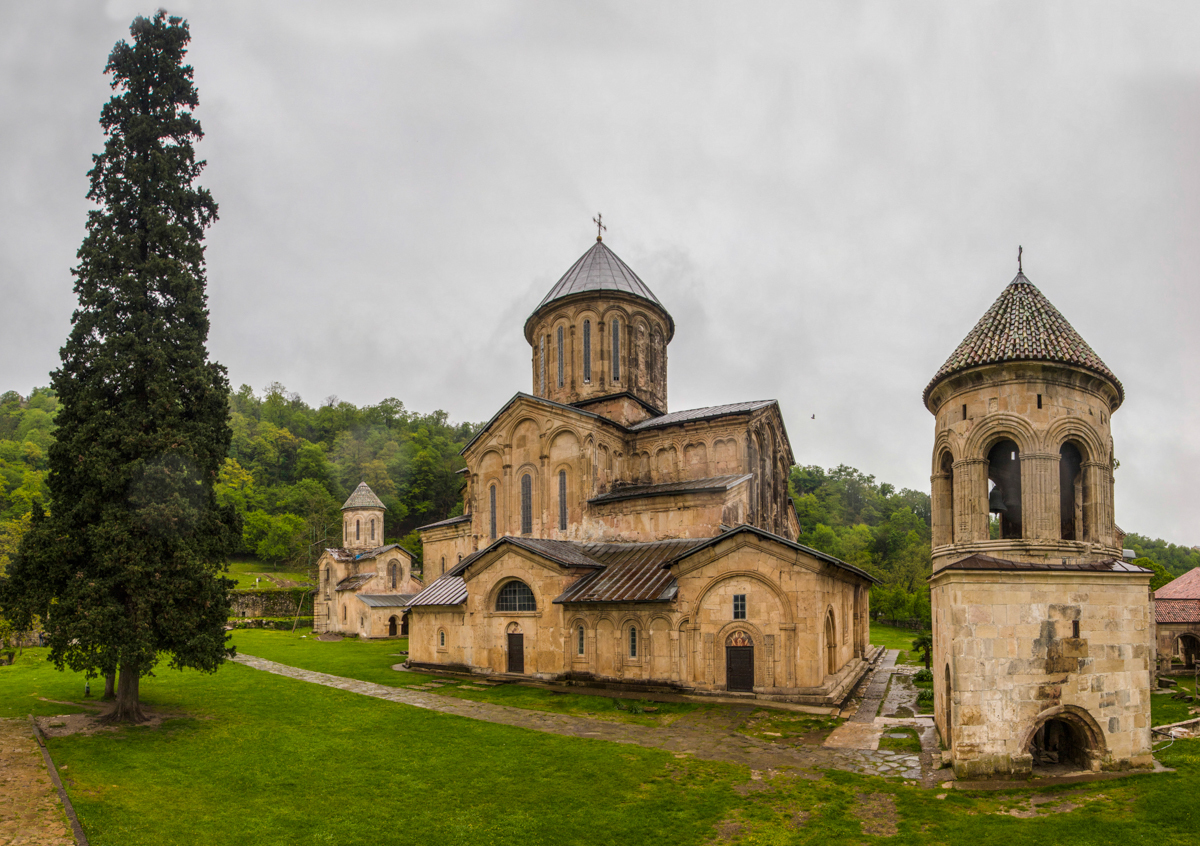
© Ihor Burliai, CC BY-SA 3.0 Resized from original. (This derivative is under the same CC BY-SA license.)
World Heritage Research
Discover scientific research and academic studies that deepen our understanding of Gelati Monastery from its history and significance to its conservation, management, and contemporary challenges.
-
A historical-index measurement framework of agentic capital, the Georgian Church, monastic knowledge networks and institutional resilience
This study reveals that the long-term resilience and institutional status of the Georgian Church stem not solely from formal structures but from a co-accumulation of agentic capital, knowledge networks, autonomy, external recognition, and post-shock recovery capacity. By constructing a historical-index dataset (AD 33–1990) coding ecclesiastical events, monastic centers, hagiographic texts, and international positioning on a 0-100 scale, the research quantifies institutional productivity through econometric models like PCA and HAC-OLS. Findings show that knowledge capital, institutional autonomy, and external recognition positively correlate with the Church's trajectory, even surviving formal disruptions (e.g., 1811, 1917, 1990). The framework bridges historical ecclesiology, institutional economics, and agentic theory, offering a methodology to transform qualitative historical data into measurable indices. This approach underscores how knowledge, agency, and resilience function as long-term productive assets in an 'agentic economy.'
Gondauri, D. (2026). A historical-index measurement framework of agentic capital, the Georgian Church, monastic knowledge networks and institutional resilience. Zenodo. https://doi.org/10.5281/ZENODO.20706804
View Publication Record | Read Publication -
Prospecting on the UNESCO World Heritage Site Gelati, Georgia
Recent archaeo-geophysical prospecting around the UNESCO World Heritage Site Gelati Monastery, Georgia, has uncovered new discoveries that promise to deepen our understanding of the site's historical and cultural significance. The study employed advanced geophysical techniques to explore subsurface structures, revealing potential hidden features that could include ancient foundations or buried artifacts. This approach combines ground-penetrating radar (GPR), electrical resistivity tomography (ERT), and magnetic surveys to create a comprehensive subsurface map. Such integrated methods enhance the precision of archaeological investigations while minimizing invasive excavation, thereby preserving the integrity of the site. The findings highlight the potential for non-invasive prospecting to uncover significant historical insights in protected areas like Gelati.
Fassbinder, J. W. E., Lambers, L. S. L., Linck, R., & Lordkipanidze, D. O. (2025). Prospecting on the UNESCO World Heritage Site Gelati, Georgia. ArchéoSciences, 49-1, 263–266. https://doi.org/10.4000/14ns7
View Publication Record | Read Publication -
The Gate of Ganja
A significant historical discovery reveals that the iron gate preserved at Gelati Monastery, Georgia, is not from Derbent as previously believed, but rather the captured 'Gate of Ganja' taken by Georgian King Demetrius I following a devastating earthquake in 1139. This conclusion, supported by local historiographer Kirakos Gandzaketsi's account, clarifies a long-standing misconception about its origin. The study leverages historical records and architectural analysis to authenticate the gate's provenance, providing new insights into medieval Caucasian history and the aftermath of seismic events on urban defenses.
Gippert, J. (2023). 15A The Gate of Ganja. Caucasian Albania, 571–580. https://doi.org/10.1515/9783110794687-018
View Publication Record | Read Publication -
Transforming Religious and Monarchial Power
A significant discovery sheds light on the symbolic transformation of power through the relocation of the Iron Gates of Ganja from an Islamic emirate to Gelati Monastery, a key architectural and political symbol of medieval Georgia. The study reveals that these gates, inscribed with Arabic script detailing their original purpose under the Islamic ruler of Ganja, underwent a profound shift in meaning when King Demet’re I of Georgia incorporated them into his father’s tomb at Gelati. This relocation not only reinforced the monastery’s role as a center of political and religious authority but also demonstrated Georgia’s strategic use of spoils of war to assert dominance over neighboring Islamic territories. The research employs a comparative analysis of the gates' original context in Ganja and their new significance within the Gelati complex, providing insights into the intersection of power, culture, and diplomacy during this pivotal period.
Hubbert, J. (2023). Transforming Religious and Monarchial Power. Journal of Islamic Archaeology, 10(1), 83–100. https://doi.org/10.1558/jia.20436
View Publication Record | Read Publication -
Altars in Medieval Georgian Churches. Preliminary Notes on Their Arrangement, Decoration, and the Rite of Consecration
Medieval Georgian altars, often plain but occasionally adorned with crosses or complex figural decorations, were found to hold deep symbolic significance as places of sacrifice. Archaeological and written sources reveal that these altars were typically surmounted by canopies, with one surviving example from the 18th century showcasing a rich structure that underscores Gelati Monastery's tradition as the 'Second Jerusalem.' The study also highlights the rite of consecration, translated in the 10th–11th centuries, and the materials used in altar construction. By analyzing liturgical texts alongside archaeological evidence, researchers uncovered the multifaceted roles of altars in medieval Georgian churches, blending practical and symbolic elements.
Chitishvili, N. (2021). Altars in Medieval Georgian Churches. Preliminary Notes on Their Arrangement, Decoration, and the Rite of Consecration. Georgia as a Bridge between Cultures, 90–115. https://doi.org/10.1484/m.convisup-eb.5.130912
View Publication Record | Read Publication -
The composition of Amnos in the murals of the north-west chapel of the main church of Gelati Monastery / წმ. მსხვერპლის თაყვანისცემის სცენა გელათის მთავარი ტაძრის ჩრდილო-დასავლეთი ეკვდერის მოხატულობაში
A detailed analysis of the Amnos composition in the murals of Gelati Monastery's northwest chapel reveals unique iconographic features characteristic of the period under the prelateship of Zakaria Kvariani (1637-1660). The study, conducted by Ana Jikia, a doctoral student at Tbilisi State University, focuses on the monumental painting of this era, offering insights into the artistic and religious practices of 17th-century Georgia. By examining the visual elements and symbolic representations within the chapel's murals, the research provides a nuanced understanding of the cultural and historical context of Gelati Monastery during this significant period.
Jikia, A. (2021). The composition of Amnos in the murals of the north-west chapel of the main church of Gelati Monastery / წმ. მსხვერპლის თაყვანისცემის სცენა გელათის მთავარი ტაძრის ჩრდილო-დასავლეთი ეკვდერის მოხატულობაში. Spekali / სპეკალი (Ed.: Nana Gaprindashvili / სამეცნიერო რედაქტორი: ნანა გაფრინდაშვილი). https://doi.org/10.55804/jtsu-1987-8583-15-1
View Publication Record | Read Publication -
Tourism Potential of Imereti
Georgia's Imereti region, home to UNESCO World Heritage Sites like the Bagrati Cathedral and Gelati Monastery, presents significant tourism potential due to its rich cultural heritage, diverse landscapes, and strategic location. The study highlights Georgia's unique blend of ancient history, architecture, and natural beauty, including mountains, seaside resorts, and health spas, all concentrated within a small territory. Recent government efforts to restore Kutaisi, the regional capital, have further enhanced its appeal as a cultural and historical destination. The research emphasizes the region's potential for sustainable tourism development, leveraging its heritage assets while ensuring preservation and safety.
BERDZENISHVILI, N., & BERDZENISHVILI, N. (2018). Tourism Potential of Imereti. Journal in Humanities, 6(1), 31–33. https://doi.org/10.31578/hum.v6i1.346
View Publication Record | Read Publication