World Heritage Identification Number: 1073
World Heritage since: 2003
Category: Cultural Heritage
WHE Type: Archaeological Sites
Transboundary Heritage: No
Endangered Heritage: No
Country: 🇸🇩 Sudan
Continent: Africa
UNESCO World Region: Arab States
Map
Exploring the Cultural Richness of Gebel Barkal and the Napatan Region
The Napatan Region, situated approximately 400 kilometers north of Khartoum, along the banks of the Nile River, offers a fascinating glimpse into the rich cultural history of ancient Kush. This expansive region, spanning over 60 kilometers, encompasses five significant archaeological sites, collectively recognized as a UNESCO World Heritage Site since 2003. Among these sites, Gebel Barkal stands out as a central hub of religious traditions and folklore.
More to come…UNESCO Description of the World Heritage Site
These five archaeological sites, stretching over more than 60 km in the Nile valley, are testimony to the Napatan (900 to 270 BC) and Meroitic (270 BC to 350 AD) cultures, of the second kingdom of Kush. Tombs, with and without pyramids, temples, living complexes and palaces, are to be found on the site. Since Antiquity, the hill of Gebel Barkal has been strongly associated with religious traditions and folklore. The largest temples are still considered by the local people as sacred places.
UNESCO Justification of the World Heritage Site
Criterion (i): The pyramids, palaces, temples, burial chambers and funerary chapels of Gebel Barkal and the Sites of the Napatan Region and their related relief, writings and painted scenes on walls represent a masterpiece of creative genius demonstrating the artistic, social, political and religious values of a human group for more than 2000 years. The corbel vaults of the tombs of Kurru constitute a new building technique which influenced Mediterranean architecture from the 7th Century BC onwards.
Criterion (ii): In terms of their architecture the sites of the Napatan Region testify to the revival of a once almost universal religion and related language: the Egyptian old script and the worship of the State God Amon.
Criterion (iii): Gebel Barkal and the other sites of the property bear an exceptional witness of the Napato-Meroitic (Kushite) civilization that prevailed in the Nile Valley from the 9th Century BC to the Christianization of the country in the 6th Century. This civilization had strong links to the northern Pharaonic and other African cultures.
Criterion (iv): The typology of the buildings, their details and the layout of the ensemble of the pyramids of Gebel Barkal, Nuri and Kurru with their steep angles and decorated sides, together with the painted rock-cut burial chambers, represent an outstanding example of funerary architecture and distinctive art that prevailed over a long period of time (9th Century BC- 4th Century AD). The mounds of Zuma represent a continuation of some aspects of this burial tradition up to the 6th Century AD.
Criterion (vi): Since antiquity the hill of Gebel Barkal has been strongly associated with religious traditions and local folklore. For this reason, the largest temples (Amon Temple for example) were built at the foot of the hill and are still considered by the local people as sacred places.
Encyclopedia Record: Jebel Barkal
Jebel Barkal or Gebel Barkal is a mesa located 400 km north of Khartoum, next to Karima in Northern State in Sudan, and near the Nile River in Nubia. The Jebel is 104 meters tall, has a flat top, and came to have religious significance for both ancient Kush and ancient Egyptian occupiers. In 2003, the mountain, together with the extensive archaeological site at its base, were named as a World Heritage Site by UNESCO. The area houses the Jebel Barkal Museum.Additional Site Details
Area: 182.5 hectares
Number of Components: 5
(ii) — Significant interchange of human values
(iii) — Unique or exceptional testimony to a cultural tradition
(iv) — Outstanding example of a type of building or landscape
(vi) — Directly associated with events or living traditions
Coordinates: 18.537 , 31.8280277778
Image
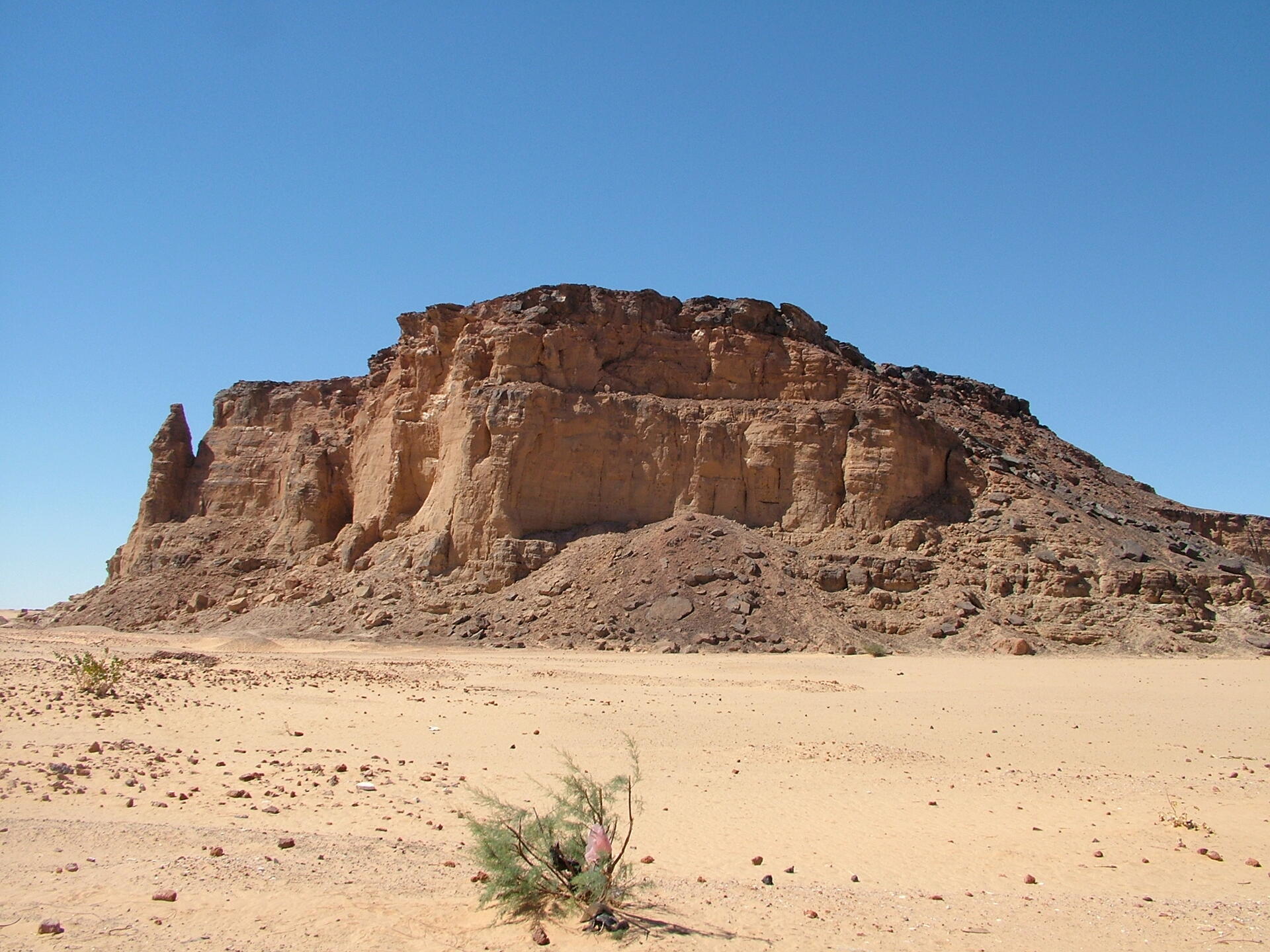
© LassiHU, CC BY-SA 4.0 Resized from original. (This derivative is under the same CC BY-SA license.)
World Heritage Research
Discover scientific research and academic studies that deepen our understanding of Gebel Barkal and the Sites of the Napatan Region from its history and significance to its conservation, management, and contemporary challenges.
-
Holocene Nile dynamics shaped the physical and cultural landscape of ancient Nubia
Research reveals that the Nile River's response to Holocene climate change, particularly its stabilization near Jebel Barkal during the Late Holocene, played a pivotal role in shaping ancient Nubia's landscape and cultural development. The study found that while the Early-Middle Holocene period saw significant valley incision, around 4,000 years ago, floodplain buildup occurred due to changing rainfall and river flow patterns. This stability, combined with Jebel Barkal's natural prominence, fostered enduring settlement and ritual activity in Napata, a UNESCO World Heritage site known for its pyramids, temples, and palaces, which flourished from 1070 BCE to 350 CE. The findings were derived from 26 sediment cores analyzed using optically stimulated luminescence and radiocarbon dating, supplemented by pottery typology and other chronological constraints.
Peeters, J., Winkels, T. G., Wolf, P., Skuldbøl, T. B. B., Chamberlain, E. L., Büchner-Matthews, S., Elamin, S. M., Mohamed, E.-H. A., & Emberling, G. (2026). Holocene Nile dynamics shaped the physical and cultural landscape of ancient Nubia. Proceedings of the National Academy of Sciences, 123(18). https://doi.org/10.1073/pnas.2529986123
View Publication Record | Read Publication -
Three Ostraca from Jebel Barkal: Problems of Text and Context
Three newly analyzed ostraca from Jebel Barkal, Sudan, offer rare insights into Meroitic inscriptions, challenging assumptions about the site's epigraphic record. Unlike the well-studied Natakamani Stele, these fragmentary texts—discovered between 1973 and 2026 at Building B2200 (the 'Edifice of the Basins')—reveal nuanced linguistic and contextual complexities, suggesting a more dynamic epigraphic tradition than previously recognized. The analysis employs comparative textual and archaeological methods to reconstruct meanings while addressing gaps in preservation and interpretation. These findings highlight the importance of minor inscriptions in understanding Meroitic culture and the site's historical significance.
Iannarilli, F., & Ferrandino, G. (2026). Three Ostraca from Jebel Barkal: Problems of Text and Context. Annals of the Náprstek Museum, 47(1), 61. https://doi.org/10.37520/anpm.2026.003
View Publication Record | Read Publication -
Community-Engaged Archaeology at the UNESCO World Heritage Site of Jebel Barkal, Sudan
A collaborative, de-colonial approach to heritage conservation at Jebel Barkal, Sudan, has successfully integrated local communities and international experts to address challenges in protecting a UNESCO World Heritage Site. This study highlights the effectiveness of community-engaged archaeology in balancing sustainable tourism with cultural preservation, despite operating in a conflict-prone region. The research emphasizes co-directed efforts by Sudanese and Western professionals, ensuring that conservation strategies are both culturally sensitive and scientifically rigorous. Key achievements include the development of comprehensive management and conservation plans, as well as innovative community engagement initiatives that foster long-term stewardship.
Bradshaw, R., Abulgasim, T., Davis, S., Dafalla, E., Elamin, S., Mohamed, E. H. A., & Emberling, G. (2025). Community-Engaged Archaeology at the UNESCO World Heritage Site of Jebel Barkal, Sudan. Cultural Heritage, Community Engagement and Sustainable Tourism, 152–169. https://doi.org/10.4324/9781003491071-12
View Publication Record | Read Publication -
The End of the Egyptian New Kingdom in Colonial Nubia: New Perspectives on Sociocultural Transformations in the Middle Nile
New archaeological evidence from the Attab to Ferka region in Sudan challenges the notion of a 'Dark Age' following Egypt's colonial rule over Nubia. Remote sensing, surveys, and excavations reveal continued occupation between 1070 and 750 BCE, highlighting local resilience and innovation. Studies of settlement patterns and ceramics provide insights into sociocultural transformations during this period, complicating the traditional understanding of secondary states' emergence in Sudan. This research underscores the significance of previously marginalized regions in shaping cultural dynamics during the first millennium BCE.
Budka, J. (2025). The End of the Egyptian New Kingdom in Colonial Nubia: New Perspectives on Sociocultural Transformations in the Middle Nile. Humans, 5(4), 26. https://doi.org/10.3390/humans5040026
View Publication Record | Read Publication -
Intangible Cultural Heritage in the Napatan Region and Gebel El-Barkal
Local communities' intangible cultural heritage offers a counterpoint to official narratives at the UNESCO World Heritage Site of Gebel El-Barkal, revealing complex, lived meanings that transcend global and national symbolism. Through ethnographic and phenomenological methods, this study demonstrates how ethnicity, religion, social class, gender, and age shape diverse community perspectives on heritage—often in tension with authorized discourses. The findings challenge elite-driven heritage management, advocating for inclusive, bottom-up approaches that integrate local knowledge systems while preserving global significance.
Elnour, I. H. M. (2025). Intangible Cultural Heritage in the Napatan Region and Gebel El-Barkal. https://doi.org/10.30861/9781407363110
View Publication Record | Read Publication -
Imperial Art: Duality on Tanwetamani’s Dream Stela
A striking dualistic motif on the Dream Stela of Kushite king Tanwetamani, commissioned in the 7th century BCE and housed in the Amun Temple of Jebel Barkal, reveals a sophisticated political ideology. The lunette's back-to-back offering scenes, though nearly symmetrical at first glance, differ subtly to symbolize the 'Double Kingdom' of Kush and Egypt under Tanwetamani's rule. This 'Mirrored Motif' encapsulates the duality central to Kushite kingship during the Twenty-Fifth Dynasty, reconciling imperial expansion with Nubian-Egyptian history. The study analyzes iconographic and textual features to uncover this motif's rhetorical function, demonstrating its role in advancing Kushite imperial propaganda.
Cox, C. (2024). Imperial Art: Duality on Tanwetamani’s Dream Stela. Arts, 13(4), 128. https://doi.org/10.3390/arts13040128
View Publication Record | Read Publication -
The Evidence of Osiris Lord of Neheh-Eternity in Amun Temple B 700 at the Sacred Town of Gebel Barkal, Sudan
A previously unattested Osirian hymn, linked to the solarized form of Osiris and associated with the local deity Dedwen, has been identified within reused blocks from Amun Temple B 700 in Gebel Barkal, Sudan. This fragmented text represents the first such hymn found in Kush, offering a critical comparative point against its integral version discovered in Thebes. The analysis explores the cult's origins and significance, suggesting a syncretic religious practice rooted in Nubian traditions. The study employs epigraphic and textual analysis to reconstruct and interpret the hymn's content, providing new insights into the religious landscape of the Napatan Kingdom (713–290 BCE).
Petacchi, S. (2024). The Evidence of Osiris Lord of Neheh-Eternity in Amun Temple B 700 at the Sacred Town of Gebel Barkal, Sudan. Journal of Ancient near Eastern Religions, 24(1), 98–125. https://doi.org/10.1163/15692124-12341344
View Publication Record | Read Publication