World Heritage Identification Number: 1666
World Heritage since: 2023
Category: Cultural Heritage
WHE Type: Archaeological Sites
Transboundary Heritage: No
Endangered Heritage: No
Country: 🇰🇷 Republic of Korea
Continent: Asia
UNESCO World Region: Asia and the Pacific
Map
Gaya Tumuli: Archaeological Cemetery Sites of the Gaya Confederacy
The Gaya Tumuli, inscribed as a UNESCO World Heritage Site in 2023, represents a significant collection of archaeological cemetery sites that offer valuable insights into the ancient Gaya Confederacy that thrived in the southern region of the Korean Peninsula between the 1st and 6th centuries CE.
More to come…UNESCO Description of the World Heritage Site
This serial property includes archaeological cemetery sites with burial mounds attributed to the Gaya Confederacy, which developed in the southern part of the Korean Peninsula from the 1st to the 6th century CE. Through their geographical distribution and landscape characteristics, types of burials, and grave goods, the cemeteries attest to the distinctive Gaya political system in which polities existed as autonomous political equals while sharing cultural commonalities. The introduction of new forms of tombs and the intensification of the spatial hierarchy in the tumuli sites reflect the structural changes experienced by Gaya society during its history.UNESCO Justification of the World Heritage Site
Criterion (iii): The Gaya Tumuli bear exceptional testimony to Gaya, a unique ancient East Asian civilisation that coexisted with its more strongly centralised neighbours but maintained a distinct confederated political system. The property is important evidence of the diversity found among ancient East Asian civilisations.
Encyclopedia Record: Gaya Tumuli
Gaya Tumuli (Korean: 가야고분군) comprises seven tumuli complexes of the Gaya confederacy, from the 1st to the late 6th century CE. In 2023, seven tumuli complexes in South Korea were listed as a UNESCO World Heritage Site.Additional Site Details
Area: 189 hectares
Number of Components: 7
Coordinates: 35.2372638889 , 128.873725
Image
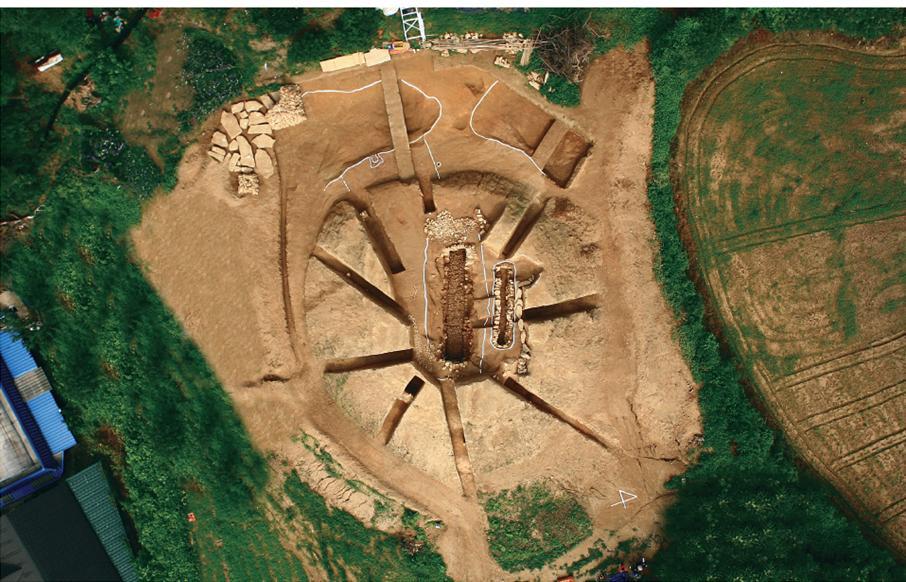
© 문화재청 (공공누리 제1유형), CC BY-SA 4.0 Resized from original. (This derivative is under the same CC BY-SA license.)
World Heritage Research
Discover scientific research and academic studies that deepen our understanding of Gaya Tumuli from its history and significance to its conservation, management, and contemporary challenges.
-
A Space-Time Analysis on the Ancient Gaya Tombs in Hapcheon Region : Focusing on Hapcheon Samga Ancient Tomb Complex Excavated by the Dong-A University Museum in the Year 1981 -
The Hapcheon Samga Ancient Tomb Complex, excavated by the Dong-A University Museum in 1981, reveals significant cultural interchange among Gaya, Baekjae, and Shilla during the early 5th to late 6th century. Analysis of artifacts, such as 'Short-Mounted Dish' (type II-A · B) and iron-rings, indicates a transition from preceding Gaya culture to Shilla influence, while also highlighting Baekjae's earlier cultural impact on the region. The study employs space-time analysis of excavated remains and structures to demonstrate this dynamic period of cultural exchange in the Hapcheon region.
Jeong, D. (2025). A Space-Time Analysis on the Ancient Gaya Tombs in Hapcheon Region : Focusing on Hapcheon Samga Ancient Tomb Complex Excavated by the Dong-A University Museum in the Year 1981 -. The Yeongnam Archaeological Society, 102, 133–171. https://doi.org/10.47417/yar.2025.102.133
View Publication Record | Read Publication -
Fortified Dwellings Of A Forgotten Past: The Mystery of Korean Mounds
Korean mounds, traditionally classified as tombs, may serve a more complex purpose beyond burial sites. A new study challenges the conventional understanding by proposing that these megalithic structures could have functioned as fortified dwellings or repositories for preserving cultural knowledge and artifacts, akin to Egyptian pyramids or Chinese mounds. The research suggests that sealed wooden chambers, encased in layers of clay and earth, were designed not only to protect grave contents from robbers but also from environmental elements. If Korean mounds contain artifacts inconsistent with typical burial practices, this theory could gain further support. The study revisits ancient sites like the Gaya Tumuli, offering a fresh perspective on their role in safeguarding a lost civilization's heritage.
Fernandes, D. L. (2025). Fortified Dwellings Of A Forgotten Past: The Mystery of Korean Mounds. Self-Published. https://doi.org/10.5281/ZENODO.17931859
View Publication Record | Read Publication -
The Technology and the Provenance Study on Gilt-Copper Crown Excavated from Tomb No.63 of the Ancient Tumuli in Gyo-dong/Songhyeon-dong, Changnyeong
A gilt-copper crown excavated from Tomb No.63 of the ancient Gaya Tumuli in Changnyeong, South Korea, reveals sophisticated metallurgical techniques and regional material sourcing practices. Analysis confirmed the crown was made of unalloyed copper with gold and silver plating applied using the mercury amalgam method, a rare technique for this period. The gilded surface's red and yellow hues suggest variations in manufacturing processes, such as thickness and heat treatment. Crucially, the copper raw material originated from Zone 3 (Jeolla-do, Chungcheong-do, or northern Gyeongsang-do), distinct from the excavation site in Changnyeong. This indicates long-distance trade or material exchange, challenging assumptions about localized craftsmanship in ancient Korea.
Han, W. R., Kwon, J. H., Park, J. Y., & Kim, S. J. (2022). The Technology and the Provenance Study on Gilt-Copper Crown Excavated from Tomb No.63 of the Ancient Tumuli in Gyo-dong/Songhyeon-dong, Changnyeong. Journal of Conservation Science, 38(6), 576–594. https://doi.org/10.12654/jcs.2022.38.6.02
View Publication Record | Read Publication -
“A Thousand Mounds”: Original Sites of Ancient Japan and Korea (Materials for Educational Course “Archaeology of Foreign Asia”)
A notable discovery from the Kofun Period (3rd–4th centuries) reveals that large-scale mounded tomb complexes, or 'packed tumuli clusters,' emerged as symbols of elite social support in central Honshu, Japan. These sites, often accompanied by Korean-origin artifacts such as ceramic rice-cookers and weapons, suggest significant cultural exchange and possible immigration of artisans from the Korean Peninsula to Japan. Parallels in Korea's ancient Gaya state further highlight shared burial traditions, including haniwa-like ceramic figures. The study, based on archaeological analysis, posits that these findings indicate both technological transfer and resettlement patterns, offering new insights into East Asian cultural dynamics during this period.
Gnezdilova, I. S., Nesterkina, A. L., & Solovyeva, E. A. (2021). “A Thousand Mounds”: Original Sites of Ancient Japan and Korea (Materials for Educational Course “Archaeology of Foreign Asia”). Vestnik NSU. Series: History and Philology, 20(3), 9–21. https://doi.org/10.25205/1818-7919-2021-20-3-9-21
View Publication Record | Read Publication -
The Chronology of Tombs in Daeseong-dong in the Age of The early Dojil Pottery
A detailed chronological framework for the tombs of Daeseong-dong, associated with the Geumgwan Gaya kingdom, has been established, revealing six distinct burial periods spanning from the late 4th to early 5th century. This study leverages the analysis of Dojil pottery—particularly brazier-shaped stands and mounted dishes—found in large wooden chamber tombs, categorizing them into subtypes to trace evolutionary patterns in burial practices. Comparative analysis with imported prestige goods from China further refines absolute dating, pinpointing specific periods within a 75-year span. Notably, Tomb No. 39, dated to the second quarter of the 5th century (seventh period), showcases advanced pottery styles that likely influenced later burial vessels in neighboring regions, such as Dongri, Changnyeong.
Shim, J. Y. (2019). The Chronology of Tombs in Daeseong-dong in the Age of The early Dojil Pottery. The Pusan Archaeological Society, 24, 25–44. https://doi.org/10.47735/odia.2019.24.25
View Publication Record | Read Publication