World Heritage Identification Number: 736
World Heritage since: 1995
Category: Cultural Heritage
WHE Type: Religious Sites & Sacred Architecture
Transboundary Heritage: No
Endangered Heritage: No
Country: 🇰🇷 Republic of Korea
Continent: Asia
UNESCO World Region: Asia and the Pacific
Map
A Journey Through Time: Exploring the Seokguram Grotto and Bulguksa Temple
The Seokguram Grotto and Bulguksa Temple, located in Gyeongju, South Korea, stand as testaments to the rich cultural heritage of the ancient Korean kingdom of Silla. These remarkable structures, inscribed as a UNESCO World Heritage Site in 1995, offer a unique glimpse into the artistic and spiritual achievements of the Silla dynasty.
More to come…UNESCO Description of the World Heritage Site
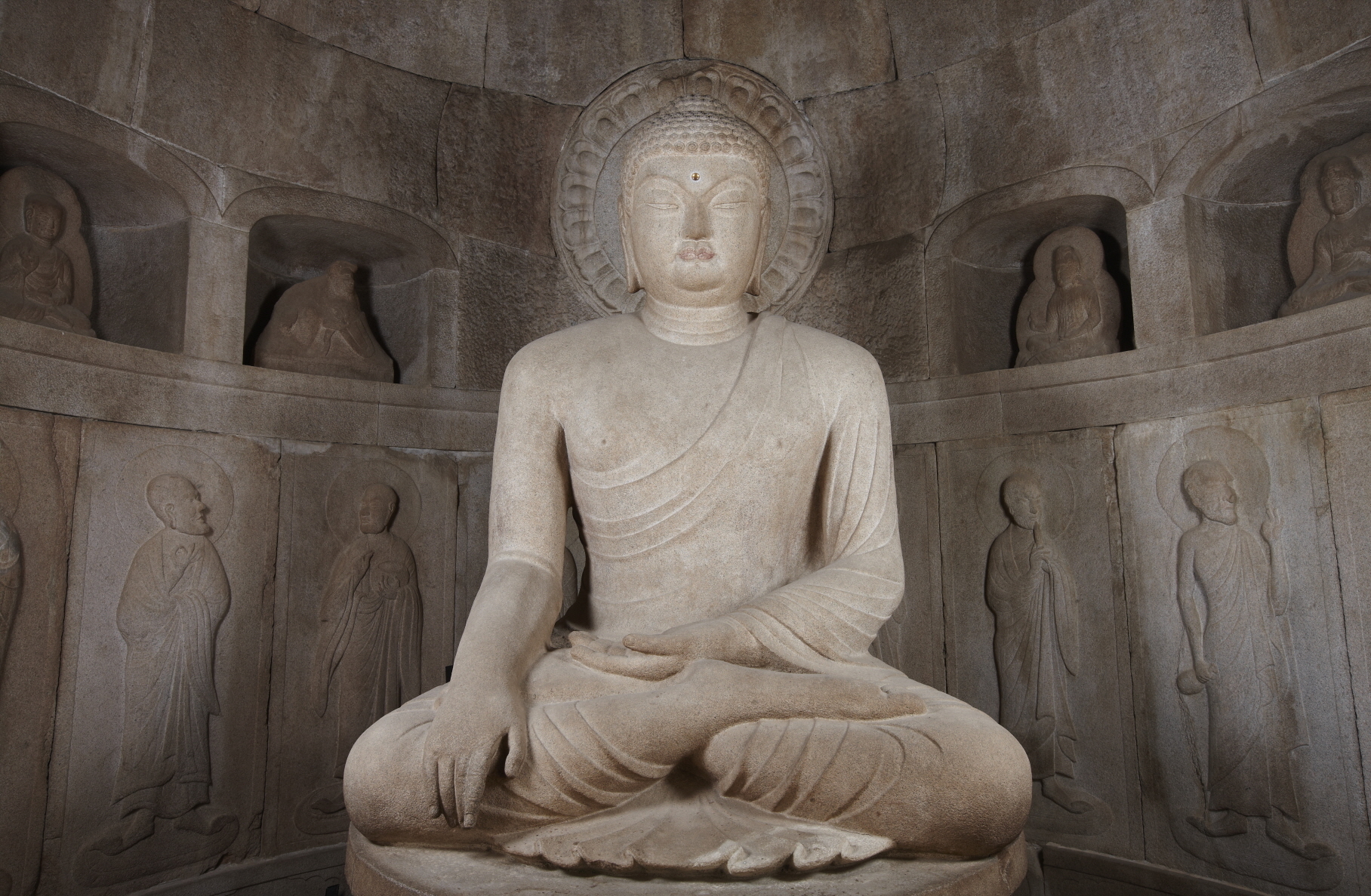
Established in the 8th century on the slopes of Mount Toham, the Seokguram Grotto contains a monumental statue of the Buddha looking at the sea in the bhumisparsha mudra position. With the surrounding portrayals of gods, Bodhisattvas and disciples, all realistically and delicately sculpted in high and low relief, it is considered a masterpiece of Buddhist art in the Far East. The Temple of Bulguksa (built in 774) and the Seokguram Grotto form a religious architectural complex of exceptional significance.
UNESCO Justification of the World Heritage Site
Criterion (i): The Seokguram Grotto, with its statue of Buddha surrounded by Bodhisattvas, the Ten Disciples, Eight Divine Guardians, two Devas, and two Vajrapanis all carved from white granite, is a masterpiece of East Asian Buddhist Art.
Criterion (iv): The Seokguram Grotto, with its artificial cave and stone sculptures, and the associated Bulguksa temple with its wooden architecture and stone terraces, is an outstanding example of Buddhist religious architecture that flourished in Gyeongju, capital of the Silla Kingdom in the 8th century, as a material expression of Buddhist belief.
Encyclopedia Record: Seokguram
Seokguram is a hermitage and part of the Bulguksa temple complex in Gyeongju, South Korea. It and Bulguksa are both on the mountain Tohamsan, although the two are separated by distance of around 3 kilometres (1.9 mi). The grotto overlooks the East Sea and rests 750 meters above sea level. In 1962, it was designated as a National Treasure of South Korea. In 1995, Seokguram was added to the UNESCO World Heritage List together with the Bulguksa Temple. It exemplifies some of the best Buddhist sculptures in the world.Additional Site Details
Area: Not available
Number of Components: 1
(iv) — Outstanding example of a type of building or landscape
Coordinates: 35.791498 , 129.349029
World Heritage Research
Discover scientific research and academic studies that deepen our understanding of Seokguram Grotto and Bulguksa Temple from its history and significance to its conservation, management, and contemporary challenges.
-
Seokguram Grotto and the Lacanian triad: Imaginary, symbolic, and Real dimensions of heritage interpretation
Seokguram Grotto's heritage value is sustained through cyclical interpretations shaped by Lacanian dimensions of the Imaginary, Symbolic, and Real. The study reveals that despite its canonical status, the monument generates recurring debates over restoration and digital reproduction due to unresolved historical tensions and interpretive plurality. Using architectural analysis, discourse study, field observation, and digital heritage critique, researchers traced Seokguram's transformations and symbolic codification within colonial, nationalist, and UNESCO frameworks. The findings highlight how the grotto functions as an objet petit a in the Imaginary register of idealized harmony while being positioned within institutional narratives (Symbolic) and revealing Real intrusions through interpretive tensions. This work advances psychoanalytic approaches to architectural heritage research and advocates for an ethics of interpretation that embraces uncertainty.
Youn, H. C., & Bae, J. (2026). Seokguram Grotto and the Lacanian triad: Imaginary, symbolic, and Real dimensions of heritage interpretation. Frontiers of Architectural Research. https://doi.org/10.1016/j.foar.2026.03.021
View Publication Record | Read Publication -
Originality and Alteration: The Repair and Restoration of Sŏkkuram Grotto During the Park Chung-hee Era
The restoration of Sŏkkuram Grotto during the Park Chung-hee era fundamentally altered its structure and public perception, shifting its narrative from a single Buddhist hall to an enclosed dual-chamber temple resembling Indian cave temples. Key modifications included adding a concrete double-dome and realigning the entrance, which reinforced a specific historical interpretation as both a state-protecting temple and a royal prayer hall. This study re-examines these 1960s interventions, combining modern and pre-modern techniques, to analyze their lasting impact on heritage management and public understanding of Sŏkkuram's original design.
Kang, H. (2026). Originality and Alteration: The Repair and Restoration of Sŏkkuram Grotto During the Park Chung-hee Era. Korean Journal of Art History, 329, 239–268. https://doi.org/10.31065/kjah.329.202603.008
View Publication Record | Read Publication -
Deconstructing Seokguram Grotto: Revisiting the Schematic Design
Seokguram Grotto, renowned for its sculptural artistry, is revealed to be a masterpiece of rational architectural design. Contrary to prior assumptions that it relied on irrational numbers like √2, this study demonstrates that the grotto's dimensions follow an integer-based proportional system using 12 cheok as the main module and binary division, facilitating practical construction. The research employs the concept of design constraints to analyze its dimensional system and scene perception, identifying external (e.g., Bodhgaya Buddha dimensions, cosmological symbolism) and internal (visual coordination between the Buddha's head and nimbus stone) factors. Findings show that the pedestal’s height and position were iteratively adjusted, and the arched headstone served as a threshold to ensure perfect alignment from the viewer’s perspective. This challenges the notion of Seokguram being purely aesthetic, highlighting its tectonics of empathy—prioritizing human-scale intimacy and visual harmony over vertical transcendence.
Yoon, C., & Kwon, Y. (2025). Deconstructing Seokguram Grotto: Revisiting the Schematic Design. Buildings, 15(24), 4546. https://doi.org/10.3390/buildings15244546
View Publication Record | Read Publication -
Impact of Cultural Heritage Travel Experience on Well-being Mediating Escapism: A Multi-Group Analysis between Travelers from the Daily and Non-Daily Living Spheres
A holistic travel experience at UNESCO World Heritage Sites, encompassing sensory, emotional, cognitive, behavioral, and relational aspects, significantly enhances travelers' well-being. This study, conducted on visitors to Bulguksa Temple and Seokguram Grotto in Gyeongju, found that escapism mediates the relationship between cultural heritage travel experiences and well-being, providing crucial insights for designing more effective travel programs. Using multi-group analysis with 509 responses, researchers employed statistical tools like SPSS and AMOS to validate their findings, emphasizing the importance of a comprehensive experience over isolated escapism.
Namu, G. m., & Ja, C. J. (2024). Impact of Cultural Heritage Travel Experience on Well-being Mediating Escapism: A Multi-Group Analysis between Travelers from the Daily and Non-Daily Living Spheres. https://doi.org/10.20944/preprints202407.1387.v1
View Publication Record | Read Publication -
The Influence of Cultural Heritage Travel Experiences on Well-being: Mediating and Moderating Role of Daily Escapism and Awareness
Travelers' well-being is significantly enhanced through cultural heritage experiences, particularly when these experiences facilitate daily escapism. A study analyzing data from 509 travelers visiting sites like Bulguksa Temple and Seokguram Grotto in Gyeongju found that sensory, emotional, cognitive, behavioral, and relational aspects of travel—frame by Schmitt's (1999) Strategic Experiential Modules (SEMs)—positively impact well-being. Daily escapism acted as a mediator, strengthening the link between travel experiences and well-being, while mindfulness did not moderate this relationship. The findings suggest that designing travel programs to emphasize escapism could be an effective strategy for improving travelers' psychological benefits.
Gamanamu, G., Choi, J.-J.,. (2024). The Influence of Cultural Heritage Travel Experiences on Well-being: Mediating and Moderating Role of Daily Escapism and Awareness. Korea International Trade Research Institute, 20(3), 391–413. https://doi.org/10.16980/jitc.20.3.202406.391
View Publication Record | Read Publication -
Trends and Directions of Research History Regarding the Background of the Construction of Seokguram Grotto
A notable connection between two interpretations of symbolic elements in Seokguram Grotto’s construction background has emerged, bridging the gap between 19th-century scholar Igi Baek’s analysis and modern scholar Sung Nak Ju’s perspective. Both interpretations uniquely frame a bear as representing surviving Baekje people, suggesting deeper historical parallels than previously acknowledged. While Igi Baek’s work on Song Gosungjeon (a record of Korean Buddhist monks) sparked significant academic debate, Sung Nak Ju’s interpretation remains underdiscussed despite its potential to enrich broader discussions on Seokguram’s symbolic meanings. The study urges further exploration of metaphorical and allegorical sources to advance understanding of the grotto’s ideological foundations, particularly in relation to Baekje heritage and Buddhist thought.
Jeong, S.-k. (2024). Trends and Directions of Research History Regarding the Background of the Construction of Seokguram Grotto. Sillasahakpo, 60, 27–54. https://doi.org/10.65509/jshs.2024.04.60.27
View Publication Record | Read Publication -
How do visitors perceive the significance of tangible cultural heritage through a 3D reconstructed immersive visual experience at the Seokguram Grotto, South Korea?
A 3D reconstructed immersive visual experience significantly enhances visitors' perceived significance and value of tangible cultural heritage sites, such as the Seokguram Grotto World Heritage Site in South Korea. The study found that these immersive presentations influence visitors' psychological factors, thereby deepening their engagement with the site's cultural, historical, and archaeological importance. This research contributes to the field of sustainable heritage tourism by demonstrating how advanced visualization technologies can be leveraged to improve visitor experiences while ensuring the careful management of heritage sites for future generations.
Tufail, M., Park, J., Kim, H., Kim, S., Kim, K., & Lee, J.-H. (2022). How do visitors perceive the significance of tangible cultural heritage through a 3D reconstructed immersive visual experience at the Seokguram Grotto, South Korea? Journal of Heritage Tourism, 17(4), 409–430. https://doi.org/10.1080/1743873x.2022.2039672
View Publication Record | Read Publication