
World Heritage Identification Number: 1195
World Heritage since: 2005
Category: Natural Heritage
WHE Type: Natural Landscapes & Geographic Features
Transboundary Heritage: No
Endangered Heritage: No
Country: 🇳🇴 Norway
Continent: Europe
UNESCO World Region: Europe and North America
Map
Exploring the Breathtaking West Norwegian Fjords: Geirangerfjord and Nærøyfjord
The West Norwegian Fjords, encompassing the Geirangerfjord and Nærøyfjord, are among the most striking natural landscapes in Norway. Inscribed as a UNESCO World Heritage Site in 2005, these fjords represent outstanding examples of glacially carved fjord systems and offer visitors a powerful impression of Norway’s dramatic coastal geography.
Both fjords owe their dramatic shape to repeated glaciations during the Ice Ages. Over millions of years, massive glaciers carved deep U-shaped valleys into the bedrock, deepening and widening existing river valleys. When the ice retreated and sea levels rose, these valleys were flooded by the sea, forming the fjords we see today. The surrounding steep mountains and submerged valleys are a direct result of this powerful combination of glacial erosion and post-glacial sea-level change.
Geirangerfjord, located roughly 300–350 kilometers northwest of Oslo, is one of Norway’s most visited natural attractions. The fjord is about 15 kilometers long and reaches depths of approximately 260 meters below sea level. It is surrounded by cliffs that rise up to around 1,400–1,500 meters above sea level, creating a dramatic and enclosed landscape. The fjord cuts through ancient, hard crystalline bedrock such as gneiss, shaped over millions of years by repeated glaciations.
One of the most iconic sights in Geirangerfjord is the Seven Sisters Waterfall (Dei Sju Systrene). This group of seven separate streams cascades down the cliff face, especially impressive during snowmelt. Opposite it lies the Suitor (Friaren), a single waterfall whose name comes from local legend describing it as “courting” the Seven Sisters across the fjord.
Nærøyfjord, located about 100–120 kilometers northeast of Bergen, is another exceptional fjord landscape. It is approximately 17–18 kilometers long and is among the narrowest fjords in the world, with some sections only about 250 meters wide. Its maximum depth reaches roughly 500 meters. The steep, towering cliffs that surround the fjord provide a habitat for various plant species, including deciduous and coniferous forests, creating a sense of tranquility and serenity.
The designation of Geirangerfjord and Nærøyfjord as a UNESCO World Heritage Site reflects their outstanding geological value and exceptionally well-preserved fjord landscape. Together, they represent one of the finest examples of active glacially formed fjord systems in the world, with a clear visual link between high mountain plateaus, steep valley walls, and deep marine inlets. This integrity of landscape, with minimal large-scale industrial alteration, is a key reason for their global recognition.
The fjord region also contains traditional cliffside fjord farms (fjordgårder) clinging to the rock walls, as well as high-altitude summer dairy farms, known in Norwegian as seter or støl farms, located on the upper plateaus. These seter settlements were seasonal outposts where communities practiced livestock farming and hay production during the summer months. Some of these historic structures have been carefully preserved or restored, offering unique insight into traditional rural life in western Norway
Wildlife in the West Norwegian Fjords is diverse but often subtle. Birds of prey such as eagles, ospreys, and peregrine falcons are commonly seen. Marine life includes seals and porpoises, and occasional larger whales may pass through offshore waters, though they are not regular inhabitants of the narrow fjords themselves. Larger land mammals such as moose can be found in surrounding valleys.
Today, the fjords are not only natural wonders but also living landscapes shaped by tourism and small coastal communities. Villages such as Geiranger and Gudvangen rely heavily on seasonal visitors, with cruise ships, ferries, and scenic road routes bringing travelers into otherwise remote areas. At the same time, strict environmental management has become increasingly important to balance tourism with the preservation of the fjords’ fragile ecosystems and unique visual character.
Visiting the West Norwegian Fjords offers travelers a chance to experience some of the world’s most breathtaking natural scenery and some of the most iconic glacial landscapes in the world. Whether exploring the waterfalls of Geirangerfjord or the narrow, dramatic passageways of Nærøyfjord, the region provides a deeply memorable encounter with Norway’s natural heritage.
UNESCO Description of the World Heritage Site
Situated in south-western Norway, north-east of Bergen, Geirangerfjord and Nærøyfjord, set 120 km from one another, are part of the west Norwegian fjord landscape, which stretches from Stavanger in the south to Andalsnes, 500 km to the north-east. The two fjords, among the world’s longest and deepest, are considered as archetypical fjord landscapes and among the most scenically outstanding anywhere. Their exceptional natural beauty is derived from their narrow and steep-sided crystalline rock walls that rise up to 1,400 m from the Norwegian Sea and extend 500 m below sea level. The sheer walls of the fjords have numerous waterfalls while free-flowing rivers cross their deciduous and coniferous forests to glacial lakes, glaciers and rugged mountains. The landscape features a range of supporting natural phenomena, both terrestrial and marine, such as submarine moraines and marine mammals.
UNESCO Justification of the World Heritage Site
Criterion (vii): The Geirangerfjord and Nærøyfjord areas are considered to be among the most scenically outstanding fjord areas on the planet. Their outstanding natural beauty is derived from their narrow and steep-sided crystalline rock walls that rise up to 1400 m direct from the Norwegian Sea and extend 500 m below sea level. Along the sheer walls of the fjords are numerous waterfalls while free-flowing rivers run through deciduous and coniferous forest to glacial lakes, glaciers and rugged mountains. There is a great range of supporting natural phenomena, both terrestrial and marine such as submarine moraines and marine mammals. Remnants of old and now mostly abandoned transhumant farms add a cultural aspect to the dramatic natural landscape that complements and adds human interest to the area.
Criterion (viii): The West Norwegian Fjords are classic, superbly developed fjords, considered as the type locality for fjord landscapes in the world. They are comparable in scale and quality to other existing fjords on the World Heritage List and are distinguished by the climate and geological setting. The property displays a full range of the inner segments of two of the world’s longest and deepest fjords, and provides well-developed examples of young, active glaciation during the Pleistocene ice age. The ice- and wave-polished surfaces of the steep fjord sides provide superbly exposed and continuous three-dimensional sections through the bedrock. The record of the postglacial isostatic rebound of the crust and its geomorphic expression in the fjord landscape are significant, and represent key areas for the scientific study of slope instability and the resulting geohazards.
Encyclopedia Record: West Norwegian Fjords
The West Norwegian Fjords is the common name of two fjords in Norway listed as a World Heritage Site by UNESCO: the Geirangerfjord and the Nærøyfjord.Additional Site Details
Area: 122,712 hectares
Number of Components: 2
(viii) — Outstanding example representing major earth stages
Coordinates: 62.11667 , 7.16667
IUCN World Heritage Outlook
The 2025 Conservation Outlook on West Norwegian Fjords – Geirangerfjord and Nærøyfjord reports the following assessment:
Source: International Union for Conservation of Nature (IUCN) · View assessment
Image
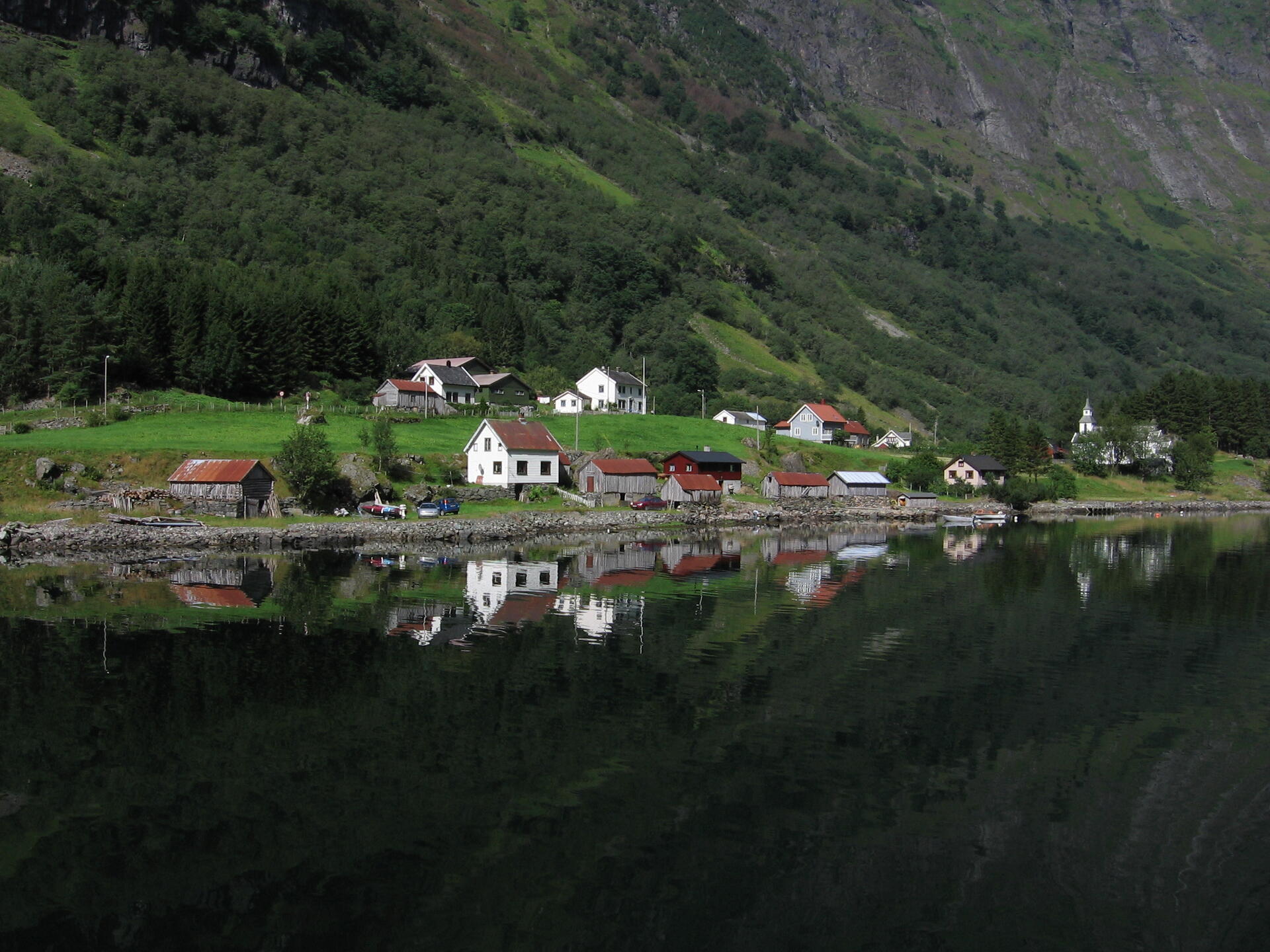
© No machine-readable author provided. Yorian~commonswiki assumed (based on copyright claims)., CC BY-SA 3.0 Resized from original. (This derivative is under the same CC BY-SA license.)
World Heritage Research
Discover scientific research and academic studies that deepen our understanding of West Norwegian Fjords – Geirangerfjord and Nærøyfjord from its history and significance to its conservation, management, and contemporary challenges.
-
Dataset from long-term air quality monitoring in the World Natural Heritage Geirangerfjord, Western Norway (AQM-G)
Long-term air quality monitoring in the UNESCO World Heritage Site Geirangerfjord, Western Norway, reveals critical insights into atmospheric conditions within one of Norway's most pristine natural landscapes. The dataset, part of an ongoing program, captures observational air quality and meteorological data, providing a baseline for understanding environmental factors affecting this unique fjord system. By integrating continuous monitoring with advanced analytical techniques, researchers aim to assess the impacts of natural and anthropogenic influences on air quality, contributing valuable data for conservation efforts and climate studies. This dataset is designed to be updated with future observations, ensuring its relevance for both scientific research and heritage management.
Löffler, J., Tschorn, K. M., Dobbert, S., Albrecht, E. C., Pape, R., & Wundram, D. (2023). Dataset from long-term air quality monitoring in the World Natural Heritage Geirangerfjord, Western Norway (AQM-G). Erdkunde, DP311205. https://doi.org/10.3112/erdkunde.2023.dp.03
View Publication Record | Read Publication -
Eld som slokna? Historiebruk i Storfjorden/Verdsarvsområdet Geirangerfjord
Historical narratives about the fading lifestyle of mountain and fjord farms in Storfjorden, particularly those by local historian Sakarias Ansok, significantly influenced public awareness and preservation efforts. His works, which documented a unique way of life on the brink of extinction, laid the groundwork for the establishment of the conservation organization 'Storfjordens Venner' in 1975 and inspired subsequent historical representations through books and TV programs. The study analyzes Ansok's distinctive approach to history-writing and its lasting impact, contrasting it with later works on the same theme. By examining historical usage and its societal effects, this research sheds light on how localized narratives can drive conservation initiatives in UNESCO World Heritage Sites like Geirangerfjord.
Tafjord, H. E. (2022). Eld som slokna? Historiebruk i Storfjorden/Verdsarvsområdet Geirangerfjord. Heimen, 59(1), 49–66. https://doi.org/10.18261/heimen.59.1.3
View Publication Record | Read Publication -
Travel Format versus Nationality as Drivers of the Perception of Crowding in a Rural Tourist Destination
Travel format significantly influences the perception of crowding in rural tourist destinations, with group cruise travelers experiencing less perceived crowding compared to individual land travelers. Nationality plays a limited role in shaping these perceptions. The study, conducted in Geirangerfjord and Nærøyfjord, a UNESCO World Heritage Site in Western Norway, attributes this phenomenon to factors such as site customization, visitor personality, expectations, and exposure. These findings deepen the understanding of crowding mechanisms and their impact on visitor satisfaction, offering insights for sustainable tourism management.
Yttredal, E. R., & Homlong, N. (2020). Travel Format versus Nationality as Drivers of the Perception of Crowding in a Rural Tourist Destination. Athens Journal of Tourism, 7(4), 209–226. https://doi.org/10.30958/ajt.7-4-2
View Publication Record | Read Publication -
Perception of Sustainable Development in a Local World Heritage Perspective
Social dimensions dominate local perceptions of sustainable development, with stakeholders' views shaped by immediate sustainability issues and their place of residence. This study, conducted in the UNESCO World Heritage Site Geirangerfjord, Norway, used semi-structured interviews and innovative analytical methods—including theme analysis, emergent pattern analysis, group comparisons, and a novel 'What Is Not There (WINT) analysis'—to uncover how sustainability is perceived at a local level. The findings reveal that stakeholder perceptions are context-dependent and highlight the importance of place-based factors in shaping sustainability narratives.
Yttredal, E. R., & Homlong, N. (2020). Perception of Sustainable Development in a Local World Heritage Perspective. Sustainability, 12(21), 8825. https://doi.org/10.3390/su12218825
View Publication Record | Read Publication -
Norwegian PILOT-E scheme funds maritime hydrogen projects
Norwegian government funding through the PILOT-E scheme is advancing hydrogen as a clean energy solution for maritime transport, with two key projects targeting the West Norwegian Fjords. The Hellesylt Hydrogen Hub consortium aims to establish a hydrogen production facility to power ferries and cruise ships in Geirangerfjord, reducing emissions in this UNESCO-listed area. Meanwhile, Wilhelmsen and NorSea are developing a supply chain for 'green' liquid hydrogen for commercial shipping. These initiatives mark a significant step toward decarbonizing maritime operations, leveraging Norway's existing expertise in renewable energy to support sustainable tourism and transport in the region.
(Ed.). (2020). Norwegian PILOT-E scheme funds maritime hydrogen projects. Fuel Cells Bulletin, 2020(1), 10–11. https://doi.org/10.1016/s1464-2859(20)30027-4
View Publication Record | Read Publication
