
World Heritage Identification Number: 59
World Heritage since: 1979
Category: Cultural Heritage
WHE Type: Buildings & Architectural Ensembles
Transboundary Heritage: No
Endangered Heritage: No
Country: 🇳🇴 Norway
Continent: Europe
UNESCO World Region: Europe and North America
Map
Preserving History at Bryggen: A Unique Blend of Tradition and Modernity in Bergen, Norway
Bryggen, officially known as Tyskebryggen, stands as a testament to the rich history and cultural significance of Bergen, Norway. Inscribed as a UNESCO World Heritage Site in 1979, Bryggen offers a unique blend of tradition and modernity that attracts visitors from around the world.
More to come…UNESCO Description of the World Heritage Site
Bryggen, the old wharf of Bergen, is a reminder of the town’s importance as part of the Hanseatic League’s trading empire from the 14th to the mid-16th century. Many fires, the last in 1955, have ravaged the characteristic wooden houses of Bryggen. Its rebuilding has traditionally followed old patterns and methods, thus leaving its main structure preserved, which is a relic of an ancient wooden urban structure once common in Northern Europe. Today, some 62 buildings remain of this former townscape.
UNESCO Justification of the World Heritage Site
Criterion (iii): Bryggen bears the traces of social organization and illustrates the use of space in a quarter of Hanseatic merchants that dates back to the 14th century. It is a type of northern “fondaco”, unequalled in the world, where the structures have remained within the cityscape and perpetuate the memory of one of the oldest large trading ports of Northern Europe.
Encyclopedia Record: Bryggen
Bryggen, also known as Tyskebryggen, is a series of Hanseatic heritage commercial buildings lining up the eastern side of the Vågen harbour in the city of Bergen, Norway. Bryggen has been on the UNESCO list for World Cultural Heritage sites since 1979.Additional Site Details
Area: 1.196 hectares
Number of Components: 2
Coordinates: 60.39722 , 5.32306
Image
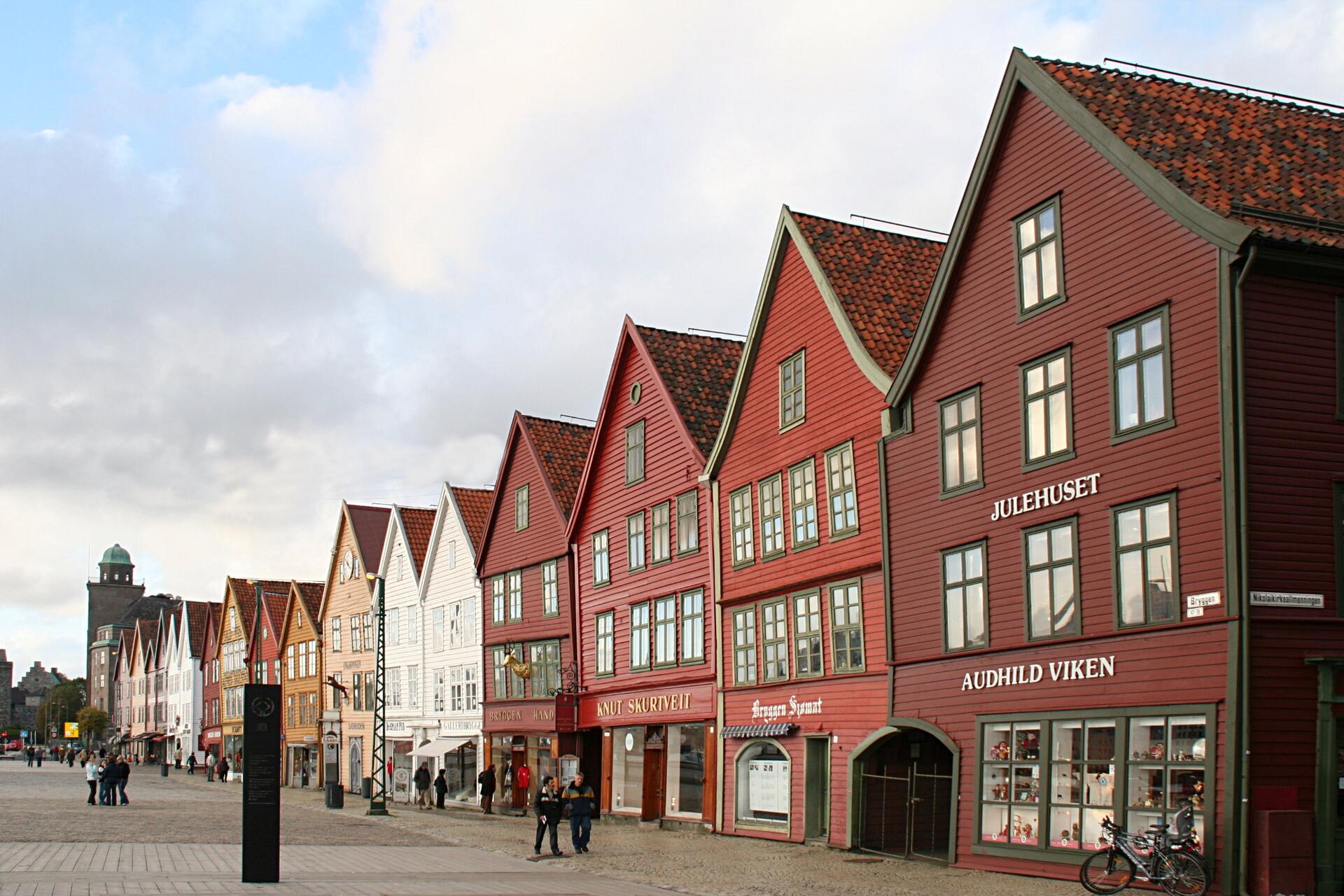
© Unknown, CC BY-SA 2.5 Resized from original. (This derivative is under the same CC BY-SA license.)
World Heritage Research
Discover scientific research and academic studies that deepen our understanding of Bryggen from its history and significance to its conservation, management, and contemporary challenges.
-
Runer: Fra historiske bellegg til en handlingsarkitektur med 27 noder
A groundbreaking study reveals that rune inscriptions on sandstone fragments from the Svingerud field, dated to 50 BCE–275 CE, represent the earliest radiocarbon-dated context for a runestone. These fragments suggest a dynamic history of rune use, where inscribed stones could be divided, moved, and repurposed over time. The research traces the evolution of rune symbols from paleolithic engravings to complex scripts like the Vinča–Tordoš and eldre futhark, integrating Norwegian runic sources with broader Indo-European traditions. Notably, it introduces a hypothesis of 'strategic legibility resistance,' proposing that reduced orthography in younger futharks may have served as culturally protected communication. The study also explores Johannes Bureus' dual role in documenting Swedish runes and shaping modern rune cosmology. By combining historical runology, comparative linguistics, and relational ontology, the research constructs a novel 27-node action architecture (Livstre) that reinterprets rune symbols through verbs, challenging conventional interpretations of their form and function.
Lileika, A. C. (2026). Runer: Fra historiske bellegg til en handlingsarkitektur med 27 noder (Version V 1.0 NOR). Zenodo. https://doi.org/10.5281/ZENODO.21462243
View Publication Record | Read Publication -
Material Culture on Display
The role of material culture in medieval archaeology has been underutilized, particularly in display contexts. This study reveals that the first two permanent exhibitions at Bryggen Museum (1976 and 1986), Norway's only dedicated medieval archaeological museum, prioritized written sources over archaeological artifacts, reflecting an early phase in medieval archaeology where historical narratives dominated. Despite the museum's archaeological focus, objects were largely used illustratively rather than as primary evidence. This pattern suggests a broader trend in Scandinavian urban research during this period, shaped by a short research history and strong historical discipline influence.
Mygland, S. S. (2024). Material Culture on Display. Archaeological Accessory or Science-Based Medieval Mediator? META – Historiskarkeologisk Tidskrift, 9–28. https://doi.org/10.59008/meta.2024.22651
View Publication Record | Read Publication -
Språkspor på Bryggen. Lingvistiske landskap og lingvistiske palimpsestar
Bryggen, a historic trading site in Bergen, Norway, serves as a rich linguistic landscape where 'language traces' and 'linguistic palimpsests' reveal layers of cultural and historical significance. The study demonstrates that visible language elements—such as writing systems and multilingual representations—coexist with deeper, diachronic layers that emerge through exploration. By analyzing street names and naming conventions, the research highlights how normative language practices reflect cultural identity and historical shifts. This approach underscores Bryggen's role in preserving linguistic heritage and its didactic potential for education.
Budal, I. B. (2024). Språkspor på Bryggen. Lingvistiske landskap og lingvistiske palimpsestar. Språkhistoriske Muligheter I Skole Og Utdanning, 99–120. https://doi.org/10.23865/cdf.237.ch6
View Publication Record | Read Publication -
Bybanen i Bergen og manglende arkivundersøkelser
A critical analysis reveals that the proposed route for Bergen's Bybanen tram system assumes the presence of a stable stone fill over sterile seabed, implying historical seabed layers have been removed. This assumption poses risks to the UNESCO World Heritage Site Bryggen, as it suggests cultural layers may remain undisturbed, potentially threatening their preservation. The study highlights gaps in archival investigations, emphasizing the need for thorough archaeological assessments before construction begins.
Skivenes, A. (2024). Bybanen i Bergen og manglende arkivundersøkelser. Norsk Arkivforum, 30(1), 135–174. https://doi.org/10.18261/naf.30.1.5
View Publication Record | Read Publication -
Tracing Textile Production from the Viking Age to the Middle Ages: Tools, Textiles, Texts and Contexts
A groundbreaking analysis reveals the evolution of textile production techniques from the Viking Age to the Middle Ages, particularly in Bryggen, Bergen. The study identifies shifts in tool usage and textile types, linking them to broader socio-economic changes. By integrating archaeological evidence with historical texts, researchers reconstructed the context of textile manufacturing, offering new insights into the region's economic and cultural development during this transitional period.
Rogers, P. W. (2023). Tracing Textile Production from the Viking Age to the Middle Ages: Tools, Textiles, Texts and Contexts. Medieval Archaeology, 67(1), 240–241. https://doi.org/10.1080/00766097.2023.2204755
View Publication Record | Read Publication -
Corpus Editions of Norwegian Runic Inscriptions
Norwegian runic inscriptions, initially documented in Ole Worm's 17th-century corpus with only fifty items, have seen significant advancements through modern editions. The first comprehensive edition, Norway's Inscriptions with Older Runes (NIæR), was published between 1891 and 1924 by Sophus Bugge and Magnus Olsen but is now outdated due to more extensive supranational editions. A subsequent project, Norway's Inscriptions with Younger Runes (NIyR), began in 1937 under Olsen's leadership and continued by Aslak Liestøl, aiming for a complete corpus publication. However, the 1955 fire at Bryggen in Bergen uncovered nearly as many new inscriptions as those previously published, necessitating additional volumes—one already released and another nearing completion. This ongoing work, characterized by its thorough illustration and indexing, reflects both scholarly rigor and occasional speculative tendencies in earlier volumes.
Knirk, J. E. (2022). Corpus Editions of Norwegian Runic Inscriptions. Futhark: International Journal of Runic Studies, 12, 29–48. https://doi.org/10.33063/diva-491877
View Publication Record | Read Publication -
Reconciling the Bryggen World Heritage Property with Bergen’s Strategy for Sustainable Urban Development through Heritage Impact Assessment
A Heritage Impact Assessment (HIA) process initiated in 2019 has successfully reconciled the preservation of Bergen's Bryggen World Heritage site with the city's sustainable urban development strategy. This approach, involving collaboration between planning authorities, experts, and public hearings, demonstrates how water-related heritage can be integrated into broader sustainability goals while adhering to UNESCO standards. The HIA serves as a critical tool for implementing the UN Agenda 2030, balancing modern infrastructure needs—such as Bergen's new transport strategy—with the protection of historic harbor settings.
Kloos, M. (2022). Reconciling the Bryggen World Heritage Property with Bergen’s Strategy for Sustainable Urban Development through Heritage Impact Assessment. Blue Papers, 1(1), 151–159. https://doi.org/10.58981/bluepapers.2022.1.15
View Publication Record | Read Publication
