
World Heritage Identification Number: 58
World Heritage since: 1979
Category: Cultural Heritage
WHE Type: Religious Sites & Sacred Architecture
Transboundary Heritage: No
Endangered Heritage: No
Country: 🇳🇴 Norway
Continent: Europe
UNESCO World Region: Europe and North America
Map
Urnes Stave Church: A Unique Blend of Artistic Traditions
The Urnes Stave Church, located in the picturesque landscape of Sogn og Fjordane, Norway, stands as a testament to the rich cultural heritage and architectural prowess of the medieval Scandinavian world. Inscribed as a UNESCO World Heritage Site in 1979, this remarkable wooden structure offers a fascinating glimpse into the intermingling of artistic influences from various civilizations.
More to come…UNESCO Description of the World Heritage Site
The wooden church of Urnes (the stavkirke) stands in the natural setting of Sogn og Fjordane. It was built in the 12th and 13th centuries and is an outstanding example of traditional Scandinavian wooden architecture. It brings together traces of Celtic art, Viking traditions and Romanesque spatial structures.
UNESCO Justification of the World Heritage Site
Criterion (i): The Urnes Stave Church is an outstanding example of traditional Scandinavian wooden architecture. It brings together traces of Celtic art, Viking traditions and Romanesque spatial structures. The outstanding quality of the carved décor of Urnes is a unique artistic achievement.
Criterion (ii): The stave churches are representative of the highly developed tradition of wooden buildings that extended through the Western European cultural sphere during the Middle Ages. Urnes is one of the oldest of the Norwegian stave churches and an exceptional example of craftsmanship. It also reveals the development from earlier techniques and therefore contributes to the understanding of the development of this specific tradition.
Criterion (iii) : Urnes Stave Church is an ancient wooden building and is outstanding due to the large-scale reuse of both decorative and constructive elements originating from a stave church built about one century earlier. It is an outsTanding example of the use of wood to express the language of Romanesque stone architecture.
Encyclopedia Record: Urnes Stave Church
Urnes Stave Church is a 12th-century stave church at Ornes, along the Lustrafjorden in the municipality of Luster in Vestland county, Norway.Additional Site Details
Area: 0.21 hectares
Number of Components: 1
(ii) — Significant interchange of human values
(iii) — Unique or exceptional testimony to a cultural tradition
Coordinates: 61.2982594908 , 7.322678289
Image
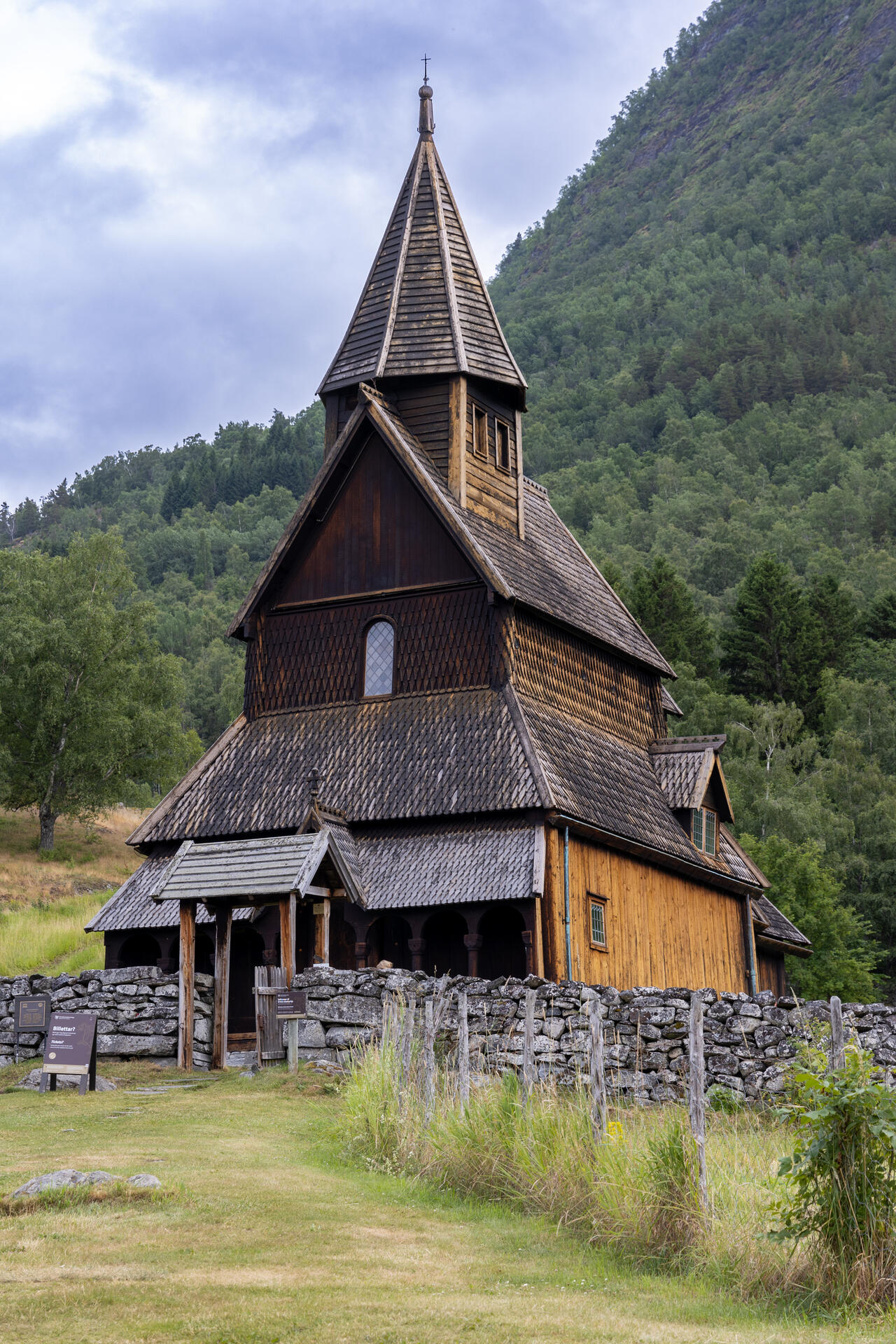
© Superbass, CC BY-SA 4.0 Resized from original. (This derivative is under the same CC BY-SA license.)
World Heritage Research
Discover scientific research and academic studies that deepen our understanding of Urnes Stave Church from its history and significance to its conservation, management, and contemporary challenges.
-
Beyond universal templates: the Three Ethical Indicators (3EIR) and the art of contextual conservation
A paradigm shift is proposed for UNESCO World Heritage conservation, moving from rigid adherence to universal norms towards ethically grounded, community-engaged stewardship. The study introduces the Three Ethical Indicators (3EIR)—Respect, Referencing, and Reflection—and operationalizes them through the Three Operational Parameters (3OPR): Replacement, Reinforcement, and Regeneration. These frameworks reframe Outstanding Universal Value (OUV) as a living document guiding culturally responsive conservation, addressing tensions between internationally mandated standards and diverse cultural ontologies. The research compares Japan’s Hōryū-ji Temple Complex and Norway’s Urnes Stave Church, highlighting how their distinct preservation methods reflect underlying ethical principles. By embracing differences and critiquing homogenised universality, the study advocates for a more nuanced approach that honours each site's unique heritage.
Lao, T. W. (2026). Beyond universal templates: the Three Ethical Indicators (3EIR) and the art of contextual conservation. International Journal of Heritage Studies, 32(9), 1301–1325. https://doi.org/10.1080/13527258.2026.2673354
View Publication Record | Read Publication -
Provenience of a Monument: Serial Rediscovery in the Image History of Urnes Stave Church
A new perspective on the transformation of Urnes Stave Church into an international heritage icon emerges from the rediscovery of previously overlooked images by Thomas Fearnley and Mathias Wilhelm Eckhoff, predating Johan Christian Dahl's 1837 documentation. This micro-historical reconstruction reveals the movements of artists around the Lusterfjord in 1826, challenging the dominant narrative that credits Dahl alone with the monument's rediscovery. By presenting forgotten impressions of Urnes as a functioning local village church, the study sheds light on the collective contributions to its cultural significance and offers a nuanced understanding of its evolution into a symbol of Norwegian heritage.
Walkley, N. (2025). Provenience of a Monument: Serial Rediscovery in the Image History of Urnes Stave Church. Kunst Og Kultur, 108(3-4), 99–114. https://doi.org/10.18261/kk.108.3-4.3
View Publication Record | Read Publication -
Urnes Stave Church and Its Global Romanesque Connections
Urnes Stave Church stands out for its intricate wood carvings and architectural innovation, offering new insights into the global connections of Romanesque art. The publication explores how Urnes' design elements, such as knotwork patterns and structural techniques, share similarities with other Romanesque buildings worldwide, suggesting a broader cultural exchange during the medieval period. Through detailed analysis of visual motifs and historical records, researchers reveal that these churches likely influenced one another through trade, pilgrimage, or monastic networks, challenging previous assumptions about regional isolation in art development.
Walkley, N. (2023). Urnes Stave Church and Its Global Romanesque ConnectionsUrnes Stave Church and Its Global Romanesque Connections. Edited by kirk ambrose, griffin murray and margrete syrstad andås.Turnhout, Brepols (Studies in the Visual Cultures of the Middle Ages, 18), 2022. 480 pp., 7 b/w, 230 col. illus., 2 maps.
View Publication Record | Read Publicationisbn 9782503594514. €165 (hb). Journal of the British Archaeological Association, 176(1), 321–323. https://doi.org/10.1080/00681288.2023.2234760 -
Conversation with Kirk Ambrose, Founding Director of the Center for Teaching and Learning, University of Colorado, Boulder
Urnes Stave Church stands as a pivotal example of global Romanesque connections. Kirk Ambrose, a renowned scholar in medieval art history, sheds light on the church's significance through his research, which explores its intricate sculpture and architectural elements. His work, including co-edited volumes such as 'Urnes Stave Church and its Global Romanesque Connections,' highlights the church's role as a bridge between Scandinavian and broader European artistic traditions. Ambrose's approach combines art historical analysis with interdisciplinary insights, revealing how Urnes Stave Church reflects both local craftsmanship and wider cultural exchanges during the 12th century.
Lampert-Weissig, L., & Ambrose, K. (2022). Conversation with Kirk Ambrose, Founding Director of the Center for Teaching and Learning, University of Colorado, Boulder. New Chaucer Studies: Pedagogy and Profession, 3(2). https://doi.org/10.5070/nc33259134
View Publication Record | Read Publication -
Tree of Salvation
A significant connection between Norse/Germanic mythology and northern Christianity has been identified, revealing that the myth of Yggdrasil—the cosmic tree of life—was symbolically linked to the cross of Christ. This association was evident in various artifacts, architecture, and literary works, such as the Jelling stone in Denmark, Norwegian stave churches (including Urnes Stave Church), Viking crosses, and poetic texts like 'The Dream of the Rood.' The study suggests that Yggdrasil's narrative elements foreshadowed key events in the New Testament, particularly the crucifixion and resurrection, emphasizing a shared symbolism of salvation and eternal life. The research draws on evidence from runic inscriptions, architectural motifs (e.g., Urnes portal), and cultural traditions like the Yule wreath and Christmas tree to support this interpretation.
Murphy, G. R. (2013). Tree of Salvation. https://doi.org/10.1093/acprof:oso/9780199948611.001.0001
View Publication Record | Read Publication
