World Heritage Identification Number: 1614
World Heritage since: 2021
Category: Cultural Heritage
WHE Type: Buildings & Architectural Ensembles
Transboundary Heritage: No
Endangered Heritage: No
Country: 🇩🇪 Germany
Continent: Europe
UNESCO World Region: Europe and North America
Map
The Darmstadt Artists' Colony at Mathildenhöhe: A Testimony to Early Modernism
The Darmstadt Artists' Colony on Mathildenhöhe, located in the western part of the city of Darmstadt in West-Central Germany, stands as a significant testament to early modernism in architecture, arts, and crafts. Inscribed as a UNESCO World Heritage Site in 2021, this site offers a unique insight into the evolution of modern art and design, particularly within the context of the Arts and Crafts movement and the Vienna Secession.
More to come…UNESCO Description of the World Heritage Site
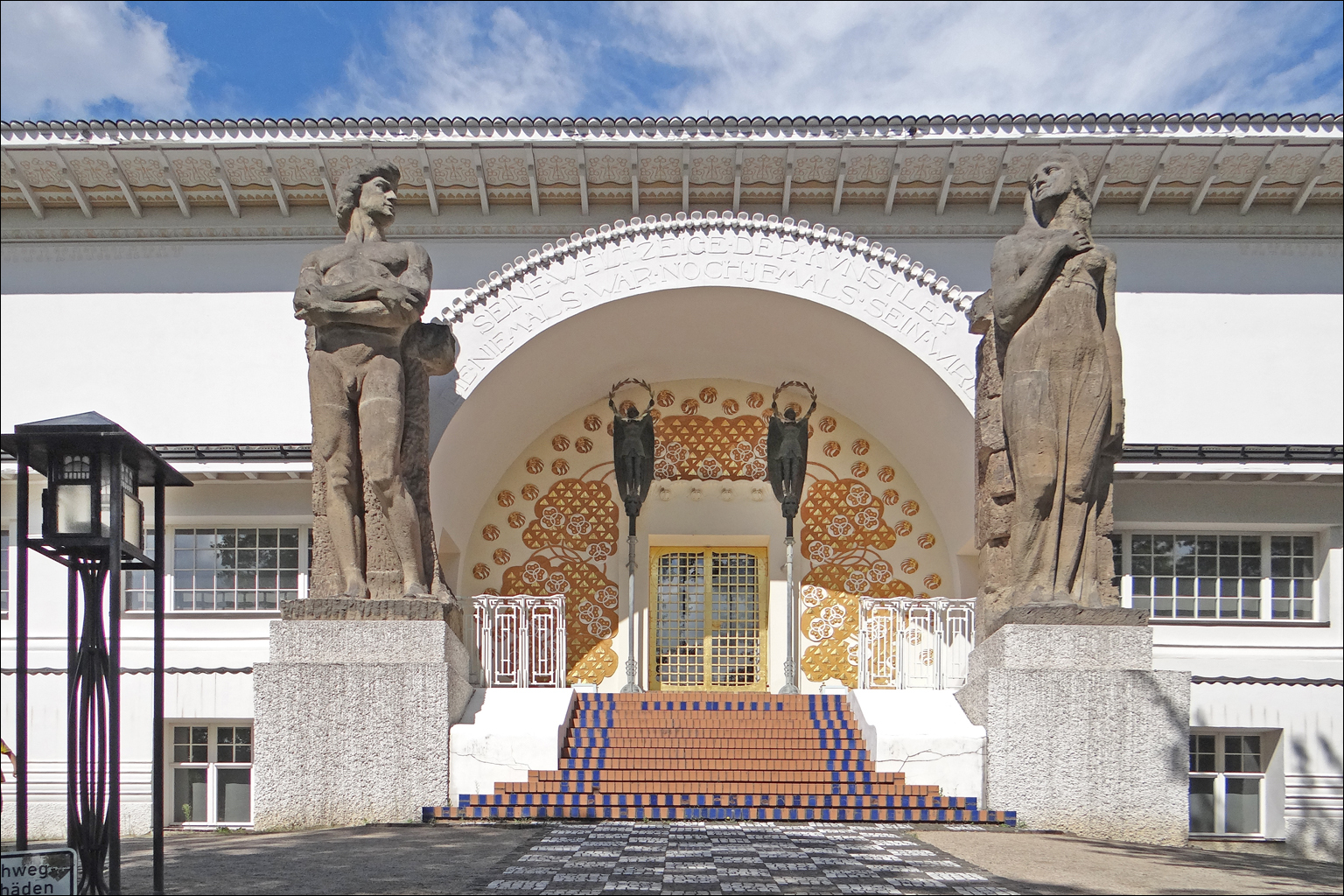
The Darmstadt Artists’ Colony on Mathildenhöhe, the highest elevation above the city of Darmstadt in west-central Germany, was established in 1897 by Ernst Ludwig, Grand Duke of Hesse, as a centre for emerging reform movements in architecture, arts and crafts. The buildings of the colony were created by its artist members as experimental early modernist living and working environments. The colony was expanded during successive international exhibitions in 1901, 1904, 1908 and 1914. Today, it offers a testimony to early modern architecture, urban planning and landscape design, all of which were influenced by the Arts and Crafts movement and the Vienna Secession. The serial property consists of two component parts including 23 elements, such as the Wedding Tower (1908), the Exhibition Hall (1908), the Plane Tree Grove (1833, 1904-14), the Russian Chapel of St. Maria Magdalena (1897-99), the Lily Basin, the Gottfried Schwab Memorial (1905), the Pergola and Garden (1914), the “Swan Temple” Garden Pavilion (1914), the Ernst Ludwig Fountain, and the 13 houses and artists’ studios that were built for the Darmstadt Artists’ Colony and for the international exhibitions. A Three House Group, built for the 1904 exhibition is an additional component.UNESCO Justification of the World Heritage Site
Criterion (ii): Mathildenhöhe Darmstadt is a prototype of Modernism that provides compact and exceptional testimony to the emergence of twentieth-century modernist architecture and urban landscape design; and of the avant-garde processes by which this happened. Its epochal functional and aesthetic quality reveals a vibrant era of artistic and social reform and embodies a crucial international interchange in the development of architecture and design, urban planning, landscape design and modern exhibition culture. It is a holistic symbol of early Modernism. Four pioneering and internationally acclaimed building exhibitions were held between 1901 and 1914. The innovative permanency of the exhibitions gave form to the Mathildenhöhe, and all exhibits were developed in collaboration with companies from both Germany and abroad. For the very first time as part of an exhibition, modern living and working environments were presented that consisted of permanent homes open to the public during the exhibitions. Mathildenhöhe Darmstadt developed as a semi-utopian community which became a focal point of the relevant trends of early Modernism and a fundamental influence on numerous international building exhibitions in the twentieth and twenty-first centuries.
Criterion (iv): Mathildenhöhe Darmstadt is an exceptional ensemble of architectural elements in a designed landscape, and it represents a prototype of Modernism that documents the emergence of twentieth-century modernist architecture and urban landscape design. It is seminal in the history of architecture. Construction took place between 1899 and 1914, during an era of radical experimentation that characterises the revolutionary age of Modernism. The radical synthesis of architecture, design and art includes experimental exhibition buildings that feature progressive architecture, ambitious designed urban landscapes, contemporary spatial art, and innovative artists’ houses and studio buildings.
Encyclopedia Record: Darmstadt Artists' Colony
The Darmstadt Artists' Colony refers to the Jugendstil artists' group and buildings near Rosenhöhe Park in Mathildenhöhe, Darmstadt, where these artists lived and worked in the late 19th and early 20th centuries. They were largely financed by patrons and worked with one another, taste permitting.Additional Site Details
Area: 5.37 hectares
Number of Components: 2
(iv) — Outstanding example of a type of building or landscape
Coordinates: 49.8763888889 , 8.6675
World Heritage Research
Discover scientific research and academic studies that deepen our understanding of Mathildenhöhe Darmstadt from its history and significance to its conservation, management, and contemporary challenges.
-
Dünya Modern Mİmarlik Mİrasi ve Modernİzm Etkİlerİ: Mathİldenhöhe Darmstadt Örneğİ
Modern architectural heritage preservation requires balancing original context and function to ensure both structural and cultural sustainability. A study of Mathildenhöhe Darmstadt, a key example of early 20th-century modernism, reveals that retaining its unique historical framework—rather than generic conservation—safeguards its enduring value as a UNESCO-listed site. The research, combining literature review and fieldwork, analyzed the site's protection strategies to assess their impact on long-term preservation. Findings underscore that modernist landmarks thrive when conservation respects their specific social, architectural, and technological dimensions.
Özkan, K., & Şentürk, A. (2025). DÜNYA MODERN MİMARLIK MİRASI VE MODERNİZM ETKİLERİ: MATHİLDENHÖHE DARMSTADT ÖRNEĞİ. İstanbul Ticaret Üniversitesi Teknoloji Ve Uygulamalı Bilimler Dergisi, 8(1), 323–339. https://doi.org/10.56809/icujtas.1746095
View Publication Record | Read Publication -
Transforming Mathildenhöhe: A World Heritage Site
A sensitive restoration of the Exhibition Hall at Mathildenhöhe demonstrates best practices for preserving Art Nouveau architecture while integrating contemporary elements. The renovation, led by schneider+schumacher, addressed complex challenges including historic conservation, climatic conditions, and exhibition technology, ensuring the building’s iconic status remains intact. The project highlights how modern interventions can enhance heritage sites without compromising their historical integrity, serving as a model for future restorations.
Jaeger, F. (2024). Transforming Mathildenhöhe: A World Heritage Site. https://doi.org/10.1515/9783986121280
View Publication Record | Read Publication -
Weiterbauen am Welterbe Mathildenhöhe
A sensitive restoration of the Exhibition Hall at Mathildenhöhe, designed by Art Nouveau architect Joseph Maria Olbrich, successfully balances historic preservation with contemporary integration. The renovation, completed by schneider+schumacher, addressed complex challenges including the building's protected status and its declaration as a UNESCO World Heritage Site during the project. By reintroducing original architectural elements while incorporating modern design, the restoration exemplifies best practices in heritage conservation, ensuring the structure remains both authentic and functional. Published to coincide with the reopening in autumn 2024, this work serves as a case study for preserving iconic monuments without compromising their integrity.
Jaeger, F. (2024). Weiterbauen am Welterbe Mathildenhöhe. https://doi.org/10.1515/9783986121273
View Publication Record | Read Publication -
Firmen und Verbände: Mauerwerk 1/2016
A notable exploration of the Darmstadt Artists' Colony on Mathildenhöhe reveals its significance as both a cultural and architectural milestone. The study highlights how the colony, founded in 1901, aimed to create an entire town that would redefine artistic and urban living through innovative design and craftsmanship. By focusing on the integration of art and architecture—particularly through the use of masonry—the colony became a pioneering example of modernist thought, blending functionality with aesthetic innovation. The research approach combines historical analysis with architectural study, emphasizing the colony's enduring influence on UNESCO World Heritage Sites like Mathildenhöhe.
(Ed.). (2016). Firmen und Verbände: Mauerwerk 1/2016. Mauerwerk, 20(1), 89–91. Portico. https://doi.org/10.1002/dama.201690005
View Publication Record | Read Publication -
Titelbild: Mauerwerk 1/2016
The Darmstadt Artists’ Colony on the Mathildenhöhe stands as a groundbreaking ensemble, uniquely documenting the transition from Art Nouveau to Modernism at the turn of the 20th century. Inspired by the International Reform Movement, this site integrates architecture, fine and applied arts, and public gardens into an experimental whole, serving as a pivotal cultural and artistic milestone. The publication explores its significance through detailed analysis, emphasizing its innovative design and enduring influence on modernist aesthetics.
(Ed.). (2016). Titelbild: Mauerwerk 1/2016. Mauerwerk, 20(1). Portico. https://doi.org/10.1002/dama.201690007
View Publication Record | Read Publication -
The Museion Ideal Reinterpreted as Art Colony on the Outskirts of Darmstadt and Hagen = el Ideal del Museion Reinterpretado como Colonia Artística en las Afueras de Darmstadt y Hagen
This study reveals that the art colonies of Darmstadt and Hagen, established on the outskirts of their respective cities, were not merely artistic communities but also embodied the classical 'mouseion' ideal, blending high cultural aspiration with practical integration of arts and crafts. These colonies, characterized by a dense population of artists and elaborate art nouveau ornamentation, evolved into modern museum complexes over time. The research reinterprets these sites as innovative urban crowns that transcended traditional artistic enclaves by incorporating exhibition spaces and museums at their core. By analyzing architectural and historical records, the study demonstrates how these colonies synthesized classical ideals with early 20th-century artistic movements, offering a model for future cultural urban development.
Lorente Lorente, J.-P. (2014). THE MOUSEION IDEAL REINTERPRETED AS ART COLONY ON THE OUTSKIRTS OF DARMSTADT AND HAGEN = EL IDEAL DEL MOUSEION REINTERPRETADO COMO COLONIA ARTÍSTICA EN LAS AFUERAS DE DARMSTADT Y HAGEN. Espacio Tiempo Y Forma. Serie VII, Historia Del Arte, 0(1), 83. https://doi.org/10.5944/etfvii.1.2013.11886
View Publication Record | Read Publication -
Darmstadt – Stadt der Chemie
Darmstadt, Germany, stands out as a unique urban center where chemistry and culture intersect, exemplified by its innovative 'DA stimmt die Chemie' event series. This initiative, spearheaded by Merck, the city of Darmstadt, and the Technical University, showcases the deep-rooted connection between chemistry and the city's identity, even naming it after the element Darmstadtium. The program, spanning from September 2014 to 2015, featured diverse events including scientific colloquia with Nobel laureates like Roald Hoffmann, science slams, and industry visits, blending education, entertainment, and public engagement. A notable highlight was Merck's $250 million investment in a new innovation center, reinforcing Darmstadt's commitment to scientific advancement. The series also drew attention to the city's dual heritage as a hub of Jugendstil architecture, with Mathildenhöhe serving as an iconic symbol. This model has been lauded by German officials as a blueprint for other cities, demonstrating how chemistry can be both a driver of innovation and a cultural bridge.
Fischer‐Henningsen, D. (2014). Darmstadt – Stadt der Chemie. Chemie in Unserer Zeit, 48(5), 323. Portico. https://doi.org/10.1002/ciuz.201490054
View Publication Record | Read Publication