
Abbey and Altenmünster of Lorsch


World Heritage Identification Number: 515

World Heritage since: 1991

Category: Cultural Heritage

WHE Type: Religious Sites & Sacred Architecture

Transboundary Heritage: No

Endangered Heritage: No

Country: 🇩🇪 Germany

Continent: Europe

UNESCO World Region: Europe and North America

Map

Lorsch Abbey and Altenmünster: A Carolingian Architectural Gem

The Lorsch Abbey and Altenmünster, inscribed as a UNESCO World Heritage Site in 1991, stand as a testament to the architectural prowess of the Carolingian era. Located approximately 10 kilometers east of Worms, Germany, these structures hold significant historical and artistic value, making them a crucial part of Europe's cultural heritage.

More to come…

UNESCO Description of the World Heritage Site

The abbey, together with its monumental entrance, the famous 'Torhall', are rare architectural vestiges of the Carolingian era. The sculptures and paintings from this period are still in remarkably good condition.

UNESCO Justification of the World Heritage Site

Criterion (iii): The religious complex represented by the former Lorsch Abbey, with its 1200-year-old gatehouse in unique and excellent condition, comprises a rare architectural document of the Carolingian era with impressively preserved sculpture and painting of that period.

Criterion (iv): The Lorsch Abbey, with its Carolingian gatehouse, gives architectural evidence of the awakening of the West to the spirit of the Early and High Middle Ages under the first King and Emperor, Charlemagne.

Encyclopedia Record: Lorsch Abbey

Lorsch Abbey, otherwise the Imperial Abbey of Lorsch, is a former Imperial abbey in Lorsch, Germany, about 10 km (6.2 mi) east of Worms. It was one of the most important monasteries of the Carolingian Empire. Even in its ruined state, its remains are among the most important pre-Romanesque–Carolingian style buildings in Germany.

Read more on Wikipedia

Additional Site Details

Area: 3.34 hectares

Number of Components: 2

UNESCO Criteria: (iii) — Unique or exceptional testimony to a cultural tradition
(iv) — Outstanding example of a type of building or landscape

Coordinates: 49.65369 , 8.56858

Image
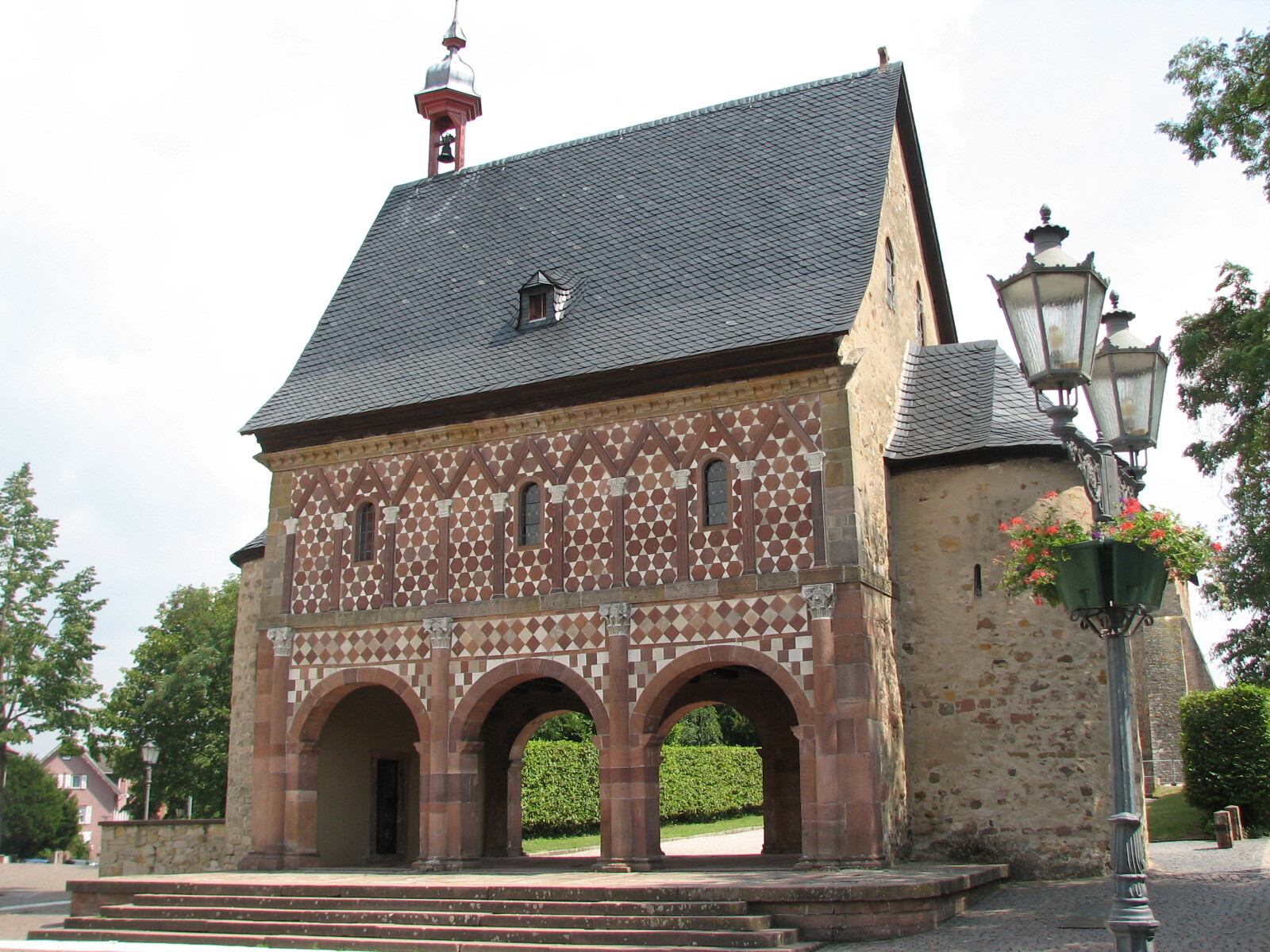
Image of Abbey and Altenmünster of Lorsch

© Elswhs at Dutch Wikipedia (Original text: Els Slots), CC BY-SA 3.0 Resized from original. (This derivative is under the same CC BY-SA license.)

About World Heritage Explorer

World Heritage Explorer is an independent educational project designed to uncover and share the richness of our world’s cultural and natural heritage. Dive into detailed site profiles, immersive imagery, interactive maps, and tools that help you explore UNESCO World Heritage Sites across the globe. Drawing extensively on open data sources, the project delivers authoritative, well-structured information for learners, educators, travelers, and younger explorers alike.

Learn more about the project

Nearby World Heritage Sites

Mathildenhöhe Darmstadt
26 km — Germany
Messel Pit Fossil Site
32 km — Germany
Speyer Cathedral
39 km — Germany
ShUM Sites of Speyer, Worms and Mainz
39 km — Germany
Maulbronn Monastery Complex
75 km — Germany
Flag of Germany

Germany and the World Heritage Convention

State Party since: August 23, 1976

Status: Ratification

Mandates to the World Heritage Committee: 1976-1978, 1980-1987, 1991-1997, 2011-2015

Total of Mandate Years: 19

Total of Mandates: 4

WHC Electoral Group: I (Western Europe/North America)

Learn more about Germany

Weather at the World Heritage Site

World Heritage Insights

Monasteries and Abbeys on the World Heritage List: Sacred Landscapes of Monastic and Spiritual Life

From vast cave universities and cliffside hermitages to monumental abbeys and temple cities, monastic heritage on the UNESCO World Heritage List reflects one of the most persistent ways in which human societies have organized spiritual life, learning, and landscape transformation. These sites are not only architectural achievements but also long-lived institutional systems—sometimes still active, sometimes archaeological—where religious practice shaped settlement patterns, artistic production, and political authority.

Last updated: June 12, 2026

Portions of the page Abbey and Altenmünster of Lorsch are based on data from UNESCO — World Heritage List Dataset and on text from the Wikipedia article Lorsch Abbey, licensed under CC BY-SA 4.0. Changes made. Additional original content by World Heritage Explorer (WHE), licensed under CC BY-SA 4.0. WHE is not affiliated with UNESCO or the World Heritage Committee. Legal Notice. Privacy Policy.

Open Data for an Open World