World Heritage Identification Number: 230
World Heritage since: 1983
Category: Cultural Heritage
WHE Type: Religious Sites & Sacred Architecture
Transboundary Heritage: No
Endangered Heritage: No
Country: 🇫🇷 France
Continent: Europe
UNESCO World Region: Europe and North America
Map
The Abbey Church of Saint-Savin sur Gartempe: A Medieval Masterpiece in Western France
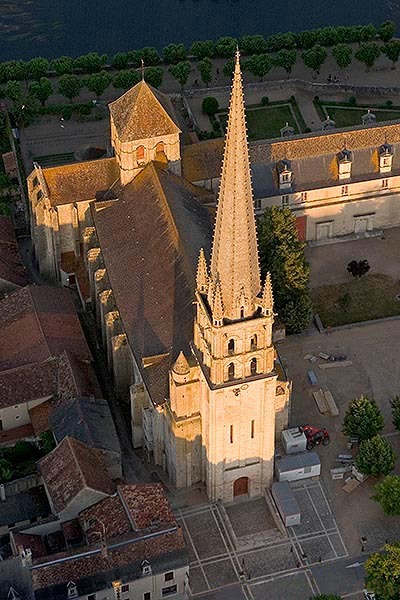
The Abbey Church of Saint-Savin sur Gartempe, nestled on the banks of the Gartempe river in the Vienne department of western France, stands as a testament to the artistic and architectural prowess of the Middle Ages. Inscribed as a UNESCO World Heritage Site in 1983, this medieval masterpiece is often referred to as the 'Romanesque Sistine Chapel' due to its extraordinary collection of 11th- and 12th-century murals.
More to come…UNESCO Description of the World Heritage Site
Known as the 'Romanesque Sistine Chapel', the Abbey-Church of Saint-Savin contains many beautiful 11th- and 12th-century murals which are still in a remarkable state of preservation.
UNESCO Justification of the World Heritage Site
Criterion (i): The Abbey Church of Saint-Savin-sur-Gartempe is a masterpiece of the murals of the 11th and 12th centuries. Its outstanding character is due to its extraordinary decor, testimony to the art of representing and painting in western Christian medieval civilization. The walls are covered with murals containing narrative scenes, using an entire palette of colours and compositions that are full of elegance and movement. Such an art form reached its peak over this period. Its monumental style and the extensiveness of its iconography justify the name of “Romanesque Sistine Chapel”, which has been given to Saint-Savin-sur-Gartempe.
Criterion (iii): The Abbey Church of Saint-Savin-sur-Gartempe bears witness to the importance of the image in a monastic building, considered at that time as a major educational place, reflecting medieval ways of thinking. The images, profusely spread over its walls, are an outstanding testimony to medieval civilization and its means of representation and diffusion of ideas. Some of these biblical themes represented in image are topical in western Christian civilization.
Encyclopedia Record: Saint-Savin, Vienne
Saint-Savin, also referred to as Saint-Savin-sur-Gartempe, is a commune in the Vienne department in the Nouvelle-Aquitaine region in western France. It is located on the banks of the Gartempe.Additional Site Details
Area: 1.61 hectares
Number of Components: 1
(iii) — Unique or exceptional testimony to a cultural tradition
Coordinates: 46.56472 , 0.86611
World Heritage Research
Discover scientific research and academic studies that deepen our understanding of Abbey Church of Saint-Savin sur Gartempe from its history and significance to its conservation, management, and contemporary challenges.
-
In choro, ad occidentem spectans. Les peintures de Saint-Savin-sur-Gartempe d’un autre point de vue
A novel perspective on the painted nave of Saint-Savin-sur-Gartempe Abbey reveals that the spatial organization and perception of its murals were significantly influenced by the monastic closure, which separated the clergy from laypeople. The study identifies a previously understudied partition in the third bay, marked today only by a painted bestiary, which defined the monks' space and altered their view of the western paintings. This finding challenges conventional interpretations of the nave's cycle of Old Testament scenes and sheds light on lesser-known murals visible only when exiting the church after facing west. By integrating the monastic closure into the analysis, the research offers a fresh understanding of the distribution of paintings and the function of the western tower-porch.
Boisseau, C. (2025). In choro, ad occidentem spectans. Les peintures de Saint-Savin-sur-Gartempe d’un autre point de vue. Frontière·S, 11. https://doi.org/10.4000/15jyy
View Publication Record | Read Publication -
Expériences bénédictines en Aquitaine du Nord sous Louis le Pieux : contribution à l’histoire de la diffusion de la regula Benedicti à l’époque carolingienne
The adoption of the Rule of Saint Benedict in northern Aquitaine during the Carolingian era, particularly under Louis the Pious, was not as uniform or early as previously suggested. While some monasteries like Nouaillé, Abbey Church of Saint-Savin sur Gartempe, and Charroux are often cited as emblematic cases, a closer examination reveals that the 'Benedictine reform' in this region was more nuanced, with early attempts facing fragility and alternative clerical practices persisting. The study critiques regional sources, noting their scarcity and potential interpolations, to challenge the narrative of a rapid or widespread transition. It highlights that the reform's success was more gradual, particularly under Charles the Bald and Pépin II d'Aquitaine, rather than under Louis the Pieux.
Treffort, C. (2024). Expériences bénédictines en Aquitaine du Nord sous Louis le Pieux : contribution à l’histoire de la diffusion de la regula Benedicti à l’époque carolingienne. Cahiers de Civilisation Médiévale, n° 265(4), 49–84. https://doi.org/10.3917/ccm.265.0037a
View Publication Record | Read Publication -
Restaurer les peintures murales de l’église Notre-Dame de Charly (Cher) au xixe siècle
A 19th-century restoration of medieval murals in the church of Notre-Dame de Charly (Cher) revealed that the work, inspired by Saint-Savin-sur-Gartempe's abbatial paintings, replicated errors from earlier scholarly interpretations. The study found that Abbé Lenoir's restoration, aimed at preserving a Romanesque Apocalypse depiction, instead mirrored misreadings from 1845 sketches by Gérard Seguin, used to illustrate Prosper Mérimée's Notice sur les peintures de Saint-Savin. This discrepancy highlights the influence of 19th-century exegetical and artistic interpretations on medieval art restoration. The analysis underscores how historical restorations can inadvertently perpetuate inaccuracies, reflecting both spiritual and scholarly shifts of their time.
Boisseau, C. (2024). Restaurer les peintures murales de l’église Notre-Dame de Charly (Cher) au xixe siècle. In Situ, 53. https://doi.org/10.4000/122po
View Publication Record | Read Publication -
Les strategies de la narration dans la peinture médiévale: La representation de l’Ancien Testament aux IVe–XIIe siècles
Medieval church art employed sophisticated narrative strategies to convey complex biblical stories, particularly from the Old Testament, between the 4th and 12th centuries. A study of Saint-Savin-sur-Gartempe's restored nave reveals how painters used visual techniques such as spatial sequencing, symbolic motifs, and hierarchical composition to guide viewers through scriptural narratives. The research, conducted during a 2005–2008 restoration project led by the Centre d’études de civilisation médiévale (CESCM), analyzed these strategies to demonstrate their role in religious education and liturgical communication within medieval churches.
Mcneill, J. (2021). Les strategies de la narration dans la peinture médiévale: La representation de l’Ancien Testament aux IVe–XIIe siècles. Journal of the British Archaeological Association, 174(1), 192–194. https://doi.org/10.1080/00681288.2021.1965328
View Publication Record | Read Publication -
Les stratégies de la narration dans la peinture médiévale
Medieval narrative strategies in Western art, particularly those adapted from the Cotton Genesis tradition, are revealed through an analysis of the 12th-century frescoes in Saint-Savin-sur-Gartempe's nave barrel vault. This study demonstrates how the frescoes reinterpret Byzantine and Carolingian traditions to reflect themes from Augustine's De civitate Dei, blending political and theological narratives into a cohesive visual storytelling framework. The research employs comparative iconographic analysis, tracing the evolution of narrative techniques from the 5th-century Om Cotton Genesis manuscript through to later medieval art, highlighting Saint-Savin-sur-Gartempe as a pivotal example of this adaptation.
Angheben, M. (Ed.). (2020). Les stratégies de la narration dans la peinture médiévale. Culture et Société Médiévales. https://doi.org/10.1484/m.csm-eb.5.116110
View Publication Record | Read Publication -
Death in the Middle Ages and Early Modern Times: The Material and Spiritual Conditions of the Culture of Death ed. by Albrecht Classen
A multidisciplinary exploration of death culture in the Middle Ages and Early Modern period reveals how premodern societies conceptualized mortality through material and spiritual practices. The study, featuring contributions from art history, history, literary studies, and drama, examines diverse representations—from heroic memorialization in Anglo-Saxon texts to the symbolic use of a false arch at Saint-Savin-sur-Gartempe, France, which exemplifies martyrdom. It also analyzes revenant folklore, cosmological iconography, and macabre imagery, including Chaucer’s satirical 'Pardoner’s Tale' and German estates satire, highlighting how death was ritualized, feared, or weaponized across centuries. The research employs chronological ordering to trace evolving attitudes toward mortality, blending textual analysis with material culture, offering a nuanced understanding of death's cultural resonance.
Gordon, S. (2018). Death in the Middle Ages and Early Modern Times: The Material and Spiritual Conditions of the Culture of Death ed. by Albrecht Classen. Magic, Ritual, and Witchcraft, 13(1), 125–127. https://doi.org/10.1353/mrw.2018.0005
View Publication Record | Read Publication -
Saint-Savin-sur-Gartempe. Le décor peint de la chapelle axiale (XIe-XIIe siècle)
A rare survival of 11th–12th century painted decoration on the axial chapel ceiling at Saint-Savin-sur-Gartempe reveals a sophisticated, programmatic use of geometric and vegetal motifs to guide the viewer’s gaze toward the apse. Multispectral imaging and stratigraphic analysis confirm that the scheme was executed in two distinct phases, with later additions carefully integrated into the original composition. This discovery challenges conventional views on Romanesque wall-painting techniques and underscores the site’s role as a transitional prototype for later medieval decorative programs.
Boisseau, C. (2018). Saint-Savin-sur-Gartempe. Le décor peint de la chapelle axiale (XIe-XIIe siècle). Bulletin Monumental, 176(2), 163–166. https://doi.org/10.3406/bulmo.2018.13278
View Publication Record | Read Publication