
World Heritage Identification Number: 635
World Heritage since: 1992
Category: Cultural Heritage
WHE Type: Religious Sites & Sacred Architecture
Transboundary Heritage: No
Endangered Heritage: No
Country: 🇫🇷 France
Continent: Europe
UNESCO World Region: Europe and North America
Map
The Architectural Marvel: Bourges Cathedral - A Gothic Masterpiece in Central France
The Bourges Cathedral, officially known as the Cathedral of Saint Stephen of Bourges, stands as a testament to the grandeur of Gothic architecture in medieval France. Inscribed as a UNESCO World Heritage Site in 1992, this magnificent structure has captivated visitors for centuries with its stunning proportions, harmonious design, and rich artistic details.
More to come…UNESCO Description of the World Heritage Site
The Cathedral of St Etienne of Bourges, built between the late 12th and late 13th centuries, is one of the great masterpieces of Gothic art and is admired for its proportions and the unity of its design. The tympanum, sculptures and stained-glass windows are particularly striking. Apart from the beauty of the architecture, it attests to the power of Christianity in medieval France.
UNESCO Justification of the World Heritage Site
Criterion (i): Bourges Cathedral is of considerable importance in the development of Gothic architecture and as a symbol of the strength of Christianity in medieval France. However, its principal claim lies in its striking beauty, combining masterly management of space with harmonious proportions and decoration of the highest quality.
Criterion (iv): Although Bourges Cathedral lies outside the mainstream of the French Gothic, represented by St Denis, Paris, Chartres or Amiens, it strongly influenced the architectural values of cathedrals of this style. With the unity of its design, the skilful articulation of its spaces and the treatment of light, it represents an outstanding expression of style applied to this type of edifice.
Encyclopedia Record: Bourges Cathedral
Bourges Cathedral or the Cathedral of Saint Stephen of Bourges is a Roman Catholic church located in Bourges, France. The cathedral is dedicated to Saint Stephen and is the seat of the Archbishop of Bourges. Built atop an earlier Romanesque church from 1195 until 1230, it is largely in the High Gothic or Classic Gothic architectural style and was constructed at about the same time as Chartres Cathedral. The cathedral is particularly known for the great size and unity of its interior, the sculptural decoration of its portals, and the large collection of 13th century stained glass windows. Owing to its quintessential Gothic architecture, the cathedral was declared a UNESCO World Heritage Site in 1992.Additional Site Details
Area: 0.85 hectares
Number of Components: 1
(iv) — Outstanding example of a type of building or landscape
Coordinates: 47.08222222 , 2.398333333
Image
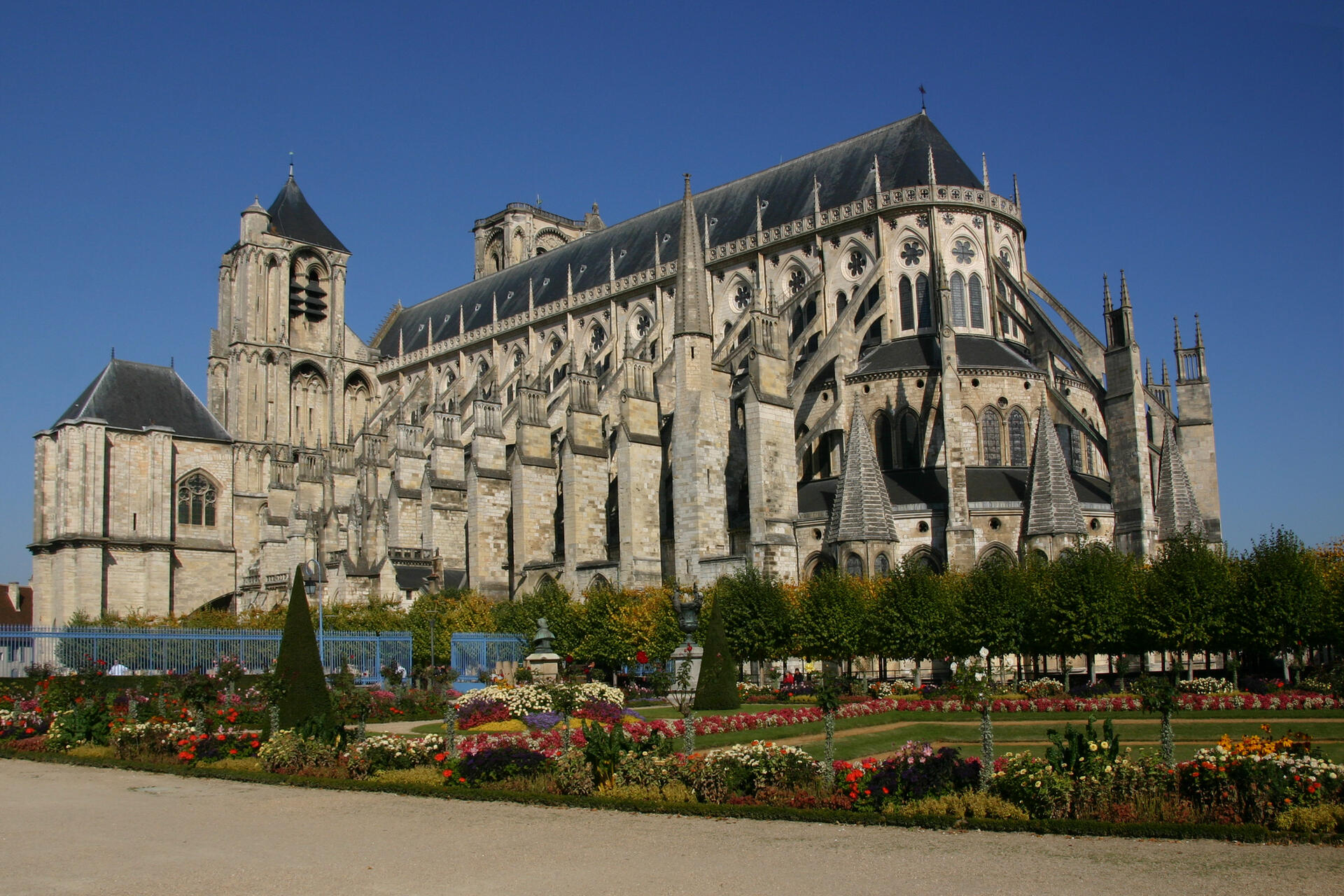
© Gerd Eichmann, CC BY-SA 4.0 Resized from original. (This derivative is under the same CC BY-SA license.)

World Heritage Research
Discover scientific research and academic studies that deepen our understanding of Bourges Cathedral from its history and significance to its conservation, management, and contemporary challenges.
-
Deciphering the Iron Provenance on a Medieval Building Yard: The Case of Bourges Cathedral
A groundbreaking analysis reveals that Bourges Cathedral's iron reinforcements, crucial for its architectural stability during the 13th century, were sourced from four distinct metallurgical districts. This study, combining trace rare earth element analysis and statistical methods, provides unprecedented precision in tracing iron circulation over a 30 to 40-year construction period. The research identifies local and more distant supply areas, linking them to specific construction phases and types of iron armatures used. By integrating archaeological, historical, and chemical data, the study offers new insights into medieval trade networks and material sourcing practices around a single UNESCO World Heritage Site.
L’Héritier, M., Dillmann, P., & Sarah, G. (2020). Deciphering the Iron Provenance on a Medieval Building Yard: The Case of Bourges Cathedral. Minerals, 10(12), 1131. https://doi.org/10.3390/min10121131
View Publication Record | Read Publication -
Les armatures de fer de la cathédrale de Bourges : nouvelles données, nouvelles lectures
A groundbreaking study of Bourges Cathedral reveals that iron armatures, integral to its Gothic architecture, were not part of the original design but were introduced mid-construction to address structural instability. Analysis of 70 iron samples and 58 lead sealings, combined with archaeological observations from 2010–2011, demonstrates these reinforcements—including truss rods and chains in the triforium—were contemporary with the cathedral's early thirteenth-century construction but implemented reactively to stabilize an unfinished structure. This challenges long-held assumptions about medieval engineering practices and positions Bourges as a pivotal case study in the evolution of iron integration in Gothic masonry, highlighting a phase of experimental adaptation during its formative years.
L’Héritier, M. (2016). Les armatures de fer de la cathédrale de Bourges : nouvelles données, nouvelles lectures. Bulletin Monumental, 174(4), 447–465. https://doi.org/10.3406/bulmo.2016.12893
View Publication Record | Read Publication -
Ordination, Purification, and Consecration: Episcopal Privilege at Bourges Cathedral
Medieval bishops, particularly those at Bourges Cathedral, wielded profound influence through religious, intellectual, and political spheres. This volume explores how their authority was articulated and perceived, revealing bishops as symbols of piety, intellectual life, and action. Through interdisciplinary essays, it examines the production of images—created by, for, and about medieval episcopacy—to dissect the complex interplay between privilege and perception. The research employs a multifaceted approach, analyzing visual and textual representations to illuminate the nuanced ways bishops shaped societal narratives during this pivotal era.
Morrow, K. A. (2014). Ordination, Purification, and Consecration: Episcopal Privilege at Bourges Cathedral. Envisioning the Bishop, 347–376. https://doi.org/10.1484/m.mcs-eb.1.102238
View Publication Record | Read Publication -
The Geometry of Bourges Cathedral
A groundbreaking geometrical analysis of Bourges Cathedral reveals that its original designer employed a tightly interlocking, five-fold subdivision in the chevet ground plan. This design, vertically extruded into the elevation, exhibits striking coherence, fitting both within squares and progressively smaller equilateral triangles. The study, leveraging high-precision laser survey data and computer-aided design (CAD) techniques, provides new evidence for the geometrical unity of Gothic cathedral architecture and advances the debate on 'ad quadratum' and 'ad triangulum' geometries. This methodology also underscores the potential of CAD-based analysis in studying precisely surveyed medieval buildings.
Bork, R. (2014). The Geometry of Bourges Cathedral. Architectural Histories, 2(1). https://doi.org/10.5334/ah.bz
View Publication Record | Read Publication