World Heritage Identification Number: 949
World Heritage since: 1999
Category: Cultural Heritage
WHE Type: Archaeological Sites
Transboundary Heritage: No
Endangered Heritage: No
Country: 🇻🇳 Viet Nam
Continent: Asia
UNESCO World Region: Asia and the Pacific
Map
Exploring the Ancient My Son Sanctuary: A Remarkable Testimony of the Champa Kingdom's Cultural Legacy
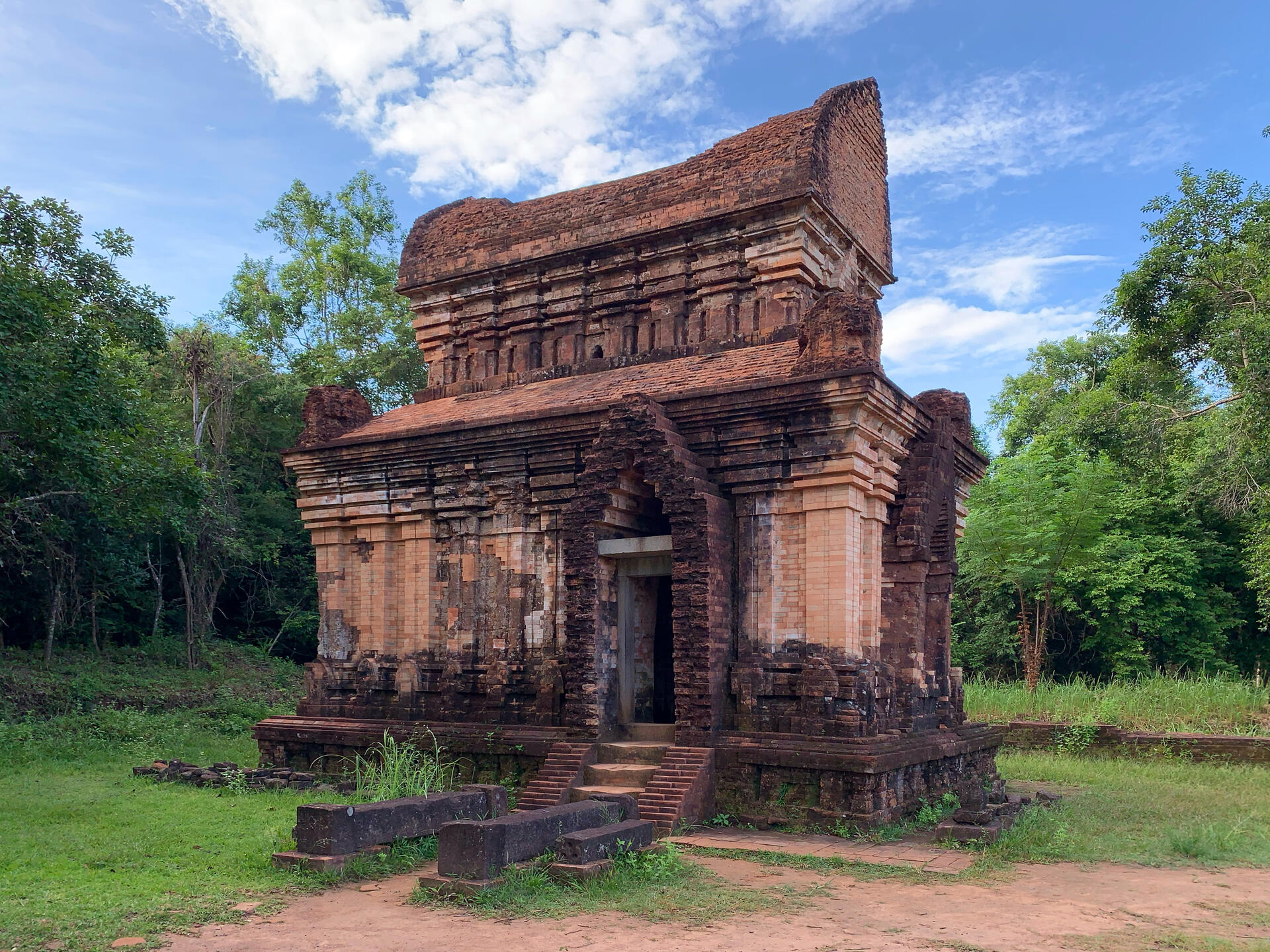
The My Son Sanctuary, nestled within the verdant hills of Quang Nam Province in Central Vietnam, stands as a captivating testament to the rich cultural heritage of the Champa Kingdom. Designated as a UNESCO World Heritage Site in 1999, this remarkable collection of abandoned and partially ruined Shaiva Hindu temples offers visitors a glimpse into the spiritual and political heart of the ancient Champa civilization.
More to come…UNESCO Description of the World Heritage Site
Between the 4th and 13th centuries a unique culture which owed its spiritual origins to Indian Hinduism developed on the coast of contemporary Viet Nam. This is graphically illustrated by the remains of a series of impressive tower-temples located in a dramatic site that was the religious and political capital of the Champa Kingdom for most of its existence.
UNESCO Justification of the World Heritage Site
Criterion (ii): The My Son Sanctuary is an exceptional example of cultural interchange, with an indigenous society adapting to external cultural influences, notably the Hindu art and architecture of the Indian sub-continent.
Criterion (iii): The Champa Kingdom was an important phenomenon in the political and cultural history of South – East Asia, vividly illustrated by the ruins of My Son.
Encyclopedia Record: Mỹ Sơn
Mỹ Sơn is a cluster of abandoned and partially ruined Shaiva Hindu temples in central Vietnam, constructed between the 4th and the 13th century by the Kings of Champa, an Indianized kingdom of the Cham people. The temples are dedicated to the veneration of God in accordance with Shaivism, wherein God is named Shiva, or The Auspicious One. In this particular complex, he is venerated under various local names, the most important of which is Bhadreshvara.Additional Site Details
Area: 142 hectares
Number of Components: 1
(iii) — Unique or exceptional testimony to a cultural tradition
Coordinates: 15.773843 , 108.109169
World Heritage Research
Discover scientific research and academic studies that deepen our understanding of My Son Sanctuary from its history and significance to its conservation, management, and contemporary challenges.
-
Mobilizing International Resources for the Conservation of My Son Heritage in Vietnam
My Son Sanctuary, an ancient Champa temple complex and UNESCO World Cultural Heritage site, faces significant deterioration due to environmental factors and human activity. This study highlights the effectiveness of international collaboration in addressing its conservation challenges. By analyzing projects involving partnerships between Vietnam and countries like Poland, Italy, India, as well as the World Heritage Fund under UNESCO, researchers demonstrate how such cooperation can mobilize critical resources for heritage preservation. The findings underscore the importance of these initiatives in safeguarding My Son Sanctuary, contributing to global efforts in protecting humanity's shared cultural legacy. This work serves as a valuable resource for both domestic and international stakeholders invested in preserving this significant site.
Van Trong, D., Thi Kieu Trinh, N., & Van Ha, N. (2026). Mobilizing International Resources for the Conservation of My Son Heritage in Vietnam. Conservation Science in Cultural Heritage, 25(1), 289–301. https://doi.org/10.6092/ISSN.1973-9494/25460
View Publication Record | Read Publication -
Preservation and Promotion of Champa Cultural Values in the Modern World: From Hoa Lai Style Champa Sculpture to Contemporary Fashion in Vietnam
A dialogue between Champa heritage and contemporary fashion can effectively preserve and promote Vietnamese culture globally. This study demonstrates that integrating intricate patterns and symbolic motifs from Hoa Lai-style Champa sculpture into modern fashion design not only safeguards the artistic legacy of My Son Sanctuarybut also engages younger generations, fostering international cultural appreciation. Employing a 'research by design' approach, the study conducted photographic surveys to document motifs, then designed and displayed fashion garments, gathering public responses through surveys. The findings suggest that contemporary applications of Champa sculpture can bridge historical preservation with modern creativity, offering a sustainable pathway for cultural revitalization.
Hoa, L. T. (2026). Preservation and Promotion of Champa Cultural Values in the Modern World: From Hoa Lai Style Champa Sculpture to Contemporary Fashion in Vietnam. ISVS E-Journal, 13(3), 65. https://doi.org/10.61275/isvsej-2026-13-03-05
View Publication Record | Read Publication -
Heritage Education for Conservation: A New Perspective from the My Son Sanctuary, Vietnam
A new 'Heritage Education for Conservation' model emerges as a promising strategy for sustainable preservation, demonstrated through the case of My Son Sanctuary, Vietnam. This approach integrates historical, cultural, and architectural education to address existing threats while fostering community engagement, individual responsibility, and deeper emotional connections to heritage. By combining knowledge dissemination with active participation, it aims to raise awareness, promote conservation behaviors, and cultivate a resilient local community dedicated to safeguarding cultural heritage. The model offers a practical framework for balancing educational outreach with tangible conservation outcomes.
Trong, D. V., & Trinh, N. T. K. (2025). Heritage Education for Conservation: A New Perspective from the My Son Sanctuary, Vietnam. Journal of Cultural Analysis and Social Change, 1867–1872. https://doi.org/10.64753/jcasc.v10i2.1882
View Publication Record | Read Publication -
Bảo tồn, phát huy giá trị các di sản văn hóa thế giới trong phát triển du lịch trên địa bàn tỉnh Quảng Nam
Quảng Nam's cultural heritage, including the UNESCO-listed My Son Sanctuary and Hoi An Ancient Town, has significantly boosted tourism but faces severe degradation due to harsh natural conditions and human activities. This study highlights the urgent need for conservation strategies that balance heritage preservation with sustainable tourism development. It emphasizes the role of these sites in fostering national identity, economic growth, job creation, and social stability while addressing challenges like environmental stress and improper human behavior. The research underscores the importance of integrating cultural heritage into long-term development plans to ensure its protection and utilization for future generations.
Đinh Văn Trọng, Nguyễn Minh Phương, & Dương Việt Anh. (2026). Bảo tồn, phát huy giá trị các di sản văn hóa thế giới trong phát triển du lịch trên địa bàn tỉnh Quảng Nam. Tạp Chí Khoa Học Xã Hội Và Nhân Văn (VNU Journal of Social Sciences and Humanities), 9(1b), 23–32. https://doi.org/10.33100/tckhxhnv9.1b.dinhvantrong.vcs
View Publication Record | Read Publication -
Nghiên Cứu Ứng Dụng Công Nghệ Photogrammetry Tái Hiện Các Hiện Vật Lịch Sử tại Bảo Tàng Mỹ Sơn trong Không Gian Ba Chiều
Photogrammetry offers a highly effective solution for reconstructing historical artifacts in three-dimensional models, as demonstrated by its successful application at the My Son Sanctuary museum. This study validates photogrammetry's precision and efficiency in digitizing cultural heritage, providing a robust method for both conservation and educational purposes. The research outlines a practical workflow—encompassing image data acquisition, processing, 3D modeling, and publication—that can be replicated to preserve and disseminate historical objects. By leveraging this technology, museums can enhance research, analysis, and public engagement with cultural heritage, addressing the growing demand for accessible yet scientifically rigorous documentation.
Thịnh, Đ. T. (2024). NGHIÊN CỨU ỨNG DỤNG CÔNG NGHỆ PHOTOGRAMMETRY TÁI HIỆN CÁC HIỆN VẬT LỊCH SỬ TẠI BẢO TÀNG MỸ SƠN TRONG KHÔNG GIAN BA CHIỀU. TNU Journal of Science and Technology, 229(07), 149–155. https://doi.org/10.34238/tnu-jst.10296
View Publication Record | Read Publication -
Memori dan Rekonsiliasi Trauma dalam Cerpen Siapa Namamu, Sandra? Karya Norman Erikson Pasaribu
A study on the short story 'What's Your Name, Sandra?' by Norman Erikson Pasaribu reveals that Mama Sandra experiences traumatic memory due to two significant events: the betrayal of her son Bison's identity as gay and his subsequent suicide. These events trigger symptoms such as flashbacks, withdrawal, denial, guilt, and nightmares, leading to an urge for reconciliation through a 'healing journey' to Mỹ Sơn in Vietnam. The research applies theories by Cathy Caruth and Dominic LaCapra to analyze trauma and its resolution, highlighting the psychological impact of societal rejection and the process of working through trauma.
Fajariyah, W. (2024). Memori dan Rekonsiliasi Trauma dalam Cerpen Siapa Namamu, Sandra? Karya Norman Erikson Pasaribu. Ilmu Budaya: Jurnal Bahasa, Sastra, Seni, Dan Budaya, 8(3), 292. https://doi.org/10.30872/jbssb.v8i3.15105
View Publication Record | Read Publication -
Sơn Truyền Thống trên Nghệ Thuật Trang Trí thời Nguyễn, Thực Trạng, Giải Pháp và Hướng Bảo Tồn
Traditional lacquer art from the Nguyen Dynasty, used in decorative motifs at My Son Sanctuary and other imperial structures, retains its aesthetic and cultural significance despite over a century of use. This study reveals that these lacquered elements, characterized by their timeless hues and intricate designs, embody deep cultural values—Chân (truth), Thiện (kindness), and Mỹ (beauty)—while also serving spiritual purposes. Through field surveys, expert consultations, and archival research, the authors document the current state of traditional lacquer in historical sites like the Thai Hoa Palace and various mausoleums. They propose conservation strategies to preserve these artistic and cultural heritage elements, addressing both their material degradation and the need for sustainable restoration techniques.
Phú, Đ. X. (2020). SƠN TRUYỀN THỐNG TRÊN NGHỆ THUẬT TRANG TRÍ THỜI NGUYỄN, THỰC TRẠNG, GIẢI PHÁP VÀ HƯỚNG BẢO TỒN. Hue University Journal of Science: Social Sciences and Humanities, 129(6D), 49–63. https://doi.org/10.26459/hueunijssh.v129i6d.5527
View Publication Record | Read Publication