World Heritage Identification Number: 1325
World Heritage since: 2010
Category: Natural Heritage
WHE Type: Protected Areas & National Parks
Transboundary Heritage: No
Endangered Heritage: No
Country: 🇰🇮 Kiribati
Continent: Oceania
UNESCO World Region: Asia and the Pacific
Map
The Phoenix Islands Protected Area: A Giant Sanctuary in the Central Pacific
The Phoenix Islands Protected Area (PIPA) is a vast expanse of marine and terrestrial habitats situated in the heart of the Southern Pacific Ocean. Encompassing the Phoenix Island Group, one of three island groups in Kiribati, this protected area represents the largest designated Marine Protected Area (MPA) globally, spanning over 408,250 square kilometers. Established in 2010, PIPA was the first site in Kiribati to be inscribed on the prestigious UNESCO World Heritage List.
More to come…UNESCO Description of the World Heritage Site
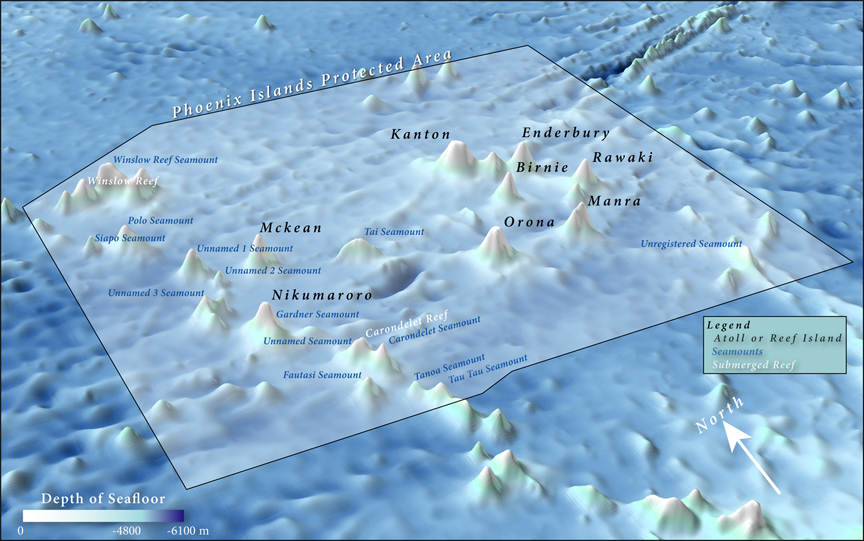
The Phoenix Island Protected Area (PIPA) is a 408,250 sq.km expanse of marine and terrestrial habitats in the Southern Pacific Ocean. The property encompasses the Phoenix Island Group, one of three island groups in Kiribati, and is the largest designated Marine Protected Area in the world. PIPA conserves one of the world's largest intact oceanic coral archipelago ecosystems, together with 14 known underwater sea mounts (presumed to be extinct volcanoes) and other deep-sea habitats. The area contains approximately 800 known species of fauna, including about 200 coral species, 500 fish species, 18 marine mammals and 44 bird species. The structure and functioning of PIPA's ecosystems illustrates its pristine nature and importance as a migration route and reservoir. This is the first site in Kiribati to be inscribed on the World Heritage List.
UNESCO Justification of the World Heritage Site
Criterion (vii): Phoenix Islands Protected Area, an oceanic wilderness, is sufficiently remote and inhospitable to human colonisation as to be exceptional in terms of the minimal evidence of the impacts of human activities both on the atolls and in the adjacent seas. The Phoenix Islands Protected Area is a very large protected area, a vast wilderness domain where nature prevails and man is but an occasional visitor. The property is distinguished by containing a large suite of seamounts complete with a broad expanse of contextual abyssal plain with a natural phenomenon of global significance. The essentially pristine environment, outstanding underwater clarity, the spectacle of large groups of charismatic aquatic animals (e.g. bumphead parrotfish, Napolean wrasse, surgeonfishes, parrotfishes, groupers, maori wrasse, sharks, turtles, dolphins, manta rays, giant clams) in quantities rarely found elsewhere in the world, aesthetically outstanding coral reef features (e.g. giant clams, large coral heads) together with the spectacle of huge concentrations of seabirds on remote atolls, makes of this property a truly kaleidoscopic natural oceanscape exhibiting exceptional natural beauty of global significance.
Criterion (ix): With its rich biota, as a known breeding site for numerous nomadic, migratory and pelagic marine and terrestrial species, and the known and predicted high level of biodiversity and endemicity associated with these isolated mid-ocean atolls, submerged reefs and seamounts, Phoenix Islands Protected Area makes an outstanding contribution to ongoing ecological and biological processes in the evolution and development of global marine ecosystems and communities of plants and animals. Phoenix Islands Protected Area has exceptional value as a natural laboratory for the study and understanding of the significant ongoing ecological and biological processes in the evolution and development of marine ecosystems of the Pacific, the world's largest ocean, indeed all oceans. This property is of crucial scientific importance in identifying and monitoring the processes of sea level change, growth rates and age of reefs and reef builders, (both geologically and historically) and in evaluating effects from climate change.
Encyclopedia Record: Phoenix Islands Protected Area
The Phoenix Islands Protected Area (PIPA) is located in the Republic of Kiribati, an ocean nation in the central Pacific approximately midway between Australia and Hawaii. PIPA constitutes 11.34% of Kiribati's exclusive economic zone (EEZ), and with a size of 408,250 km2 (157,630 sq mi), it is one of the largest marine protected areas (MPA) and one of the largest protected areas of any type on Earth. The PIPA was also designated as the world's largest and deepest UNESCO World Heritage Site in 2010.Additional Site Details
Area: 40,825,000 hectares
Number of Components: 1
(ix) — Outstanding example representing ecological and biological processes
Coordinates: -3.864454 , -172.650203
IUCN World Heritage Outlook
The 2025 Conservation Outlook on Phoenix Islands Protected Area reports the following assessment:
Source: International Union for Conservation of Nature (IUCN) · View assessment
Image
© Kerry Lagueux, New England Aquarium., CC BY-SA 3.0 Resized from original. (This derivative is under the same CC BY-SA license.)
World Heritage Research
Discover scientific research and academic studies that deepen our understanding of Phoenix Islands Protected Area from its history and significance to its conservation, management, and contemporary challenges.
-
Limited conservation efficacy of large-scale marine protected areas for Pacific skipjack and bigeye tunas
Large-scale marine protected areas (MPAs) may not effectively conserve tropical tuna stocks, including skipjack and bigeye tunas. A study evaluating the Phoenix Islands Protected Area (PIPA) and hypothetical 33% MPAs in the western and central Pacific found minimal stock-wide conservation benefits for these species. Using the SEAPODYM model, researchers compared control and counterfactual simulations to assess population dynamics under different MPA scenarios. Results indicated weak to non-existent benefits for skipjack tuna (-0.1% to +5.8% change in spawning biomass) and modest gains for bigeye tuna (+4.8% to +12.0%). The limited efficacy is attributed to the species' wide larval dispersal and high mobility, which dissipate MPA protective effects. Additionally, fishing effort displacement from MPAs can negatively impact stocks outside these areas. This suggests that large oceanic MPAs may not be effective frontline management tools for tropical tunas with similar life history characteristics.
Hampton, J., Lehodey, P., Senina, I., Nicol, S., Scutt Phillips, J., & Tiamere, K. (2023). Limited conservation efficacy of large-scale marine protected areas for Pacific skipjack and bigeye tunas. Frontiers in Marine Science, 9. https://doi.org/10.3389/fmars.2022.1060943
View Publication Record | Read Publication -
Increasing Coral Reef Resilience Through Successive Marine Heatwaves
A study of the Phoenix Islands Protected Area (PIPA) reveals that coral reefs are becoming more resilient to marine heatwaves over time. Analyzing an 18-year record of coral cover across three major bleaching events, researchers found that coral mortality due to thermal stress has decreased in recent heatwaves compared to earlier ones. This suggests that selective survival through successive heatwaves may be shaping the coral community's response to future warming. The findings highlight the potential for corals to adapt under repeated thermal stress and underscore the importance of identifying conditions that facilitate coral survival and recovery to effectively manage reefs amid climate change.
Fox, M. D., Cohen, A. L., Rotjan, R. D., Mangubhai, S., Sandin, S. A., Smith, J. E., Thorrold, S. R., Dissly, L., Mollica, N. R., & Obura, D. (2021). Increasing Coral Reef Resilience Through Successive Marine Heatwaves. Geophysical Research Letters, 48(17). Portico. https://doi.org/10.1029/2021gl094128
View Publication Record | Read Publication -
Oceanographic Drivers of Deep-Sea Coral Species Distribution and Community Assembly on Seamounts, Islands, Atolls, and Reefs Within the Phoenix Islands Protected Area
Deep-sea coral communities in the Phoenix Islands Protected Area (PIPA) are shaped by oceanographic factors, with seamounts hosting more diverse and abundant species compared to islands, atolls, and reefs. This pattern is driven by stronger currents and nutrient upwelling on seamounts, which enhance coral growth and recruitment. The study used submersible surveys and genetic analyses to map coral distributions across 19 sites, revealing that depth, substrate type, and oceanographic conditions are key determinants of community assembly. These findings highlight the importance of seamounts as biodiversity hotspots and underscore the need for targeted conservation strategies in PIPA.
Auscavitch, S. R., Deere, M. C., Keller, A. G., Rotjan, R. D., Shank, T. M., & Cordes, E. E. (2020). Oceanographic Drivers of Deep-Sea Coral Species Distribution and Community Assembly on Seamounts, Islands, Atolls, and Reefs Within the Phoenix Islands Protected Area. Frontiers in Marine Science, 7. https://doi.org/10.3389/fmars.2020.00042
View Publication Record | Read Publication -
Discovery of a recovering climax Acropora community in Kanton Lagoon in the remote Phoenix Islands Protected Area
A resilient coral community in Kanton Lagoon, part of the remote Phoenix Islands Protected Area (PIPA), has shown remarkable recovery from near-total mortality caused by thermal stress. Despite temperatures reaching up to 30.5°C, which typically induces bleaching, Acropora stands within the lagoon exhibited minimal signs of thermal stress, suggesting that recovering coral species may have developed greater resistance. An expedition in 2015 documented a 52.8% recovery of hard corals, indicating a potential shift toward a more thermally tolerant climax community. This discovery highlights the capacity for coral reefs to rebound under protected conditions, even after severe disturbances.
Mangubhai, S., Nand, Y., & Rotjan, R. (2018). Discovery of a recovering climax Acropora community in Kanton Lagoon in the remote Phoenix Islands Protected Area. Pacific Conservation Biology, 25(3), 322–323. https://doi.org/10.1071/pc18051
View Publication Record | Read Publication -
Shipboard design and fabrication of custom 3D-printed soft robotic manipulators for the investigation of delicate deep-sea organisms
A groundbreaking approach using shipboard 3D printing of soft robotic manipulators enables delicate interactions with fragile deep-sea organisms, addressing longstanding challenges in sampling and studying these species. Deployed via a Remotely Operated Vehicle (ROV) at depths reaching 2224 meters in the Phoenix Islands Protected Area (PIPA), these custom-designed manipulators successfully grasped goniasterids and holothurians—organisms historically difficult to collect undamaged with rigid tools or suction samplers. Rapid iterative design, fabrication, and testing at sea allowed for real-time adaptations, such as adding 'fingernails,' enhancing precision. This method offers a less invasive alternative to traditional sampling, benefiting slow-growing deep-sea organisms, some of which can be up to 18,000 years old. By combining soft robotics with on-the-fly fabrication, the study demonstrates a scalable solution for exploring delicate marine ecosystems in remote and logistically challenging environments.
Vogt, D. M., Becker, K. P., Phillips, B. T., Graule, M. A., Rotjan, R. D., Shank, T. M., Cordes, E. E., Wood, R. J., & Gruber, D. F. (2018). Shipboard design and fabrication of custom 3D-printed soft robotic manipulators for the investigation of delicate deep-sea organisms. Plos One, 13(8), e0200386. https://doi.org/10.1371/journal.pone.0200386
View Publication Record | Read Publication -
Silent killer: black reefs in the Phoenix Islands Protected Area
Black reefs in the Phoenix Islands Protected Area, characterized by degraded coral ecosystems, show no signs of recovery despite being observed over a 12-year period from 2003 to 2015. The study links this degradation to the introduction of iron from shipwrecks, which promotes the proliferation of turf algae and cyanobacterial mats in an otherwise iron-poor equatorial Pacific environment. Researchers analyzed these black reefs to understand their formation and persistence, revealing a silent ecological threat that undermines conservation efforts in protected areas.
Mangubhai, S., & Obura, D. O. (2018). Silent killer: black reefs in the Phoenix Islands Protected Area. Pacific Conservation Biology, 25(2), 213–214. https://doi.org/10.1071/pc18048
View Publication Record | Read Publication -
The blue paradox: Preemptive overfishing in marine reserves
Announcing marine reserves can inadvertently trigger preemptive overfishing, undermining conservation efforts before policies take effect. A study of the Phoenix Islands Protected Area (PIPA), one of the world's largest marine reserves, revealed that fishers more than doubled their fishing activity once the area was designated for protection. This surge in effort depleted fish stocks to levels equivalent to 1.5 years of banned fishing, setting PIPA back before it even began. Using satellite data tracking fishing activity, researchers demonstrated that anticipation of conservation measures can lead to a 'race-to-fish,' potentially increasing global overexploitation by up to 7%. These findings highlight the unintended consequences of preemptive resource extraction and challenge conventional approaches to monitoring policy efficacy in marine conservation.
McDermott, G. R., Meng, K. C., McDonald, G. G., & Costello, C. J. (2018). The blue paradox: Preemptive overfishing in marine reserves. Proceedings of the National Academy of Sciences, 116(12), 5319–5325. https://doi.org/10.1073/pnas.1802862115
View Publication Record | Read Publication -
Unraveling the blue paradox: Incomplete analysis yields incorrect conclusions about Phoenix Islands Protected Area closure
A critical analysis reveals that the reported fishing surge around the Phoenix Islands Protected Area (PIPA) was not due to its closure, as previously claimed, but instead a consequence of a strong El Niño event affecting multiple exclusive economic zones (EEZs). The study challenges the 'blue paradox' concept, which posits unintended negative outcomes from conservation policies. By examining regional data and long-term catch trends, researchers demonstrate that the surge was part of a broader phenomenon unrelated to PIPA's closure. This finding underscores the importance of comprehensive data analysis in attributing environmental changes.
Hanich, Q., Rotjan, R., Aqorau, T., Bailey, M., Campbell, B., Gray, N., Gruby, R., Hampton, J., Ota, Y., Parris, H., Reid, C., Sumaila, U. R., & Swartz, W. (2018). Unraveling the blue paradox: Incomplete analysis yields incorrect conclusions about Phoenix Islands Protected Area closure. Proceedings of the National Academy of Sciences, 115(52). https://doi.org/10.1073/pnas.1815600115
View Publication Record | Read Publication -
Co‐operation between large‐scale MPAs: successful experiences from the Pacific Ocean
Collaboration among large-scale marine protected areas (LSMPAs) in the Pacific Ocean has proven effective in addressing shared management, governance, and research challenges. These LSMPAs, which cover vast areas (>100,000 km²), share common natural histories, threats, cultural ties, and scientific needs due to their common ancestry. The study highlights successful bilateral agreements, learning exchanges, and joint research, monitoring, and enforcement activities among notable sites such as the Phoenix Islands Protected Area (PIPA) and others in the region. By leveraging traditional Pacific collaboration models, these LSMPAs have made significant strides toward achieving global conservation targets, despite covering less than 3% of the ocean's area.
Friedlander, A. M., Wagner, D., Gaymer, C. F., Wilhelm, T. ’., Lewis, N., Brooke, S., Kikiloi, K., & Varmer, O. (2016). Co‐operation between large‐scale MPAs: successful experiences from the Pacific Ocean. Aquatic Conservation: Marine and Freshwater Ecosystems, 26(S2), 126–141. Portico. https://doi.org/10.1002/aqc.2645
View Publication Record | Read Publication -
Contracting for Conservation in the Central Pacific: An Overview of the Phoenix Islands Protected Area
The Phoenix Islands Protected Area (PIPA) stands as a pioneering model for marine conservation in the Central Pacific, demonstrating how large-scale protected areas can be established and managed through innovative contractual agreements. This study highlights PIPA's unique governance structure, which combines international treaties with domestic legislation to create one of the world's largest fully protected marine reserves. The research approach involves analyzing the legal framework, implementation challenges, and ecological benefits, offering insights into effective conservation strategies for remote and biologically rich regions. By focusing on contractual mechanisms, this work provides a blueprint for balancing sovereignty, conservation, and sustainable development in the Pacific Islands.
Shelley, P. (2012). Contracting for Conservation in the Central Pacific: An Overview of the Phoenix Islands Protected Area. Proceedings of the ASIL Annual Meeting, 106, 511–516. https://doi.org/10.5305/procannmeetasil.106.0511
View Publication Record | Read Publication -
Phoenix Islands Protected Area Conservation Trust Act 2009 Explanatory Memorandum
The Phoenix Islands Protected Area Conservation Trust Act 2009 establishes a legal framework to safeguard one of the world's largest and most remote marine protected areas, spanning over 400,000 square kilometers in the central Pacific. This act emphasizes the importance of integrating conservation with sustainable development, particularly for island communities dependent on marine resources. The explanatory memorandum outlines mechanisms for governance, including the creation of a trust to manage the area's ecological integrity while supporting local livelihoods. By combining traditional knowledge with modern conservation science, this approach sets a precedent for balancing biodiversity protection and human well-being in remote, vulnerable ecosystems.
Tabane, T. (2012). Phoenix Islands Protected Area Conservation Trust Act 2009 Explanatory Memorandum. Proceedings of the ASIL Annual Meeting, 106, 516–517. https://doi.org/10.5305/procannmeetasil.106.0516
View Publication Record | Read Publication