World Heritage Identification Number: 1507
World Heritage since: 2024
Category: Cultural Heritage
WHE Type: Religious Sites & Sacred Architecture
Transboundary Heritage: No
Endangered Heritage: No
Country: 🇹🇭 Thailand
Continent: Asia
UNESCO World Region: Asia and the Pacific
Map
Phu Phrabat: A Testament to the Sīma Stone Tradition of the Dvaravati Period
Phu Phrabat, located in Ban Phue District, Udon Thani Province, Thailand, stands as a unique testament to the Sīma stone tradition of the Dvaravati period (7th-11th centuries CE). This historical park, renowned for its distinctive rock formations, serves as a significant archaeological site that offers insights into the cultural practices and religious beliefs of ancient Southeast Asian societies.
More to come…UNESCO Description of the World Heritage Site
The property illustrates the Sīma stone tradition of the Dvaravati period (7th-11th centuries CE). While sacred boundary markers for areas of Theravada Buddhist monastic practice vary in materials, extensive use of stones is found only in the Khorat Plateau region in Southeast Asia. Buddhism’s arrival in the 7th century led to an increase in the erection of Sīma stones throughout the region for over four centuries. The Phu Phrabat Mountain area preserves the largest corpus in the world of in situ Sīma stones from the Dvaravati period, testifying to the tradition that once prevailed in the region. The scale of Sīma stone erection and rock shelter modification has transformed the natural landscape into a religious centre, and rock paintings on surfaces of 47 rock shelters are the physical evidence of human occupation over two millennia.
UNESCO Justification of the World Heritage Site
Criterion (iii): Phu Phrabat preserves the largest corpus in the world of in situ Sīma stones from the Dvaravati period, with all the types of establishment patterns as prescribed in Buddhist scripture, and exhibits the majority of forms and artistic styles of this particular type of sacred boundary marker with a very clear evolutionary path. It is an exceptional testimony to the Sīma stone tradition of the Dvaravati period in a global context.
Criterion (v): The landscape of Phu Phrabat has been purposefully and extensively transformed by the erection of the Sīma stones over more than four centuries to fulfil Buddhist ceremonial functions, possibly linked to the forest monastic tradition. It is an outstanding example of land use that is representative of the Sīma stone tradition that once prevailed in the Khorat Plateau during the Dvaravati period.
Encyclopedia Record: Phu Phra Bat Historical Park
Phu Phra Bat is a historical park in Ban Phue District, Udon Thani Province, Thailand. The park's distinguishing feature is its unusual rock formations around which religious shrines have been constructed. Some formations also feature prehistoric rock paintings.Additional Site Details
Area: 585.955 hectares
Number of Components: 2
(v) — Outstanding example of traditional human settlement
Coordinates: 17.7310583333 , 102.3562666667
Image
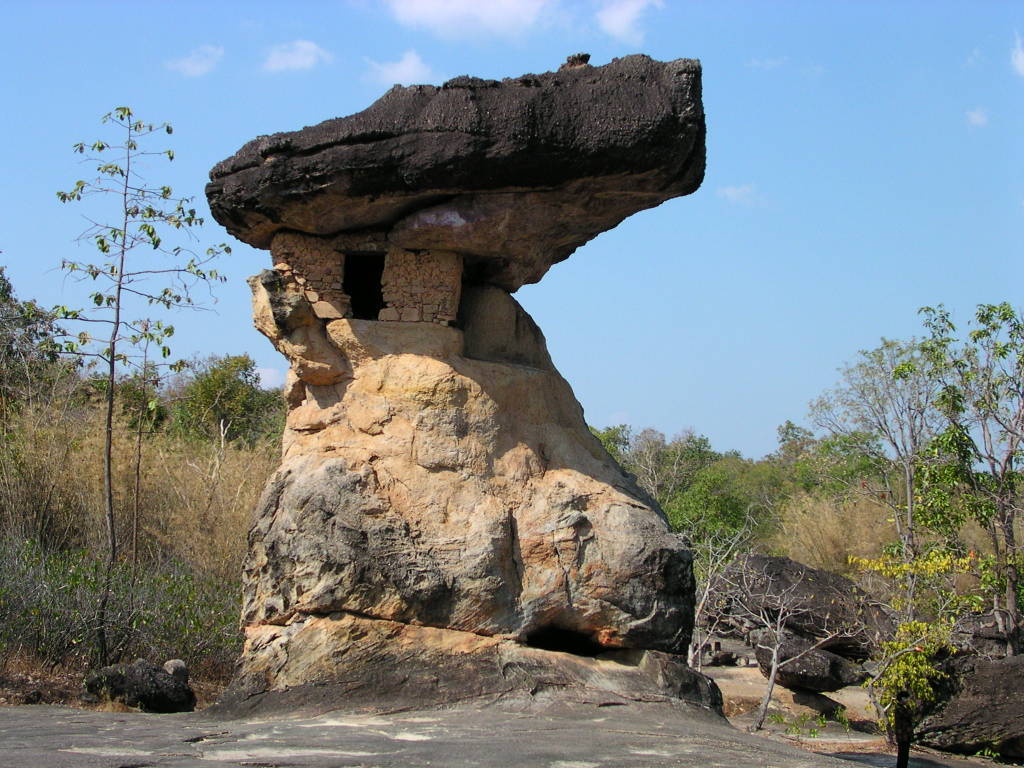
© Theppitak Karoonboonyanan, CC BY-SA 2.0 Resized from original. (This derivative is under the same CC BY-SA license.)
World Heritage Research
Discover scientific research and academic studies that deepen our understanding of Phu Phrabat, a testimony to the Sīma stone tradition of the Dvaravati period from its history and significance to its conservation, management, and contemporary challenges.
-
Cultural landscape implications and sustainable development at Phu Phra Bat historical park
A significant discovery in heritage tourism reveals that the physical environment of Phu Phra Bat Historical Park, Thailand, plays a crucial role in shaping visitor perceptions and revisit intentions. The study found that tangible elements like heritage structures and interpretive signage amplify the relationship between product/service quality and perceived price fairness, indirectly boosting the likelihood of repeat visits. Using advanced statistical analysis (Hayes 2013 PROCESS macro) on data from 423 visitors, researchers demonstrated that these physical features moderate the indirect path linking service quality to revisit potential via price perceptions. This insight underscores the importance of environmental and structural design in enhancing visitor experience and sustainability at culturally significant sites.
Luekveerawattana, R. (2025). Cultural landscape implications and sustainable development at Phu Phra Bat historical park. Journal of Asian Architecture and Building Engineering, 1–15. https://doi.org/10.1080/13467581.2025.2553251
View Publication Record | Read Publication