World Heritage Identification Number: 395
World Heritage since: 1987
Category: Cultural Heritage
WHE Type: Buildings & Architectural Ensembles
Transboundary Heritage: No
Endangered Heritage: No
Country: 🇮🇹 Italy
Continent: Europe
UNESCO World Region: Europe and North America
Map
The Architectural Marvel of Piazza del Duomo, Pisa: A Glimpse into Medieval Art
The Piazza del Duomo, popularly known as Piazza dei Miracoli ("Square of Miracles"), stands as a testament to the grandeur of medieval Italian architecture. Located in the northwestern part of the historic city of Pisa, Tuscany, Italy, this expansive walled compound spanning 8.87 hectares (21.9 acres) has been recognized as an essential center of European medieval art and boasts one of the world's most remarkable architectural complexes.
The piazza is celebrated as one of the finest examples of Pisan Romanesque architecture, a distinctive style that flourished during the city's period as a powerful maritime republic. Characterized by elegant arcades, alternating bands of white and grey marble, classical influences, and decorative elements inspired by the Mediterranean world, the style reflects Pisa's extensive commercial and cultural connections. The harmonious arrangement of the monuments across a broad green lawn creates one of the most recognizable architectural ensembles in Europe.
The popular name Piazza dei Miracoli, meaning "Square of Miracles," was coined by the Italian poet and writer Gabriele D'Annunzio in the early 20th century. Inspired by the extraordinary beauty of the monuments, he described the square as a "meadow of miracles," a name that has since become more widely known than the piazza's official designation, Piazza del Duomo.
Inscribed as a UNESCO World Heritage Site in 1987, the Piazza del Duomo is a collection of four architectural marvels that exerted a profound influence on monumental art in Italy from the 11th to the 14th century. The four structures that dominate the piazza are the Pisa Cathedral, the Pisa Baptistery, the Leaning Tower of Pisa, and the Camposanto Monumentale.
The Pisa Cathedral, or Duomo di Pisa, is the principal church of the city and the seat of the Archbishop of Pisa. Construction began in 1064 and the cathedral was consecrated in 1118, with additional work continuing into the 12th century. Designed in the Romanesque style, it showcases intricate marble decoration and a magnificent façade of white and grey marble. The cathedral's interior features a nave, two aisles, and three apses, along with notable artistic treasures, including Giovanni Pisano's celebrated pulpit, an impressive apse mosaic depicting Christ in Majesty, an ornate gilded ceiling, and other masterpieces that reflect the city's artistic heritage.
Adjacent to the cathedral lies the Pisa Baptistery, a circular structure whose construction began in 1152 and was completed in the 14th century. It is an exceptional example of the transition from Romanesque to Gothic architecture. Its exterior is decorated with elaborate carvings, while its spacious interior is renowned for its remarkable acoustics, which create rich echoes and harmonies during demonstrations.
One of the most famous landmarks within the Piazza del Duomo is the Leaning Tower of Pisa, or Torre Pendente. Construction began on this freestanding bell tower in 1173 but was halted for nearly a century due to unstable ground and political conflicts, during which time the tower's gradual lean became apparent. Construction eventually resumed, and the tower was completed in the 14th century. Today, visitors can climb its narrow spiral staircase for panoramic views of the piazza and the surrounding city.
The Leaning Tower owes its distinctive tilt to unstable subsoil composed of soft clay, sand, and silt beneath its shallow foundations. The lean became apparent during the early stages of construction, prompting lengthy interruptions that inadvertently allowed the ground to settle and helped prevent the tower's collapse. Extensive engineering work carried out between 1990 and 2001 stabilized the structure, reducing its lean while preserving its iconic appearance and ensuring it remains safe for visitors.
The Piazza del Duomo is also closely associated with the history of science through the work of Galileo Galilei (1564–1642), who studied at the University of Pisa. According to a long-standing tradition, Galileo's observations of a swinging lamp in the cathedral inspired his investigations into the isochronism of pendulum oscillations, an important step in the development of classical mechanics. Another enduring tradition holds that he demonstrated the principles of falling bodies by dropping objects from the Leaning Tower of Pisa. Although historians debate the details of these episodes, the cathedral and its famous campanile remain enduring symbols of Galileo's pioneering contributions to physics.
Completing the quartet of architectural wonders is the Camposanto Monumentale, a rectangular cloistered cemetery whose construction began in 1278 and continued into the 15th century. According to tradition, the Camposanto was built around sacred soil brought from Golgotha during the Third Crusade by Archbishop Ubaldo de' Lanfranchi, giving rise to its name, meaning "holy field." The Camposanto is renowned for its remarkable fresco cycles depicting scenes from the Old Testament, the New Testament, the lives of saints, and allegorical themes. Among its most celebrated works are those by artists such as Bonamico Buffalmacco, Benozzo Gozzoli, Antonio Veneziano, and Taddeo Gaddi, whose frescoes are considered masterpieces of medieval Italian art.
Beyond these four iconic structures, the Piazza del Duomo also includes the former Ospedale Nuovo di Santo Spirito, parts of which now house the Museo delle Sinopie and the Museo dell'Opera del Duomo. The Museo delle Sinopie displays the preparatory drawings, known as sinopias, for many of the Camposanto's frescoes, while the Museo dell'Opera del Duomo houses an outstanding collection of sculptures, paintings, liturgical objects, and other artifacts that illuminate the artistic and religious history of Pisa.
UNESCO recognizes the Piazza del Duomo as one of the world's outstanding medieval architectural ensembles because of the exceptional artistic unity achieved by its monuments. Although each building served a distinct religious purpose—the cathedral for worship, the baptistery for baptism, the bell tower for liturgical functions, and the Camposanto as a cemetery—they were conceived as complementary elements of a single monumental composition that has remained remarkably intact for more than eight centuries.
UNESCO Description of the World Heritage Site
Standing in a large green expanse, Piazza del Duomo houses a group of monuments known the world over. These four masterpieces of medieval architecture – the cathedral, the baptistry, the campanile (the 'Leaning Tower') and the cemetery – had a great influence on monumental art in Italy from the 11th to the 14th century.UNESCO Justification of the World Heritage Site
Criterion (i): Artistically unique because of its spatial design, the Piazza del Duomo contains four absolute architectural masterpieces: the cathedral, the baptistery, the bell tower and the Campo Santo. Within these monuments are such world-renowned art treasures as the bronze doors and mosaics of the cathedral, the pulpits in the baptistery and cathedral, the frescoes of the Campo Santo, and many others.
Criterion (ii): The monuments of the Piazza del Duomo considerably influenced the development of architecture and monumental arts at two different times in history. First, from the 11th century up to 1284, during the epitome of Pisa's prosperity, a new type of church characterized by the refinement of polychrome architecture and the use of loggias was established. The Pisan style that first appeared with the Cathedral can be found elsewhere in Tuscany (notably at Lucca and Pistoia), but also within the Pisan maritime territory, as shown in more humble form by the pieve in Sardegna and Corsica. Later, during the 14th century, architecture in Tuscany was dominated by the monumental style of Giovanni Pisano (who sculpted the pulpit of the Cathedral between 1302 and 1311), a new era of pictorial art - the Trecento - was ushered in after the epidemic of the Black Death (Triumph of Death, a fresco by Bonamico Buffalmacco at the Campo Santo, c. 1350).
Criterion (iv): The group of monuments of the Piazza del Duomo, composed of typical religious buildings constructed for distinct and specific functions, constitutes an outstanding example of medieval Christian architecture.
Criterion (vi): It was at the Cathedral of Pisa that Galileo Galilei (1564-1642), observing the oscillations of the bronze chandelier created by Battista Lorenzi, discovered at the age of 19 the theory of isochronism of small oscillations, a prelude to his pioneering work on dynamics. From the top of the campanile, he conducted experiments, which led him to formulate the laws governing falling bodies. Two of the principal buildings of the Piazza dei Miracoli are thus directly and tangibly associated with a decisive stage in the history of physical sciences.
Encyclopedia Record: Piazza dei Miracoli
The Piazza dei Miracoli, formally known as Piazza del Duomo, is a walled 8.87-hectare (21.9-acre) compound in central Pisa, Tuscany, Italy, recognized as an important center of European medieval art and one of the finest architectural complexes in the world. It was all owned by the Catholic Church and is dominated by four great religious edifices: Pisa Cathedral, the Pisa Baptistery, the Leaning Tower of Pisa, and the Camposanto Monumentale. Partly paved and partly grassed, the Piazza dei Miracoli is also the site of the Ospedale Nuovo di Santo Spirito, which now houses the Sinopias Museum and the Cathedral Museum.Additional Site Details
Area: 8.87 hectares
Number of Components: 1
(ii) — Significant interchange of human values
(iv) — Outstanding example of a type of building or landscape
(vi) — Directly associated with events or living traditions
Coordinates: 43.72305556 , 10.39638889
Image
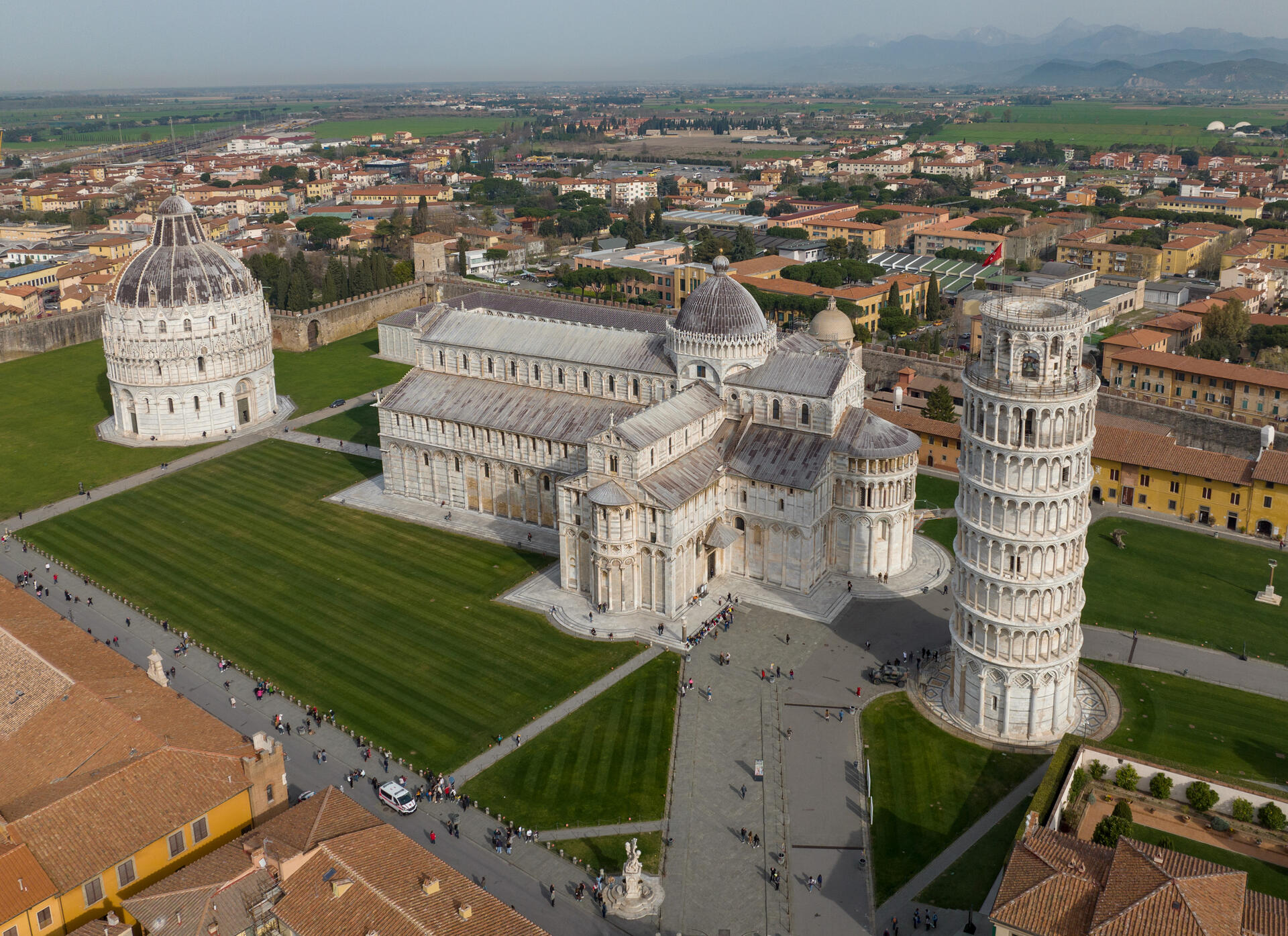
© Arne Müseler, CC BY-SA 3.0 de Resized from original. (This derivative is under the same CC BY-SA license.)
World Heritage Research
Discover scientific research and academic studies that deepen our understanding of Piazza del Duomo, Pisa from its history and significance to its conservation, management, and contemporary challenges.
-
Secondary Teachers’ Experiences in International Professional Development for Convergence Research in STEM and Tradition
A transdisciplinary professional development (PD) model, Convergence Research in STEM and Tradition (CReST), demonstrates significant potential for enhancing secondary teachers' instructional practices by integrating cultural heritage artifacts—such as Renaissance frescoes—as boundary objects. This approach fosters cross-disciplinary connections between chemistry, engineering, world history, and technology. Findings from an exploratory case study involving four secondary teachers reveal that CReST facilitated shifts toward problem-centered, artifact-anchored pedagogy, with teachers reporting the adoption of real-world conservation practices in their instructional planning. The study highlights the importance of sustained collaboration and shared tools for extending learning beyond immersive experiences. This work offers a promising framework for designing culturally grounded STEM education that bridges traditional subjects and real-world applications.
White, R. S., Gutierrez, K. S., & Ferri, J. K. (2026). Secondary Teachers’ Experiences in International Professional Development for Convergence Research in STEM and Tradition. Education Sciences, 16(5), 712. https://doi.org/10.3390/educsci16050712
View Publication Record | Read Publication -
Interactive Visualization Tools for Managing the Monitoring System of the Piazza del Duomo UNESCO Site in Pisa
A breakthrough in structural health monitoring (SHM) for UNESCO World Heritage Sites, exemplified by the Piazza del Duomo in Pisa, demonstrates how advanced 3D informational models and interactive web-based platforms can revolutionize data management. This study integrates complex, heterogeneous sensor data with metadata into an accessible, user-friendly format, enabling rapid analysis of structural changes over time. The developed tools address critical gaps in monitoring systems for heritage sites, offering a scalable solution that enhances awareness and facilitates detailed examination of sensor recordings. By leveraging the historical significance and structural complexity of Pisa's site, this approach sets a new standard for managing long-term monitoring data in culturally significant contexts.
Vignali, L., Bartolini, G., De Falco, A., Gianfranceschi, L., Martino, M., Pucci, F., & Resta, C. (2024). Interactive Visualization Tools for Managing the Monitoring System of the Piazza del Duomo UNESCO Site in Pisa. Heritage, 8(1), 5. https://doi.org/10.3390/heritage8010005
View Publication Record | Read Publication -
Understanding the acoustics of St. John’s Baptistery in Pisa through a virtual approach
St. John’s Baptistery in Pisa, renowned for its exceptional reverberation among medieval central-symmetry buildings, stands out acoustically even when compared to similar structures, piquing scholarly interest. A study leveraged virtual acoustics and numerical simulations calibrated with in situ measurements, material properties, and liturgical use data to dissect the factors influencing its unique sound behavior. By modeling both the current geometry and early design hypotheses, researchers aimed to unravel the architectural evolution shaping its acoustic signature. The analysis of a specifically recorded Gregorian chant further supported the necessity for large reverberation in this historic site, offering critical insights for its preservation.
D’Orazio, D., Fratoni, G., Rossi, E., & Garai, M. (2020). Understanding the acoustics of St. John’s Baptistery in Pisa through a virtual approach. Journal of Building Performance Simulation, 13(3), 320–333. https://doi.org/10.1080/19401493.2020.1728382
View Publication Record | Read Publication -
The Tower of Pisa
The Leaning Tower of Pisa, a UNESCO World Heritage Site and iconic symbol of early Renaissance Romanesque architecture, was stabilized after decades of concern over its structural integrity. Key to this effort were two critical studies: one reconstructing the tower's inclination history during construction, which informed a sophisticated numerical model essential for evaluating stabilization schemes, and another revealing an unexpected foundation movement mechanism since 1911. These insights enabled the development of temporary and permanent stabilization measures that allowed the tower to reopen to the public in 2001. The research highlights the intersection of geotechnical engineering, conservation architecture, and historical analysis, offering a model for preserving at-risk heritage sites.
Burland, J. B., Jamiolkowski, M. B., Squeglia, N., & Viggiani, C. (2020). The Tower of Pisa. https://doi.org/10.1201/9781003046127
View Publication Record | Read Publication