World Heritage Identification Number: 1592
World Heritage since: 2019
Category: Cultural Heritage
WHE Type: Archaeological Sites
Transboundary Heritage: No
Endangered Heritage: No
Country: 🇨🇳 China
Continent: Asia
UNESCO World Region: Asia and the Pacific
Map
Unraveling the Mysteries of the Archaeological Ruins of Liangzhu City
The Archaeological Ruins of Liangzhu City, situated in the Yangtze River Basin on the southeastern coast of China, offer a captivating glimpse into one of the earliest known regional states in Late Neolithic China. Inscribed as a UNESCO World Heritage Site in 2019, this significant archaeological find spans approximately 1,000 years, from around 3,300 BCE to 2,300 BCE.
More to come…UNESCO Description of the World Heritage Site
Located in the Yangtze River Basin on the south-eastern coast of the country, the archaeological ruins of Liangzhu (about 3,300-2,300 BCE) reveal an early regional state with a unified belief system based on rice cultivation in Late Neolithic China. The property is composed of four areas – the Area of Yaoshan Site, the Area of High-dam at the Mouth of the Valley, the Area of Low-dam on the Plain and the Area of City Site. These ruins are an outstanding example of early urban civilization expressed in earthen monuments, urban planning, a water conservation system and a social hierarchy expressed in differentiated burials in cemeteries within the property.
UNESCO Justification of the World Heritage Site
Criterion (iii): The Archaeological Ruins of Liangzhu City, as the centre of power and belief of Liangzhu culture, is an outstanding testimony of an early regional state with rice-cultivating agriculture as its economic base, and social differentiation and a unified belief system, which existed in the lower reaches of the Yangtze River in the Late Neolithic period of China. It provides unparalleled evidence for concepts of cultural identity, social and political organization, and the development of society and culture in the late Neolithic and early Bronze Age in China and the region.
Criterion (iv): The Archaeological Ruins of Liangzhu illustrates the transition from small-scale Neolithic societies to a large integrated political unit with hierarchy, rituals and crafts. It includes outstanding examples of early urbanization expressed in earthen monuments, city and landscape planning, social hierarchy expressed in burial differentiations in cemeteries within the property, socio-cultural strategies for organization of space, and materialization of power. It represents the great achievement of prehistoric rice-cultivating civilization of China over 5000 years ago, and as an outstanding example of early urban civilization.
Encyclopedia Record: Archaeological ruins of Liangzhu City
The archaeological ruins of Liangzhu City, or simply the Liangzhu site, consist of a cluster of Neolithic sites located in the Liangzhu Subdistrict and Pingyao Town of Yuhang, Hangzhou, China. Initially excavated by Shi Xingeng in 1936, the ruins were recognised to belong to a previously unknown civilisation, termed Liangzhu culture, in 1959. The site was confirmed as an ancient city after the discovery of its city walls in 2006.Additional Site Details
Area: 1,433.66 hectares
Number of Components: 4
(iv) — Outstanding example of a type of building or landscape
Coordinates: 30.3955555556 , 119.9908333333
Image
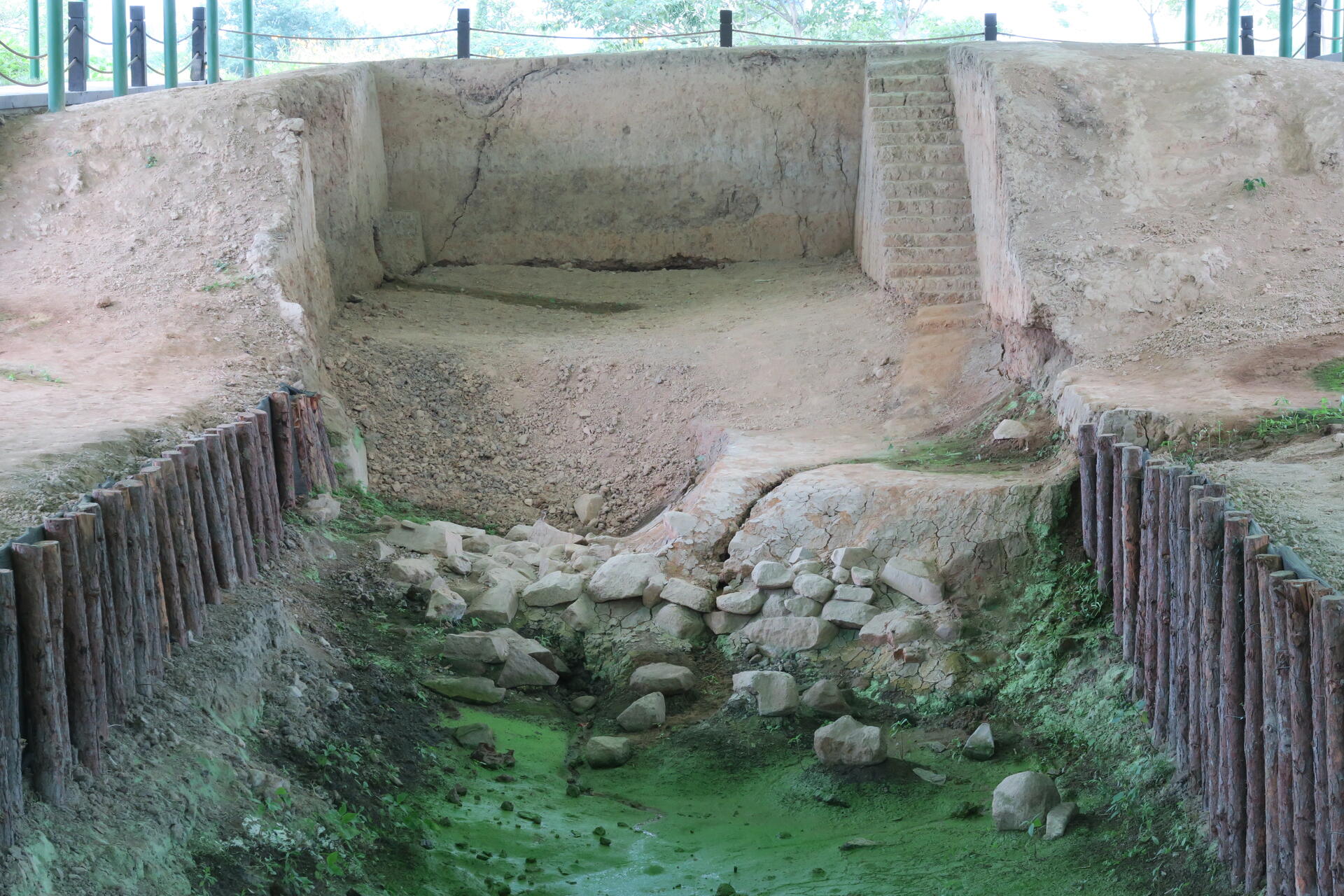
© Siyuwj, CC BY-SA 4.0 Resized from original. (This derivative is under the same CC BY-SA license.)
World Heritage Research
Discover scientific research and academic studies that deepen our understanding of Archaeological Ruins of Liangzhu City from its history and significance to its conservation, management, and contemporary challenges.
-
A New Method of Archaeological Ruins Identification Based on CORONA Stereo Pairs
A novel method utilizing CORONA stereo pairs for archaeological ruins identification has proven effective, significantly enhancing the survey and mapping of significant landscapes at UNESCO World Heritage Sites. By processing 1960s-70s CORONA remote-sensing images into 3D optical stereo models, researchers could overlay these with real-time field observations using mobile devices to pinpoint Liangzhu-period dams and tombs. This approach, validated through archaeological investigations, demonstrates reliability for widespread application in identifying and mapping buried structures, offering a non-invasive tool for preserving cultural heritage.
Zhang, Y., Wang, N., He, J., Zhang, T., Zhang, X., & Luo, H. (2024). A New Method of Archaeological Ruins Identification Based on CORONA Stereo Pairs. https://doi.org/10.21203/rs.3.rs-4203362/v1
View Publication Record | Read Publication -
A convenient archaeological ruins identification method through elevation information extraction from CORONA stereo pairs
A novel method for identifying archaeological ruins using elevation data extracted from CORONA stereo pairs has proven effective at the UNESCO World Heritage Site of Liangzhu City. By processing 1960s and 1970s CORONA remote-sensing images into a 3D optical stereo model, researchers could overlay these on mobile devices to pinpoint ruins in real-time during field surveys. The approach successfully identified Liangzhu-period dams and was later validated at the mausoleums of the Southern Song dynasty emperors, demonstrating its reliability for large-scale archaeological site mapping. This technique offers a cost-effective, scalable solution for preserving and studying heritage sites without extensive on-site excavation.
Zhang, Y., Wang, N., He, J., Zhang, T., Zhang, X., & Luo, H. (2024). A convenient archaeological ruins identification method through elevation information extraction from CORONA stereo pairs. Heritage Science, 12(1). https://doi.org/10.1186/s40494-024-01427-7
View Publication Record | Read Publication -
An empirical study on cultural identity measurement and its influence mechanism among heritage tourists
A positive correlation between cultural identity and travel experience, as well as place attachment, has been identified among heritage tourists at the Archaeological Ruins of Liangzhu City. The study also found that while satisfaction does not significantly influence cultural identity, it is strongly linked to revisit intention through the mediation of place attachment and travel experience. This research, combining qualitative interviews with quantitative analysis using Nvivo and Smart-PLS, provides a theoretical framework for understanding how these factors interact and offers practical recommendations for heritage management.
Fu, Y., & Luo, J. M. (2023). An empirical study on cultural identity measurement and its influence mechanism among heritage tourists. Frontiers in Psychology, 13. https://doi.org/10.3389/fpsyg.2022.1032672
View Publication Record | Read Publication -
When the whole-nation system meets cultural heritage in China
China's mobilization of its 'whole-nation system' (juguo tizhi) to secure UNESCO World Heritage status for cultural sites, while aligning with global heritage discourses, risks overshadowing grassroots narratives and reinforcing statist approaches. This study, based on ethnographic fieldwork at three Hangzhou sites—West Lake Cultural Landscape, Grand Canal of China, and Liangzhu City—reveals tensions between Chinese and international heritage frameworks, particularly in how national goals are prioritized over local cultural preservation. The research suggests a shift toward global discourse integration, raising questions about the future impact on both China's heritage landscape and UNESCO's global standards.
Liu, Z., & Chang, J.-a. (2023). When the whole-nation system meets cultural heritage in China. International Journal of Cultural Policy, 30(6), 714–727. https://doi.org/10.1080/10286632.2023.2249488
View Publication Record | Read Publication -
Microbial diversity of archaeological ruins of Liangzhu City and its correlation with environmental factors
Researchers have uncovered significant temporal and spatial variations in microbial diversity at the UNESCO-listed Archaeological Ruins of Liangzhu City, highlighting its potential impact on earthen ruin conservation. The study found that prokaryotic diversity fluctuated with seasons and locations, while eukaryotic diversity was more influenced by geographic factors. Key soil properties such as water content, pH, nutrients, and metal ions—particularly calcium, magnesium, and aluminum—showed strong correlations with microbial diversity, all of which are critical for soil stability. This groundbreaking work provides the first comprehensive dataset linking microbial activity to environmental conditions at this World Heritage Site, offering crucial insights for preventive conservation strategies in humid regions.
Wang, Y., Huang, W., Han, Y., Huang, X., Wang, C., Ma, K., Kong, M., Jiang, N., & Pan, J. (2022). Microbial diversity of archaeological ruins of Liangzhu City and its correlation with environmental factors. International Biodeterioration & Biodegradation, 175, 105501. https://doi.org/10.1016/j.ibiod.2022.105501
View Publication Record | Read Publication -
Correlation of Environmental Parameters and the Water Saturation Induced Deterioration of Earthen Archaeological Sites: The Case of World Heritage Liangzhu City, China
A novel methodology has been developed to quantitatively analyze the correlation between environmental factors and water saturation-induced deterioration of earthen relics, using the UNESCO World Heritage site of Liangzhu City as a case study. The research identifies 11 key influencing indexes—including groundwater levels, soil moisture, temperature at various depths, atmospheric radiation, and rainfall—and establishes their weight rankings in contributing to the deterioration process. By employing a monitoring system that tracks these parameters alongside surface imaging, the study provides a regression model that can guide the quantitative control of atmospheric conditions for the preservation of earthen archaeological ruins in humid environments.
Dong, M., Hu, H., Guo, Q., Gong, X., Azzam, R., & Kong, M. (2021). Correlation of Environmental Parameters and the Water Saturation Induced Deterioration of Earthen Archaeological Sites: The Case of World Heritage Liangzhu City, China. Heritage, 4(1), 387–400. https://doi.org/10.3390/heritage4010024
View Publication Record | Read Publication -
Analysis of Microbial Community in the Archaeological Ruins of Liangzhu City and Study on Protective Materials
Research at the Archaeological Ruins of Liangzhu City reveals that excess ethyl orthosilicate can alter soil particle size and condensation, potentially accelerating weathering and erosion. The study also found that microorganisms in the site interact with epoxy resin, a protective material, which may impact its effectiveness over time. To uncover these findings, scientists analyzed microbial communities using SEM imaging and metagenomic sequencing, while also assessing the biodegradation of epoxy resin. These insights provide critical guidance for preserving this UNESCO World Heritage Site, though further investigation is needed to fully understand the mechanisms behind microbial-epoxy interactions.
Sun, M., Zhang, F., Huang, X., Han, Y., Jiang, N., Cui, B., Guo, Q., Kong, M., Song, L., & Pan, J. (2020). Analysis of Microbial Community in the Archaeological Ruins of Liangzhu City and Study on Protective Materials. Frontiers in Microbiology, 11. https://doi.org/10.3389/fmicb.2020.00684
View Publication Record | Read Publication -
Area Development in the Setting of Chinese “Large-scale Archaeological Sites” by Government, Residents and Companies
Development around China's large-scale archaeological sites, such as the Archaeological Ruins of Liangzhu City, can significantly enhance local economies and living environments when managed collaboratively by government, residents, and companies. A study highlights that projects like Liangzhu Culture Village, driven by community engagement and tourism, have successfully improved economic conditions in the area. However, it also identifies a gap in resident and corporate participation in archaeological protection efforts, suggesting room for improvement to balance development with heritage preservation. The research analyzed case studies, including Vanke Liangzhu new town, to propose recommendations addressing these challenges.
WANG, Y., & KURODA, N. (2020). Area Development in the Setting of Chinese “Large-scale Archaeological Sites” by Government, Residents and Companies. Journal of the Japanese Institute of Landscape Architecture, 83(5), 679–684. https://doi.org/10.5632/jila.83.679
View Publication Record | Read Publication -
The Location where Narmer probably buried
A groundbreaking analysis suggests that the Archaeological Ruins of Liangzhu City, particularly its Fanshan Cemetery and Yaoshan Hill, may have been a burial site for King Narmer of ancient Egypt. The study draws parallels between the DNA haplogroups found in the region and those in Egypt, as well as similarities in architectural structures like Mojiaoshan Terrace resembling ziggurats. Additionally, it proposes that the Liangzhu culture area was once an Egyptian colony based on shared burial practices, divine emblems, and symbolic artifacts. The research also hypothesizes that Narmer's tomb in Umm el-Qa'ab may have been a cenotaph, with Fanshan Cemetery serving as his initial intended resting place before being relocated to Mount Kuaiji.
Xu, B. (2019). The Location where Narmer probably buried. https://doi.org/10.31235/osf.io/gbhvf
View Publication Record | Read Publication