World Heritage Identification Number: 1606
World Heritage since: 2019
Category: Natural Heritage
WHE Type: Natural Landscapes & Geographic Features
Transboundary Heritage: No
Endangered Heritage: No
Country: 🇨🇳 China
Continent: Asia
UNESCO World Region: Asia and the Pacific
Map
Migratory Bird Sanctuaries along the Coast of Yellow Sea-Bohai Gulf of China: A Vital Stopover for Millions of Waterbirds
The Migratory Bird Sanctuaries along the Coast of Yellow Sea-Bohai Gulf of China constitute a significant extension to the existing World Heritage Site of the same name. This expansive region, situated within the Yellow Sea Ecoregion, plays a pivotal role in supporting crucial habitats for birds traversing the East Asian-Australasian Flyway (EAAF). Spanning over 25 countries from the Arctic to Southeast Asia and Australasia, the EAAF is one of the world's most extensive flyways, with these Chinese sanctuaries serving as vital stopover sites for millions of waterbirds.
More to come…UNESCO Description of the World Heritage Site
The Migratory Bird Sanctuaries along the Coast of Yellow Sea-Bohai Gulf of China is a serial extension of the property of the same name already inscribed on the World Heritage List. As part of the world’s largest intertidal wetland system, this area within the Yellow Sea Ecoregion supports crucial habitats for birds migrating on the East Asian-Australasian Flyway which spans some 25 countries from the Arctic to South-East Asia and Australasia. The wetlands serve a unique ecological function as indispensable stopover sites for many millions of waterbirds and represent a significant example of the shared natural heritage embodied in migratory birds.
UNESCO Justification of the World Heritage Site
Criterion (x): The Migratory Bird Sanctuaries along the Coast of Yellow Sea-Bohai Gulf of China support more than 400 species of birds. The property’s tidal flats are of exceptional importance for the conservation of the world’s migratory birds, supporting internationally significant numbers of migratory bird species, including globally threatened species. The component parts of the Migratory Bird Habitat in the South of Yancheng, Jiangsu and the Migratory Bird Habitat in the North of Yancheng, Jiangsu alone are significant for more than 10% of the East Asian-Australasian Flyway populations and provide critical habitat for two of the world’s rarest migratory birds – the Spoon-billed Sandpiper and the Nordmann’s Greenshank, which depend on the tidal flats for their continued survival. The wetlands within the Migratory Bird Sanctuaries along the Coast of Yellow Sea Bohai Gulf of China serve a unique ecological function as indispensable stopover and staging sites that provide necessary food resources, ensuring fat replenishment and storage for subsequent flights during northward/southward migration. Without these important hubs, the successful migration, breeding, and population maintenance of birds in the flyway could not be maintained. In addition to providing stopover habitat for migratory birds, the component parts also include wintering areas and breeding areas for at least 45 threatened bird species including shorebirds, waterfowl, and raptors. The property’s tidal flats also provide important migratory habitat for the threatened Black-faced Spoonbill, Oriental Stork, Red-crowned Crane and Great Knot; the Chinese Egret, Dalmatian Pelican, Swan Goose, Relict Gull and Saunders’s Gull. The property also supports further migratory bird species, including the Red Knot, Asian Dowitcher, Black-tailed Godwit, Eurasian Curlew, Reed Parrotbill, Curlew Sandpiper, Greater Sand Plover, Lesser Sand Plover and Ruddy Turnstone. Other migratory birds that utilise the property include the Eurasian Oystercatcher, Pied Avocet, Grey Plover, Kentish plover, Far Eastern Curlew, Broad-billed Sandpiper, Red-necked Stint, Sanderling, Dunlin, Terek Sandpiper, and Common Tern. The property also hosts large numbers of zoobenthos and fish species as well as important mammal, amphibian and reptile species, all part of the coastal ecosystems the migratory birds depend on.
Encyclopedia Record: Yellow Sea
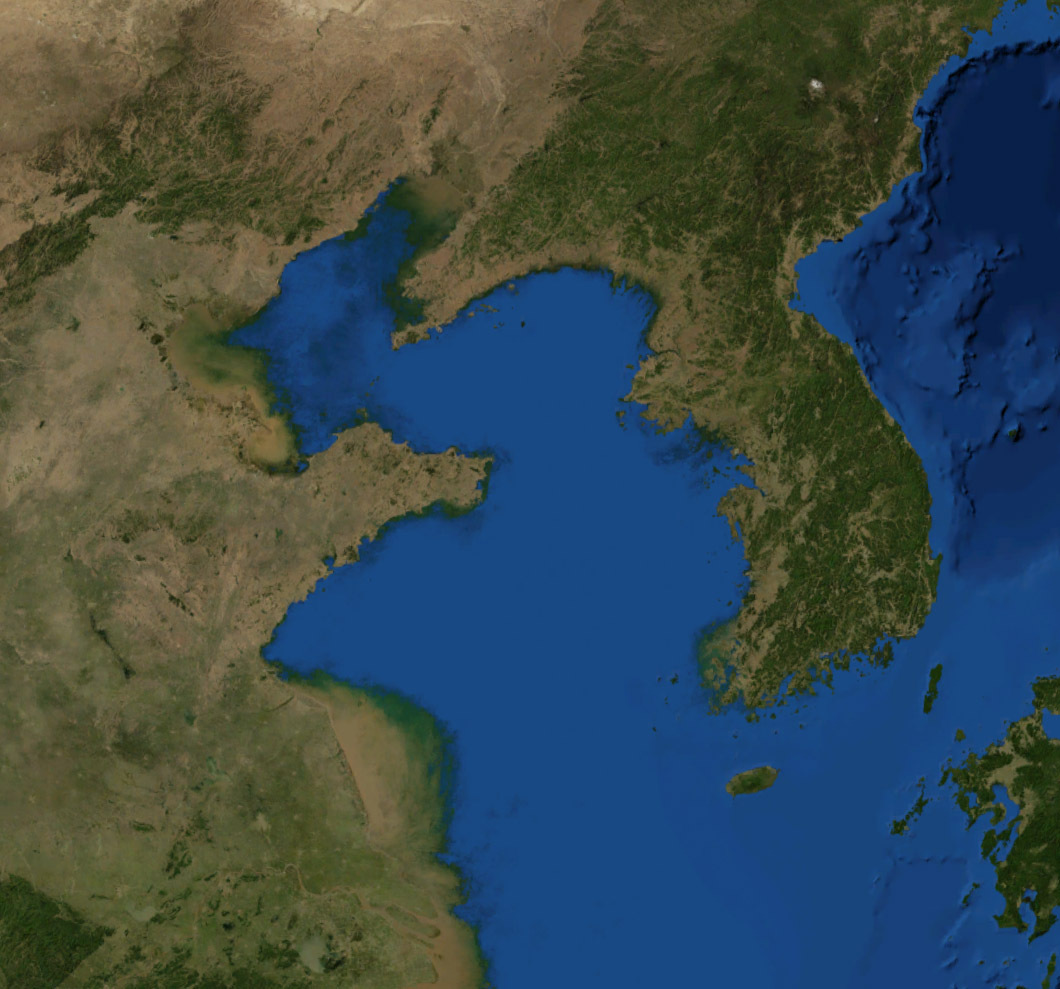
The Yellow Sea, also known as the North Sea, is a marginal sea of the Western Pacific Ocean located between mainland China and the Korean Peninsula, and can be considered the northwestern part of the East China Sea.Additional Site Details
Area: 289,710.9 hectares
Number of Components: 12
Coordinates: 31.5129166667 , 121.9993888889
IUCN World Heritage Outlook
The 2025 Conservation Outlook on Migratory Bird Sanctuaries along the Coast of Yellow Sea-Bohai Gulf of China reports the following assessment:
Source: International Union for Conservation of Nature (IUCN) · View assessment
World Heritage Research
Discover scientific research and academic studies that deepen our understanding of Migratory Bird Sanctuaries along the Coast of Yellow Sea-Bohai Gulf of China from its history and significance to its conservation, management, and contemporary challenges.
-
Trait-based indicators of migratory waterbird communities suggest decoupled ecosystem service potential across Yellow Sea–Bohai Gulf wetlands
A novel trait-based framework reveals that body size, bill morphology, and foraging behavior of migratory waterbirds are stronger predictors of regulating and supporting ecosystem services than site area or species richness. This study analyzed 14 Yellow Sea-Bohai Gulf wetlands, finding that plumage coloration best predicts cultural services while functional diversity metrics often fail to capture service-specific signals. The approach complements traditional prioritization methods by flagging sites with potential for distinct ecosystem functions, offering a transparent tool for conservation assessment where standardized trait data are available.
Pan, L., Liu, X., Jia, Y., & Dou, Y. (2026). Trait-based indicators of migratory waterbird communities suggest decoupled ecosystem service potential across Yellow Sea–Bohai Gulf wetlands. Ecological Indicators, 190, 115347. https://doi.org/10.1016/j.ecolind.2026.115347
View Publication Record | Read Publication -
Identification of Spartina alterniflora habitat expansion in a Suaeda salsa dominated coastal wetlands
A significant expansion of the invasive Spartina alterniflora habitat, from 3,920 to 4,350 hectares, was identified between 2017 and 2020 in the core area of the Migratory Bird Sanctuaries along the Coast of Yellow Sea-Bohai Gulf of China. This expansion coincided with a marked reduction and fragmentation of the native Suaeda salsa habitat, which shrank to just 1,414 hectares by 2020. The study utilized GF-2 remote sensing images and the U-Net model, demonstrating high classification accuracy, to analyze habitat shifts, interspecific competition, and the resulting ecological impacts. The findings highlight intensified competition between S. alterniflora and Phragmites australis, both encroaching on S. salsa habitats, which threatens biodiversity by reducing food and shelter for red-crowned cranes. This research offers critical insights into the competitive dynamics among native and invasive species in coastal wetlands under global warming and human influences.
Huang, Y., Liu, Z., Zheng, G., & Zhao, C. (2022). Identification of Spartina alterniflora habitat expansion in a Suaeda salsa dominated coastal wetlands. Ecological Indicators, 145, 109704. https://doi.org/10.1016/j.ecolind.2022.109704
View Publication Record | Read Publication -
Environmental Characteristics and Macrobenthic Community Structure of Yubu Island, a UNESCO-Designated Migratory Bird Sanctuary in the South Korea
A UNESCO-designated migratory bird sanctuary on Yubu Island, South Korea, exhibits unique sediment characteristics and macrobenthic community structures that differ significantly from other tidal flats in the Yellow Sea. Research reveals a sedimentation rate of 0.99 to 1.66 cm per year, higher than previously recorded, with sediments primarily of marine origin containing 50% mud, 0.35% total carbon, and 0.05% total nitrogen. The study identified 13 macrobenthic species, dominated by Heteromastus filiformis (23.1%), Perinereis linea (19.2%), and Tubuca arcuata (17.3%), with mean densities of 92 individuals per square meter and biomass of 58.6 grams wet weight per square meter. These findings provide critical data for developing conservation policies to protect migratory birds in this ecologically significant region.
Kim, H. S., & Kim, H. (2021). Environmental Characteristics and Macrobenthic Community Structure of Yubu Island, a UNESCO-Designated Migratory Bird Sanctuary in the South Korea. Journal of Marine Science and Engineering, 9(5), 455. https://doi.org/10.3390/jmse9050455
View Publication Record | Read Publication -
Coastal wetlands in Lianyungang, Jiangsu Province, China: probably the most important site globally for the Asian Dowitcher (Limnodromus semipalmatus)
A groundbreaking study reveals that the coastal wetlands of Lianyungang, Jiangsu Province, China, host over 97.5% of the global Asian Dowitcher population during boreal spring migration, making it the most critical stopover site for this species. Field surveys in 2019 and 2020 documented unprecedented concentrations, with over 22,432 individuals recorded in a single area, underscoring its vital role in both northward and southward migrations. The research, combining field observations with expert consultations, highlights the wetlands' ecological significance while raising concerns about population declines due to human disturbances and stochastic events. These findings strongly advocate for the inclusion of Lianyungang's coastal wetlands in China's Phase II nomination for UNESCO World Heritage listing, emphasizing the urgent need for conservation measures to protect this globally critical site.
Yang, Z., Li, J., Han, Y., Hassell, C. J., Leung, K.-S. K., Melville, D. S., Yu, Y.-t., Zhang, L., & Choi, C.-Y. (2021). Coastal wetlands in Lianyungang, Jiangsu Province, China: probably the most important site globally for the Asian Dowitcher (Limnodromus semipalmatus). Avian Research, 12(1). https://doi.org/10.1186/s40657-021-00272-7
View Publication Record | Read Publication