World Heritage Identification Number: 1002
World Heritage since: 2000
Category: Cultural Heritage
WHE Type: Archaeological Sites
Transboundary Heritage: No
Endangered Heritage: No
Country: 🇨🇳 China
Continent: Asia
UNESCO World Region: Asia and the Pacific
Map
Preserving the Past: A Journey Through Ancient Villages in Southern Anhui - Xidi and Hongcun
The ancient villages of Xidi and Hongcun, nestled in the heart of southern Anhui province, offer a captivating glimpse into China's rich cultural heritage. Inscribed as a UNESCO World Heritage Site in 2000, these two traditional settlements have managed to maintain a remarkable degree of authenticity, preserving the essence of rural Chinese life from centuries past.
More to come…UNESCO Description of the World Heritage Site
The two traditional villages of Xidi and Hongcun preserve to a remarkable extent the appearance of non-urban settlements of a type that largely disappeared or was transformed during the last century. Their street plan, their architecture and decoration, and the integration of houses with comprehensive water systems are unique surviving examples.
UNESCO Justification of the World Heritage Site
Criteria (iii) : The villages of Xidi and Hongcun are graphic illustrations of a type of human settlement created during a feudal period and based on a prosperous trading economy.
Criteria (iv) : In their buildings and their street patterns, the two villages of southern Anhui reflect the socio-economic structure of a long-lived settled period of Chinese history.
Criteria (v) : The traditional non-urban settlements of China, which have to a very large extent disappeared during the past century, are exceptionally well preserved in the villages of Xidi and Hongcun.
Encyclopedia Record: Hongcun
Hongcun is a village in Hongcun Town, Yi County, Huangshan City in the historical Huizhou region of southern Anhui Province, China, near the southwest slope of Mount Huangshan.Additional Site Details
Area: 52 hectares
Number of Components: 2
(iv) — Outstanding example of a type of building or landscape
(v) — Outstanding example of traditional human settlement
Coordinates: 29.90444444 , 117.9875
Image
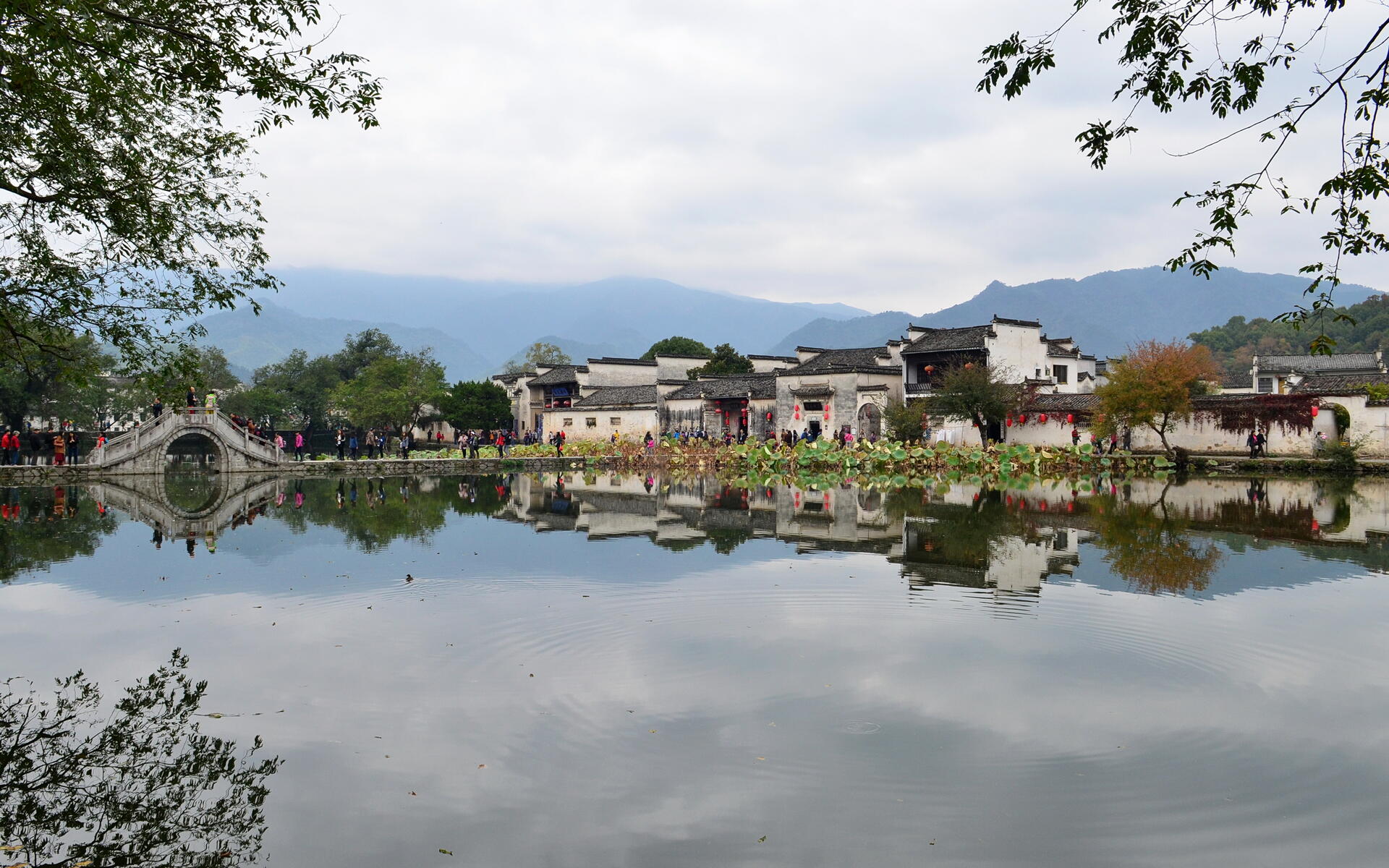
© 颐园新居, CC BY-SA 4.0 Resized from original. (This derivative is under the same CC BY-SA license.)
World Heritage Research
Discover scientific research and academic studies that deepen our understanding of Ancient Villages in Southern Anhui – Xidi and Hongcun from its history and significance to its conservation, management, and contemporary challenges.
-
Folk Culture Tourism Development Strategies Based on RMP Analysis in Traditional Villages: Evidence from Xidi Village, China
A systematic analysis of folk culture tourism development in Xidi Village, China, reveals significant gaps between cultural resources, market demands, and available products, despite overall consistency among these dimensions. Key strategies to bridge these gaps include creating material product systems that emphasize local characteristics, innovating nonmaterial folk cultural experiences, designing attractive tourism routes, and addressing differentiated tourist needs. The study leverages the Resource–Market–Product (RMP) framework, integrating data from a local chronicle, pilot surveys, and online content analysis, to provide actionable insights for sustainable rural tourism and cultural revitalization.
Zhang, L., Nor, N. A. M., & Ramely, A. (2026). Folk Culture Tourism Development Strategies Based on RMP Analysis in Traditional Villages: Evidence from Xidi Village, China. Tourism and Hospitality, 7(2), 29. https://doi.org/10.3390/tourhosp7020029
View Publication Record | Read Publication -
The Impact of Perceived Value, Social Norms, Destination Context and Psychological Ownership on Low-Carbon Tourism Behaviour in Chinese Rural Tourism
A comprehensive model identifying key factors influencing low-carbon tourism behavior among visitors to UNESCO World Heritage Sites, specifically the ancient villages of Xidi and Hongcun in Anhui Province, was developed. The study found that destination context, perceived value of low-carbon tourism, social norms, and psychological ownership significantly positively impact such behaviors, with destination context emerging as the most influential factor. Psychological ownership acted as a mediating variable, contributing to a model explaining 60.4% of the variance in behavior. This research provides actionable insights for governments, communities, and tourism enterprises to foster sustainable low-carbon rural tourism by integrating environmental design, value perception, social norms, and psychological ownership strategies.
Zhu, L., & Sutunyarak, C. (2026). The Impact of Perceived Value, Social Norms, Destination Context and Psychological Ownership on Low-Carbon Tourism Behaviour in Chinese Rural Tourism. Research in Ecology, 217–233. https://doi.org/10.30564/re.v8i3.13086
View Publication Record | Read Publication -
Social Entrepreneurship and Community Development in Rural Tourism: Lessons from Community-driven Models in Xidi Ancient Village, Anhui Province, China
Community-driven social entrepreneurship models can effectively foster sustainable rural tourism development, as demonstrated by Xidi Ancient Village, a UNESCO World Heritage Site in Anhui Province, China. This study highlights how participatory decision-making, equitable benefit-sharing, and capacity building enhance the sustainability of rural tourism while preserving cultural heritage and promoting economic empowerment. Despite challenges such as limited resources and regulatory constraints, innovative strategies like digital marketing, niche tourism development, and public-private partnerships have bolstered the resilience and scalability of social enterprises in Xidi. The findings underscore the potential for such models to inspire inclusive and sustainable rural tourism initiatives globally.
Lujie, Z., & Omar, S. I. (2026). Social Entrepreneurship and Community Development in Rural Tourism: Lessons from Community-driven Models in Xidi Ancient Village, Anhui Province, China. Entrepreneurship for Rural Tourism Growth: New Perspectives and Future Directions (Part 1), 93–111. https://doi.org/10.2174/9798898814359126010009
View Publication Record | Read Publication -
Human-Centered Cultural Heritage Conservation Beyond the Material Paradigm: A Marxian Framework and Evidence from Xidi Village, China
A paradigm shift from material-centered to human-centered cultural heritage conservation is proposed, integrating Marxian theory with collective memory and community agency. The study diagnoses alienating effects of traditional conservation—ossification of practice, reification of social relations, and narrowed human needs—and offers a dynamic framework emphasizing adaptive reuse, knowledge sharing, and ecological wholeness. Using Xidi Village, China, as a case study, the research demonstrates how festivals, rituals, and community governance can reconnect heritage with daily life, collective identity, and social relations without reducing it to static fabric or abstract theory.
Cheng, K., & Du, K. (2026). Human-Centered Cultural Heritage Conservation Beyond the Material Paradigm: A Marxian Framework and Evidence from Xidi Village, China. Conservation, 6(3), 83. https://doi.org/10.3390/conservation6030083
View Publication Record | Read Publication -
The Chain Effect of B&B Cluster Driving Tourism Income Increment in Heritage Sites: Economic Multiplier Simulation of LoRa Sensor Network and System Dynamics
Researchers have identified a critical inflection point for home stay cluster density that maximizes tourism revenue while minimizing the decay of heritage integrity, addressing a core challenge in balancing economic development and ecological protection at UNESCO World Heritage Sites. This discovery was achieved through a three-in-one technical framework combining LoRa sensor networks, system dynamics modeling, and nonlinear threshold analysis. The study demonstrated that dynamic regulation mechanisms, enabled by high-precision monitoring of tourist behavior (with 1.37–2.68 m accuracy) and consumption trajectories, can significantly boost tourism revenue—doubling local industrial chain added value—and increase return visit rates by over 50%. Empirical validation in the ancient villages of Xidi and Hongcun supports the broader applicability of this approach to karst heritage sites with similar cluster characteristics.
Jin, S. (2026). The Chain Effect of B&B Cluster Driving Tourism Income Increment in Heritage Sites: Economic Multiplier Simulation of LoRa Sensor Network and System Dynamics. Discrete Dynamics in Nature and Society, 2026(1). Portico. https://doi.org/10.1155/ddns/2037837
View Publication Record | Read Publication -
Quantitative Analysis of Color Characteristics of the Buildings in the Streets and Alleys of Huizhou Based on Visual Perception: A Case Study of Hongcun
A quantitative analysis of the color characteristics of buildings in Hongcun, a UNESCO World Heritage Site in southern Anhui, reveals that Huizhou architecture predominantly features warm tones and low chroma, with brightness distribution enhancing color hierarchy. The study found that hue ranges from 0° to 60°, chroma from 0 to 33, and brightness is most prominent in medium to high ranges. Color harmony values remain stable between 0.6 and 0.9, indicating a high level of visual consistency. This research introduces objective metrics for analyzing color composition and distribution, offering scientific evidence for the preservation of traditional architecture and modern design strategies.
WANG, D., DING, N., LI, Y., & MIAO, J. (2025). Quantitative Analysis of Color Characteristics of the Buildings in the Streets and Alleys of Huizhou Based on Visual Perception: A Case Study of Hongcun. Industrial Construction, 55(2), 82–91. https://doi.org/10.3724/j.gyjzg24101702
View Publication Record | Read Publication -
A Multi-factor analysis for evaluating habitat suitability of traditional settlements in Huizhou
A comprehensive evaluation of habitat suitability for traditional villages in the Huizhou region of southern Anhui, China, reveals distinct spatial patterns influenced by multiple environmental and geographical factors. The study, using the GeoDetector method, found that precipitation, vegetation, geomorphology, ancient pathways, and land use significantly impact village distribution, with interactions between these factors having a stronger effect than any single factor alone. The analysis identified a high-suitability zone in the northern region, characterized by basin topography, gentle terrain, and favorable climate, while the southern area shows low suitability due to mountainous terrain, frequent rainfall, geological hazards, and limited transportation. Notably, 83% of traditional villages are located in moderate-to-high suitability zones, validating the model's reliability. This research provides a scientific foundation for the conservation of traditional settlements and offers insights into human habitats in mountainous regions globally.
Bi, Z., Li, Y., Wang, J., Guo, Y., & Liu, H. (2025). A Multi-factor analysis for evaluating habitat suitability of traditional settlements in Huizhou. Scientific Reports, 15(1). https://doi.org/10.1038/s41598-025-13268-w
View Publication Record | Read Publication