World Heritage Identification Number: 1348
World Heritage since: 2011
Category: Cultural Heritage
WHE Type: Archaeological Sites
Transboundary Heritage: No
Endangered Heritage: Yes
Country: 🇸🇾 Syrian Arab Republic
Continent: Asia
UNESCO World Region: Arab States
Map
The Ancient Villages of Northern Syria: A Testament to Rural Life in Late Antiquity and the Byzantine Period
The Ancient Villages of Northern Syria, inscribed as a UNESCO World Heritage Site in 2011, offer a unique glimpse into the lives of people living in rural areas during the Late Antique and Byzantine periods. This collection of around 40 villages, located in north-western Syria, provides a well-preserved landscape and architectural remains that serve as a testament to the ingenuity, culture, and religious evolution of these ancient societies.
More to come…UNESCO Description of the World Heritage Site
Some 40 villages grouped in eight parks situated in north-western Syria provide remarkable testimony to rural life in late Antiquity and during the Byzantine period. Abandoned in the 8th to 10th centuries, the villages, which date from the 1st to 7th centuries, feature a remarkably well preserved landscape and the architectural remains of dwellings, pagan temples, churches, cisterns, bathhouses etc. The relict cultural landscape of the villages also constitutes an important illustration of the transition from the ancient pagan world of the Roman Empire to Byzantine Christianity. Vestiges illustrating hydraulic techniques, protective walls and Roman agricultural plot plans furthermore offer testimony to the inhabitants' mastery of agricultural production.
UNESCO Justification of the World Heritage Site
Criterion (iii): The Ancient Villages of Northern Syria and their relict landscapes provide exceptional testimony to the lifestyles and cultural traditions of the rural civilisations that developed in the Middle East, in the context of a Mediterranean climate in mid-altitude limestone mountains from the 1st to the 7th centuries.
Criterion (iv): The Ancient Villages of Northern Syria and their relict landscapes provide exceptional testimony to the architecture of the rural house and civilian and religious community buildings at the end of the Classical era and in the Byzantine Period. Their association in villages and places of worship forms relict landscapes characteristic of the transition between the ancient pagan world and Byzantine Christianity.
Criterion (v): The Ancient Villages of Northern Syria and their relict landscapes provide an eminent example of a sustainable rural settlement from the 1st to the 7th centuries, based on the careful use of the soil, water and limestone, and the mastery of production of valuable agricultural crops. The economic functionality of the habitat, hydraulic engineering, low protective walls and the Roman agricultural plot plan inscribed on the relict landscapes are testimony to this.
Encyclopedia Record: Dead Cities
The Dead Cities or Forgotten Cities are a group of 700 abandoned settlements in northwest Syria between Aleppo and Idlib. Around 40 villages grouped in eight archaeological parks situated in north-western Syria provide an insight into rural life in Late Antiquity and during the Byzantine period. Most of the villages, which date from the 1st to 7th centuries, were abandoned between the 8th and 10th centuries. The settlements feature the well-preserved architectural remains of buildings such as dwellings, pagan temples, churches, cisterns and bathhouses. Important dead cities include the Church of Saint Simeon Stylites, Dahis, Serjilla, Ruweiha and al Bara.Additional Site Details
Area: 12,290 hectares
Number of Components: 8
(iv) — Outstanding example of a type of building or landscape
(v) — Outstanding example of traditional human settlement
Coordinates: 36.3341666667 , 36.8441666667
Image
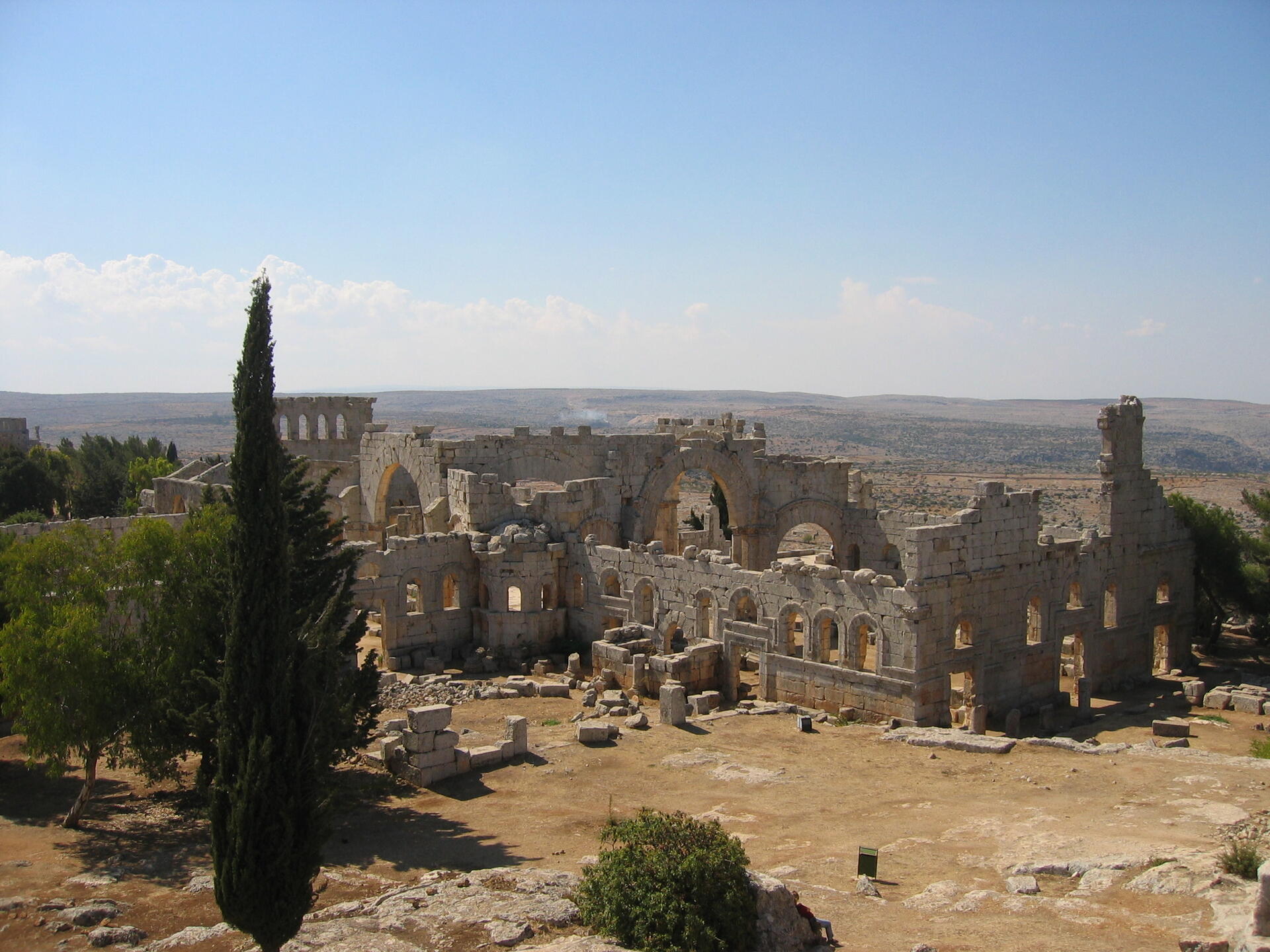
© Unknown, CC BY-SA 2.5 Resized from original. (This derivative is under the same CC BY-SA license.)
World Heritage Research
Discover scientific research and academic studies that deepen our understanding of Ancient Villages of Northern Syria from its history and significance to its conservation, management, and contemporary challenges.
-
Documentation of some Cultural Heritage Emergencies in Syria In August 2010 by Spherical Photrammetry
A pioneering application of spherical photogrammetry demonstrates that even non-professional, hand-held photographic documentation can yield valuable metric data for cultural heritage preservation, despite deviations from standard survey protocols. This approach successfully generated usable restitutions and plottings from images taken during a 2010 tourist trip in Syria, proving its utility for emergency documentation when formal survey methods are unattainable due to threats such as war. The study highlights the potential of rapid, accessible techniques in safeguarding endangered World Heritage Sites, including those inscribed on UNESCO's List of World Heritage in Danger—six Syrian properties threatened by conflict. While the method's precision is compromised compared to tripod-based surveys, it offers a critical alternative for reconstructive efforts and documentation gaps.
Fangi, G. (2015). Documentation of some Cultural Heritage Emergencies in Syria In August 2010 by Spherical Photrammetry. ISPRS Annals of the Photogrammetry, Remote Sensing and Spatial Information Sciences, II-5/W3, 401–408. https://doi.org/10.5194/isprsannals-ii-5-w3-401-2015
View Publication Record | Read Publication -
Historical and cultural landscape of the Ancient Villages of Northern Syria
The Ancient Villages of Northern Syria exemplify a unique cultural landscape where architecture and nature merge seamlessly, challenging traditional distinctions between the two. This study highlights that such landscapes, shaped by human activity over time, form a harmonious unity with their natural surroundings, reflecting deep cultural significance. The research draws on philosophical perspectives, notably Le Corbusier's emphasis on landscape integration in architectural design, to argue for the preservation of these relict areas as vital components of national heritage. By analyzing the interplay between space, culture, and nature, the study underscores the importance of recognizing historical and cultural landscapes as distinct categories of heritage deserving urgent conservation efforts.
Wail, H. (2015). Historical and cultural landscape of the Ancient Villages of Northern Syria. European Science Review, 3–6. https://doi.org/10.20534/esr-15-5.6-3-6
View Publication Record | Read Publication