World Heritage Identification Number: 21
World Heritage since: 1986
Category: Cultural Heritage
WHE Type: Historic Cities & Urban Areas
Transboundary Heritage: No
Endangered Heritage: Yes
Country: 🇸🇾 Syrian Arab Republic
Continent: Asia
UNESCO World Region: Arab States
Map
The Ancient City of Aleppo: A Historical Crossroads of Civilizations
The Ancient City of Aleppo, located in modern-day Syria, stands as a testament to the rich cultural heritage and historical significance of this region. Inscribed as a UNESCO World Heritage Site in 1986, the ancient city center of Aleppo offers a glimpse into the past, providing insights into the various civilizations that have shaped its development over thousands of years.
More to come…UNESCO Description of the World Heritage Site
Located at the crossroads of several trade routes from the 2nd millennium B.C., Aleppo was ruled successively by the Hittites, Assyrians, Arabs, Mongols, Mamelukes and Ottomans. The 13th-century citadel, 12th-century Great Mosque and various 17th-century madrasas, palaces, caravanserais and hammams all form part of the city's cohesive, unique urban fabric, now threatened by overpopulation.
UNESCO Justification of the World Heritage Site
Criterion (iii): The old city of Aleppo reflects the rich and diverse cultures of its successive occupants. Many periods of history have left their influence in the architectural fabric of the city. Remains of Hittite, Hellenistic, Roman, Byzantine and Ayyubid structures and elements are incorporated in the massive surviving Citadel. The diverse mixture of buildings including the Great Mosque founded under the Umayyads and rebuilt in the 12th century; the 12th century Madrasa Halawiye, which incorporates remains of Aleppo's Christian cathedral, together with other mosques and madrasas, suqs and khans represents an exceptional reflection of the social, cultural and economic aspects of what was once one of the richest cities of all humanity.
Criterion (iv): Aleppo is an outstanding example of an Ayyubid 12th century city with its military fortifications constructed as its focal point following the success of Salah El-Din against the Crusaders. The encircling ditch and defensive wall above a massive, sloping, stone-faced glacis, and the great gateway with its machicolations comprise a major ensemble of military architecture at the height of Arab dominance. Works of the 13th-14th centuries including the great towers and the stone entry bridge reinforce the architectural quality of this ensemble. Surrounding the citadel within the city are numerous mosques from the same period including the Madrasah al Firdows, constructed by Daifa Khatoun in 1235.
Encyclopedia Record: Ancient Aleppo
The Ancient City of Aleppo is the historic city centre of Aleppo, Syria. Prior to the Syrian Civil War, many districts of the ancient city remained essentially unchanged since they were initially constructed between the 11th and 16th centuries. Being subjected to constant invasions and political instability, the inhabitants of the city were forced to build economically independent cell-like quarters and districts, most of which were delineated along ethnic and religious lines. These urban subdistricts, along with the ancient walled city that they surround, comprise an approximate area of 350 hectares and are home to more than 120,000 residents.Additional Site Details
Area: 364 hectares
Number of Components: 1
(iv) — Outstanding example of a type of building or landscape
Coordinates: 36.1991666667 , 37.1627777778
Image
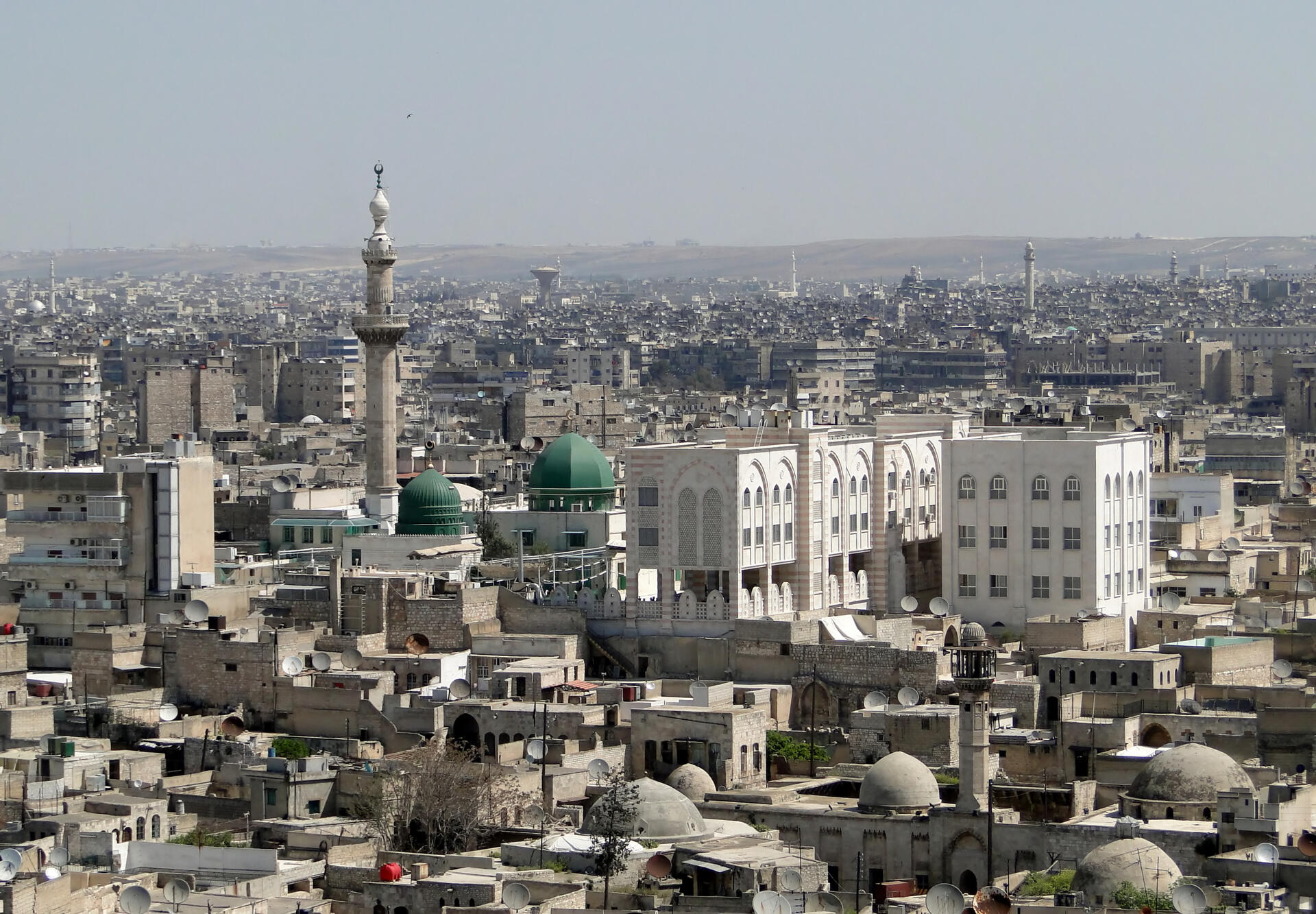
© Bernard Gagnon, CC BY-SA 3.0 Resized from original. (This derivative is under the same CC BY-SA license.)
World Heritage Research
Discover scientific research and academic studies that deepen our understanding of Ancient City of Aleppo from its history and significance to its conservation, management, and contemporary challenges.
-
Destruction Of Cultural Heritage in Times of Conflict
Conflict in Syria between 2011 and 2021 led to widespread destruction of cultural heritage, with distinct patterns observed across three phases: pre-IS (March 2011–May 2014), under IS control (June 2014–March 2017), and post-IS (April 2017–April 2021). The study highlights the targeting of iconic sites like the Ancient City of Aleppo, Palmyra, and archaeological sites in the Syrian Golan Heights, revealing deliberate and systematic damage during armed conflict. Methodologically, the research categorizes destruction by phase, emphasizing media-reported cases to illustrate broader trends in heritage loss.
Munawar, N. A. (2023). Destruction Of Cultural Heritage in Times of Conflict. The Routledge Handbook of Heritage Destruction, 301–312. https://doi.org/10.4324/9781003131069-27
View Publication Record | Read Publication -
Mapping Spatial Social Aspects of Urban Recovery in contested cities: A Case of The Historic Commercial Center of The Ancient City of Aleppo
A framework for post-conflict urban rehabilitation that prioritizes local aspirations and community engagement has been proposed to address the social dimensions of rebuilding heritage sites. The study, focusing on Aleppo's historic commercial center, reveals that current rehabilitation efforts often overlook social damage and fail to incorporate locals' needs. Through onsite field observations, interviews with shop owners and residents (including those in diaspora), and an online questionnaire survey conducted between 2020 and 2021, the research highlights the necessity of inclusive decision-making processes. This approach aims to balance physical reconstruction with social recovery, ensuring that rehabilitation efforts reflect the vision and identity of affected communities.
Ibrahim, S. (2022). Mapping Spatial Social Aspects of Urban Recovery in contested cities: A Case of The Historic Commercial Center of The Ancient City of Aleppo. Proceedings HERITAGE 2022 - International Conference on Vernacular Heritage: Culture, People and Sustainability. https://doi.org/10.4995/heritage2022.2022.15764
View Publication Record | Read Publication -
Post-Conflict reconstruction, forced migration & community engagement: the case of Aleppo, Syria
A top-down governmental approach to post-conflict reconstruction of the Ancient City of Aleppo fails to foster reconciliation and social cohesion. Empirical data from surveys with Syrians and Iraqis reveal that sustainable heritage reconstruction requires a bottom-up, participatory model that engages all societal members. This approach could serve as a unifying force for displaced people's reintegration and future stability, contrasting with the current top-down methods.
Munawar, N. A., & Symonds, J. (2022). Post-Conflict reconstruction, forced migration & community engagement: the case of Aleppo, Syria. International Journal of Heritage Studies, 28(9), 1017–1035. https://doi.org/10.1080/13527258.2022.2117234
View Publication Record | Read Publication -
The Souqs of Aleppo, Syria
The souqs of Aleppo, central to the city's economic and cultural identity for millennia, have suffered significant damage due to prolonged armed conflict. This study highlights their historical role in shaping Aleppo’s architecture and socio-economic fabric, tracing their evolution from ancient trade hubs to modern marketplaces like Al-Saqatiyya. It emphasizes the urgent need for a structured rehabilitation policy that integrates local community participation to ensure sustainable recovery and revitalization of these heritage sites.
Asslan, H., AlWaer, H., & Khanji, A. (2022). The Souqs of Aleppo, Syria. Architecture and Urban Transformation of Historical Markets, 81–96. https://doi.org/10.4324/9781003143208-9
View Publication Record | Read Publication -
Decision-Making Methodology Between Revitalisation and Rehabilitation of World Heritage City Centers. Case Study: The Ancient City of Aleppo (Syria)
A validated decision-making methodology (DMT) for post-conflict revitalization of UNESCO World Heritage Sites, demonstrated through the rehabilitation of Aleppo's historic souk, offers a replicable framework to guide conservation efforts. The approach integrates 3D scanning and damage assessment data to inform cost-effective, contextually appropriate interventions that restore functionality while preserving cultural integrity. This DMT bridges scientific evidence with practical implementation, providing actionable tools for stakeholders in conflict-affected heritage conservation.
Ibrahim, S. (2020). DECISION-MAKING METHODOLOGY BETWEEN REVITALISATION AND REHABILITATION OF WORLD HERITAGE CITY CENTERS. CASE STUDY: THE ANCIENT CITY OF ALEPPO (SYRIA). The International Archives of the Photogrammetry, Remote Sensing and Spatial Information Sciences, XLIV-M-1-2020, 255–262. https://doi.org/10.5194/isprs-archives-xliv-m-1-2020-255-2020
View Publication Record | Read Publication -
The Centrality of Aleppo and its Environs
Aleppo's enduring significance as a central place in the ancient Middle East, unlike other major cities of its time, is attributed to its strategic topographic location and multifunctional roles in trade, exchange, craft production, and cult activity. This study employs spatial statistics and extends the theoretical concept of 'central place' to reconstruct Aleppo's historical importance. By analyzing its relationship with surrounding settlements, researchers demonstrate that Aleppo maintained its dominance through a combination of local, regional, and supra-regional functions, ensuring its long-lasting relevance in economic and cultural networks.
Knitter, D., Nakoinz, O., Fabbro, R. D., Kohlmeyer, K., Schütt, B., & Meyer, M. (2014). The Centrality of Aleppo and its Environs. Freie Universität Berlin. https://doi.org/10.17169/REFUBIUM-23241
View Publication Record | Read Publication -
Travels in Syria and the Holy Land
John Lewis Burckhardt's 'Travels in Syria and the Holy Land' offers a unique and detailed account of Arabian life, culture, and architecture during the early 19th century. The publication is notable for its vivid descriptions of the ancient city of Petra, particularly its Nabataean tombs, which provide invaluable insights into the architectural and cultural heritage of the region. Burckhardt's two-year sojourn in Aleppo, where he immersed himself in Arabic studies and Islamic law to prepare for his travels, allowed him to gain firsthand knowledge and perspective. His observations, while constrained by the need to avoid suspicion as a non-Muslim, contribute significantly to our understanding of the historical and cultural landscape of Syria and the Holy Land during this period.
Burckhardt, J. L. (2011). Travels in Syria and the Holy Land. https://doi.org/10.1017/cbo9780511841736
View Publication Record | Read Publication