World Heritage Identification Number: 1229
World Heritage since: 2006
Category: Cultural Heritage
WHE Type: Buildings & Architectural Ensembles
Transboundary Heritage: No
Endangered Heritage: Yes
Country: 🇸🇾 Syrian Arab Republic
Continent: Asia
UNESCO World Region: Arab States
Map
Crac des Chevaliers and Qal'at Salah El-Din: Medieval Fortresses of the Near East
The Crac des Chevaliers and Qal'at Salah El-Din are two remarkable examples of medieval fortifications in the Near East that showcase the interplay of architectural styles during the Crusades era (11th-13th centuries). Both sites have been designated as UNESCO World Heritage Sites since 2006.
More to come…UNESCO Description of the World Heritage Site
These two castles represent the most significant examples illustrating the exchange of influences and documenting the evolution of fortified architecture in the Near East during the time of the Crusades (11th - 13th centuries). The Crac des Chevaliers was built by the Hospitaller Order of Saint John of Jerusalem from 1142 to 1271. With further construction by the Mamluks in the late 13th century, it ranks among the best-preserved examples of the Crusader castles. The Qal’at Salah El-Din (Fortress of Saladin), even though partly in ruins, represents an outstanding example of this type of fortification, both in terms of the quality of construction and the survival of historical stratigraphy. It retains features from its Byzantine beginnings in the 10th century, the Frankish transformations in the late 12th century and fortifications added by the Ayyubid dynasty (late 12th to mid-13th century).
UNESCO Justification of the World Heritage Site
Criterion (ii): The castles represent a significant development in the fortification systems, which substantially differed from the European rather more passive defence systems, and which also contributed to the development of the castles in the Levant. Within the castles that have survived in the Near East, the property represents one of the most significant examples illustrating the exchange of influences and documenting the evolution in this field, which had an impact both in the East and in the West.
Criterion (iv): In the history of architecture, the Crac des Chevaliers is taken as the best preserved example of the castles of the Crusader period, and it is also seen as an archetype of a medieval castle particularly in the context of the military orders. Similarly, the Qal'at Salah El-Din, even though partly in ruins, still represents an outstanding example of this type of fortification, both in terms of its quality of construction and the survival of its historical stratigraphy.
Encyclopedia Record: Krak des Chevaliers
Krak des Chevaliers is a medieval castle in Syria and one of the most important preserved medieval castles in the world. The site was first inhabited in the 11th century by Kurdish troops garrisoned there by the Mirdasids. In 1142 it was given by Raymond II, Count of Tripoli, to the order of the Knights Hospitaller. It remained occupied by them until it was reconquered by the Muslims in 1271.Additional Site Details
Area: 8.87 hectares
Number of Components: 2
(iv) — Outstanding example of a type of building or landscape
Coordinates: 34.7566666667 , 36.2944444444
Image
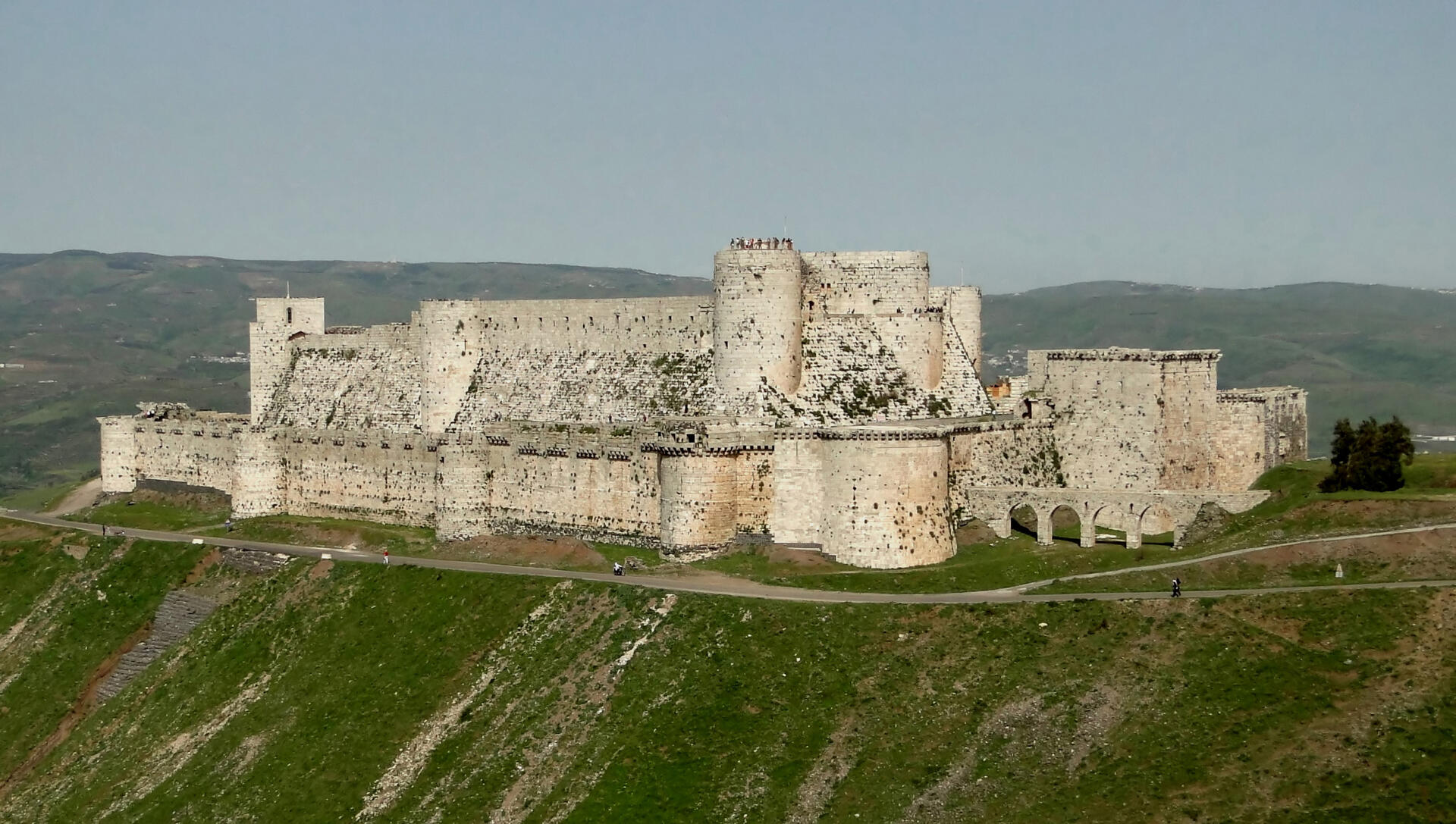
© Bernard Gagnon, CC BY-SA 4.0 Resized from original. (This derivative is under the same CC BY-SA license.)
World Heritage Research
Discover scientific research and academic studies that deepen our understanding of Crac des Chevaliers and Qal’at Salah El-Din from its history and significance to its conservation, management, and contemporary challenges.
-
Examinations of the medieval wall paintings in Crac des Chevaliers (Syria)
A recent examination of the medieval wall paintings in Crac des Chevaliers, a UNESCO World Heritage Site and one of the most significant Crusader fortifications in the Levant, has uncovered previously unknown details. The study, conducted as part of a new restoration program supported by Hungary and involving the Syro-Hungarian Archaeological Mission, utilized advanced techniques such as ED-XRF, OM, and PFIB-SEM to analyze the murals in situ within the castle's main chapel. These investigations revealed intricate details of damaged and incomplete depictions, providing insights into the painting technique and materials used. The research, conducted at the University of Miskolc's laboratories, contributes significantly to our understanding of the artistic and historical significance of Crac des Chevaliers, especially following the devastation caused by recent conflicts.
Török, B., & Márk, Zs. (2025). Examinations of the medieval wall paintings in Crac des Chevaliers (Syria). Architectural Archeology, (6). https://doi.org/10.25681/iaras.2024.978-5-94375-455-5.86-94
View Publication Record | Read Publication -
The Military Orders and the Ransoming of Captives from Islam (Twelfth to Early Fourteenth Centuries)
A study of the Military Orders' interactions with Muslim rulers from the 12th to early 14th centuries reveals that while captives were often executed, there were significant instances where safe-conduct was granted. The research, based on historical accounts, shows that the fate of captured brethren varied depending on circumstances, such as sieges or battlefield conditions. Notable examples include the execution of Templar and Hospitaller prisoners after the battle of Hattin in 1187, yet also instances where safe-conduct was negotiated, such as during the surrender of Crac des Chevaliers in 1271. The study highlights the inconsistent treatment of captives, influenced by factors like military strategy and political dynamics.
Forey, A. (2024). The Military Orders and the Ransoming of Captives from Islam (Twelfth to Early Fourteenth Centuries). Military Orders and Crusades, VI–259. https://doi.org/10.4324/9781003557203-6
View Publication Record | Read Publication -
Cum Omni Raisagio Montanee... À Propos De La Cession Du Crac Aux Hospitaliers
A critical examination of the 12th-century donation of the Crac des Chevaliers to the Hospitallers reveals complex geopolitical and strategic motivations. Raymond II of Tripoli's cession, often assumed to be purely defensive, appears instead tied to broader diplomatic and economic considerations, including the consolidation of control over key trade routes in the Levant. The study employs a combination of historical documentation analysis, cross-referencing with contemporary chronicles, and spatial reconstruction of the fortress's strategic position. Findings suggest that the donation was not an isolated act but part of a deliberate strategy to strengthen Hospitaller influence in the region, reshaping the balance of power during the Crusades.
Richard, J. (2024). Cum Omni Raisagio Montanee... À Propos De La Cession Du Crac Aux Hospitaliers. Francs et Orientaux Dans Le Monde Des Croisades, X–187. https://doi.org/10.4324/9781003554998-10
View Publication Record | Read Publication -
Jean Mesqui et Maxime Goepp, Le Crac des chevaliers. Histoire et architecture. Paris, Académie des Inscriptions et Belles-Lettres, 2018 (Collection Mémoires de l’Académie des Inscriptions et Belles-Lettres, 54). 462 pages, 890 illustrations.
Crac des Chevaliers, a fortress of immense historical and architectural significance, stands as a testament to the Frankish military presence in the Levant. This 462-page monograph by Jean Mesqui and Maxime Goepp delves deeply into its history and architecture, offering a comprehensive analysis that blends archaeological findings with medieval studies. The book highlights the fortress's dual perception—admired by Lawrence of Arabia as 'the most beautiful castle in the world' yet seen as an obstacle by Muslim chroniclers like Ibn al-Athîr. Through meticulous research and 890 illustrations, it provides a nuanced understanding of Crac des Chevaliers' role during the Crusades, its strategic importance, and its enduring legacy.
Hupin, É. (2024). Jean Mesqui et Maxime Goepp, Le Crac des chevaliers. Histoire et architecture. Paris, Académie des Inscriptions et Belles-Lettres, 2018 (Collection Mémoires de l’Académie des Inscriptions et Belles-Lettres, 54). 462 pages, 890 illustrations. Memini, 30. https://doi.org/10.4000/130wr
View Publication Record | Read Publication -
Assessment of the Resistance of Dolomite Stone from Crac des Chevaliers Against Salt Crystallization
Salt crystallization significantly impacts the durability of dolomite stones from Crac des Chevaliers, a 12th-century UNESCO World Heritage Site, with weathering patterns varying by salt type and stone porosity. The study found that while open porosity primarily influences resistance, closed porosity also plays a critical role in decay mechanisms. Sodium sulfate caused granular disintegration, sodium chloride led to pitted surfaces, and magnesium sulfate induced surface exfoliation into thin layers. Notably, NaCl was less aggressive than sulfates. Researchers tested six dolomite lithotypes—two microbioclastic wackstones with low open porosity (11–18 v/v%) and four microcrystalline dolomites (28 v/v% open porosity)—under salt aging in three solutions: sodium chloride, magnesium sulfate, and sodium sulfate.
Bilal, O., & Rozgonyi-Boissinot, N. (2023). Assessment of the Resistance of Dolomite Stone from Crac des Chevaliers Against Salt Crystallization. Periodica Polytechnica Civil Engineering. https://doi.org/10.3311/ppci.21606
View Publication Record | Read Publication -
Bridge of Civilizations: The Near East and Europe c. 1100–1300
A comprehensive analysis of the cultural and architectural exchanges between Europe and the Near East during the 12th and 13th centuries, particularly under Crusader influence, reveals significant advancements in castle engineering, water management, and material culture. The study, featuring contributions from the Syrian-Hungarian Archaeological Mission (SHAM), provides detailed insights into the structural development of key sites like Crac des Chevaliers and Margat, including wall paintings, cooking installations, and medieval burials. It also examines the impact of Crusader occupation on urban landscapes in regions such as Cairo and Latakia, as well as the influence on ecclesiastical architecture, including chapels and churches in Lebanon and Cyprus. The research combines archaeological evidence with historical sources to highlight the complex interplay between European and Near Eastern civilizations during this period.
Edbury, P., Pringle, D., & Major, B. (Eds.). (2020). Bridge of Civilizations: The Near East and Europe c. 1100–1300. https://doi.org/10.2307/j.ctvxrq04h
View Publication Record | Read Publication -
Fortifications and siege
Medieval fortifications, particularly in the context of UNESCO World Heritage Sites such as Crac des Chevaliers and Qal’at Salah El-Din, evolved significantly by the 13th century, with a focus on defensive structures that could withstand prolonged sieges. A key finding is the emergence of massive towers, like Baybars’ Tower, designed to support counterweight-trebuchets, which became pivotal in the struggle for control during conflicts. These fortifications reflected not only advances in military engineering but also the strategic importance of maintaining political will and resources on both defensive and offensive fronts. The study highlights how successful sieges could yield outcomes comparable to battlefield victories but at substantial risk, underscoring the enduring influence of strongholds on warfare patterns.
France, J. (2020). Fortifications and siege. Western Warfare in the Age of the Crusades, 1000–1300, 107–127. https://doi.org/10.4324/9781003071402-9
View Publication Record | Read Publication