World Heritage Identification Number: 294
World Heritage since: 1984
Category: Cultural Heritage
WHE Type: Archaeological Sites
Transboundary Heritage: No
Endangered Heritage: No
Country: 🇱🇧 Lebanon
Continent: Asia
UNESCO World Region: Arab States
Map
Baalbek: A City of Imperial Roman Architecture
Baalbek, officially known as Heliopolis during the Hellenistic period, is a significant archaeological site located in the Beqaa Valley of Lebanon. The city, which serves as the capital of Baalbek-Hermel Governorate, is approximately 67 kilometers northeast of Beirut and has a rich history that spans various civilizations.
More to come…UNESCO Description of the World Heritage Site
This Phoenician city, where a triad of deities was worshipped, was known as Heliopolis during the Hellenistic period. It retained its religious function during Roman times, when the sanctuary of the Heliopolitan Jupiter attracted thousands of pilgrims. Baalbek, with its colossal structures, is one of the finest examples of Imperial Roman architecture at its apogee.
UNESCO Justification of the World Heritage Site
Criterion (i): The archaeological site of Baalbek represents a religious complex of outstanding artistic value and its majestic monumental ensemble, with its exquisitely detailed stonework, is a unique artistic creation which reflects the amalgamation of Phoenician beliefs with the gods of the Greco-Roman pantheon through an amazing stylistic metamorphosis.
Criterion (iv): The monumental complex of Baalbek is an outstanding example of a Roman sanctuary and one of the most impressive testimonies to the Roman period at its apogee that displays to the full the power and wealth of the Roman Empire. It contains some of the largest Roman temples ever built, and they are among the best preserved. They reflect an extraordinary amalgamation of Roman architecture with local traditions of planning and layout.
Encyclopedia Record: Baalbek
Baalbek is a city located east of the Litani River in Lebanon's Beqaa Valley, about 67 km (42 mi) northeast of Beirut. It is the capital of Baalbek-Hermel Governorate. In 1998, the city had a population of 82,608. Most of the population consists of Shia Muslims, followed by Sunni Muslims and Christians; in 2017, there was also a large presence of Syrian refugees.Additional Site Details
Area: Not available
Number of Components: 1
(iv) — Outstanding example of a type of building or landscape
Coordinates: 34.0066666667 , 36.2041666667
Image
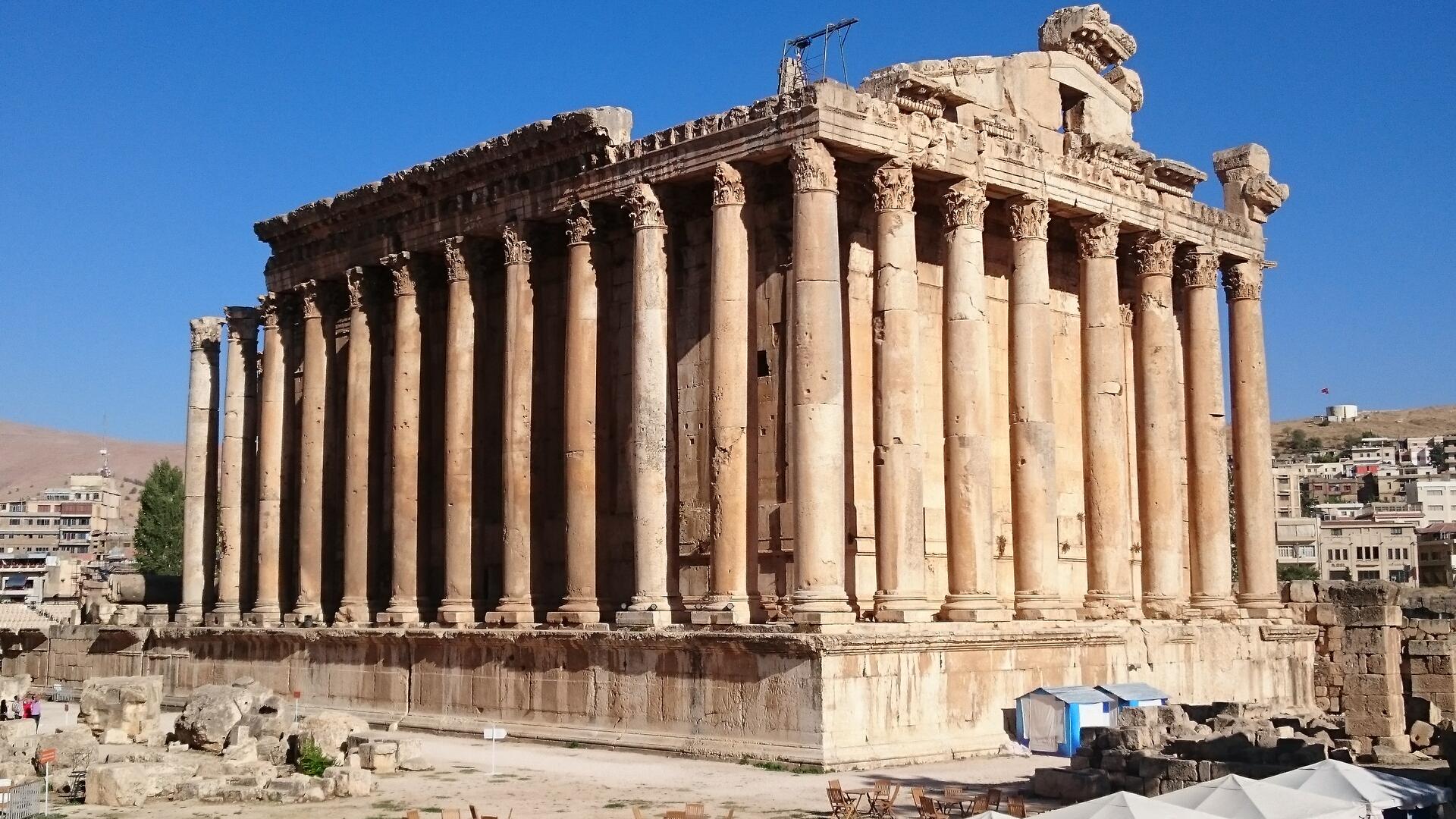
© Saadedine AL SAIDI, CC BY-SA 4.0 Resized from original. (This derivative is under the same CC BY-SA license.)
World Heritage Research
Discover scientific research and academic studies that deepen our understanding of Baalbek from its history and significance to its conservation, management, and contemporary challenges.
-
Ancient Egypt, Baalbek and Peru
A groundbreaking study challenges the conventional understanding of megalithic construction, proposing that massive stone blocks at sites like Baalbek were not transported and fitted with primitive tools but instead cast in situ using a geopolymer process. This 'Geopolymer Hypothesis' suggests the use of crushed stone aggregate and chemical plasticizers, enabling manual transport in small containers. By analyzing evidence from Giza Plateau, Baalbek, and the Andes through industrial engineering principles, the research argues that traditional monolithic theories are technically infeasible, offering a novel perspective on ancient construction techniques.
Yerzhan, O. (2026). Ancient Egypt, Baalbek and Peru. Zenodo. https://doi.org/10.5281/ZENODO.18308335
View Publication Record | Read Publication -
The Baalbek Enigma
Baalbek’s temple complex, particularly its colossal Trilithon monoliths, challenges conventional Roman-era construction timelines. Weaving together archaeological evidence—continuous Neolithic habitation, Bronze Age foundations, and geodetic alignments with Giza and Heliopolis—this study argues that Baalbek’s megalithic structures may predate the Roman Imperial period (1st–3rd centuries CE). The research synthesizes conventional and alternative viewpoints, proposing a reassessment of the site’s historical timeline. By examining medieval legends, ancient names like 'Heliopolis,' and sacred significance across millennia, it offers a new framework for understanding Baalbek’s enduring enigma.
Vigato, M. M. (2026). The Baalbek Enigma (Version 1.0) [Zenodo]. https://doi.org/10.5281/ZENODO.18573528
View Publication Record | Read Publication -
Hellenistic and Roman Baalbek and the Bekaa
Recent archaeological surveys and excavations at Baalbek-Heliopolis challenge long-standing assumptions about the origins of the Temple of Jupiter Heliopolitanus, revealing that its construction began just before 15 BCE, coinciding with the establishment of the Roman colony centered on Berytus. This contradicts previous notions of deep antiquity linked to ancient Semitic deities. The study also provides insights into Roman life in the Bekaa Valley through excavations at Niha and Hosn Niha, offering a consistent picture with other Roman sites across the empire. Historical sources describe Seleucid and Ptolemaic competition for the region before the rise of the Ituraeans, contributing to a nuanced understanding of the area's Hellenistic period.
Paturel, S. E. (2025). Hellenistic and Roman Baalbek and the Bekaa. The Oxford Handbook of the Hellenistic and Roman near East, 765–780. https://doi.org/10.1093/oxfordhb/9780190858155.013.89
View Publication Record | Read Publication -
Ein hellenistisches Kapitell in Baalbek?
A unique Hellenistic capital from the 1st century BCE, discovered at Baalbek, provides evidence of architectural innovation during a previously undocumented period. This capital, with its distinctive design, challenges conventional expectations by demonstrating a non-canonical approach to architectural elements and a free interpretation of formal conventions, even in pre-imperial Baalbek. The study relies on archaeological analysis to shed light on this elusive era, offering insights into the complex interplay between local traditions and Hellenistic influences in the region's early architectural development.
Wienholz, H. (2026). Ein hellenistisches Kapitell in Baalbek? Zeitschrift Für Orient-Archäologie, 3(Zeitschrift für Orient-Archäologie, Bd. 3 (2010): Zeitschrift für Orient-Archäologie). https://doi.org/10.34780/7W2ZPT98
View Publication Record | Read Publication -
Das Orakel von Baalbek und die sogenannte Sibyllentheosophie
A newly discovered Greek manuscript of the Sibylline Oracles, dated to Emperor Theodosius I's reign and later revised at Baalbek (502–506 AD), reveals significant Eastern variations from Western texts. This manuscript suggests possible Monophysite influence and traces of an unknown work, 'Theosophy,' challenging traditional interpretations of these ancient prophecies. The study analyzed textual discrepancies to uncover their historical and theological implications.
Beatrice, P. F. (1970). Das Orakel von Baalbek und die sogenannte Sibyllentheosophie. Römische Quartalschrift, Bd. 92 Nr. 3/4 (1997), Heft 3/4. https://doi.org/10.60962/RQ.V92I3/4.90686
View Publication Record | Read Publication -
Nābulusī Explores the Ruins of Baalbek: Antiquarianism in the Ottoman Empire during the Seventeenth Century
A study reveals that the Damascene scholar ʿAbd al-Ghanī al-Nābulusī, during the 17th century, visited and described the Roman ruins of Baalbek twice, in 1689 and 1700. Contrary to the common perception that Muslims ignored pre-Islamic antiquity, Nābulusī's interpretation of the site as a palace built by jinns for Solomon was likely a deliberate play on its historicity to emphasize Syria's innate sanctity. This finding challenges the notion of a stark contrast between antiquarianism in the Ottoman Empire and Renaissance Europe, suggesting instead that they developed along parallel but variant lines.
Shafir, N. (2022). Nābulusī Explores the Ruins of Baalbek: Antiquarianism in the Ottoman Empire during the Seventeenth Century. Renaissance Quarterly, 75(1), 136–184. https://doi.org/10.1017/rqx.2021.332
View Publication Record | Read Publication -
The process of urban heritage (Case study: Baalbek)
Baalbek, once a thriving cultural and administrative hub with significant heritage value, now faces severe social, economic, and political challenges that threaten its urban continuity. Despite its historical importance as the center of agricultural and tourist activities in Lebanon, including hosting the renowned Baalbek International Festivals (1955), the city has struggled to maintain its identity due to failed state-led development projects. These projects lacked comprehensive regional or national integration, leading to a loss of social cohesion and cultural meaning. The study highlights that Baalbek's decline is a result of systemic failures in urban planning, compounded by economic crises and political instability, which have distorted its heritage morphology and isolated it from broader developmental narratives.
husni el hajj, M. (2022). The process of urban heritage (Case study: Baalbek). Arts and Architecture Journal, 3(1), 99–125. https://doi.org/10.21608/aaj.2022.242303
View Publication Record | Read Publication