World Heritage Identification Number: 23
World Heritage since: 1980
Category: Cultural Heritage
WHE Type: Archaeological Sites
Transboundary Heritage: No
Endangered Heritage: Yes
Country: 🇸🇾 Syrian Arab Republic
Continent: Asia
UNESCO World Region: Arab States
Map
The Site of Palmyra: A Crossroads of Civilizations
The Site of Palmyra, officially recognized as a UNESCO World Heritage Site since 1980, stands as a testament to the rich cultural heritage of the ancient world. Located in the Syrian desert, northeast of Damascus, this once-great city offers a unique blend of architectural styles, artistic techniques, and historical influences.
More to come…UNESCO Description of the World Heritage Site
An oasis in the Syrian desert, north-east of Damascus, Palmyra contains the monumental ruins of a great city that was one of the most important cultural centres of the ancient world. From the 1st to the 2nd century, the art and architecture of Palmyra, standing at the crossroads of several civilizations, married Graeco-Roman techniques with local traditions and Persian influences.
UNESCO Justification of the World Heritage Site
Criterion (i): The splendour of the ruins of Palmyra, rising out of the Syrian desert north-east of Damascus is testament to the unique aesthetic achievement of a wealthy caravan oasis intermittently under the rule of Rome from the Ier to the 3rd century AD. The grand colonnade constitutes a characteristic example of a type of structure which represents a major artistic development.
Criterion (ii): Recognition of the splendour of the ruins of Palmyra by travellers in the 17th and 18th centuries contributed greatly to the subsequent revival of classical architectural styles and urban design in the West.
Criterion (iv): The grand monumental colonnaded street, open in the centre with covered side passages, and subsidiary cross streets of similar design together with the major public buildings, form an outstanding illustration of architecture and urban layout at the peak of Rome's expansion in and engagement with the East. The great temple of Ba'al is considered one of the most important religious buildings of the 1st century AD in the East and of unique design. The carved sculptural treatment of the monumental archway through which the city is approached from the great temple is an outstanding example of Palmyrene art. The large scale funerary monuments outside the city walls in the area known as the Valley of the Tombs display distinctive decoration and construction methods.
Encyclopedia Record: Palmyra
Palmyra is an ancient city in central Syria. It is located in the eastern part of the Levant, and archaeological finds date back to the Neolithic period, and documents first mention the city in the early second millennium BCE. Palmyra changed hands on a number of occasions between different empires before becoming a subject of the Roman Empire in the first century CE.Additional Site Details
Area: 1,640 hectares
Number of Components: 1
(ii) — Significant interchange of human values
(iv) — Outstanding example of a type of building or landscape
Coordinates: 34.5541666667 , 38.2666666667
Image
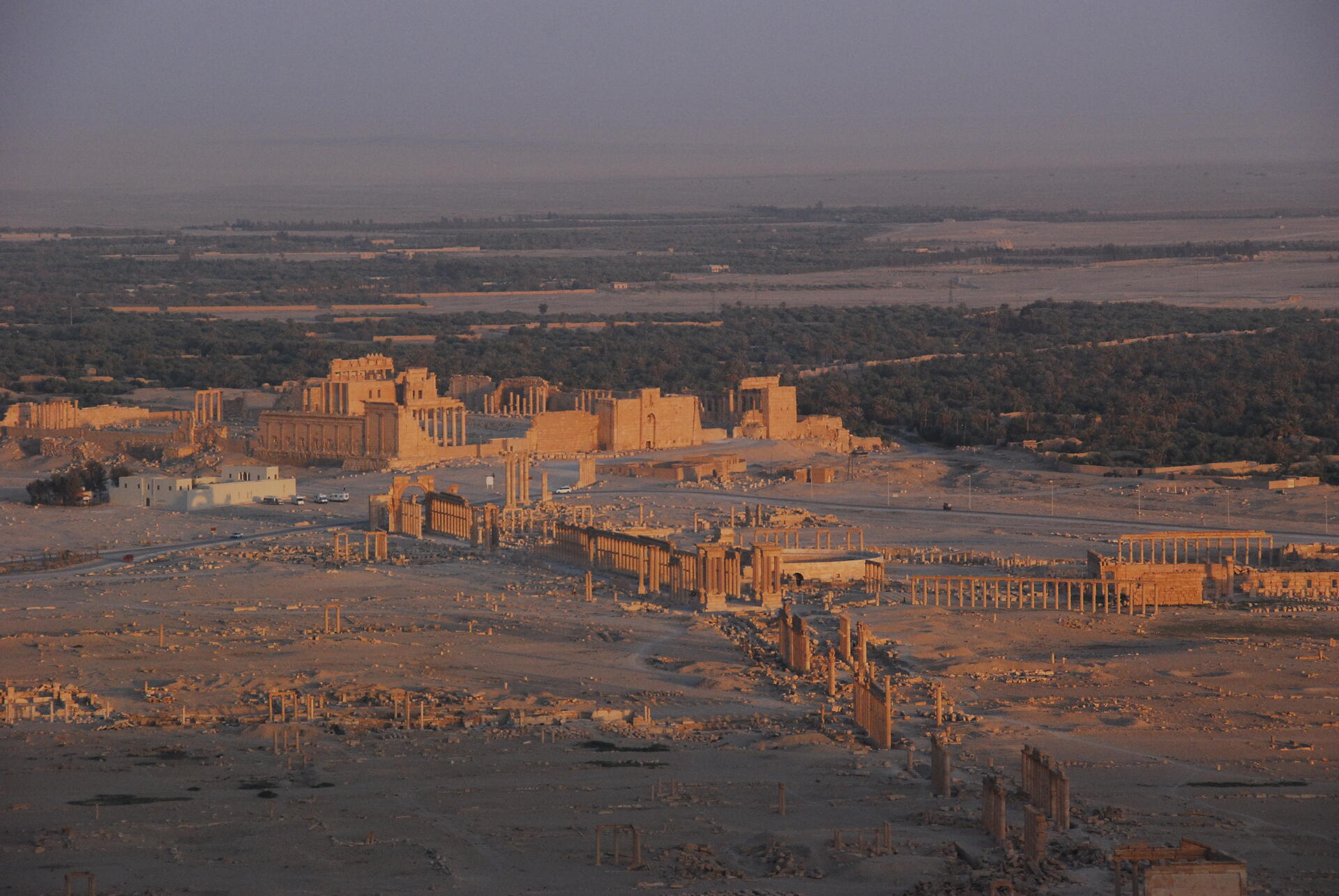
© Quim Bahí from Catalunya, CC BY-SA 2.0 Resized from original. (This derivative is under the same CC BY-SA license.)
World Heritage Research
Discover scientific research and academic studies that deepen our understanding of Site of Palmyra from its history and significance to its conservation, management, and contemporary challenges.
-
Palmyra Revisited from Space – High-Resolution Satellite Prospection of a UNESCO World Heritage Site
High-resolution satellite prospection, leveraging Synthetic Aperture Radar (SAR) from the TerraSAR-X mission, has revolutionized archaeological research at UNESCO World Heritage Site Palmyra. This integrated approach combines ground-based geophysical methods like magnetometry and resistivity with space-borne techniques such as optical satellite imagery and radar to provide both detailed and broad-scale insights into the ancient city's layout and buried structures. While ground-based methods confirmed the existence of a Hellenistic town south of Wadi el Kubur, mapping its intricate layout, space-borne surveys revealed upstanding remains and uncovered new buried archaeological features, significantly advancing our understanding of Palmyra's cultural landscape.
Linck, R., Fassbinder, J. W. E., & Buckreuss, S. (2025). Palmyra Revisited from Space – High-Resolution Satellite Prospection of a UNESCO World Heritage Site. Across Space and Time, 54–63. https://doi.org/10.5117/9789089647153-6
View Publication Record | Read Publication -
Palmyra, the Mediterranean and Beyond
Palmyra emerges as a pivotal crossroads between the Mediterranean and Eastern trade routes, showcasing its strategic significance during antiquity. This study reveals Palmyra's dynamic interplay with the Roman Empire, highlighting how it leveraged its unique position to assert influence despite being on the empire's fringes. The research examines Palmyrene society's multifaceted roles—ranging from traders and contractors to political and military leaders—and their ability to navigate and capitalize on the complexities of a rapidly evolving world. By integrating archaeological and historical evidence, the study underscores Palmyra's dual identity: deeply rooted in its local context while simultaneously engaging with broader global networks.
Raja, R. (Ed.). (2025). Palmyra, the Mediterranean and Beyond. https://doi.org/10.1017/9781009532044
View Publication Record | Read Publication -
The Oxford Handbook of Palmyra
The Oxford Handbook of Palmyra offers a comprehensive, expert-led exploration of one of the ancient world's most significant oasis cities, from its pre-Roman origins to modern times. This 37-chapter volume synthesizes firsthand knowledge from archaeologists, historians, and philologists, covering Palmyra's development, archaeology, and historical networks across antiquity. Structured thematically with introductory and postludium chapters, it provides an accessible yet rigorous overview, updated bibliographies, and insights into the site's devastating recent destruction during Syria's conflict. A vital resource for researchers, it bridges deep historical analysis with contemporary relevance.
Raja, R. (Ed.). (2024). The Oxford Handbook of Palmyra. https://doi.org/10.1093/oxfordhb/9780190858117.001.0001
View Publication Record | Read Publication -
Russia in Palmyra: Contextualizing the Kremlin’s Postconflict Heritage Rehabilitation Efforts
Russian-led reconstruction efforts at the UNESCO World Heritage Site of Palmyra, Syria, serve as a tool for cultural diplomacy and political legitimization. While these efforts are often perceived primarily as propaganda aimed at foreign audiences, they also reflect Russia's domestic political goals, particularly under President Putin. The Kremlin uses heritage rehabilitation to promote its narrative of reasserting global power in a multipolar world order. This study, combining ethnographic and historical research on world heritage politics, highlights the dual nature of these efforts—both international propaganda and a means to bolster Russia’s geopolitical standing.
Plets, G. F. J., & Munawar, N. A. (2024). Russia in Palmyra: Contextualizing the Kremlin’s Postconflict Heritage Rehabilitation Efforts. Journal of Eastern Mediterranean Archaeology and Heritage Studies, 12(1), 63–78. https://doi.org/10.5325/jeasmedarcherstu.12.1.0063
View Publication Record | Read Publication -
The Future of the Temple of Bel in Palmyra after Its Destruction
The Temple of Bel in Palmyra, a significant historical and architectural landmark, faced severe damage from ISIS in 2015. Despite its partial destruction, the cella remains a priority for conservation efforts, not only to preserve Palmyra's World Heritage status but also to safeguard Syria's broader cultural legacy. The study revisits the temple's history, including conservation measures during the French Mandate (1920–1946), such as community relocation and repairs, and examines post-destruction assessments by specialists. This underscores the urgent need for targeted preservation strategies to protect Palmyra’s irreplaceable heritage.
Abdulkarim, M., & Seigne, J. (2024). The Future of the Temple of Bel in Palmyra after Its Destruction. Bulletin of the American Society of Overseas Research, 391, 93–106. https://doi.org/10.1086/729835
View Publication Record | Read Publication -
Interactive 360° media for the dissemination of endangered world heritage sites: the ancient city of Palmyra in Syria
An interactive online platform utilizing 360° media has been developed to document and disseminate information about the endangered UNESCO World Heritage Site of Palmyra, Syria. This innovative approach allows users to explore both archival and current data on damaged historical monuments, providing a reality-based digital environment akin to Google Street View. The platform facilitates public engagement, supports decision-making for policy planners, and serves as an educational tool, potentially influencing post-conflict restoration efforts. By revealing the layered histories of monuments before and after demolition, it offers a unique resource for research and preservation strategies, with applications extendable to other heritage sites in conflict zones.
Dieb, R., Alsalloum, A., & Webb, N. (2024). Interactive 360° media for the dissemination of endangered world heritage sites: the ancient city of Palmyra in Syria. Built Heritage, 8(1). https://doi.org/10.1186/s43238-024-00126-3
View Publication Record | Read Publication -
Geomatics and metaverse for lost heritage sites documentation and dissemination: the case study of Palmyra Roman Theatre (Syria)
A groundbreaking approach combining geomatics and metaverse technologies has successfully reconstructed the lost Palmyra Roman Theatre, Syria, using spherical photogrammetry to digitally preserve its pre-destruction state. The study optimized 3D models for virtual reality (VR) applications through polygon decimation and texturing, creating an immersive, online-accessible virtual environment that enables shared exploration of this UNESCO World Heritage Site. User response experiments demonstrated the effectiveness of these digital tools in conveying historical significance, offering a scalable model for disseminating lost heritage. This method provides a powerful solution to safeguard and educate about sites threatened by conflict or destruction.
Forte, A., Alkhatib, Y. J., Bitelli, G., Malinverni, E. S., & Pierdicca, R. (2024). Geomatics and metaverse for lost heritage sites documentation and dissemination: the case study of Palmyra Roman Theatre (Syria). Virtual Archaeology Review, 16(32), 85–99. https://doi.org/10.4995/var.2024.21662
View Publication Record | Read Publication