World Heritage Identification Number: 405
World Heritage since: 1988
Category: Natural Heritage
WHE Type: Protected Areas & National Parks
Transboundary Heritage: No
Endangered Heritage: No
Country: 🇱🇰 Sri Lanka
Continent: Asia
UNESCO World Region: Asia and the Pacific
Map
Sinharaja Forest Reserve: A Biodiverse Haven in Southwestern Sri Lanka
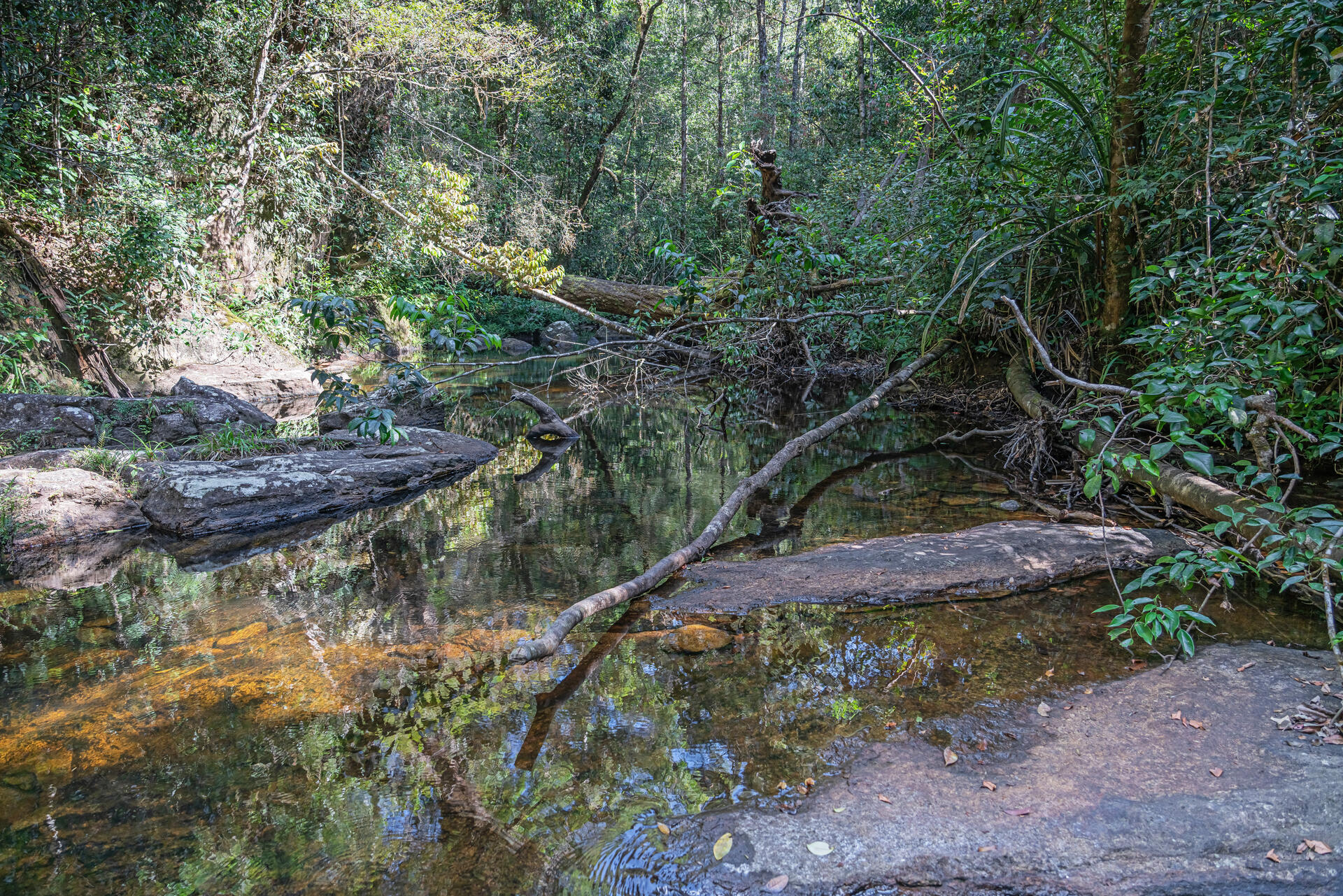
The Sinharaja Forest Reserve, located in the southwestern region of Sri Lanka, stands as a testament to the island nation's rich biodiversity. Established in 1978, this protected area was inscribed as a UNESCO World Heritage Site in 1988, recognizing its global significance.
More to come…UNESCO Description of the World Heritage Site
Located in south-west Sri Lanka, Sinharaja is the country's last viable area of primary tropical rainforest. More than 60% of the trees are endemic and many of them are considered rare. There is much endemic wildlife, especially birds, but the reserve is also home to over 50% of Sri Lanka's endemic species of mammals and butterflies, as well as many kinds of insects, reptiles and rare amphibians.
UNESCO Justification of the World Heritage Site
Criterion (ix): Sinharaja is the last remaining relatively undisturbed remnant of tropical humid evergreen forest in Sri Lanka. The property’s flora is a relic of Gondwanaland and provides an important component to our scientific understanding of continental drift and an outstanding site for the study of the processes of biological evolution. A geological feature of considerable interest is the presence of the Sinharaja basic zone, with the reserve located within the transition zone of two important rock types characteristic of Sri Lanka; the south-western group and the highland group.
Criterion (x): Endemism within the property is extremely high. Protecting the last viable remnant of Sri Lanka’s tropical lowland rainforest, Sinharaja is home to at least 139 endemic plant species within two main types of forest: remnants of Dipterocarpus in the valleys and on the lower slopes, and secondary forest and scrub where the original forest cover has been removed. Sixteen of the endemic plant species within the property are considered rare, including endemic palms Loxococcus rupicola and Atalantia rotundifolia. Faunal endemism is also high, particularly for mammals, birds and butterflies, exceeding 50%. Nineteen (95%) of Sri Lanka’s 20 endemic birds are present in the property, which is also home to leopard and Indian elephant, both of which are threatened species.
Encyclopedia Record: Sinharaja Forest Reserve
Sinharaja Forest Reserve is a forest reserve and a biodiversity hotspot in Sri Lanka. It is of international significance and has been designated a Biosphere Reserve and World Heritage Site by UNESCO.Additional Site Details
Area: 8,864 hectares
Number of Components: 1
(x) — Contains most important habitats for biodiversity
Coordinates: 6.416666667 , 80.5
IUCN World Heritage Outlook
The 2025 Conservation Outlook on Sinharaja Forest Reserve reports the following assessment:
Source: International Union for Conservation of Nature (IUCN) · View assessment
World Heritage Research
Discover scientific research and academic studies that deepen our understanding of Sinharaja Forest Reserve from its history and significance to its conservation, management, and contemporary challenges.
-
Spatiotemporal analysis and deep-learning based forecasting of land surface temperature in the UNESCO world heritage sinharaja rainforest
A deep-learning framework using Convolutional Long Short-Term Memory (ConvLSTM) has successfully forecasted temperature dynamics in the Sinharaja Rainforest, a critical UNESCO World Heritage Site and biodiversity hotspot. The model achieved high predictive accuracy with a root mean square error (RMSE) of 1.55°C, capturing complex, nonlinear spatiotemporal patterns from two decades of satellite-derived Land Surface Temperature (LST) data (2000–2021). While the nonparametric Mann-Kendall test did not indicate a statistically significant trend, time series decomposition revealed a subtle but persistent long-term warming signal. This study provides essential insights for climate adaptation and conservation policy decisions in tropical ecosystems, where accurate temperature prediction is challenging due to sparse ground observations and strong spatial heterogeneity.
Silva, K. I., Fonseka, P. U., Gamage, S., Kantamaneni, K., & Rathnayake, U. (2026). Spatiotemporal analysis and deep-learning based forecasting of land surface temperature in the UNESCO world heritage sinharaja rainforest. Trees, Forests and People, 25, 101308. https://doi.org/10.1016/j.tfp.2026.101308
View Publication Record | Read Publication -
Assessing Habitat Occupancy of Chevrotains (Moschiola meminna and Moschiola kathygre) in Sri Lanka
A study assessing the habitat occupancy of chevrotains in Sri Lanka reveals distinct differences between the two endemic species. In Sinharaja Forest Reserve, the White-spotted Chevrotain (Moschiola meminna) shows high and stable occupancy across all habitats, suggesting widespread abundance. Conversely, in Wilpattu National Park, occupancy is lower and influenced by habitat features such as litter cover, distance to water, and leopard relative abundance, with tropical thorn forests supporting the highest occupancy. The research used camera trapping and occupancy modeling via PRESENCE software to analyze detection histories over multiple survey periods. These findings underscore the need for site-specific conservation strategies: sustaining current conditions in Sinharaja while addressing habitat degradation in Wilpattu.
Tharinduni, W.A.L., Hippala, H.M.U.K., Jayasekara, E.G.D.P., & Mahaulpatha, W.A.D. (2026). Assessing Habitat Occupancy of Chevrotains (Moschiola meminna and Moschiola kathygre) in Sri Lanka. Proceedings of International Forestry and Environment Symposium, 30. https://doi.org/10.31357/fesympo.v30.8905
View Publication Record | Read Publication -
Avifaunal Richness and Composition Along the Land-Use Gradient of the Endane Biodiversity Corridor Landscape, Nivithigala, Sri Lanka
A study of the Endane Biodiversity Corridor (EBC) in Sri Lanka reveals that restored areas act as critical ecological intermediaries, bridging natural and human-modified habitats while supporting high avifaunal richness and distinct species compositions. The research recorded 111 bird species across four land-use types—restored area (RA), home gardens (HG), productive tea lands (PT), and Walankanda Forest Reserve (WFR)—with RA showing the highest species diversity (100 species) and functioning as a connectivity hub, as evidenced by high Sørensen similarity indices with both HG and PT. Significant variation in Margalef’s richness index among land-use types underscores the importance of habitat restoration for avian biodiversity, while PERMANOVA confirmed distinct avifaunal communities in each habitat. The findings highlight the EBC's role in sustaining endemism (21 endemic species) but also note persistent threats such as illegal mining and encroachment, emphasizing the need for long-term monitoring to understand temporal dynamics.
Kodithuwakku, K. A. I. A., Perera, A., Geekiyanage, N., & Wickramasinghe, S. (2026). Avifaunal Richness and Composition Along the Land-Use Gradient of the Endane Biodiversity Corridor Landscape, Nivithigala, Sri Lanka. Proceedings of International Forestry and Environment Symposium, 30. https://doi.org/10.31357/fesympo.v30.8908
View Publication Record | Read Publication -
Integration of Biodiversity Conservation with Sustainable Ecotourism in Sri Lanka
A qualitative study identifies six critical themes essential for integrating biodiversity conservation with sustainable ecotourism in Sri Lanka's UNESCO World Heritage Sites. These include strengthening governance and enforcement, investing in capacity and infrastructure, promoting genuine community partnerships, prioritizing education and interpretation, ensuring meaningful stakeholder participation, and leveraging digitalization. The research, based on semi-structured interviews with 15 frontline forest and wildlife officers across five sites, provides an evidence-based framework for enhancing the sustainability of Sri Lanka's ecotourism sector while safeguarding its unique biodiversity. The findings underscore that the synergy between conservation and ecotourism is not automatic but must be consciously built through addressing operational challenges and empowering local stakeholders.
Ekanayake, E.J.M.J.K., Fernando, H.C., Widyasekera, E.C.S., & Manchanayakke, S.M.A.K. (2026). Integration of Biodiversity Conservation with Sustainable Ecotourism in Sri Lanka. Proceedings of International Forestry and Environment Symposium, 30. https://doi.org/10.31357/fesympo.v30.8847
View Publication Record | Read Publication -
Impacts of Modified Forest Landscapes on Tropical Fish Assemblages
A critical shift in tropical fish assemblages, particularly among ecologically specialized species, is triggered by forest conversion to agro-crop landscapes. While community-level changes were not robustly detected, the study found that the Critically Endangered loach Schistura madhavai exhibited a strong preference for forested streams, highlighting its sensitivity to habitat modification. The research, conducted in Sinharaja Forest Reserve’s submontane streams, revealed that forest conversion alters environmental gradients such as hydrology, water chemistry, and substrate, thereby reshaping habitats preferred by S. madhavai. Species-level responses were more pronounced than community-wide patterns, underscoring the importance of indicator species in detecting biodiversity changes. The findings suggest that conservation strategies for range-restricted endemics must incorporate species-specific ecological requirements to mitigate the impacts of habitat disturbance.
Bandara, J., Nanayakkara, S., & Randeniya, S. (2026). Impacts of Modified Forest Landscapes on Tropical Fish Assemblages. Ecology of Freshwater Fish, 35(3). Portico. https://doi.org/10.1111/eff.70053
View Publication Record | Read Publication -
Mapping the vegetation and spatial dynamics of Sinharaja tropical rain forest incorporating NASA’s GEDI spaceborne LiDAR data and multispectral satellite images
A high-accuracy vegetation map of Sinharaja Forest Reserve, with 90% overall accuracy (Kappa coefficient 0.9), was developed by integrating NASA’s GEDI spaceborne LiDAR data and multispectral satellite imagery. This approach revealed eight distinct vegetation/land cover types and provided detailed insights into canopy height, plant area index, and volume density, enhancing our understanding of tropical forest dynamics. The study demonstrates that combining advanced remote sensing techniques with high-resolution data offers a robust framework for ecological characterization, conservation, and management strategies.
Jayasekara, D., Dhananjani, T., Mendis, V., Jayawickrama, H., Prasad, T., Gunarathna, M., Gunarathna, P., & Mahaulpatha, D. (2025). Mapping the vegetation and spatial dynamics of Sinharaja tropical rain forest incorporating NASA’s GEDI spaceborne LiDAR data and multispectral satellite images. iForest - Biogeosciences and Forestry, 18(2), 45–53. https://doi.org/10.3832/ifor4632-017
View Publication Record | Read Publication -
Identification of Priority Areas for Conservation of Threatened Agamid Lizards of Sri Lanka Using Species Distribution Modeling
Sinharaja Forest Reserve, along with the Peak Wilderness Sanctuary and Knuckles Mountain Range, has been identified as a critical conservation hotspot for threatened agamid lizards in Sri Lanka. Using Species Distribution Modeling (SDM), researchers mapped the distribution of 14 endangered species, revealing that over 40% of their high-priority habitats remain unprotected despite some overlap with existing protected areas. This study highlights the urgent need to expand conservation efforts beyond current boundaries, particularly for poorly documented species. By integrating IUCN status, occurrence records, and range size, the research provides a data-driven approach to prioritize biodiversity protection in one of the world's most significant hotspots.
Wijerathne, I., Karunarathna, S., Sursinghe, T., Vidanapathirana, D. R., Ukuwela, K., Wickramasinghe, S., Sarathchandra, C., Gunatilake, J., Jiang, A., Goodale, E., & Fernando, S. (2025). Identification of Priority Areas for Conservation of Threatened Agamid Lizards of Sri Lanka Using Species Distribution Modeling. Integrative Conservation, 4(2), 188–204. Portico. https://doi.org/10.1002/inc3.70019
View Publication Record | Read Publication