World Heritage Identification Number: 1483
World Heritage since: 2015
Category: Cultural Heritage
WHE Type: Agriculture Landscapes, Parks & Gardens
Transboundary Heritage: No
Endangered Heritage: No
Country: 🇸🇬 Singapore
Continent: Asia
UNESCO World Region: Asia and the Pacific
Map
Singapore Botanic Gardens: A Living Legacy of Nature, Science, and Heritage
The Singapore Botanic Gardens, established in 1859, stand as a testament to the enduring legacy of horticulture, biodiversity conservation, and scientific research in Southeast Asia. This historic tropical garden, situated adjacent to Singapore's bustling Orchard Road shopping district, is not just a verdant oasis amidst urban development; it is a living chronicle of the region's natural, cultural, and historical evolution. In recognition of its outstanding universal value, the Singapore Botanic Gardens was inscribed as a UNESCO World Heritage Site in 2015.
The gardens' origins can be traced back to Sir Stamford Raffles, the founder of modern Singapore, who envisioned a “botanical and zoological garden” in his 1822 town plan for the island. Although the original botanical garden established under his vision did not survive, the idea endured, culminating in the establishment of the present Singapore Botanic Gardens in 1859 by the Agri-Horticultural Society. Over the years, the gardens have evolved from a colonial botanical garden into a modern scientific institution, serving as a leading center for research, conservation, and education.
One of the key highlights of the gardens is the Rainforest, a six-hectare patch of primary tropical rainforest that predates the establishment of the gardens themselves. It contains more than 300 species of plants, many of which are native to Singapore, and provides an important habitat for numerous birds, insects, and other wildlife. Another notable attraction is the National Orchid Garden, which houses more than 60,000 orchid plants representing around 1,000 species and 2,000 hybrids. The garden also showcases Singapore's national flower, the Vanda Miss Joaquim, a hybrid orchid bred by Agnes Joaquim and first recognized in 1893.
Another fascinating attraction is the Evolution Garden, an outdoor exhibit that traces the remarkable history of plant life on Earth over the past 400 million years. Visitors journey through a series of landscapes illustrating the evolution of plants, from primitive aquatic organisms and ancient ferns to conifers and flowering plants. Throughout the Gardens, magnificent Heritage Trees, including towering rain trees and the celebrated Tembusu tree featured on Singapore's five-dollar note, stand as living monuments to Singapore's rich botanical heritage.
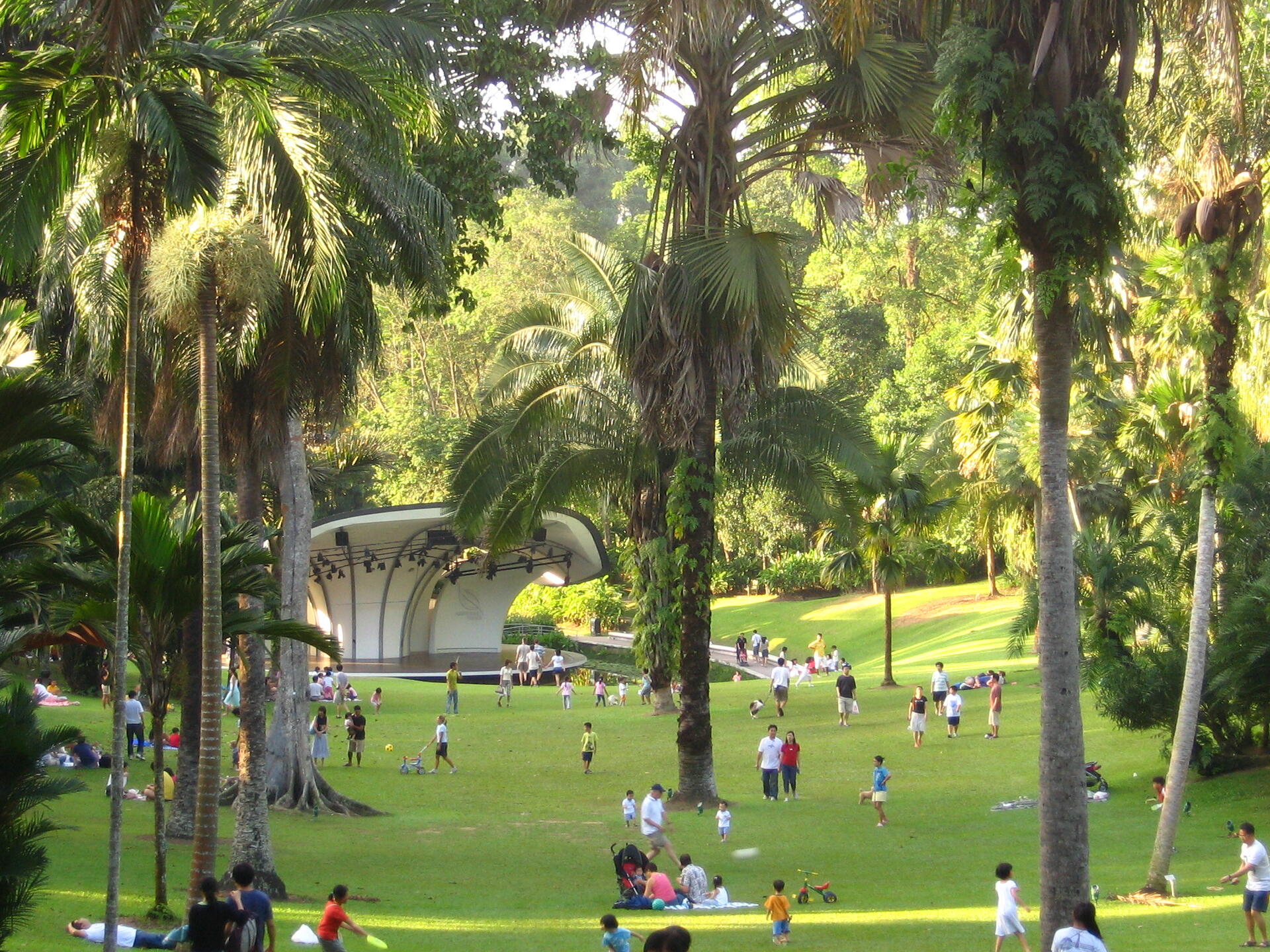
The gardens also boast several historically and culturally significant structures. The iconic Bandstand, completed in 1930, has become one of the most recognizable landmarks of the Singapore Botanic Gardens and remains a popular venue for relaxation, photography, and community gatherings. The Jacob Ballas Children's Garden, opened in 2007, was Asia's first garden dedicated exclusively to children and offers interactive exhibits designed to inspire young visitors to appreciate the wonders of nature. The Eco-Lake, created during the gardens' redevelopment in the 1970s, serves as a sanctuary for a variety of water birds, fish, turtles, and aquatic plants.
The Singapore Botanic Gardens also played a pivotal role in the development of the rubber industry in Southeast Asia during the late nineteenth and early twentieth centuries. Under the leadership of Henry Nicholas Ridley, director of the gardens from 1888 to 1911, extensive research was carried out on the cultivation, propagation, and tapping of the Para rubber tree (Hevea brasiliensis). Ridley's pioneering methods and the gardens' large-scale distribution of high-quality rubber seedlings laid the foundation for the region's thriving rubber plantations, contributing significantly to the economic development of Singapore and neighboring countries.
Today, the Singapore Botanic Gardens ranks among the world's most visited UNESCO World Heritage Sites, attracting millions of visitors annually. Unlike many World Heritage Sites that are celebrated primarily for historic monuments or archaeological remains, the Gardens continue to function as a living scientific institution while remaining one of Singapore's most cherished public parks. Scientists conduct research in plant taxonomy, ecology, horticulture, and conservation biology, while extensive collections, including the Singapore Herbarium, support botanical research across Southeast Asia.
The Singapore Botanic Gardens also shares a long-standing relationship with the Royal Botanic Gardens, Kew, in the United Kingdom, which was inscribed as a separate UNESCO World Heritage Site in 2003. Since the nineteenth century, the two institutions have exchanged plant specimens, scientific knowledge, and horticultural expertise, making important contributions to tropical botany and plant conservation. Their continuing collaboration reflects the Gardens' standing as one of the world's leading botanical institutions.
Beyond its scientific achievements, the Gardens offer a welcoming environment where nature, culture, and recreation coexist harmoniously. Visitors can stroll along scenic pathways, admire spectacular floral displays, observe native wildlife, relax beside tranquil lakes, enjoy picnics on expansive lawns, or attend open-air concerts at Symphony Lake. This unique combination of botanical excellence, historical significance, and public accessibility has made the Singapore Botanic Gardens one of the nation's most treasured landmarks.
The Singapore Botanic Gardens stands today as a remarkable fusion of history, science, culture, and nature. Its designation as a UNESCO World Heritage Site recognizes not only its exceptional botanical collections and historic landscapes but also its lasting contributions to scientific discovery, conservation, and public education. More than a beautiful tropical garden, it is a living institution that continues to inspire researchers, horticulturists, and visitors from around the world while preserving one of Southeast Asia's most important botanical treasures for future generations.
UNESCO Description of the World Heritage Site
Situated at the heart of the city of Singapore, the site demonstrates the evolution of a British tropical colonial botanic garden that has become a modern world-class scientific institution used for both conservation and education. The cultural landscape includes a rich variety of historic features, plantings and buildings that demonstrate the development of the garden since its creation in 1859. It has been an important centre for science, research and plant conservation, notably in connection with the cultivation of rubber plantations, in Southeast Asia since 1875.
UNESCO Justification of the World Heritage Site
Criterion (ii): The Singapore Botanic Gardens has been a centre for plant research in Southeast Asia since the 19th century, contributing significantly to the expansion of plantation rubber in the 20th century, and continues to play a leading role in the exchange of ideas, knowledge and expertise in tropical botany and horticultural sciences. While the Kew Botanic Gardens (United Kingdom) provided the initial seedlings, the Singapore Botanic Gardens provided the conditions for their planting, development and distribution throughout much of Southeast Asia and elsewhere.
Criterion (iv): The Singapore Botanic Gardens is an outstanding example of a British tropical colonial botanic garden, and is notable for its preserved landscape design and continuity of purpose since its inception.
Encyclopedia Record: Singapore Botanic Gardens
The Singapore Botanic Gardens is a 166-year-old tropical garden located at the fringe of the Orchard Road shopping district in Singapore. It is one of three gardens, and the only tropical garden, to be honoured as a UNESCO World Heritage Site. The Botanic Gardens has been ranked Asia's top park attraction since 2013, by TripAdvisor Travellers' Choice Awards. It was declared the inaugural Garden of the Year by the International Garden Tourism Awards in 2012.Additional Site Details
Area: 49 hectares
Number of Components: 1
(iv) — Outstanding example of a type of building or landscape
Coordinates: 1.3152777778 , 103.8161111111
Image
© Calvin teo, CC BY-SA 3.0 Resized from original. (This derivative is under the same CC BY-SA license.)
World Heritage Research
Discover scientific research and academic studies that deepen our understanding of Singapore Botanic Gardens from its history and significance to its conservation, management, and contemporary challenges.
-
Singapore Botanic Gardens Special Part
A special issue of Curtis's Botanical Magazine highlights the Singapore Botanic Gardens, showcasing its impressive biodiversity, conservation efforts, and botanical artistry. The publication features the Suppression-release Technique, an innovative method for managing tropical tree seedlings, demonstrating its potential to advance horticultural practices. This technique, combined with active research and conservation initiatives, underscores the Gardens' role in preserving native flora. The issue also celebrates the flourishing state of fine botanical art in Singapore, thanks to workshops led by Masumi Yamanaka, a regular artist for the Magazine. Orchestrated by Michele Rodda and edited by Timothy Utteridge, this special part was made possible through the generosity of the Singapore Botanic Gardens and contributions from numerous staff and artists.
Grimshaw, J. (2025). Singapore Botanic Gardens Special Part. Curtis’s Botanical Magazine, 42(2), 161. Portico. https://doi.org/10.1111/curt.70014
View Publication Record | Read Publication -
Celebrating Singapore Botanic Gardens
A special issue of Curtis's Botanical Magazine highlights the significance of the Singapore Botanic Gardens, the only tropical botanic garden inscribed on UNESCO's World Heritage List. The publication features rare tropical plants, including species from the Dipterocarpaceae family, alongside detailed scientific accounts and botanical illustrations by the Botanical Art Society Singapore. This collaboration celebrates the Gardens' 2025 milestones, including its 10th anniversary as a UNESCO site, 150 years of the Singapore Herbarium, and 30 years of the National Orchid Garden. The 82-hectare site serves as a living collection of palms, orchids, cycads, and gingers, preserving heritage trees and primary rainforest while advancing botanical heritage.
Choo, T. (2025). Celebrating Singapore Botanic Gardens. Curtis’s Botanical Magazine, 42(2), 159. Portico. https://doi.org/10.1111/curt.70015
View Publication Record | Read Publication -
A brief history of Singapore Botanic Gardens
Established in 1859, the Singapore Botanic Gardens has played a pivotal role in advancing botanical research on Southeast Asia's flora. This study traces its historical development and contributions to scientific knowledge, highlighting its enduring significance as a center for botanical exploration and conservation. The research approach combines historical documentation with an analysis of the gardens' evolution, offering insights into its impact on regional botany.
Utteridge, T. M. A., & Choo, T. (2025). A brief history of Singapore Botanic Gardens. Curtis’s Botanical Magazine, 42(2), 163–175. Portico. https://doi.org/10.1111/curt.70016
View Publication Record | Read Publication -
A Renaissance in the Tropics: The Rise of Botanical Art in Singapore
Botanical art in Singapore has experienced a significant renaissance, transitioning from colonial documentation to a contemporary cultural movement. This study highlights the evolving role of botanical illustration over two centuries, culminating in its renewed recognition through initiatives like the Botanical Art Gallery and the Botanical Art Society (Singapore). The research traces this evolution, emphasizing how local artists have driven a revival that bridges science and cultural heritage. By analyzing historical and contemporary practices, the study underscores the importance of botanical art in preserving biodiversity while fostering artistic expression.
Rodda, M., Hove, W., Lee, C.-A., & Utteridge, T. M. A. (2025). A Renaissance in the Tropics: The Rise of Botanical Art in Singapore. Curtis’s Botanical Magazine, 42(2), 321–336. Portico. https://doi.org/10.1111/curt.70018
View Publication Record | Read Publication -
Tree vitality assessment in lawn a and b of the Singapore Botanic Gardens
A comprehensive tree vitality assessment of Lawns A and B at the Singapore Botanic Gardens (SBG) reveals excellent overall health, with both the Tree Damage Index (TDI) and Visual Crown Rating (VCR) scoring 'very good' at 9. The study, employing the Forest Health Monitoring (FHM) method, identified dead branches as the most prevalent damage type (23%), followed by decay and broom damage. These findings underscore the effectiveness of current management practices while highlighting opportunities for enhancement through targeted interventions such as weeding, pruning, fertilization at the individual tree level, and thinning, mulching, and species enrichment at the plot level. This assessment provides actionable insights to further bolster the resilience and ecological vitality of this urban forest.
Utomo, I. H. A., Istomo, & Putra, E. I. (2025). Tree vitality assessment in lawn a and b of the Singapore Botanic Gardens. IOP Conference Series: Earth and Environmental Science, 1571(1), 12013. https://doi.org/10.1088/1755-1315/1571/1/012013
View Publication Record | Read Publication -
Avian functional diversity retained in a tropical rainforest fragment after more than 120 years of turnover
Despite significant species turnover over more than 120 years, a small tropical rainforest fragment within the UNESCO-listed Singapore Botanic Gardens has retained its avian functional diversity. This resilience was revealed through a comparison of historical records from 1898 with contemporary surveys conducted in 1998 and 2018–2021. The study found that while species composition shifted dramatically (50% dissimilarity), driven primarily by turnover rather than nestedness, both species richness and functional diversity remained stable. This suggests that small forest fragments can support novel but functionally equivalent bird communities, potentially due to functional redundancy. Such findings highlight the importance of habitat restoration adjacent to fragmented forests in preserving ecological functions.
LOW, B. W., WEE, S. Q. W., SOH, M. C. K., & ER, K. B. H. (2024). Avian functional diversity retained in a tropical rainforest fragment after more than 120 years of turnover. Biodiversity and Conservation, 33(6-7), 2195–2210. https://doi.org/10.1007/s10531-024-02855-4
View Publication Record | Read Publication -
Gigantochloa lako (Poaceae, Bambusoideae), a new combination for a horticulturally important bamboo species from Southeast Asia
Researchers reclassify Bambusa lako, a widely cultivated ornamental bamboo known as Timor black bamboo, into the genus Gigantochloa based on floral characteristics observed in a rare flowering specimen. The study, conducted at the Singapore Botanic Gardens, identified key reproductive traits—such as non-disarticulating rachilla segments and terminal vestigial florets—that align with Gigantochloa rather than Bambusa. This taxonomic adjustment clarifies the species' classification while maintaining its horticultural significance in Southeast Asia. The discovery underscores the importance of flowering material in bamboo taxonomy, bridging gaps left by initial descriptions lacking reproductive data.
CAI, Z.-Y., WIDJAJA, E. A., XIA, N.-H., & WONG, K. M. (2024). Gigantochloa lako (Poaceae, Bambusoideae), a new combination for a horticulturally important bamboo species from Southeast Asia. Phytotaxa, 663(2), 101–105. https://doi.org/10.11646/phytotaxa.663.2.6
View Publication Record | Read Publication