World Heritage Identification Number: 547
World Heritage since: 1990
Category: Mixed Cultural Heritage and Natural Heritage
WHE Type: Natural Landscapes & Geographic Features
Transboundary Heritage: No
Endangered Heritage: No
Country: 🇨🇳 China
Continent: Asia
UNESCO World Region: Asia and the Pacific
Map
The Enchanting Landscape of Mount Huangshan: A UNESCO World Heritage Site
Mount Huangshan, officially known as Huangshan or the Yellow Mountains, is a significant mountain range located in the southeastern region of Anhui Province, China. This breathtaking landscape has been celebrated through art, literature, and poetry for much of Chinese history, earning it the moniker 'the loveliest mountain of China.' Today, it continues to captivate visitors, artists, and photographers alike who journey to this remarkable destination.
More to come…UNESCO Description of the World Heritage Site
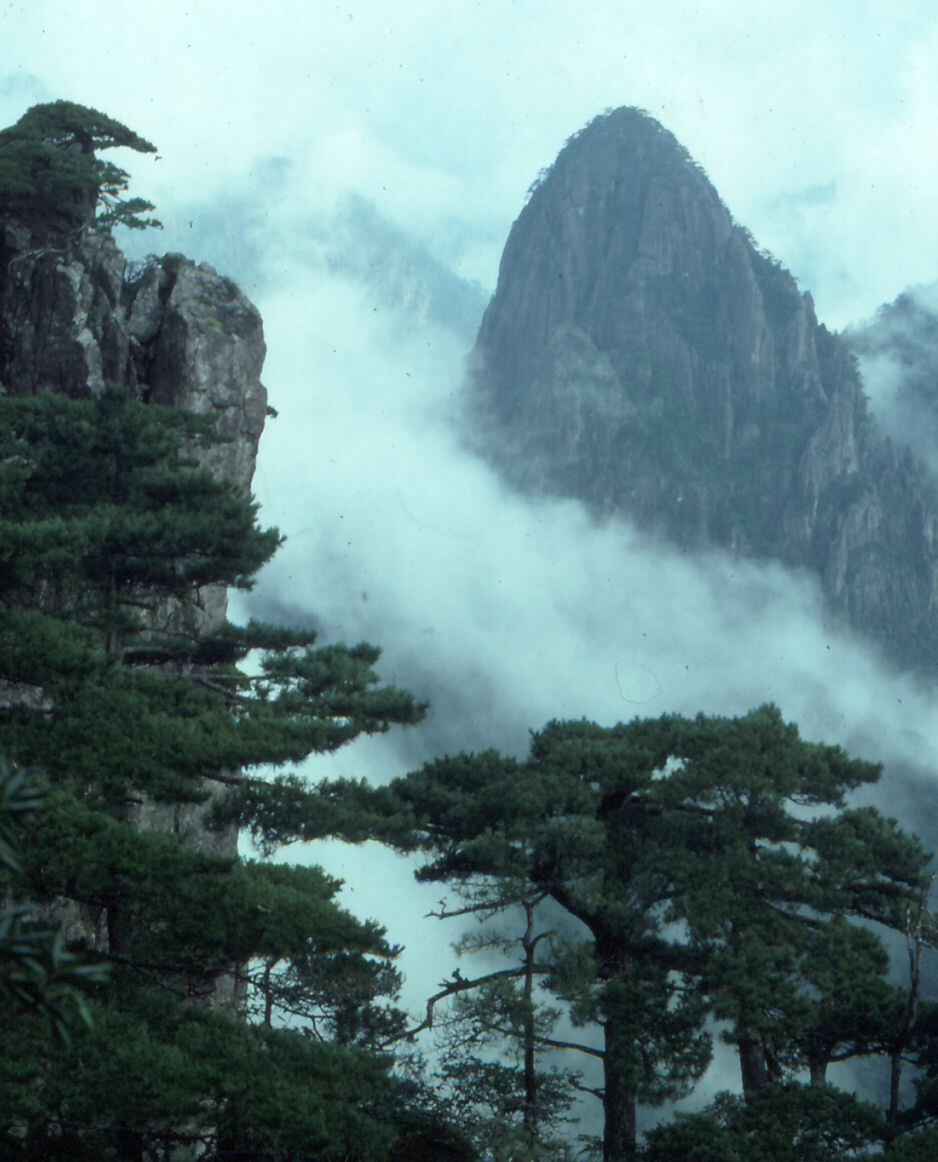
Huangshan, known as 'the loveliest mountain of China', was acclaimed through art and literature during a good part of Chinese history (e.g. the Shanshui 'mountain and water' style of the mid-16th century). Today it holds the same fascination for visitors, poets, painters and photographers who come on pilgrimage to the site, which is renowned for its magnificent scenery made up of many granite peaks and rocks emerging out of a sea of clouds.
UNESCO Justification of the World Heritage Site
Criterion (ii): The cultural value of Mount Huangshan’s scenic landscape first entered the Chinese imagination in the Tang Dynasty and has been held in high esteem ever since. The mountain was named Huangshan (Yellow Mountain) by imperial order in the year 747 and from that time on attracted many visitors, including hermits, poets and painters, all of whom eulogized the mountain’s inspirational scenery through painting and poetry, creating a rich body of art and literature of global significance. During the Yuan Dynasty (1271-1368), 64 temples were constructed on the mountain. In 1606, the monk Pumen came to Huangshan and built the Fahai Meditation Temple. By the Ming Dynasty (around the16th century), depictions of Mount Huangshan had become a favourite theme of Chinese landscape painters, establishing the influential Shanshui (“Mountain and Water”) school of landscape painting. Showcasing the interaction of man and nature in this highly scenic setting has inspired generations of Chinese artists and writers.
Criterion (vii): Mount Huangshan is renowned for its magnificent natural scenery which includes massive granitic boulders and ancient pine trees which are often further enhanced by cloud and mist effects. This dramatic landscape includes formations of natural stone pillars, grotesquely-shaped rocks, waterfalls, caves, lakes and hot springs, formed by its complex geological history. The property features numerous imposing peaks, 77 of which exceed an altitude of 1,000 m, with the highest, the famous Lianhua Peak (Lotus Flower Peak), reaching up to 1,864 m.
Criterion (x): Mount Huangshan provides the habitat for a number of locally or nationally endemic plant species, several of which are globally threatened. Its outstandingly rich flora contains one-third of China's bryophytes (mosses and liverworts) and over half of its pteridophytes (ferns). Species endemic to Huangshan include 13 species of pteridophytes and 6 species of higher plants, with many other species endemic to the region or to China. This exceptional flora is complemented by an important vertebrate fauna of over 300 species, including 48 mammal species, 170 birds, 38 reptiles, 20 amphibians and 24 fish. A total of 13 species are under state protection, including the Clouded Leopard Neofelis nebulosa (VU) and the Oriental Stork Ciconia boyciana (EN).
Encyclopedia Record: Huangshan
Huangshan, literally meaning the Yellow Mountain(s), is a mountain range in southern Anhui province in eastern China. It was originally called "Yishan", and it was renamed because of a legend that the Yellow Emperor once made alchemy here. Vegetation on the range is thickest below 1,100 meters (3,600 ft), with trees growing up to the treeline at 1,800 meters (5,900 ft).Additional Site Details
Area: 16,060 hectares
Number of Components: 1
(vii) — Contains superlative natural phenomena or beauty
(x) — Contains most important habitats for biodiversity
Coordinates: 30.145333 , 118.155083
IUCN World Heritage Outlook
The 2025 Conservation Outlook on Mount Huangshan reports the following assessment:
Source: International Union for Conservation of Nature (IUCN) · View assessment
Image
Unknown, Public domain
World Heritage Research
Discover scientific research and academic studies that deepen our understanding of Mount Huangshan from its history and significance to its conservation, management, and contemporary challenges.
-
Utilization and Protection of the World Heritage - Mixed Property in Huangshan Mount
Mount Huangshan, a UNESCO World Heritage Site recognized for its unique blend of natural and cultural significance, faces critical challenges in balancing utilization and protection. The study reveals that while Huangshan's granite peak forest landform, distinctive flora like the 'peculiar pine,' and cultural heritage such as ancient buildings and poetry contribute significantly to its value, it also grapples with water quality pollution, ecological threats, and tourism-related environmental degradation. By analyzing data from UNESCO and employing a comparative approach, the research highlights Huangshan's potential as a model for mixed-heritage sites while identifying urgent issues requiring attention. Feasible solutions are proposed to address these challenges, aiming to preserve its dual heritage for future generations.
Chu, Y. (2023). Utilization and Protection of the World Heritage - Mixed Property in Huangshan Mount. Applied and Computational Engineering, 3(1), 356–361. https://doi.org/10.54254/2755-2721/3/20230548
View Publication Record | Read Publication -
Synergizing a socio-ecological system: reflections on community-based natural resource management at the World Heritage Site of Mount Huangshan, China
A study on Mount Huangshan, China, reveals that community-based natural resource management (CBNRM) initiatives often fail to achieve conservation goals due to a lack of integration between socio-ecological systems. The research, conducted through mixed methods including questionnaires, interviews, and observations in Feicui village, highlights the complexity of CBNRM and its disconnect from the original intent of empowering communities for nature conservation. By analyzing system synergies, the study offers critical insights into why CBNRM efforts may fall short, providing a theoretical framework to guide future international debates on effective resource management strategies.
Li, J., Han, F., Chen, Z., & Cai, Y. (2022). Synergizing a socio-ecological system: reflections on community-based natural resource management at the World Heritage Site of Mount Huangshan, China. Journal of Environmental Planning and Management, 66(4), 861–881. https://doi.org/10.1080/09640568.2021.2007060
View Publication Record | Read Publication -
Tourism water footprint: an empirical analysis of Mount Huangshan
A comprehensive analysis of the tourism water footprint (TWF) at Mount Huangshan reveals that tourists consume approximately 10.19 million cubic meters of water annually, equivalent to 3.39 m³ per tourist per day or 3387 liters. The study highlights that tourism sewage and food are the primary drivers of water consumption, with significant environmental spillover effects extending beyond Mount Huangshan to Huangshan City and even nationwide. Tourist flow and temperature show a highly significant positive correlation with TWF, indicating increased water demand during peak tourist seasons. This quantification provides critical insights for sustainable water resource management in tourism-driven regions.
Zhang, J.-H., Zhang, Y., Zhou, J., Liu, Z.-H., Zhang, H.-L., & Tian, Q. (2017). Tourism water footprint: an empirical analysis of Mount Huangshan. Asia Pacific Journal of Tourism Research, 22(10), 1083–1098. https://doi.org/10.1080/10941665.2017.1369134
View Publication Record | Read Publication