World Heritage Identification Number: 800
World Heritage since: 1997
Category: Natural Heritage
WHE Type: Protected Areas & National Parks
Transboundary Heritage: No
Endangered Heritage: No
Country: 🇰🇪 Kenya
Continent: Africa
UNESCO World Region: Africa
Map
Mount Kenya National Park/Natural Forest: A Unique Biosphere Reserve in Kenya
Mount Kenya National Park/Natural Forest, officially recognized as a UNESCO World Heritage Site since 1997, is a significant natural wonder located in Kenya. This protected area encompasses Mount Kenya, the second-highest peak in Africa, standing at an impressive height of 5,199 meters above sea level.
More to come…UNESCO Description of the World Heritage Site
At 5,199 m, Mount Kenya is the second highest peak in Africa. It is an ancient extinct volcano, which during its period of activity (3.1-2.6 million years ago) is thought to have risen to 6,500 m. There are 12 remnant glaciers on the mountain, all receding rapidly, and four secondary peaks that sit at the head of the U-shaped glacial valleys. With its rugged glacier-clad summits and forested middle slopes, Mount Kenya is one of the most impressive landscapes in East Africa. The evolution and ecology of its afro-alpine flora provide an outstanding example of ecological and biological processes. Through the Lewa Wildlife Conservancy and Ngare Ndare Forest Reserve, the property also incorporates lower lying scenic foothills and arid habitats of high biodiversity, situated in the ecological transition zone between the mountain ecosystem and the semi-arid savanna grasslands. The area also lies within the traditional migrating route of the African elephant population.
UNESCO Justification of the World Heritage Site
Criterion (vii): At 5,199 m, Mount Kenya is the second-highest peak in Africa. It is an ancient extinct volcano, which during its period of activity (3.1-2.6 million years ago) is thought to have risen to 6,500 m. The entire mountain is deeply dissected by valleys radiating from the peaks, which are largely attributed to glacial erosion. There are about 20 glacial tarns (small lakes) of varying sizes and numerous glacial moraine features between 3,950 m and 4,800 m asl. The highest peaks are Batian (5,199 m) and Nelion (5,188 m). There are 12 remnant glaciers on the mountain, all receding rapidly, and four secondary peaks that sit at the head of the U-shaped glacial valleys. With its rugged glacier-clad summits and forested middle slopes, Mount Kenya is one of the most impressive landscapes in East Africa. This setting is enhanced by the visual contrast and diversity of landscapes created between the Kenyan Highlands and Mount Kenya looming over the flat, arid, grassland and sparse wooded plains of the Lewa Wildlife Conservancy extension to the north. Mount Kenya is also regarded as a holy mountain by all the communities (Kikuyu and Meru) living adjacent to it. They use the mountain for traditional rituals based on the belief that their traditional God Ngai and his wife Mumbi live on the peak of the mountain.
Criterion (ix): The evolution and ecology of the afro-alpine flora of Mount Kenya provides an outstanding example of ecological processes in this type of environment. Vegetation varies with altitude and rainfall and the property supports a rich alpine and subalpine flora. Juniperus procera and Podocarpus species are predominant in the drier parts of the lower zone (below 2,500 m asl). Cassipourea malosana predominates in wetter areas to the south-west and north-east. Higher altitudes (2,500-3,000 m) are dominated by bamboo and Podocarpus milanjianus. Above 3,000 m, the alpine zone offers a diversity of ecosystems including grassy glades, moorlands, tussock grasslands and sedges. Continuous vegetation stops at about 4,500 m although isolated vascular plants have been found at over 5,000 m. In the lower forest and bamboo zone mammals include giant forest hog, tree hyrax, white-tailed mongoose, elephant, black rhinoceros, suni, black-fronted duiker and leopard. Moorland mammals include the localized Mount Kenya mouse shrew, hyrax and common duiker. The endemic mole-rat is common throughout the northern slopes and the Hinder Valley at elevations up to 4,000 m. Lewa Wildlife Conservancy and Ngare Ndare Forest Reserve enhance the species diversity within the property including being home to the largest resident population of Grevys’ Zebra in the world. An impressive array of birdlife includes green ibis (local Mount Kenya race); Ayres hawk eagle; Abyssinian long-eared owl; scaly francolin; Rüppell's robin-chat; numerous sunbirds (Nectariniidae); the locally threatened scarce swift; and near endemic alpine swift. The Lewa Wildlife Conservancy and Ngare Ndare Forest Reserve component of the property incorporates lower lying, scenic foothills and arid habitats of high biological richness and diversity. The component lies at the ecological transition zone between the Afro Tropical Mountain ecosystem and the semi-arid East African Savannah Grasslands. Lewa Wildlife Conservancy and Ngare Ndare Forest Reserve also lie within the traditional migration route of the African elephant population of the Mount Kenya – Somali/Maasai ecosystem and has always been the traditional dry season feeding area for elephants.
Encyclopedia Record: Mount Kenya National Park
Mount Kenya National Park is a national park in Kenya that was established in 1949 around Mount Kenya to protect its surrounding environment and wildlife. It is also a drainage basin for the region's water supply.Additional Site Details
Area: 202,334 hectares
Number of Components: 2
(ix) — Outstanding example representing ecological and biological processes
Coordinates: -0.155 , 37.3155555556
IUCN World Heritage Outlook
The 2025 Conservation Outlook on Mount Kenya National Park/Natural Forest reports the following assessment:
Source: International Union for Conservation of Nature (IUCN) · View assessment
Image
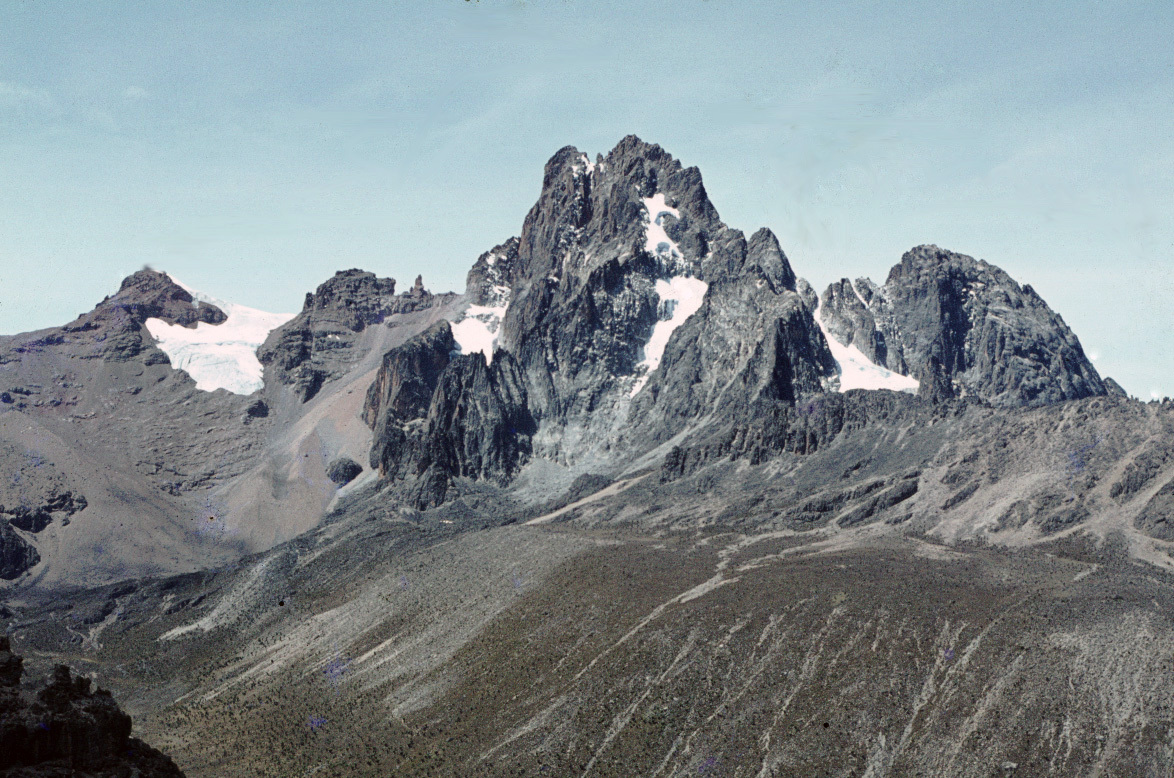
© Ronaldcameron, CC BY-SA 4.0 Resized from original. (This derivative is under the same CC BY-SA license.)