World Heritage Identification Number: 1060
World Heritage since: 2011
Category: Natural Heritage
WHE Type: Natural Landscapes & Geographic Features
Transboundary Heritage: No
Endangered Heritage: No
Country: 🇰🇪 Kenya
Continent: Africa
UNESCO World Region: Africa
Map
Kenya Lake System in the Great Rift Valley: A Biodiverse Treasure Trove
The Kenya Lake System in the Great Rift Valley is a captivating natural wonder located in the Rift Valley Province of Kenya. This UNESCO World Heritage Site spans over 32,034 hectares, encompassing three interconnected, relatively shallow lakes: Lake Bogoria, Lake Nakuru, and Lake Elementaita.
More to come…UNESCO Description of the World Heritage Site
The Kenya Lake System in the Great Rift Valley , a natural property of outstanding beauty, comprises three inter-linked relatively shallow lakes (Lake Bogoria, Lake Nakuru and Lake Elementaita) in the Rift Valley Province of Kenya and covers a total area of 32,034 hectares. The property is home to 13 globally threatened bird species and some of the highest bird diversities in the world. It is the single most important foraging site for the lesser flamingo anywhere, and a major nesting and breeding ground for great white pelicans. The property features sizeable mammal populations, including black rhino, Rothschild's giraffe, greater kudu, lion, cheetah and wild dogs and is valuable for the study of ecological processes of major importance.
UNESCO Justification of the World Heritage Site
Criterion (vii): The Kenya Lake System presents an exceptional range of geological and biological processes of exceptional natural beauty, including falls, geysers, hot springs, open waters and marshes, forests and open grasslands concentrated in a relatively small area and set among the landscape backdrop of the Great Rift Valley. The massed congregations of birds on the shores of the lakes including up to 4 million Lesser Flamingos which move between the three lakes is an outstanding wildlife spectacle. The natural setting of all three lakes surrounded by the steep escarpment of the Rift Valley and associated volcanic features provides an exceptional experience of nature.
Criterion (ix): The Kenya Lake System illustrates ongoing ecological and biological processes which provide valuable insights into the evolution and the development of soda lake ecosystems and the related communities of plants and animals. Low species diversity and abundant resident populations of birds and other animals make the soda lakes of the property especially important environments in which to conduct investigations of trophic dynamics and ecosystem processes. The production of huge biomass quantities in these distinctive soda lakes and the food web that this green algae supports are also of international scientific value, and provide critical support to birds, which visit the property in large numbers as part of their migration in response to seasonal and episodic changes in the environment.
Criterion (x): The Kenya Lake System is the single most important foraging site for the Lesser Flamingo in the world with about 1.5 million individuals moving from one lake to the other and provides the main nesting and breeding grounds for Great White Pelicans in the Great Rift Valley. The lakes' terrestrial zones also contain important populations of many mammal and bird species that are globally or regionally threatened. They are home to over 100 species of migratory birds and support globally important populations of Black-Necked Grebe, African Spoonbill, Pied Avocet, Little Grebe, Yellow Billed Stork, Black Winged Stilt, Grey-Headed Gull and Gull Billed Tern. The property makes a critical contribution to the conservation of the natural values within the Great Rift Valley, as an integral part of the most important route of the African-Eurasian flyway system where billions of birds are found to travel from northern breeding grounds to African wintering places.
Encyclopedia Record: Great Rift Valley, Kenya
The Great Rift Valley is part of an intra-continental system of topographic depressions that runs through Kenya from north to south. It is part of the Gregory Rift, the eastern branch of the East African Rift, which starts in Tanzania to the south and continues northward into Ethiopia. It was formed on the "Kenyan Dome", a geographical upwelling created by the interactions of three major tectonic plates: the Arabian, Nubian, and Somali plates. In the past, it was seen as part of a "Great Rift Valley" that runs from Mozambique to Syria. Most of the valley falls within the former Rift Valley Province.Additional Site Details
Area: 32,034 hectares
Number of Components: 3
(ix) — Outstanding example representing ecological and biological processes
(x) — Contains most important habitats for biodiversity
Coordinates: -0.4425 , 36.24
IUCN World Heritage Outlook
The 2025 Conservation Outlook on Kenya Lake System in the Great Rift Valley reports the following assessment:
Source: International Union for Conservation of Nature (IUCN) · View assessment
Image
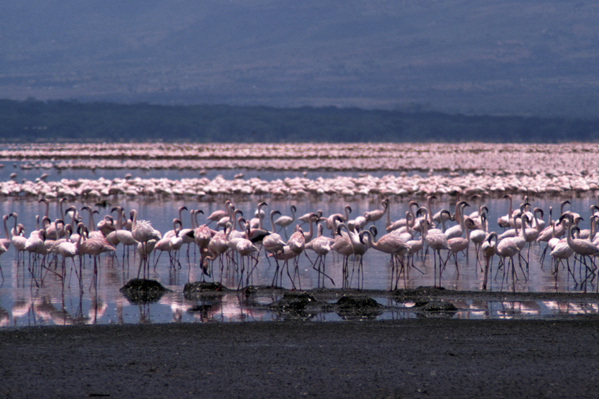
© Own work - photo made by Bob Walker in Kenya, CC BY-SA 2.5 Resized from original. (This derivative is under the same CC BY-SA license.)
World Heritage Research
Discover scientific research and academic studies that deepen our understanding of Kenya Lake System in the Great Rift Valley from its history and significance to its conservation, management, and contemporary challenges.
-
The World Heritage Convention, human rights and Indigenous Peoples
The World Heritage Convention, while rooted in universalistic aims and state-centrism, has shown inconsistent adherence to international human rights standards, particularly concerning Indigenous Peoples' rights. Despite a recent shift towards recognizing Indigenous worldviews and cultural continuity, the system remains Eurocentric, limiting equitable participation. A case study analysis of five sites—including the Kenya Lake System in Kenya—reveals variance among states and committees in upholding these standards. The research suggests that broadening World Heritage value concepts and aligning with human rights frameworks could enhance protection for Indigenous Peoples, though current practices fall short.
Fogarty, I. (2025). The World Heritage Convention, human rights and Indigenous Peoples. Hunter Gatherer Research, 11(2), 173–198. https://doi.org/10.3828/hgr.2024.7
View Publication Record | Read Publication