World Heritage Identification Number: 340
World Heritage since: 1985
Category: Natural Heritage
WHE Type: Protected Areas & National Parks
Transboundary Heritage: No
Endangered Heritage: No
Country: 🇮🇳 India
Continent: Asia
UNESCO World Region: Asia and the Pacific
Map
Keoladeo National Park: A Sanctuary for Migratory Birds
The Keoladeo National Park, formerly known as the Keoladeo Ghana National Park, is a significant natural habitat located in the Indian state of Rajasthan. Established as a hunting reserve for the Maharajas of Bharatpur, this park has since evolved into a crucial wintering ground for numerous aquatic bird species that migrate from various regions across Asia.
More to come…UNESCO Description of the World Heritage Site
This former duck-hunting reserve of the Maharajas is one of the major wintering areas for large numbers of aquatic birds from Afghanistan, Turkmenistan, China and Siberia. Some 364 species of birds, including the rare Siberian crane, have been recorded in the park.
UNESCO Justification of the World Heritage Site
Criterion (x): The Keoladeo National Park is a wetland of international importance for migratory waterfowl, where birds migrating down the Central Asian flyway congregate before dispersing to other regions. At time of inscription it was the wintering ground for the Critically Endangered Siberian Crane, and is habitat for large numbers of resident nesting birds. Some 375 bird species have been recorded from the property including five Critically Endangered, two Endangered and six vulnerable species. Around 115 species of birds breed in the park which includes 15 water bird species forming one of the most spectacular heronries of the region. The habitat mosaic of the property supports a large number of species in a small area, with 42 species of raptors recorded.
Encyclopedia Record: Keoladeo National Park
Keoladeo National Park, or Keoladeo Ghana National Park, is a national park in Rajasthan, India. The national park hosts thousands of native, resident and migratory birds, especially during the winter season, when many different species fly to the Indian subcontinent to escape harsh winters further north in Eurasia. At least 400 avian species have been noted or observed in the national park.Additional Site Details
Area: 2,873 hectares
Number of Components: 1
Coordinates: 27.15888889 , 77.50861111
IUCN World Heritage Outlook
The 2025 Conservation Outlook on Keoladeo National Park reports the following assessment:
Source: International Union for Conservation of Nature (IUCN) · View assessment
Image
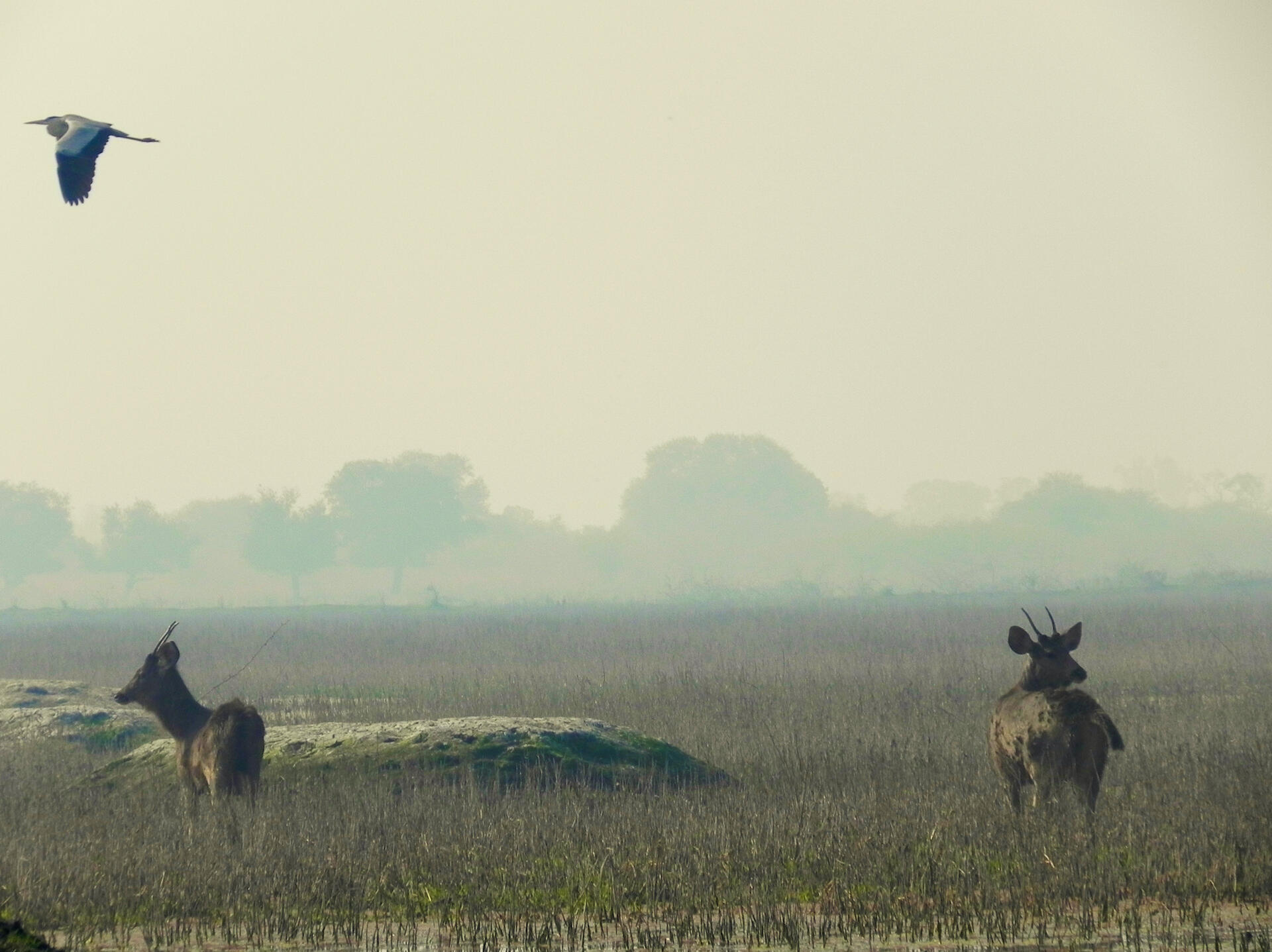
© Nikhilchandra81, CC BY-SA 3.0 Resized from original. (This derivative is under the same CC BY-SA license.)
World Heritage Research
Discover scientific research and academic studies that deepen our understanding of Keoladeo National Park from its history and significance to its conservation, management, and contemporary challenges.
-
Avian Ecology And Conservation Challenges In Keoladeo Bird Sanctuary, Bharatpur, Rajasthan, India
A recent study conducted at Keoladeo National Park, a UNESCO World Heritage Site in Rajasthan, India, reveals significant threats to its rich avian biodiversity. The research identified 73 bird species, including eight globally threatened or near-threatened ones, with Ciconiidae being the most dominant family. Notably, a decline in migratory bird populations was observed, and Eurasian spoonbills were found nesting outside park boundaries, suggesting habitat degradation. The study highlights urgent conservation challenges such as habitat loss, fragmentation, water scarcity, and human interference, emphasizing the need for sustainable habitat management and regular ecological monitoring to preserve this critical biodiversity hotspot.
(Ed.). (2025). Avian Ecology And Conservation Challenges In Keoladeo Bird Sanctuary, Bharatpur, Rajasthan, India. Journal of Advanced Zoology. https://doi.org/10.53555/jaz.v46i1.5111
View Publication Record | Read Publication -
Predation of Endangered crowned river turtles Hardella thurjii by golden jackals Canis aureus in Keoladeo National Park, India
Research at Keoladeo National Park reveals significant predation pressure on the endangered crowned river turtle (Hardella thurjii) by golden jackals (Canis aureus), with 48 documented instances over five months, particularly targeting gravid females during breeding season. The clustering of carcasses along turtle trails suggests localized hotspots that could pose demographic threats to the species. To mitigate these losses, the study proposes conservation strategies such as monitoring jackal movement patterns, installing physical barricades in high-risk areas, and implementing rescue protocols for injured turtles.
SONAWANE, G., SINGH, GAURAV. S., MUKHERJEE, A., MANCHI, S. S., & KUMARA, H. N. (2025). Predation of Endangered crowned river turtles Hardella thurjii by golden jackals Canis aureus in Keoladeo National Park, India. The Herpetological Bulletin, (172), 1–6. https://doi.org/10.33256/hb172.16
View Publication Record | Read Publication -
Assessing spatial and seasonal variability in soil organic carbon fractions of teal carbon in semi-arid Ramsar wetlands of India as a natural climate solution
Shallow inland wetlands, such as Sambhar Lake and Keoladeo National Park, play a crucial role in carbon storage, serving as potential natural climate solutions. This study quantified soil organic carbon (SOC) stocks in these Ramsar sites, revealing significant spatial and seasonal variability. SOC stocks were found to be 143 t C/ha at Sambhar Lake and 251 t C/ha at Keoladeo National Park during the post-monsoon season, with notable reductions during pre-monsoon periods. The research used ground-based observations and remote sensing data, analyzing factors like bulk density, pH, and vegetation indices through Principal Component Analysis (PCA). The study highlights the importance of these wetlands in mitigating climate change and contributing to Sustainable Development Goals (SDGs) 2030, particularly SDG-13 on climate action.
Kumar, S., & Sharma, L. K. (2025). Assessing spatial and seasonal variability in soil organic carbon fractions of teal carbon in semi-arid Ramsar wetlands of India as a natural climate solution. Discover Soil, 2(1). https://doi.org/10.1007/s44378-025-00085-w
View Publication Record | Read Publication -
Pre-Roost Habitats of Western Marsh Harriers (Circus aeruginosus) Wintering in Keoladeo National Park, Bharatpur in Northwestern India
Western Marsh Harriers (Circus aeruginosus) wintering in Keoladeo National Park (KNP), India, exhibit distinct pre-roost habitat preferences depending on their location. Within KNP, harriers predominantly perch on trees to gather before roosting, with a strong preference for sacred fig (Ficus religiosa) despite its lower abundance, likely due to its tall stature and wide canopy. In contrast, outside KNP where tree cover is sparse, harriers primarily pre-roost in open fields. This behavior may facilitate the formation of large roosting flocks, potentially offering protection from predators and access to shared food resource information. Notably, while trees were used as pre-roosting sites within KNP, no overnight roosting on trees was observed during a three-year study period. The scarcity of suitable open areas near primary roost sites in KNP may explain the reliance on tree perches for pre-roosting.
Verma, A. (2024). Pre-Roost Habitats of Western Marsh Harriers (Circus aeruginosus) Wintering in Keoladeo National Park, Bharatpur in Northwestern India. Journal of Raptor Research, 58(3). https://doi.org/10.3356/jrr-22-100
View Publication Record | Read Publication -
BirdCollect: A Comprehensive Benchmark for Analyzing Dense Bird Flock Attributes
BirdCollect introduces the largest annotated bird dataset, revolutionizing wildlife research with over 6,000 high-resolution images of dense bird flocks, including Demoiselle Cranes and 34 other species from Keoladeo National Park. This benchmark dataset, spanning 46.2 GB, provides detailed annotations for tasks like crowd counting, density estimation, segmentation, and species classification, addressing the challenges posed by varied conditions such as lighting and resolution. The dataset highlights the need for tailored AI approaches in wildlife monitoring, offering unprecedented insights into bird behavior and diversity along migratory flyways.
., K., Shreshtha, S., Dutta, B., Dosi, M., Vatsa, M., Singh, R., Anand, S., Sarkar, S., & Mali Parihar, S. (2024). BirdCollect: A Comprehensive Benchmark for Analyzing Dense Bird Flock Attributes. Proceedings of the AAAI Conference on Artificial Intelligence, 38(20), 21879–21887. https://doi.org/10.1609/aaai.v38i20.30189
View Publication Record | Read Publication -
Perception-based Assessment of Ecosystem Services in Keoladeo National Park, Bharatpur (Rajasthan), India
A perception-based survey reveals severe degradation of ecosystem services in Keoladeo National Park, a UNESCO World Heritage Site and Ramsar site renowned for its rich biodiversity. The study, involving national and international tourists, staff members, workers, and dependent villagers, identifies key threats including the reduction of water bodies, land cover changes, and anthropogenic disturbances. These factors are significantly impacting the park's ecological equilibrium, particularly affecting migratory and indigenous bird species such as the Painted stork, Saras crane, and Siberian crane. The findings underscore an urgent need for restoration and maintenance of terrestrial forest areas and wetlands to sustain species and ecosystem functions.
Toor, G., & Chandra, T. (2024). Perception-based Assessment of Ecosystem Services in Keoladeo National Park, Bharatpur (Rajasthan), India. Future Is Urban, 42–48. https://doi.org/10.4324/9781003487890-5
View Publication Record | Read Publication -
Environmental drivers of vigilance behaviour in painted stork (Mycteria leucocephala) nesting colonies
Painted storks (Mycteria leucocephala) exhibit sex-based differences in vigilance, with males displaying higher alertness likely due to territorial and mate-guarding behaviors. Parental vigilance increases as nestlings age, reflecting heightened parental investment. The study, conducted at Keoladeo National Park and the National Zoological Park in North India, used camera techniques to analyze how variables such as sex, nestling age, number of neighbors, and visitor numbers influence vigilance behavior. Generalized Linear Mixed Models (GLMMs) revealed significant effects of these factors on vigilance, with storks at the National Zoological Park showing greater vigilance than those in Keoladeo National Park, suggesting site-specific influences on behavior.
Ahmed, P., & Urfi, A. J. (2024). Environmental drivers of vigilance behaviour in painted stork (Mycteria leucocephala) nesting colonies. Scientific Reports, 14(1). https://doi.org/10.1038/s41598-024-78276-8
View Publication Record | Read Publication