Mount Sanqingshan National Park


World Heritage Identification Number: 1292

World Heritage since: 2008

Category: Natural Heritage

WHE Type: Protected Areas & National Parks

Transboundary Heritage: No

Endangered Heritage: No

Country: 🇨🇳 China

Continent: Asia

UNESCO World Region: Asia and the Pacific

Map

Mount Sanqingshan National Park: A Unique Blend of Natural Beauty and Cultural Significance

Mount Sanqingshan National Park, inscribed by UNESCO as a World Heritage Site in 2008, offers a unique blend of natural beauty and cultural significance that makes it a must-visit destination. Located in the west of the Huyaiyu mountain range in the northeast of Jiangxi Province, China, this 22,950 hectare park is renowned for its exceptional scenic quality, marked by the concentration of fantastically shaped granite peaks and pillars.

More to come…

UNESCO Description of the World Heritage Site

Mount Sanqingshan National Park, a 22,950 ha property located in the west of the Huyaiyu mountain range in the northeast of Jiangxi Province (in the east of central China) has been inscribed for its exceptional scenic quality, marked by the concentration of fantastically shaped pillars and peaks: 48 granite peaks and 89 granite pillars, many of which resemble human or animal silhouettes. The natural beauty of the 1,817 metre high Mount Huaiyu is further enhanced by the juxtaposition of granite features with the vegetation and particular meteorological conditions which make for an ever-changing and arresting landscape with bright halos on clouds and white rainbows. The area is subject to a combination of subtropical monsoonal and maritime influences and forms an island of temperate forest above the surrounding subtropical landscape. It also features forests and numerous waterfalls, some of them 60 metres in height, lakes and springs.

UNESCO Justification of the World Heritage Site

Criterion (vii): Superlative natural phenomena or natural beauty: Mount Sanqingshan’s remarkable granite rock formations combine with diverse forest, near and distant vistas, and striking meteorological effects to create a landscape of exceptional scenic quality. The most notable aspect is the concentration of fantastically shaped pillars and peaks. The natural beauty of Mount Sanqingshan also derives from the juxtaposition of its granite features with the mountain’s vegetation enhanced by meteorological conditions which create an ever-changing and arresting landscape. The access afforded by suspended walking trails in the park permits visitors to appreciate the park’s stunning scenery and enjoy its serene atmosphere.

Encyclopedia Record: Mount Sanqing

Mount Sanqing is a renowned Taoist sacred mountain located 40 kilometres (25 mi) north of Yushan County in Jiangxi Province. Sanqing means the "Three Pure Ones" in Chinese as Mount Sanqing is made up of three main summits: Yujing, Yushui, and Yuhua, representing the Taoist trinity.

Read more on Wikipedia

Additional Site Details

Area: 22,950 hectares

Number of Components: 1

UNESCO Criteria: (vii) — Contains superlative natural phenomena or beauty

Coordinates: 28.9158333333 , 118.0644444444

IUCN World Heritage Outlook

The 2025 Conservation Outlook on Mount Sanqingshan National Park reports the following assessment:

Good

Source: International Union for Conservation of Nature (IUCN) · View assessment
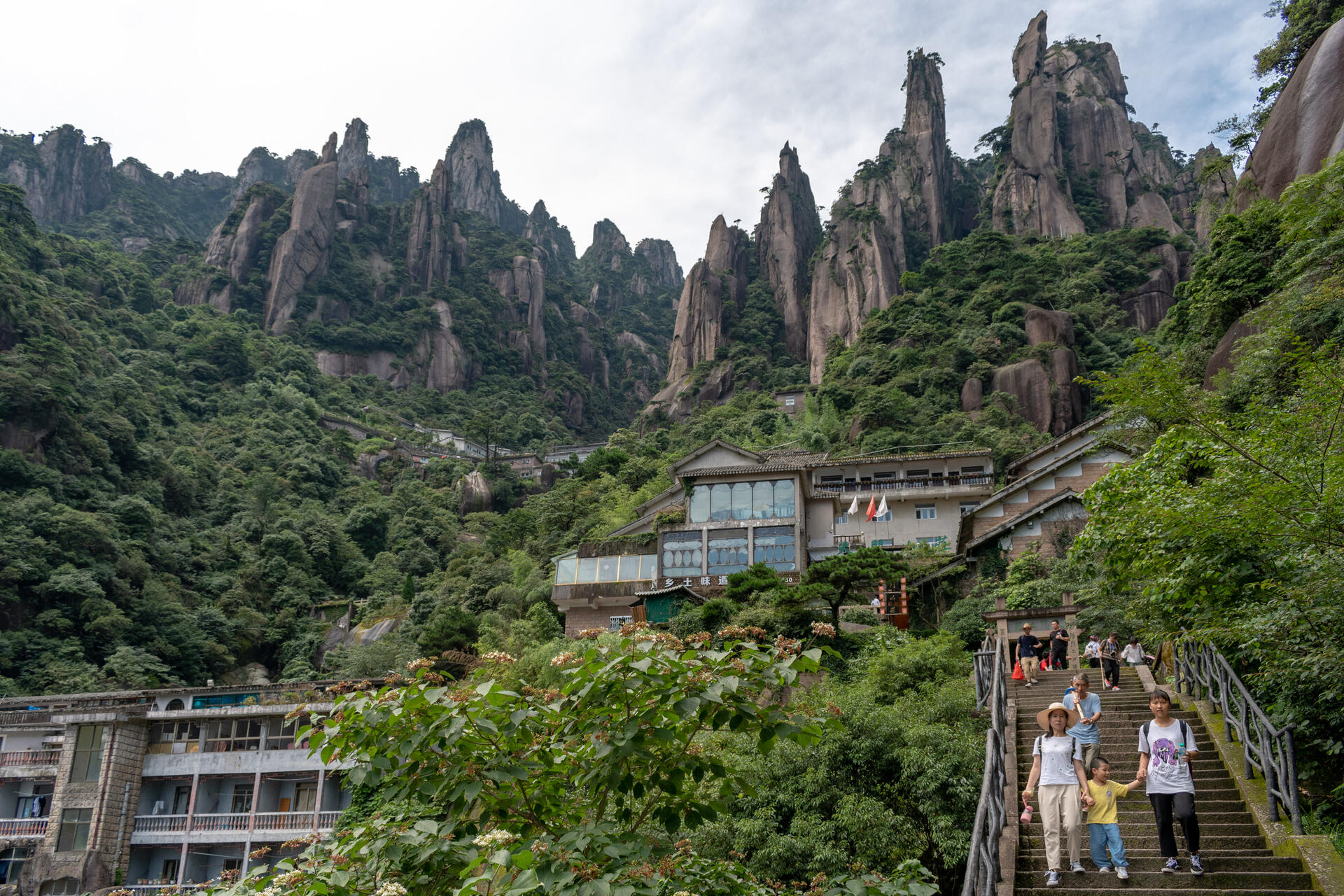
Image

Image of Mount Sanqingshan National Park

© xiquinhosilva, CC BY 2.0 Resized from original.

World Heritage Research

Discover scientific research and academic studies that deepen our understanding of Mount Sanqingshan National Park from its history and significance to its conservation, management, and contemporary challenges.

  • Examining the Mediating Effect of Destination Image Between Sensory Impression and Behavioral Intention: Empirical Evidence From China World Natural Heritage Sites

    A significant mediating role of destination image between sensory impressions and behavioral intentions is identified, particularly highlighting the influence of visual, olfactory, auditory, and tactile stimuli on tourists' cognitive, affective, and conative images at Mount Sanqingshan National Park (MSNP). The study, grounded in Stimulus-Organism-Response (S-O-R) theory, demonstrates that destination image positively impacts behavioral intention, especially through the conative component. Using data from 393 on-site questionnaires analyzed via Exploratory Factor Analysis (EFA), Confirmatory Factor Analysis (CFA), and Partial Least Squares-Structural Equation Modeling (PLS-SEM), the research reveals how sensory impressions shape tourists' perceptions and subsequent behaviors, offering novel insights for branding World Natural Heritage Sites (WNHSs).

    Zheng, Q., & Rahman, S. (2025). Examining the Mediating Effect of Destination Image Between Sensory Impression and Behavioral Intention: Empirical Evidence From China World Natural Heritage Sites. Sage Open, 15(2). https://doi.org/10.1177/21582440251341404

    View Publication Record | Read Publication
  • The moderating role of gender and generation in the impact of destination image on behavioural intention at world natural heritage site

    A significant gender gap exists in how cognitive and affective destination images influence behavioral intentions at Mount Sanqingshan National Park. Female tourists show stronger indirect effects of cognitive image on behavioral intention through affective image and conative components compared to males. Additionally, generational differences emerge between post-2000s/1990s and post-1980s/1970s groups, with notable variations in the relationships between cognitive image, affective image, and conative components. The study used Partial Least Squares Structural Equation Modeling (PLS-SEM) and Multi-Group Analysis (MGA) on data from 388 respondents to uncover these insights, providing actionable guidance for managing diverse tourist perceptions at World Natural Heritage Sites.

    Zheng, Q., & Rahman, S. (2025). The moderating role of gender and generation in the impact of destination image on behavioural intention at world natural heritage site. Journal of Tourism Management Research, 12(1), 157–171. https://doi.org/10.18488/31.v12i1.4248

    View Publication Record | Read Publication
  • Tourist Crowding versus Service Quality: Impacting Mechanism of Tourist Satisfaction in World Natural Heritage Sites from the Mountain Sanqingshan National Park, China

    Tourist satisfaction at World Heritage Sites (WHS) is significantly influenced by service quality, which positively impacts both the perceived attractiveness of Outstanding Universal Value (OUV) and overall satisfaction. Contrarily, tourist crowding—particularly functional, personal, and social crowding—negatively affects satisfaction without substantially altering OUV attractiveness. This study, conducted at Mount Sanqingshan National Park in China using structural equation modeling on 535 tourist samples, introduces the SCA-S framework (service, crowding, attractiveness, and satisfaction) to analyze these dynamics. Findings underscore the critical role of service quality in enhancing tourism experiences while mitigating the adverse effects of crowding, offering actionable insights for heritage conservation and visitor management.

    Nian, S., Chen, M., Yan, J., Du, Y., & Su, X. (2024). Tourist Crowding versus Service Quality: Impacting Mechanism of Tourist Satisfaction in World Natural Heritage Sites from the Mountain Sanqingshan National Park, China. Sustainability, 16(18), 8268. https://doi.org/10.3390/su16188268

    View Publication Record | Read Publication
  • How Outstanding Universal Value Attractiveness and Tourism Crowding Affect Visitors’ Satisfaction?

    A study on Mount Sanqingshan National Park reveals that Outstanding Universal Value (OUV) attractiveness significantly enhances tourist satisfaction and destination attachment, while perceived tourism crowding does not negatively impact these factors. Analyzing 536 questionnaire responses using structural equation modeling, researchers found that OUV's charm plays a crucial role in shaping tourists' attitudes and behaviors, contributing to their overall satisfaction. This research broadens the understanding of visitor satisfaction, offering practical implications for heritage preservation and visitor management at World Heritage Sites.

    Nian, S., Chen, M., Zhang, X., Li, D., & Ren, J. (2023). How Outstanding Universal Value Attractiveness and Tourism Crowding Affect Visitors’ Satisfaction? Behavioral Sciences, 13(2), 112. https://doi.org/10.3390/bs13020112

    View Publication Record | Read Publication
  • Stimulus-Organism-Response Framework: Is the Perceived Outstanding Universal Value Attractiveness of Tourists Beneficial to World Heritage Site Conservation?

    Tourists' perception of Outstanding Universal Value (OUV) at UNESCO World Heritage Sites, such as Mount Sanqingshan National Park, significantly influences their conservation behavior. A study using the Stimulus-Organism-Response (S-O-R) framework and structural equation modeling with 563 tourist samples found that OUV attractiveness positively affects tourists' value perception and destination attachment, which in turn enhances their heritage protection intentions. Additionally, heritage-conservation education and positive attitudes toward conservation further strengthen these behaviors. The research proposes a framework linking cognitive and affective attitudes to heritage protection intention, ultimately benefiting the sustainable development of both tourist industries and World Heritage Sites.

    Nian, S., Li, D., Zhang, J., Lu, S., & Zhang, X. (2023). Stimulus-Organism-Response Framework: Is the Perceived Outstanding Universal Value Attractiveness of Tourists Beneficial to World Heritage Site Conservation? International Journal of Environmental Research and Public Health, 20(2), 1189. https://doi.org/10.3390/ijerph20021189

    View Publication Record | Read Publication
  • Satisfaction of Tourism Communities in World Heritage Sites Based on Residents’ Perceptions—Study Area of Mount Sanqingshan National Park, PRC

    A significant positive influence of perceived benefits on place attachment and community satisfaction was found in Mount Sanqingshan National Park, a UNESCO World Natural Heritage site. The study, which analyzed 330 resident perceptions using structural equation modeling, revealed that while perceived costs negatively impacted place attachment, their effect on satisfaction did not hold true. Place attachment fully mediated the relationship between cost perception and satisfaction but partially mediated benefit perception and satisfaction, showing a strong positive effect on community satisfaction. These insights led to the development of the 'SHE-ABC' framework for World Heritage Site (WHS) tourist community satisfaction, offering theoretical value and practical guidance for sustainable heritage tourism management.

    Nian, S., Liu, F., Chen, M., & Cheng, G. (2022). Satisfaction of Tourism Communities in World Heritage Sites Based on Residents’ Perceptions—Study Area of Mount Sanqingshan National Park, PRC. Sustainability, 15(1), 533. https://doi.org/10.3390/su15010533

    View Publication Record | Read Publication
  • How Outstanding Universal Value, Service Quality and Place Attachment Influences Tourist Intention Towards World Heritage Conservation: A Case Study of Mount Sanqingshan National Park, China

    Mount Sanqingshan National Park's Outstanding Universal Value (OUV) and service quality significantly influence tourists' intentions to conserve World Heritage Sites, with service quality proving more effective than OUV. A study of 565 tourist responses found that while both factors positively impacted conservation intent, place attachment did not mediate this effect. The research, using structural equation modeling, suggests prioritizing service quality improvements and affiliate attractions to enhance heritage protection and sustainable tourism development.

    Nian, S., Zhang, H., Mao, L., Zhao, W., Zhang, H., Lu, Y., Zhang, Y., & Xu, Y. (2019). How Outstanding Universal Value, Service Quality and Place Attachment Influences Tourist Intention Towards World Heritage Conservation: A Case Study of Mount Sanqingshan National Park, China. Sustainability, 11(12), 3321. https://doi.org/10.3390/su11123321

    View Publication Record | Read Publication
  • Tourists’ perceptions of crowding, attractiveness, and satisfaction: a second-order structural model

    Tourists' perceptions of crowding at Mount Sanqingshan National Park negatively impact the attractiveness of the destination, though they do not directly affect satisfaction. This study introduces a multidimensional model of crowding—neutral, personal, and social—to refine how tourist experiences are evaluated beyond traditional metrics like satisfaction. Using a second-order structural equation model with survey data from 424 tourists, researchers found that while perceived crowding diminishes destination appeal, it does not directly influence overall visitor satisfaction. The findings underscore the need for targeted management strategies to mitigate negative perceptions of crowding and enhance tourist experiences at UNESCO World Heritage Sites.

    Li, L., Zhang, J., Nian, S., & Zhang, H. (2017). Tourists’ perceptions of crowding, attractiveness, and satisfaction: a second-order structural model. Asia Pacific Journal of Tourism Research, 22(12), 1250–1260. https://doi.org/10.1080/10941665.2017.1391305

    View Publication Record | Read Publication
  • A new species of Lophodermium with variously branched paraphyses

    Researchers have identified Lophodermium heterocladum, a new fungal species characterized by its distinctively branched paraphyses, found on the leaves of Rhododendron cavaleriei in Mount Sanqingshan National Park, China. This discovery contributes to the understanding of fungal biodiversity in the region. The study provides detailed morphological descriptions and illustrations, with the type collection preserved at Anhui Agricultural University. The research highlights the importance of systematic mycological surveys in UNESCO World Heritage Sites for uncovering novel taxa.

    Gu, H.-L., Xu, Y.-F., Lu, D.-D., Wang, S.-J., & Lin, Y.-R. (2015). A new species of Lophodermium with variously branched paraphyses. Mycotaxon, 130(1), 191–196. https://doi.org/10.5248/130.191

    View Publication Record | Read Publication

About World Heritage Explorer

World Heritage Explorer is an independent educational project designed to uncover and share the richness of our world’s cultural and natural heritage. Dive into detailed site profiles, immersive imagery, interactive maps, and tools that help you explore UNESCO World Heritage Sites across the globe. Drawing extensively on open data sources, the project delivers authoritative, well-structured information for learners, educators, travelers, and younger explorers alike.

Learn more about the project

Nearby World Heritage Sites

Jingdezhen Handicraft Porcelain Industry Sites
94 km — China
Ancient Villages in Southern Anhui – Xidi and Hongcun
110 km — China
Mount Wuyi
136 km — China
Mount Huangshan
137 km — China
Lushan National Park
221 km — China
Flag of China

China and the World Heritage Convention

State Party since: December 12, 1985

Status: Ratification

Mandates to the World Heritage Committee: 1991-1997, 1999-2005, 2007-2011, 2017-2021

Total of Mandate Years: 20

Total of Mandates: 4

WHC Electoral Group: IV (Asia/Pacific)

Learn more about China

Weather at the World Heritage Site

Last updated: September 8, 2026

Portions of the page Mount Sanqingshan National Park are based on data from UNESCO — World Heritage List Dataset and on text from the Wikipedia article Mount Sanqing, licensed under CC BY-SA 4.0. Changes made. Additional original content by World Heritage Explorer (WHE), licensed under CC BY-SA 4.0. WHE is not affiliated with UNESCO or the World Heritage Committee. Legal Notice. Privacy Policy.

Open Data for an Open World