World Heritage Identification Number: 911
World Heritage since: 1999
Category: Mixed Cultural Heritage and Natural Heritage
WHE Type: Natural Landscapes & Geographic Features
Transboundary Heritage: No
Endangered Heritage: No
Country: 🇨🇳 China
Continent: Asia
UNESCO World Region: Asia and the Pacific
Map
Mount Wuyi: A Unique Blend of Natural Beauty and Cultural Significance
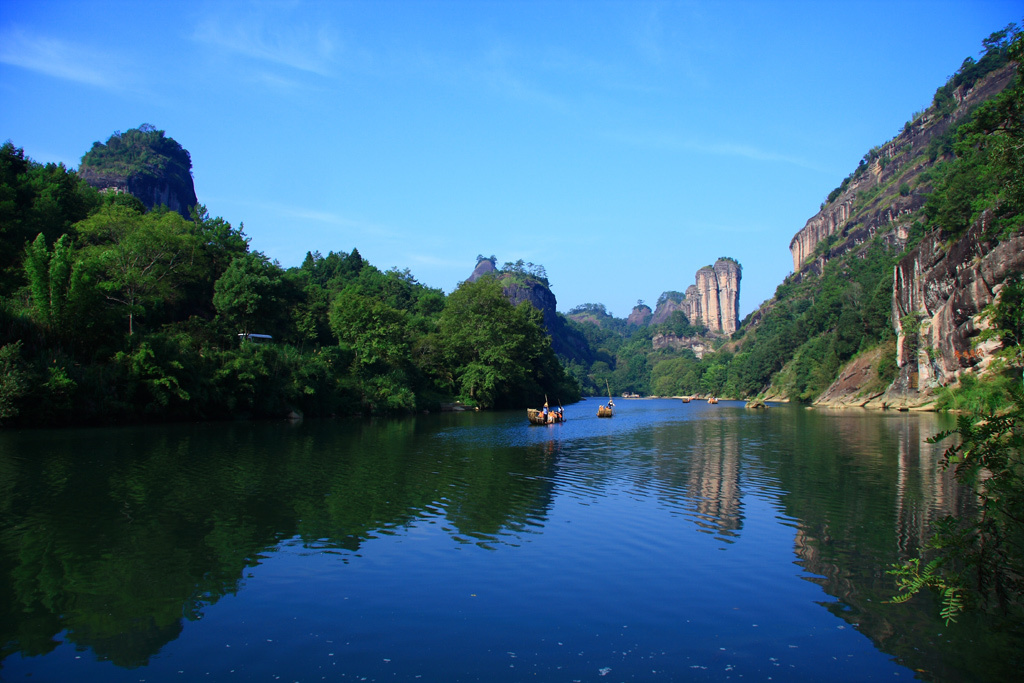
Mount Wuyi, situated in the prefecture of Nanping within the northern Fujian province of China, stands as a testament to the harmonious coexistence of natural splendor and cultural heritage. This mountain range, with its highest peak, Mount Huanggang, reaching 2,158 meters above sea level, shares borders with Jiangxi province, making it the highest point of both provinces.
More to come…UNESCO Description of the World Heritage Site
Mount Wuyi is the most outstanding area for biodiversity conservation in south-east China and a refuge for a large number of ancient, relict species, many of them endemic to China. The serene beauty of the dramatic gorges of the Nine Bend River, with its numerous temples and monasteries, many now in ruins, provided the setting for the development and spread of neo-Confucianism, which has been influential in the cultures of East Asia since the 11th century. In the 1st century B.C. a large administrative capital was built at nearby Chengcun by the Han dynasty rulers. Its massive walls enclose an archaeological site of great significance.
UNESCO Justification of the World Heritage Site
Criterion (iii): Mount Wuyi is a landscape of great beauty that has been protected for more than twelve centuries. It contains a series of exceptional archaeological sites, including the Han City established in the 1st century BCE and a number of temples and study centres associated with the birth of Neo-Confucianism in the 11th century CE.
Criterion (vi): Mount Wuyi was the cradle of Neo-Confucianism, a doctrine that played a dominant role in the countries of Eastern and South-eastern Asia for many centuries and influenced philosophy and government over much of the world.
Criterion (vii): The spectacular landforms in the eastern scenic area around Nine-Bend Stream (lower gorge) are of exceptional scenic quality, with isolated, sheer-sided monoliths of the local red sandstone. They dominate the skyline for a tortuous 10 km section of the river, standing 200-400 m above the riverbed, and terminate in clear, deep water. The ancient cliff tracks are an important dimension of the site, allowing the visitor to get a ‘bird’s-eye-view’ of the river.
Criterion (x): Mount Wuyi is one of the most outstanding subtropical forests in the world. It is the largest, most representative example of a largely intact forest encompassing the diversity of the Chinese Subtropical Forest and the South Chinese Rainforest, with high plant diversity. It acts as a refuge for a large number of ancient, relict plant species, many of them endemic to China and rare elsewhere in the country. It also has an outstanding faunal diversity, especially with respect to its reptile, amphibian and insect species.
Encyclopedia Record: Wuyi Mountains
The Wuyi Mountains or Wuyishan are a mountain range located in the prefecture of Nanping, in northern Fujian province near the border with Jiangxi province, China. The highest peak in the area is Mount Huanggang at 2,158 metres (7,080 ft) on the border of Fujian and Jiangxi, making it the highest point of both provinces; the lowest altitudes are around 200 metres (660 ft). Many oolong and black teas are produced in the Wuyi Mountains, including Da Hong Pao and lapsang souchong, and are sold as Wuyi tea. The mountain range is known worldwide for its status as a refugium for several rare and endemic plant species, its dramatic river valleys, and the abundance of important temples and archeological sites in the region, and is a UNESCO World Heritage Site.Additional Site Details
Area: 107,044 hectares
Number of Components: 2
(vi) — Directly associated with events or living traditions
(vii) — Contains superlative natural phenomena or beauty
(x) — Contains most important habitats for biodiversity
Coordinates: 27.7263888889 , 117.7252777778
IUCN World Heritage Outlook
The 2025 Conservation Outlook on Mount Wuyi reports the following assessment:
Source: International Union for Conservation of Nature (IUCN) · View assessment
World Heritage Research
Discover scientific research and academic studies that deepen our understanding of Mount Wuyi from its history and significance to its conservation, management, and contemporary challenges.
-
Soil Heavy Metal Accumulation and Ecological Risk in Mount Wuyi: Impacts of Vegetation Types and Pollution Sources
Soil heavy metal (HM) contamination poses significant ecological risks in Mount Wuyi, a UNESCO biodiversity hotspot and major tea production area. Research reveals that Cr, Cd, and Pb exhibit notable pollution levels, with Cd and Hg presenting the highest ecological hazards. Vegetation types play a crucial role in HM accumulation; cultivated areas and shrublands, such as tea gardens, show higher concentrations of Cu, Cd, Pb, and Hg due to agricultural and transportation activities, while bamboo forests demonstrate natural resistance to contamination. Geochemical indices and Positive Matrix Factorization (PMF) modeling identified four primary pollution sources: urbanization (27.94%), transport–agriculture activities (21.40%), agricultural practices (12.98%), and atmospheric deposition (12.96%). These findings highlight the urgent need for clean energy solutions, phytoremediation strategies, and tea-specific detoxification measures to ensure ecological security and sustainable agriculture in this critical region.
Wu, F., Zhu, D., Yang, T., Mao, C., Huang, W., Zhou, S., & Yang, Y. (2025). Soil Heavy Metal Accumulation and Ecological Risk in Mount Wuyi: Impacts of Vegetation Types and Pollution Sources. Land, 14(4), 712. https://doi.org/10.3390/land14040712
View Publication Record | Read Publication -
An experimental investigation on the damage mechanisms of red glutenite in the Mount Wuyi cultural and natural heritage site subject to acid rain and wet-dry cycles: a macro-to-micro approach
Acid rain and wet-dry cycles significantly degrade the physical and mechanical properties of red glutenite, a rock type at Mount Wuyi's UNESCO World Heritage Site. Research reveals that as acidity increases and exposure to these cycles prolongs, key properties like dry density, wave velocity, compressive strength, and elastic modulus decline exponentially or linearly. The study used advanced techniques—including cold field emission scanning electron microscopy (CFE-SEM), image processing, and X-ray diffraction—to uncover how rock dissolution and desiccation interact, altering microstructure and mineral composition. A predictive model for uniaxial compressive strength was developed, offering critical insights for preserving this cultural and natural heritage.
Dong, Q., Sun, X., Sheng, J., & Lei, N. (2024). An experimental investigation on the damage mechanisms of red glutenite in the Mount Wuyi cultural and natural heritage site subject to acid rain and wet-dry cycles: a macro-to-micro approach. Heritage Science, 12(1). https://doi.org/10.1186/s40494-024-01393-0
View Publication Record | Read Publication -
Multidimensional Assessment of the Aesthetic Quality of Natural Landscapes in Mount Wuyi National Park, China
A multidimensional assessment of Mount Wuyi National Park, China, reveals that southeastern landscapes exhibit superior aesthetic quality, characterized by higher uniqueness, diversity, and coordination. The study identified 341 individual and 41 combined natural landscapes using 17 landscape metrics, showing a denser concentration in the south and east, with moderate-quality landscapes scattered across northern, southwestern, and some southeastern areas. This research provides a micro-scale framework for aesthetic quality evaluation, offering valuable insights for the scientific management of natural landscapes in UNESCO World Heritage Sites.
Zheng, X., Yang, Z., & Lu, Y. (2024). Multidimensional Assessment of the Aesthetic Quality of Natural Landscapes in Mount Wuyi National Park, China. Land, 13(10), 1674. https://doi.org/10.3390/land13101674
View Publication Record | Read Publication -
The Impact of the Establishment of the Mount Wuyi National Park on the Livelihood of Farmers
Farmers around Mount Wuyi National Park continue to rely on tea-based agricultural employment and part-time work, with agricultural income remaining their primary source of revenue post-establishment. A study analyzing survey data from 354 farmers found that while the park's creation has not significantly altered livelihood choices or income levels, it underscores the need for balanced strategies to protect both ecological integrity and local economies. Researchers used a difference-in-difference model to assess changes before and after the park's establishment, also examining heterogeneity based on tea planting area and income levels. The findings suggest that targeted support for farmers could enhance sustainable livelihoods while preserving the site's UNESCO World Heritage status.
Yang, Z., Ren, J., & Zhang, D. (2023). The Impact of the Establishment of the Mount Wuyi National Park on the Livelihood of Farmers. Agriculture, 13(8), 1619. https://doi.org/10.3390/agriculture13081619
View Publication Record | Read Publication -
Trade-offs and synergies among ecosystem service Bundles in response to relief degree of land surface in a small watershed of Mount Wuyi
A study on Mount Wuyi's Jiuquxi watershed reveals that ecosystem services, including biodiversity maintenance, carbon sequestration, water yield, and water purification, increase with the relief degree of land surface (RDLS). The research identifies three distinct ecosystem service bundles: eco-fragile (low in all services), eco-regulating (high in all services, dominated by carbon sequestration), and eco-conservation (high in all services, dominated by biodiversity). Eco-fragile bundles cluster in low RDLS regions, while eco-regulating bundles are found in high RDLS areas. The study also uncovers two response patterns of ecosystem service trade-offs/synergies to RDLS: an inverted U-shape curve and an N-type curve with inflection points at secondary or quaternary RDLS levels. These findings were derived using models like InVEST, K-mean clustering analysis, and indices such as ESCI and ESTD over the period 2009-2016.
ZHANG Jinlin, 张锦琳,游巍斌,蔡新瑜,何东进. (2023). Trade-offs and synergies among ecosystem service Bundles in response to relief degree of land surface in a small watershed of Mount Wuyi. Acta Ecologica Sinica, 43(12). https://doi.org/10.5846/stxb202209282758
View Publication Record | Read Publication -
When and How Tourists Engage in Citizenship Behavior: The Interactive Effect of Trait Gratitude and Positive Resident–Tourist Contact
Tourists with higher trait gratitude are more likely to engage in citizenship behavior (TCB) at UNESCO World Heritage Site Mount Wuyi, but this effect is significantly strengthened when they experience positive interactions with local residents. The study reveals that perceived insider status—feeling accepted or valued by locals—mediates this relationship, acting as a bridge between gratitude and TCB. Using structural equation modeling on data from 497 tourists, researchers demonstrated that positive resident-tourist contact not only amplifies the impact of gratitude but also enhances its role in shaping perceived insider status, which in turn drives TCB. This finding underscores the importance of fostering positive social interactions to encourage responsible tourism behavior.
Tu, H., Zhang, Z., & Jiang, Z. (2022). When and How Tourists Engage in Citizenship Behavior: The Interactive Effect of Trait Gratitude and Positive Resident–Tourist Contact. Journal of Travel Research, 62(8), 1832–1847. https://doi.org/10.1177/00472875221140904
View Publication Record | Read Publication -
Different Time Scale Distribution of Negative Air Ions Concentrations in Mount Wuyi National Park
Negative air ions (NAIs) concentrations in Mount Wuyi National Park exhibit distinct seasonal patterns primarily influenced by relative humidity, with water emerging as a critical factor across time scales. Correlation and regression analyses revealed strong dependencies between NAI levels and meteorological conditions year-round, while the ARIMA (0,1, 1) model proved most accurate for forecasting future trends, minimizing errors compared to other models. This study advances our understanding of NAI distribution dynamics, offering insights into air quality assessment in protected natural environments like UNESCO World Heritage Sites.
Li, C., Xie, Z., Chen, B., Kuang, K., Xu, D., Liu, J., & He, Z. (2021). Different Time Scale Distribution of Negative Air Ions Concentrations in Mount Wuyi National Park. International Journal of Environmental Research and Public Health, 18(9), 5037. https://doi.org/10.3390/ijerph18095037
View Publication Record | Read Publication -
Does Positive Contact Between Residents and Tourists Stimulate Tourists’ Environmentally Responsible Behavior? The Role of Gratitude and Boundary Conditions
Positive interactions between residents and tourists at Mount Wuyi significantly enhance tourists' environmentally responsible behavior, primarily through the mediation of gratitude. The study found that highly agreeable tourists experienced stronger effects, with positive contact leading to greater gratitude and, consequently, more pro-environmental actions. This suggests that fostering positive resident-tourist relationships can be an effective strategy for promoting sustainable tourism practices.
Tu, H., & Ma, J. (2021). Does Positive Contact Between Residents and Tourists Stimulate Tourists’ Environmentally Responsible Behavior? The Role of Gratitude and Boundary Conditions. Journal of Travel Research, 61(8), 1774–1790. https://doi.org/10.1177/00472875211048938
View Publication Record | Read Publication -
A new species of the genus Megophrys Gunther, 1864 (Amphibia: Anura: Megophryidae) from Mount Wuyi, China
Scientists have identified a new species of horned toad, Megophrys ombrophila, from Mount Wuyi, China. This discovery was made through a combination of morphological, bioacoustic, and molecular analyses of 12S and 16S mitochondrial DNA. The species is characterized by its rotund body, distinct tympanum, smooth dorsal skin with granules and ridges, and unique reproductive traits. Phylogenetic analysis revealed that M. ombrophila is closely related to Megophrys obesa from Guangdong Province. The study highlights the importance of fine-scale molecular and phenotypic assessments in uncovering cryptic species within the hyper-diverse subfamily Megophryinae.
MESSENGER, K. R., DAHN, H. A., LIANG, Y., XIE, P., WANG, Y., & LU, C. (2019). A new species of the genus Megophrys Gunther, 1864 (Amphibia: Anura: Megophryidae) from Mount Wuyi, China. Zootaxa, 4554(2). https://doi.org/10.11646/zootaxa.4554.2.9
View Publication Record | Read Publication -
The Evolution of Cultural Space in a World Heritage Site: Tourism Sustainable Development of Mount Wuyi, China
Mount Wuyi, a UNESCO World Heritage Site in China, exhibits a dynamic evolution of its tea cultural space driven by market forces and cultural development. A study analyzing data from 1996 to 2017 using the vector autoregressive model revealed that culture was the most influential factor in this evolution, while market supply and demand acted as the strongest exogenous drivers. The research identified a multi-stranded interactive evolutionary model, offering insights into the sustainable development of tourism destinations and World Heritage Sites. This finding underscores the importance of balancing cultural preservation with economic growth to ensure long-term sustainability.
Guo, W., Zheng, X., Meng, F., & Zhang, X. (2019). The Evolution of Cultural Space in a World Heritage Site: Tourism Sustainable Development of Mount Wuyi, China. Sustainability, 11(15), 4025. https://doi.org/10.3390/su11154025
View Publication Record | Read Publication -
Tourism Attraction and Tourist Satisfaction with World Heritage: A Case Study of Mount Wuyi
A UNESCO World Heritage Site's brand significantly boosts its tourism attractiveness. At Mount Wuyi, natural landscapes, tea culture, ecological conditions, accommodation, transportation, ticket pricing, staff service quality, and the world heritage brand all positively influence tourist satisfaction. Cultural relics, security, and individual characteristics did not show significant impacts. The study used questionnaires and factor analysis to assess tourism attraction while employing an ologit model for regression analysis of satisfaction.
Zhao, P., Zhang, L., & Tian, R. G. (2018). Tourism Attraction and Tourist Satisfaction with World Heritage: A Case Study of Mount Wuyi. Journal of Marketing Development and Competitiveness, 12(2). https://doi.org/10.33423/jmdc.v12i2.1258
View Publication Record | Read Publication -
Impacts of nitrogen addition on foliar nitrogen and phosphorus stoichiometry in a subtropical evergreen broad-leaved forest in Mount Wuyi
Increasing nitrogen (N) availability in subtropical evergreen forests can intensify phosphorus (P) limitation, as shown by a study conducted at Mount Wuyi. Researchers found that while foliar N levels rose significantly across most species under N addition, P dynamics—rather than N—primarily drove changes in foliar N:P ratios. Herbaceous plants exhibited greater sensitivity to N addition compared to trees and shrubs, with notable increases in foliar P for herbs but a significant decrease in the moss Leucobryum chlorophyllosum. The study, spanning 2013–2015, revealed that mean foliar N:P ratios shifted from 18.67 to 19.72 under N addition, suggesting stronger P limitation. These findings highlight how elevated N inputs can alter nutrient cycling and stoichiometry in subtropical forests.
Qiao-Shu-Yi, W., Cheng-Yang, Z., Xin-Yang, Z., Fa-Xu, Z., & XING Juan, a. (2016). Impacts of nitrogen addition on foliar nitrogen and phosphorus stoichiometry in a subtropical evergreen broad-leaved forest in Mount Wuyi. Chinese Journal of Plant Ecology, 40(11), 1124–1135. https://doi.org/10.17521/cjpe.2016.0110
View Publication Record | Read Publication -
The taste of tea: Material, embodied knowledge and environmental history in northern Fujian, China
Mount Wuyi, a UNESCO World Heritage Site in northern Fujian, China, is renowned for its superior tea production, particularly rock tea, which has been cultivated for over 1500 years. The study reveals that the quality of tea in this region is not solely determined by environmental factors such as terrain but also by the embodied cultural knowledge and skills of specialist tea workers. This includes a unique vocabulary used to evaluate taste and fragrance. Recent efforts to establish national tea quality standards have had to reconcile commercial interests with traditional ecological and cultural practices, highlighting the significance of both human expertise and natural environment in tea appreciation.
Xiao, K. (2016). The taste of tea: Material, embodied knowledge and environmental history in northern Fujian, China. Journal of Material Culture, 22(1), 3–18. https://doi.org/10.1177/1359183516633901
View Publication Record | Read Publication