World Heritage Identification Number: 944
World Heritage since: 1999
Category: Cultural Heritage
WHE Type: Infrastructure & Industry
Transboundary Heritage: No
Endangered Heritage: No
Country: 🇮🇳 India
Continent: Asia
UNESCO World Region: Asia and the Pacific
Map
Mountain Railways of India: A Journey Through the Heart of the Himalayas
The Mountain Railways of India, inscribed as a UNESCO World Heritage Site in 1999, offer a captivating glimpse into the rich history and engineering prowess of India's railway system. Comprising three distinct railways – the Darjeeling Himalayan Railway (DHR), the Nilgiri Mountain Railway (NMR), and the Kalka Shimla Railway (KSR) – each line showcases unique engineering solutions designed to navigate the challenging topography of the Indian subcontinent.
More to come…UNESCO Description of the World Heritage Site
This site includes three railways. The Darjeeling Himalayan Railway was the first, and is still the most outstanding, example of a hill passenger railway. Opened in 1881, its design applies bold and ingenious engineering solutions to the problem of establishing an effective rail link across a mountainous terrain of great beauty. The construction of the Nilgiri Mountain Railway, a 46-km long metre-gauge single-track railway in Tamil Nadu State was first proposed in 1854, but due to the difficulty of the mountainous location the work only started in 1891 and was completed in 1908. This railway, scaling an elevation of 326 m to 2,203 m, represented the latest technology of the time. The Kalka Shimla Railway, a 96-km long, single track working rail link built in the mid-19th century to provide a service to the highland town of Shimla is emblematic of the technical and material efforts to disenclave mountain populations through the railway. All three railways are still fully operational.
UNESCO Justification of the World Heritage Site
Criterion (ii): The Mountain Railways of India are outstanding examples of the interchange of values on developments in technology, and the impact of an innovative transportation system on the social and economic development of a multicultural region, which was to serve as a model for similar developments in many parts of the world. The Mountain Railways of India exhibit an important cultural and technologicaly transfer in the colonial setting of the period of its construction, particularly with regard to the eminently political function of the terminus station, Shimla.. The railway then enabled significant and enduring human settlement, of which it has remained the main vector up to the present day.
Criterion (iv): The development of railways in the 19th century had a profound influence on social and economic developments in many parts of the world. The Mountain Railways of India are outstanding examples of a technological ensemble, representing different phases of the development in high mountain areas. The Mountain Railways of India are outstanding examples of how access has been provided to the plains and plateaus of the Indian mountains. They are emblematic of the technical and material efforts of human societies of this period to disenclave mountain populations through the railway. They are well-maintained and fully operational living lines. They are used in a spirit and for purposes that are the same as those at its their inception.
Encyclopedia Record: Mountain railways of India
The Mountain railways of India are the railway lines that were built in the mountainous regions of India. The term mainly includes the narrow-gauge railways in these regions but may also include some broad-gauge railways.Additional Site Details
Area: 88.99 hectares
Number of Components: 3
(iv) — Outstanding example of a type of building or landscape
Coordinates: 11.51028 , 76.93583
Image
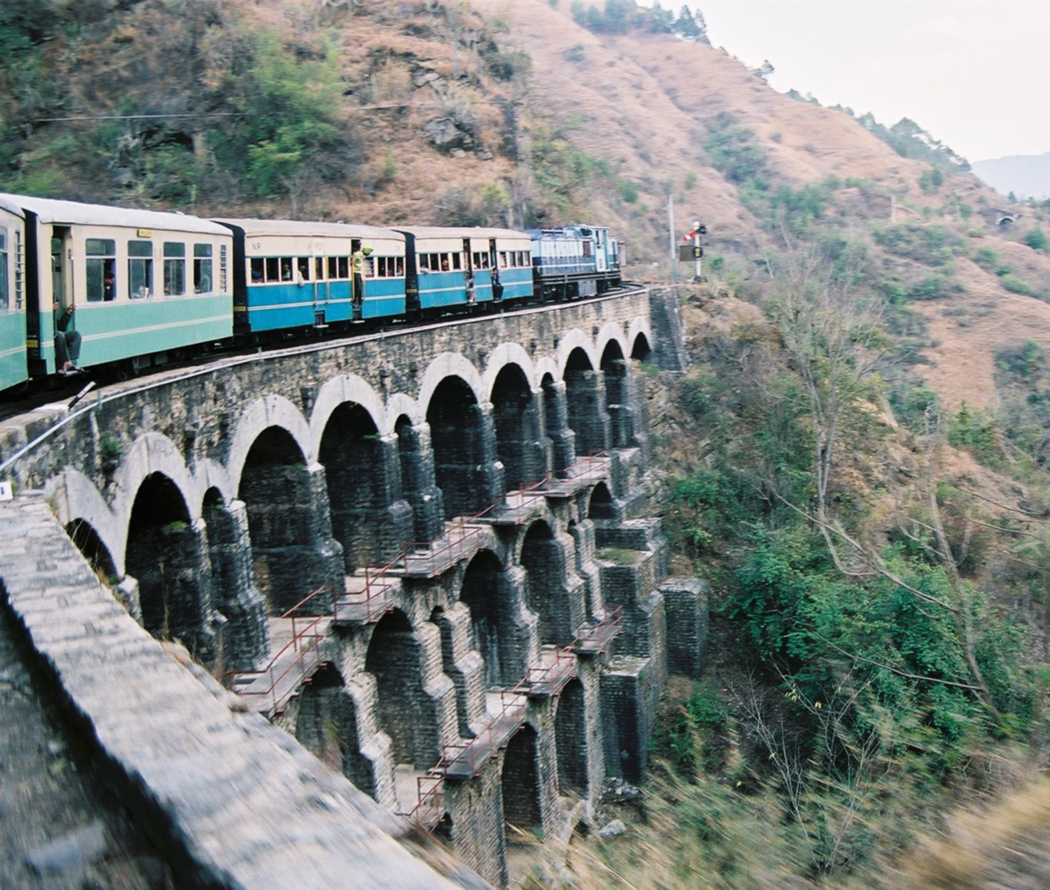
© No machine-readable author provided. AHEMSLTD~commonswiki assumed (based on copyright claims)., CC BY 2.5 Resized from original.