World Heritage Identification Number: 249
World Heritage since: 1984
Category: Cultural Heritage
WHE Type: Buildings & Architectural Ensembles
Transboundary Heritage: No
Endangered Heritage: No
Country: 🇮🇳 India
Continent: Asia
UNESCO World Region: Asia and the Pacific
Map
The Group of Monuments at Mahabalipuram: A Testament to Ancient Indian Art and Architecture
The Group of Monuments at Mahabalipuram, located in the coastal town of Mahabalipuram in Tamil Nadu, India, stands as a testament to the rich cultural heritage and artistic prowess of ancient India. Inscribed as a UNESCO World Heritage Site in 1984, this collection of 7th- and 8th-century CE religious monuments offers a unique blend of architecture, sculpture, and bas-relief art that continues to captivate visitors from around the world.
More to come…UNESCO Description of the World Heritage Site
This group of sanctuaries, founded by the Pallava kings, was carved out of rock along the Coromandel coast in the 7th and 8th centuries. It is known especially for its rathas (temples in the form of chariots), mandapas (cave sanctuaries), giant open-air reliefs such as the famous 'Descent of the Ganges', and the temple of Rivage, with thousands of sculptures to the glory of Shiva.
UNESCO Justification of the World Heritage Site
Criterion (i): The bas-relief of the “Descent of the Ganges” is – like that of the island of Elephanta – a unique artistic achievement.
Criterion (ii): The influence of the sculptures of Mahabalipuram, characterized by the softness and suppleness of their modelling, spread afar to places such as Cambodia, Annam and Java.
Criterion (iii): Mahabalipuram is, pre-eminently, the testimony to the Pallavas civilization of southeast India.
Criterion (vi): The sanctuary is one of the major centres of the cult of Siva.
Encyclopedia Record: Group of Monuments at Mahabalipuram
The Group of Monuments at Mahabalipuram is a collection of 7th- and 8th-century CE religious monuments in the coastal resort town of Mahabalipuram, Tamil Nadu, India and is a UNESCO World Heritage Site. It is on the Coromandel Coast of the Bay of Bengal, about 60 kilometres (37 mi) south of Chennai.Additional Site Details
Area: Not available
Number of Components: 3
(ii) — Significant interchange of human values
(iii) — Unique or exceptional testimony to a cultural tradition
(vi) — Directly associated with events or living traditions
Coordinates: 12.61667 , 80.19167
Image
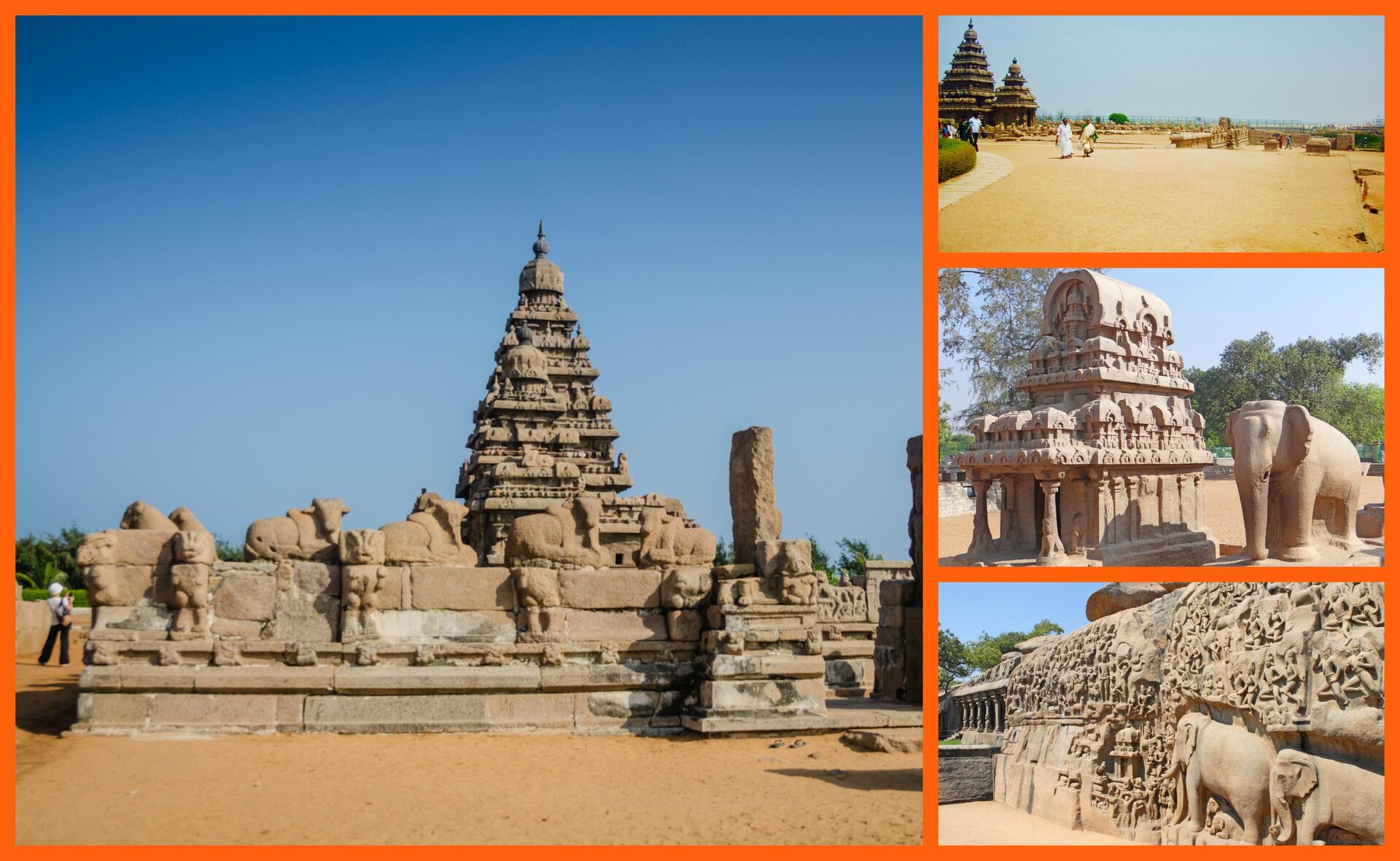
© Ms Sarah Welch, CC BY-SA 4.0 Resized from original. (This derivative is under the same CC BY-SA license.)
World Heritage Research
Discover scientific research and academic studies that deepen our understanding of Group of Monuments at Mahabalipuram from its history and significance to its conservation, management, and contemporary challenges.
-
Navigating Heritagescapes: a spatial-cognitive mapping approach for optimal tour route recommendations
Visitors to UNESCO World Heritage Sites (WHS) with varying spatial awareness navigate and perceive heritage landscapes differently, leading to distinct tour routes. A study on Mahabalipuram’s monuments revealed that visitors’ spatial cognitive mapping—how they mentally organize and relate monuments—significantly influences their mobility patterns. Using a framework combining behavioural geography and Lefebvre’s socio-spatial theory, researchers analyzed how spatially oriented and non-oriented groups interacted with the site, uncovering key differences in route preferences. These findings provide actionable insights for optimizing tour recommendations, enhancing visitor experience while preserving heritage integrity.
Devraj, V., Hasana, U., Swain, S., & Kamalapathy, R. (2025). Navigating Heritagescapes: a spatial-cognitive mapping approach for optimal tour route recommendations. Journal of Heritage Tourism, 20(5), 623–641. https://doi.org/10.1080/1743873x.2025.2495032
View Publication Record | Read Publication -
Quality of Tourism in World Heritage Sites: A Way towards Sustainability
A new framework for assessing tourism quality at UNESCO World Heritage Sites, exemplified by Mahabalipuram's Group of Monuments, reveals critical gaps in visitor experience, local perceptions, and management practices. This study shifts from narrow, one-dimensional approaches to a holistic paradigm that integrates environmental, social, and economic dimensions. By analyzing multiple perspectives—including those of visitors, residents, and destination managers—the research identifies core areas needing development for sustainable tourism. The findings provide actionable insights for policymakers and managers, offering a practical tool for gap analysis and long-term sustainability planning at heritage sites.
NAIR, B. B. (2021). Quality of Tourism in World Heritage Sites: A Way towards Sustainability. Journal of Environmental Management and Tourism, 12(2), 444. https://doi.org/10.14505//jemt.12.2(50).12
View Publication Record | Read Publication -
Visitor Perception and Expectation of Heritage Tourism at Mahabalipuram Monuments
A significant gap exists between visitors' expectations and their perceived experience at the UNESCO World Heritage Site of Mahabalipuram, highlighting challenges for sustainable heritage tourism. The study assessed tourist motives, expectations, and post-visit perceptions using structured questionnaires, focusing on five key aspects (5A's) to evaluate destination competitiveness. Findings reveal discrepancies in visitor experiences that could inform better positioning and planning strategies for the site. This research underscores the importance of aligning visitor expectations with actual heritage tourism offerings to enhance satisfaction and preservation efforts.
V. T. Nair, B., & K., S. (2020). Visitor Perception and Expectation of Heritage Tourism at Mahabalipuram Monuments. Strategies for Promoting Sustainable Hospitality and Tourism Services, 191–210. https://doi.org/10.4018/978-1-7998-4330-6.ch012
View Publication Record | Read Publication -
From Religious Shrines to Monuments
A key insight from this study is the potential for coastal religious shrines, such as those at Mahabalipuram and My Son, to be recognized as transnational World Heritage Sites. The research examines how these structures, already listed by UNESCO, can engage in dialogue over long historical periods (longue durée) across different cultures. By analyzing maritime networks connecting India and Southeast Asia, the study highlights the cultural and historical significance of these sites beyond their individual national contexts. This approach challenges traditional notions of heritage preservation, advocating for a more interconnected understanding that transcends borders.
Ray, H. P. (2020). From Religious Shrines to Monuments. Coastal Shrines and Transnational Maritime Networks across India and Southeast Asia, 208–220. https://doi.org/10.4324/9780429285233-9
View Publication Record | Read Publication -
From the Tamil Coast to Vietnam
A significant finding from this study is the challenge to early 20th-century claims that Sanskrit inscriptions across Southeast Asia were written predominantly in Pallava script, or 'southern Brahmi.' The research instead provides a detailed analysis of coastal temples in Tamilnadu and Vietnam, built from the 7th century CE onward, offering insights into religious developments in the Pallava region. It compares the monumental group at Mahabalipuram with inland structures in Kanchipuram, revealing nuanced patterns in architectural and epigraphic practices that transcend regional boundaries. The study employs a comparative approach, integrating historical, archaeological, and epigraphic data to reconstruct transnational maritime networks and their cultural exchanges.
Ray, H. P. (2020). From the Tamil Coast to Vietnam. Coastal Shrines and Transnational Maritime Networks across India and Southeast Asia, 111–135. https://doi.org/10.4324/9780429285233-5
View Publication Record | Read Publication