World Heritage Identification Number: 239
World Heritage since: 1987
Category: Cultural Heritage
WHE Type: Buildings & Architectural Ensembles
Transboundary Heritage: No
Endangered Heritage: No
Country: 🇮🇳 India
Continent: Asia
UNESCO World Region: Asia and the Pacific
Map
Exploring the Group of Monuments at Pattadakal: A Blend of Architectural Forms
The Group of Monuments at Pattadakal, located in the Bagalkot district of Karnataka, India, offers a unique glimpse into the rich cultural history of the region. Inscribed as a UNESCO World Heritage Site in 1987, these temples represent the pinnacle of an eclectic art that flourished during the reign of the Chalukya dynasty in the 7th and 8th centuries.
More to come…UNESCO Description of the World Heritage Site
Pattadakal, in Karnataka, represents the high point of an eclectic art which, in the 7th and 8th centuries under the Chalukya dynasty, achieved a harmonious blend of architectural forms from northern and southern India. An impressive series of nine Hindu temples, as well as a Jain sanctuary, can be seen there. One masterpiece from the group stands out – the Temple of Virupaksha, built c. 740 by Queen Lokamahadevi to commemorate her husband's victory over the kings from the South.
Encyclopedia Record: Pattadakal
Pattadakal (Pattadakallu), also called Raktapura, is a complex of 7th and 8th century CE Hindu and Jain temples in northern Karnataka, India. Located on the west bank of the Malaprabha River in Bagalkot district, this UNESCO World Heritage Site is 23 kilometres (14 mi) from Badami and about 9.7 kilometres (6 mi) from Aihole, both of which are historically significant centres of Chalukya monuments. The monument is a protected site under Indian law and is managed by the Archaeological Survey of India (ASI).Additional Site Details
Area: 5.56 hectares
Number of Components: 3
(iv) — Outstanding example of a type of building or landscape
Coordinates: 15.94833 , 75.81667
Image
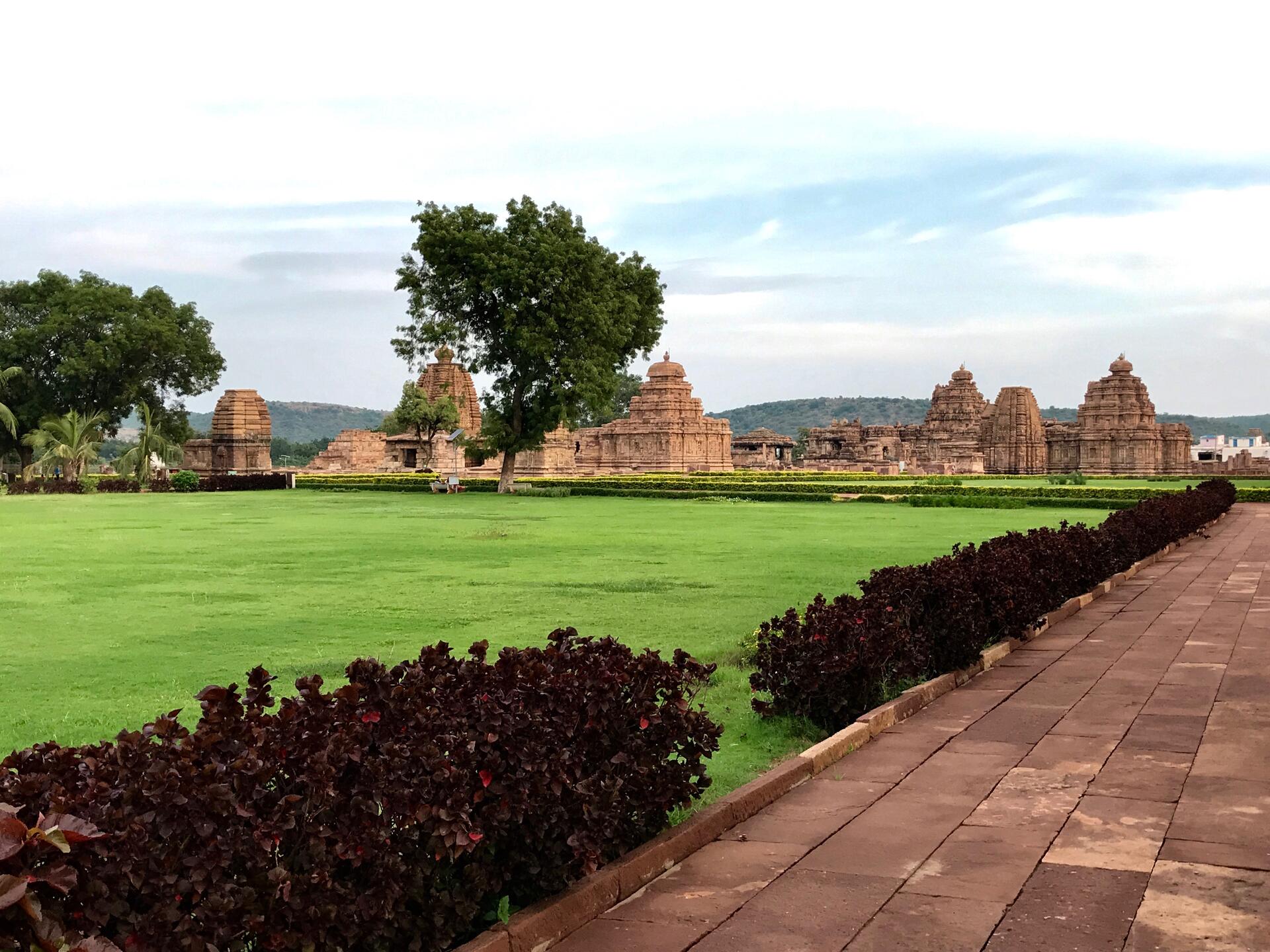
© Ms Sarah Welch, CC BY-SA 4.0 Resized from original. (This derivative is under the same CC BY-SA license.)
World Heritage Research
Discover scientific research and academic studies that deepen our understanding of Group of Monuments at Pattadakal from its history and significance to its conservation, management, and contemporary challenges.
-
Patrons of Art and Faith: A History of Temple Building under the Badami Chalukyas
The Badami Chalukyas (circa 543–757 CE) revolutionized South and Central Indian temple architecture by synthesizing indigenous Dravida and Nagara styles into the distinctive Vesara style, establishing a lasting architectural legacy that influenced subsequent dynasties. This study reveals how temple construction under Chalukyan monarchs like Pulakeshin II and Vikramaditya I served as both a manifestation of devout faith and a sophisticated political tool for legitimation, territorial integration, and imperial hegemony in early medieval peninsular India. Through analysis of epigraphical evidence, sculptural iconography, trade networks, and economic structures, the research demonstrates that these monumental sanctuaries functioned as institutional anchors, tethering nascent regional states to an overarching Puranic cosmology while facilitating long-term socioeconomic cohesion across diverse ethnic and agrarian communities. The evolution of structural engineering under the Chalukyas also showcased unprecedented mastery over material science, transforming native sandstone into complex spatial geometries that visually articulated divine right and cosmic hierarchy.
Bramaramba S M. (2025). Patrons of Art and Faith: A History of Temple Building under the Badami Chalukyas. Reutlingen Group. https://doi.org/10.5281/ZENODO.22727032
View Publication Record | Read Publication -
“Wonder of Sciences and Technology Behind Magnificent Indian Temples which Leads These to UNESCO World Heritage list” A Review
Indian temples, recognized for their architectural brilliance and cultural significance, stand as testaments to the advanced science and technology of ancient Indian engineers. These structures, dating back to the 6th–7th centuries, have been consistently added to UNESCO's World Heritage list since 1983 due to their exceptional design and innovation. The study reviews the scientific principles behind these temples, including structural engineering, material science, and acoustics, which contribute to their durability, aesthetic appeal, and functional sophistication. It highlights how temples like those in Pattadakal, Ellora, Konark, and Khajuraho exemplify India's rich heritage of integrating religious, spiritual, and technological achievements. The research synthesizes historical records and architectural analysis to underscore the enduring legacy of Indian engineering, which continues to inspire global recognition.
Chaudhari, A. (2024). Wonder of sciences and technology behind magnificent Indian temples which Leads These to UNESCO World Heritage list” A Review. International Journal for Multidisciplinary Research, 6(4). https://doi.org/10.36948/ijfmr.2024.v06i04.24239
View Publication Record | Read Publication