World Heritage Identification Number: 455
World Heritage since: 1988
Category: Mixed Cultural Heritage and Natural Heritage
WHE Type: Religious Sites & Sacred Architecture
Transboundary Heritage: No
Endangered Heritage: No
Country: 🇬🇷 Greece
Continent: Europe
UNESCO World Region: Europe and North America
Map
Meteora: Monastic Complexes on Towering Sandstone Pinnacles
Meteora, located in the Trikala regional unit of Thessaly in central mainland Greece, is a unique and captivating landscape that serves as the home to one of the most significant Eastern Orthodox monastery complexes in the world. Inscribed as a UNESCO World Heritage Site in 1988, this sanctuary seamlessly weaves together history, art, and natural beauty.
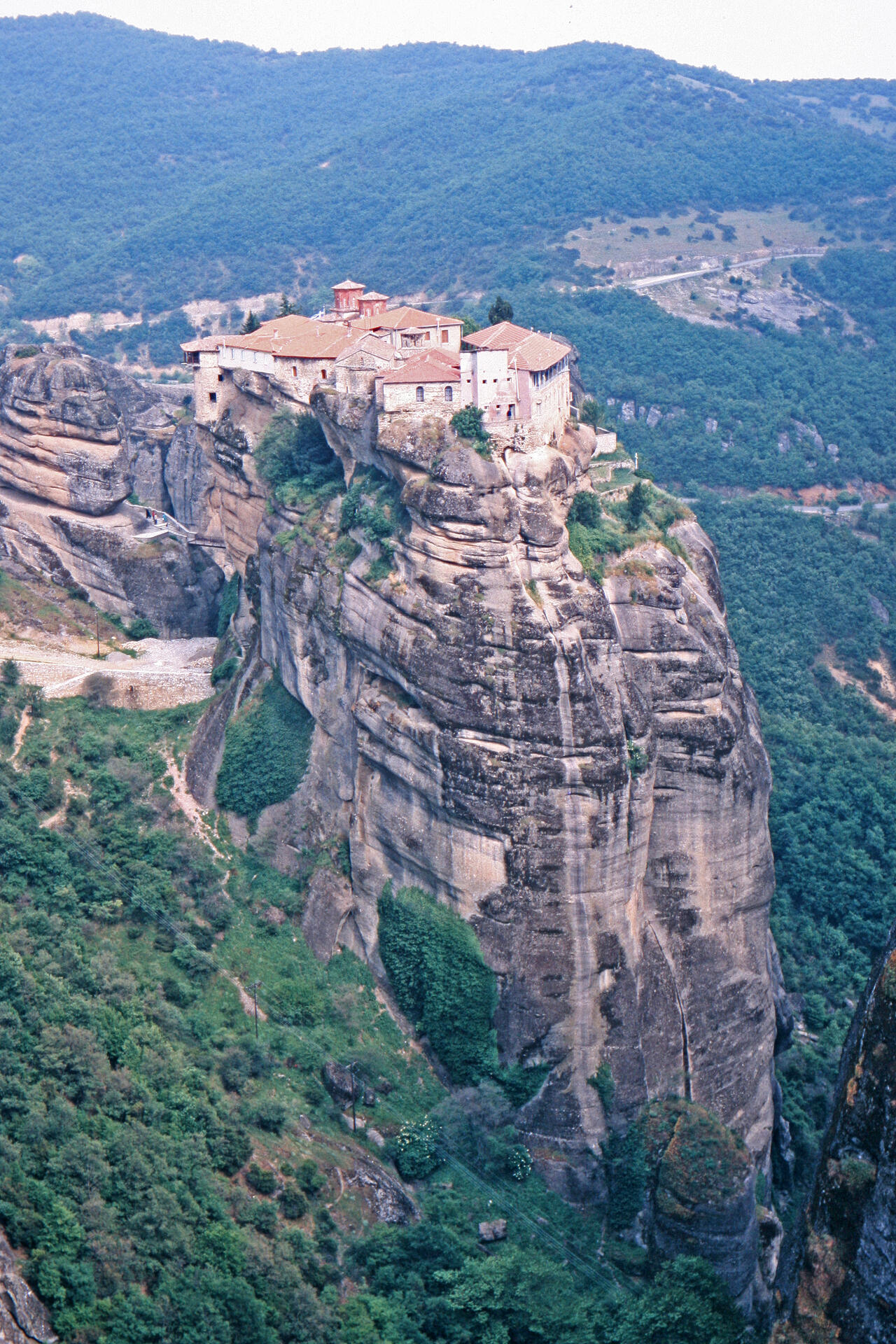
The term "Meteora" is commonly translated as "suspended in the air" or "hovering in the heavens," aptly describing the location of these monasteries atop towering rock pillars. These spectacular sandstone and conglomerate formations rise dramatically hundreds of meters above the surrounding plains, creating a breathtaking and seemingly otherworldly scene.
The extraordinary landscape of Meteora is the result of geological processes that unfolded over millions of years. The towering rock formations consist primarily of sandstone and conglomerate deposits that were gradually shaped by erosion, weathering, and tectonic activity. As rivers and natural forces sculpted the terrain, they left behind the massive pillars that now dominate the region, creating one of the most distinctive geological landscapes in Europe.
The origins of the Meteora monasteries can be traced back to the 11th century, when hermit monks began settling in caves and on these inaccessible rock formations. However, it was during the 14th and 15th centuries that the monastic community experienced its greatest expansion and the majority of the monasteries were established. Despite the immense challenges posed by the rugged terrain, monks persevered, creating homes and places of worship in these seemingly impossible locations.
A decisive moment in Meteora's history came during the 14th century with the arrival of Athanasios the Meteorite, a monk who established the first organized monastic community on the rocks. He founded the Great Meteoron Monastery, which became the largest and most influential monastery in the complex. During a period of political instability and frequent invasions in the late Byzantine era, the inaccessible cliffs of Meteora provided both security and seclusion, allowing monastic life to flourish.
Twenty-four monasteries were established during the height of Meteora's monastic development in the 14th and 15th centuries. Although many were later abandoned or fell into ruin, six remain active today: Great Meteoron Monastery, Varlaam Monastery, Rousanou Monastery, St. Nicholas Anapausas Monastery, Holy Trinity Monastery, and St. Stephen's Monastery. Together, they preserve the spiritual traditions and cultural heritage of Meteora while continuing to attract visitors from around the world.
One of the most striking features of the Meteora monasteries is their architectural style. Built atop steep rock pillars, these structures appear to defy gravity. Today, access is provided by bridges and stairways carved into the rock, although in earlier centuries monks and visitors relied on ropes, ladders, and nets to reach the monasteries. The construction methods used to build these remarkable structures remain a testament to the ingenuity, determination, and faith of their builders.
In addition to their architectural significance, the Meteora monasteries are renowned for their rich artistic heritage. The 16th-century frescoes preserved within these sacred spaces represent a crucial stage in the development of post-Byzantine painting. These vibrant and intricate works offer a visual testament to the religious beliefs, artistic achievements, and cultural traditions of the period.
Beyond their architectural and artistic significance, the monasteries of Meteora have played an important role in preserving the spiritual and cultural heritage of Eastern Orthodoxy. For centuries, they safeguarded valuable manuscripts, religious texts, icons, and historical documents that might otherwise have been lost during periods of conflict and upheaval. Today, these collections provide valuable insights into Byzantine and post-Byzantine history, while continuing to serve as symbols of faith, learning, and cultural continuity.
Today, Meteora stands as a symbol of human resilience, creativity, and spiritual devotion. It attracts visitors from around the world, who come to marvel at its dramatic natural beauty, explore its historical monuments, and witness the enduring legacy of the monastic communities that have inhabited these extraordinary rock pinnacles for centuries.
Altogether, Meteora represents a unique fusion of nature, history, and culture. Its towering rock formations, crowned with ancient monasteries and adorned with magnificent frescoes, stand as a testament to the enduring power of faith and human perseverance. As a UNESCO World Heritage Site, Meteora continues to inspire awe and wonder, inviting visitors to experience a landscape where history, spirituality, and natural beauty converge between earth and sky.
UNESCO Description of the World Heritage Site
In a region of almost inaccessible sandstone peaks, monks settled on these 'columns of the sky' from the 11th century onwards. Twenty-four of these monasteries were built, despite incredible difficulties, at the time of the great revival of the eremetic ideal in the 15th century. Their 16th-century frescoes mark a key stage in the development of post-Byzantine painting.
UNESCO Justification of the World Heritage Site
Criterion (i): “Suspended in the air” (the meaning of Meteora in Greek), these monasteries represent a unique artistic achievement and are one of the most forceful examples of the architectural transformation of a site into a place of retreat, meditation and prayer.
Criterion (ii): The frescoes executed in 1527 by Theophanes the Cretan became the basic reference of the fundamental iconographic and stylistic features of post-Byzantine painting, which exerted widespread, long-lasting influence.
Criterion (iv): The Meteora provide an outstanding example of the types of monastic construction which illustrate a significant stage in history, that of the 14th and 15th centuries when the hermitic ideals of early Christianity were restored to a place of honour by monastic communities, both in the western world (in Tuscany, for example) and in the Orthodox church.
Criterion (v): Built under impossible conditions, with no practicable roads, permanent though precarious human habitations subsist to this day in the Meteora, but have become vulnerable under the impact of time. The net in which intrepid pilgrims were hoisted up vertically alongside the 373-meter cliff where the Varlaam monastery dominates the valley symbolizes the fragility of a traditional way of life that is threatened with extinction.
Criterion (vii): The property lies within, and is surrounded by, an area of exceptional natural beauty and aesthetic importance. Rising over 400 m above ground level, the sandstone peaks on which the monasteries are perched were created 60 million years ago from deltaic river deposits. These have subsequently been transformed by earthquakes and sculpted by rain and wind into a variety of spectacular shapes.
Encyclopedia Record: Meteora
The Meteora is a rock formation in the regional unit of Trikala, in Thessaly, in northwestern Greece, hosting one of the most prominent complexes of Eastern Orthodox monasteries, viewed locally as second in importance only to Mount Athos. Their height is more than 20m.Additional Site Details
Area: 271.87 hectares
Number of Components: 1
(ii) — Significant interchange of human values
(iv) — Outstanding example of a type of building or landscape
(v) — Outstanding example of traditional human settlement
(vii) — Contains superlative natural phenomena or beauty
Coordinates: 39.71667 , 21.63333
IUCN World Heritage Outlook
The 2025 Conservation Outlook on Meteora reports the following assessment:
Source: International Union for Conservation of Nature (IUCN) · View assessment
Image
© W. Bulach, CC BY-SA 4.0 Resized from original. (This derivative is under the same CC BY-SA license.)
World Heritage Research
Discover scientific research and academic studies that deepen our understanding of Meteora from its history and significance to its conservation, management, and contemporary challenges.
-
Geospatial Tool Development for the Management of Historical Hiking Trails—The Case of the Holy Site of Meteora
A geospatial tool has been developed to manage historical hiking trails, combining authoritative and crowdsourced data for sustainable preservation. This methodology, tested at the UNESCO World Heritage Site of Meteora, integrates professional surveys with multimedia documentation into a relational database using ArcGIS Pro. The tool features advanced functionalities such as pop-ups, dynamic trail profiles, and multimedia information, while also supporting continuous feedback and efficiency monitoring. It aims to address overcrowding and ensure the long-term sustainability of this globally significant site, with potential for broader application across Greece's historic trail network.
Potsiou, C., Ioannidis, C., Soile, S., Boutsi, A.-M., Chliverou, R., Apostolopoulos, K., Gkeli, M., & Bourexis, F. (2023). Geospatial Tool Development for the Management of Historical Hiking Trails—The Case of the Holy Site of Meteora. Land, 12(8), 1530. https://doi.org/10.3390/land12081530
View Publication Record | Read Publication -
The Need for Geoethical Awareness: The Importance of Geoenvironmental Education in Geoheritage Understanding in the Case of Meteora Geomorphes, Greece
A significant gap exists between students' understanding of geological heritage and their awareness of environmental responsibility, particularly concerning Meteora's geomorphes. The study highlights that while students recognize the cultural and aesthetic significance of these sites, they lack a comprehensive grasp of their geological importance or an ethical framework for conservation. This research underscores the urgent need for strategic geoenvironmental education integration in school curricula to foster a deeper appreciation and sense of stewardship towards geocultural heritage. The findings were derived from structured questionnaires administered to junior high school students and university students, revealing a critical disconnect between their knowledge and values regarding geological and cultural heritage.
Georgousis, E., Savelides, S., Mosios, S., Holokolos, M.-V., & Drinia, H. (2021). The Need for Geoethical Awareness: The Importance of Geoenvironmental Education in Geoheritage Understanding in the Case of Meteora Geomorphes, Greece. Sustainability, 13(12), 6626. https://doi.org/10.3390/su13126626
View Publication Record | Read Publication -
Mapping Pathways to Heaven: A Topographical Engraving of Meteora (1782)
A late 18th-century topographical engraving of Meteora, the second-largest monastic complex in Greece and a UNESCO World Heritage Site, reveals how cartographic principles merged with Byzantine artistic traditions to create a unique visual representation. This 1782 print serves as both a mental map reflecting monks' perceptions of the region and a promotional tool during a period of political instability. The engraving's dual purpose—simultaneously concealing harsh terrestrial conditions while highlighting spiritual pathways—offers insight into vernacular Greek cartographic practices and the cultural significance of Meteora. The study analyzes this rare artifact to uncover its historical and artistic value, situating it within broader trends in Greek mapping and monastic visualization.
della Dora, V. (2013). Mapping Pathways to Heaven: A Topographical Engraving of Meteora (1782). Imago Mundi, 65(2), 217–233. https://doi.org/10.1080/03085694.2013.784567
View Publication Record | Read Publication