World Heritage Identification Number: 454
World Heritage since: 1988
Category: Mixed Cultural Heritage and Natural Heritage
WHE Type: Religious Sites & Sacred Architecture
Transboundary Heritage: No
Endangered Heritage: No
Country: 🇬🇷 Greece
Continent: Europe
UNESCO World Region: Europe and North America
Map
Mount Athos: A Holy Mountain of Orthodox Spirituality
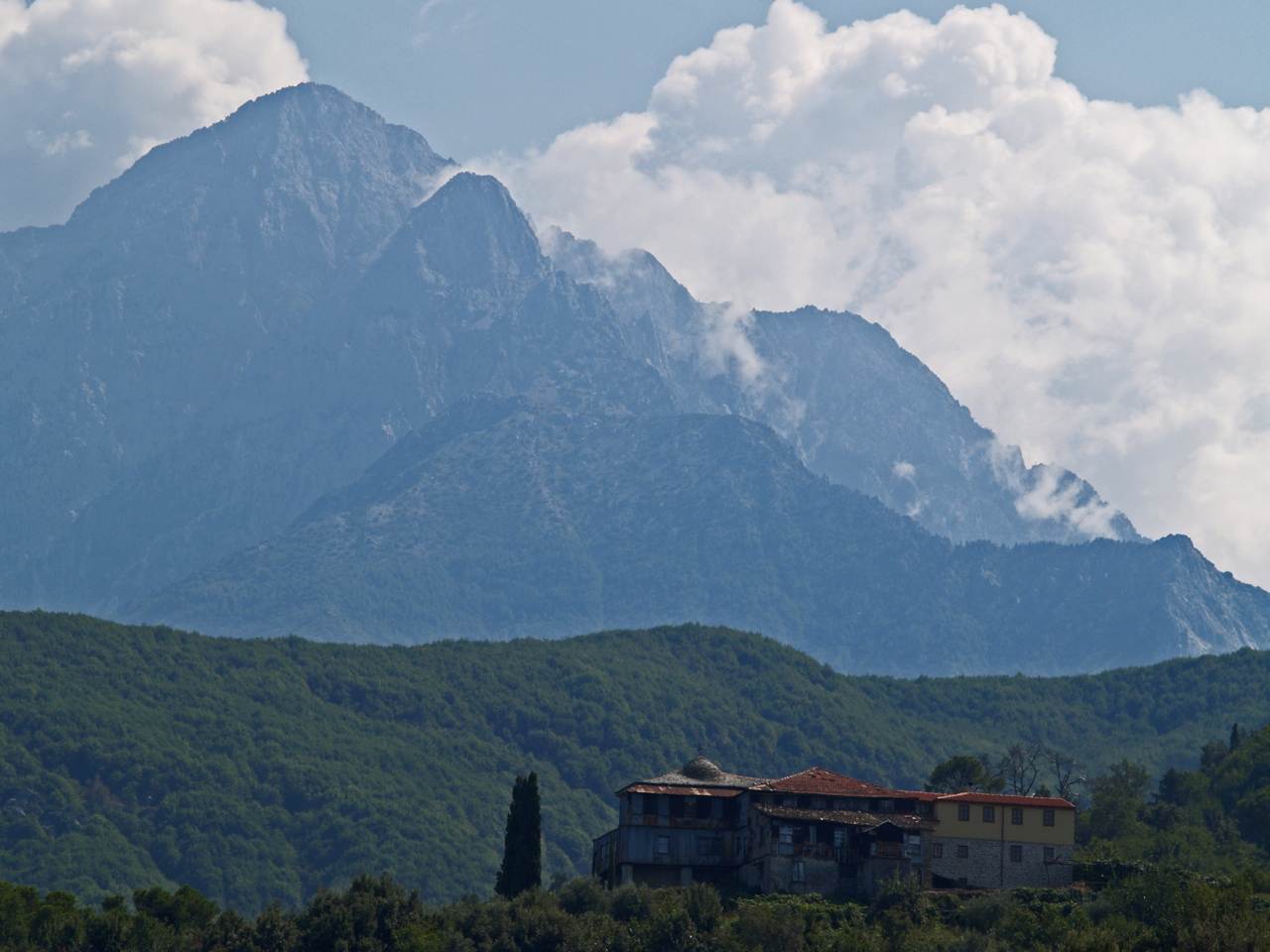
Mount Athos, officially known as the Autonomous Monastic State of the Holy Mountain, is a unique and sacred destination located on the Athos Peninsula in northeastern Greece. This rugged and picturesque mountain range, with its dramatic cliffs plunging into the Aegean Sea, has been a sanctuary of Orthodox Christian monasticism since the 10th century. In recognition of its historical, cultural, and religious significance, Mount Athos was inscribed as a UNESCO World Heritage Site in 1988.
More to come…UNESCO Description of the World Heritage Site
An Orthodox spiritual centre since 1054, Mount Athos has enjoyed an autonomous statute since Byzantine times. The 'Holy Mountain', which is forbidden to women and children, is also a recognized artistic site. The layout of the monasteries (about 20 of which are presently inhabited by some 1,400 monks) had an influence as far afield as Russia, and its school of painting influenced the history of Orthodox art.
UNESCO Justification of the World Heritage Site
Criterion (i): The transformation of a mountain into a sacred place made Mount Athos a unique artistic creation combining the natural beauty of the site with the expanded forms of architectural creation. Moreover, the monasteries of Athos are a veritable conservatory of masterpieces ranging from wall paintings (such as the works by Manuel Panselinos at Protaton Church ca. 1290 and by Frangos Catellanos at the Great Lavra in 1560) to portable icons, gold objects, embroideries and illuminated manuscripts which each monastery jealously preserves.
Criterion (ii): Mount Athos exerted lasting influence in the Orthodox world, of which it is the spiritual centre, on the development of religious architecture and monumental painting. The typical layout of Athonite monasteries was used as far away as Russia. Iconographic themes, codified by the school of painting at Mount Athos and laid down in minute detail in the Guide to Painting (discovered and published by Didron in 1845), were used and elaborated on from Crete to the Balkans from the 16th century onwards.
Criterion (iv): The monasteries of Athos present the typical layout of Orthodox monastic establishments: a square, rectangular or trapezoidal fortification flanked by towers, which constitutes the peribolos of a consecrated place, in the centre of which the community's church, or the catholicon, stands alone. Strictly organised according to principles dating from the 10th century are the areas reserved for communal activities (refectory, cells, hospital, library), those reserved solely for liturgical purposes (chapels, fountains), and the defence structures (arsenal, fortified towers). The organization of agricultural lands in the idiorrythmic sketae (daughter houses of the monasteries), the kellia and kathismata (living units operated by the monks) is also very characteristic of the medieval period.
Criterion (v): The monastic ideal at Mount Athos has preserved traditional human habitations, which are representative of the agrarian cultures of the Mediterranean and have become vulnerable through the impact of change within contemporary society. Mount Athos is also a conservatory of vernacular architecture as well as agricultural and craft traditions.
Criterion (vi): An Orthodox spiritual centre since the 10th century, the sacred mountain of Athos became the principal spiritual home of the Orthodox Church in 1054. It retained this prominent role even after the fall of Constantinople in 1453 and the establishment of the autocephalous patriarchy of Moscow in 1589. Mount Athos is directly and tangibly associated with the history of Orthodox Christianity which, in varying degrees, is present in more than 20 nations in the 20th century. It is no exaggeration to say that this thousand-year-old site, where the weight of history is palpable in the countryside, the monuments and the precious collections have been built up over time, has retained even today its universal and exceptional significance.
Criterion (vii): The harmonious interaction of traditional farming practices and forestry is linked to the stringent observance of monastic rules over the course of centuries, which has led to the excellent preservation of the Mediterranean forests and associated flora of Mount Athos.
Encyclopedia Record: Mount Athos
Mount Athos is a mountain on the Athos peninsula in northeastern Greece directly on the Aegean Sea. It is an important center of Eastern Orthodox monasticism.Additional Site Details
Area: 33,042.3 hectares
Number of Components: 1
(ii) — Significant interchange of human values
(iv) — Outstanding example of a type of building or landscape
(v) — Outstanding example of traditional human settlement
(vi) — Directly associated with events or living traditions
(vii) — Contains superlative natural phenomena or beauty
Coordinates: 40.26667 , 24.21667
IUCN World Heritage Outlook
The 2025 Conservation Outlook on Mount Athos reports the following assessment:
Source: International Union for Conservation of Nature (IUCN) · View assessment
World Heritage Research
Discover scientific research and academic studies that deepen our understanding of Mount Athos from its history and significance to its conservation, management, and contemporary challenges.
-
Long Term Post-Fire Vegetation Dynamics in North-East Mediterranean Ecosystems. The Case of Mount Athos Greece
A 30-year study on Mount Athos, Greece, reveals that post-fire vegetation recovery varies significantly between forest and maquis communities. While forests recover quickly, maintaining their structure and composition, maquis communities require several years to regain pre-fire characteristics due to the region's dry climatic conditions. The research employed field data collection, TWINSPAN for plant community identification, CART for distribution analysis, and NDVI from Landsat images for long-term monitoring. This study underscores the need for wildfire control measures in the face of climate change, which is expected to exacerbate drought conditions in the north-east Mediterranean region.
Xofis, P., Buckley, P. G., Takos, I., & Mitchley, J. (2021). Long Term Post-Fire Vegetation Dynamics in North-East Mediterranean Ecosystems. The Case of Mount Athos Greece. Fire, 4(4), 92. https://doi.org/10.3390/fire4040092
View Publication Record | Read Publication -
Risk, faith and religious tourism in Second Modernity: visits to Mount Athos in the COVID-19 era
Religious tourism destinations, such as Mount Athos, exhibit remarkable resilience to global health risks like the COVID-19 pandemic. This study highlights how pilgrims and visitors adapted their behavior despite heightened health concerns, underscoring the enduring significance of faith-driven travel even in times of crisis. Using a questionnaire-based approach, researchers analyzed respondents' attitudes toward faith, socio-cultural backgrounds, and preferences for past and future visits. The findings challenge narratives of vulnerability in 'Risk Society' and 'Second Modernity,' demonstrating that religious motivations can outweigh health-related deterrents. This research contributes to understanding the interplay between risk perception and spiritual tourism in contemporary society.
Tsironis, C. N., Sylaiou, S., & Stergiou, E. (2021). Risk, faith and religious tourism in Second Modernity: visits to Mount Athos in the COVID-19 era. Journal of Heritage Tourism, 17(5), 516–532. https://doi.org/10.1080/1743873x.2021.2007252
View Publication Record | Read Publication -
Assessing Wildfire Risk in Cultural Heritage Properties Using High Spatial and Temporal Resolution Satellite Imagery and Spatially Explicit Fire Simulations: The Case of Holy Mount Athos, Greece
Nine out of the 20 monasteries on Holy Mount Athos, Greeceface high fire intensity risks if ignited, despite low burn probabilities. This finding emerges from a study that combined high-resolution satellite imagery with spatially explicit fire simulations to assess wildfire risk at landscape level. Researchers developed site-specific fuel models using field measurements and classified fuel types through object-based analysis and machine learning. The Minimum Travel Time (MTT) algorithm in FlamMap software evaluated metrics like Burn Probability, Conditional Flame Length, Fire Size, and Source-Sink Ratio. Results highlight the need for targeted fire suppression strategies to protect these cultural heritage properties from intense wildfires.
Mallinis, G., Mitsopoulos, I., Beltran, E., & Goldammer, J. (2016). Assessing Wildfire Risk in Cultural Heritage Properties Using High Spatial and Temporal Resolution Satellite Imagery and Spatially Explicit Fire Simulations: The Case of Holy Mount Athos, Greece. Forests, 7(2), 46. https://doi.org/10.3390/f7020046
View Publication Record | Read Publication -
Mount Athos and Byzantine Monasticism
Mount Athos stands as a pivotal pillar of Orthodox Christianity and Byzantine history. Its monastic communities, established early on, wielded significant spiritual, political, and economic influence that extended beyond the Byzantine Empire's borders. The site's archives and libraries preserve an unparalleled body of Byzantine documentation, art, and archaeology, offering invaluable insights into a lost era. This volume, derived from the 28th Spring Symposium of Byzantine Studies, synthesizes international research on Athos, exploring diverse aspects such as asceticism, authority, economy, spirituality, and more. Through meticulous investigation of its archives and artifacts, scholars have uncovered substantial evidence that illuminates the complex phenomenon of Byzantine monasticism, providing a comprehensive view of this influential institution's role in shaping Orthodox Christianity.
Bryer, A., & Cunningham, M. (2016). Mount Athos and Byzantine Monasticism. https://doi.org/10.4324/9781315248622
View Publication Record | Read Publication -
Management of Living Religious Heritage: Who Sets the Agenda? The Case of the Monastic Community of Mount Athos
Heritage management at Mount Athos reveals that top-down decision-making by monastic authorities often sidelines heritage professionals. KEDAK, the agency tasked with preserving Athonite heritage, operates under strict control of the monasteries, leading to compromises in professional expertise. The study highlights tensions between expert-driven and community-based approaches, demonstrating how religious authority can dominate heritage conservation processes.
Alexopoulos, G. (2013). Management of Living Religious Heritage: Who Sets the Agenda? The Case of the Monastic Community of Mount Athos. Conservation and Management of Archaeological Sites, 15(1), 59–75. https://doi.org/10.1179/1350503313z.00000000047
View Publication Record | Read Publication