
World Heritage Identification Number: 509
World Heritage since: 1989
Category: Natural Heritage
WHE Type: Natural Landscapes & Geographic Features
Transboundary Heritage: Yes
Endangered Heritage: No
Country: Zambia, Zimbabwe
Continent: Africa
UNESCO World Region: Africa
Map
Mosi-oa-Tunya: The Majesty of Victoria Falls
Mosi-oa-Tunya, also known as Victoria Falls, is a breathtaking natural wonder situated on the border between Zambia and Zimbabwe. Inscribed as a UNESCO World Heritage Site in 1989, these falls have been recognized for their unparalleled beauty and ecological significance.
The falls were named ‘Victoria Falls’ in 1855 by explorer David Livingstone in honor of Queen Victoria of the United Kingdom. The indigenous Tonga people have long referred to the falls as Mosi-oa-Tunya, meaning 'the smoke that thunders', a reference to the immense spray and roaring sound produced by the cascading waters.
Long before European explorers arrived in the region, the area surrounding Mosi-oa-Tunya held profound cultural and spiritual importance for indigenous communities, particularly the Tonga people. Archaeological evidence indicates that humans have inhabited the region for thousands of years, relying on the Zambezi River for food, transportation, and trade. For many local communities, the falls were regarded not merely as a geographical feature but as a sacred place associated with ancestral traditions, spiritual beliefs, and oral history.
Stretching over a width of 1,708 meters (5,604 feet), Victoria Falls is one of the world’s largest waterfalls and forms the world’s largest single curtain of falling water. The Zambezi River, which is typically more than 2 kilometers wide at this point, plunges into a series of deep basalt gorges, creating a awe-inspiring natural display. The sheer volume of water and the height of the falls result in an iridescent mist that can be observed up to 20 kilometers away.
Victoria Falls is composed of several distinct sections, each with its own unique characteristics and viewpoints. From west to east, the waterfall is generally divided into the Devil’s Cataract, Main Falls, Horseshoe Falls, Rainbow Falls, and the Eastern Cataract. Among these, Rainbow Falls is the tallest section, while the Main Falls carry the greatest volume of water during peak flow periods. Together, these sections form a continuous curtain of cascading water that contributes to the falls’ reputation as one of the most spectacular natural wonders on Earth.
The geology of the area contributes significantly to the unique character of the falls. Victoria Falls was formed as the Zambezi River eroded through a basalt plateau marked by fractures and fault lines, carving a sequence of steep gorges over thousands of years. The falls drop approximately 108 meters (354 feet) at their highest point, producing a dramatic landscape of roaring water, dense spray, and vibrant rainbows that frequently appear above the gorge.
The appearance and intensity of Victoria Falls change dramatically throughout the year in response to seasonal rainfall patterns across the Zambezi basin. During the peak flood season, typically between February and May, enormous volumes of water thunder over the cliffs, generating towering clouds of mist and deafening sound. In the drier months, water levels recede significantly, exposing sections of the rock face and allowing visitors to observe the geological structure of the gorge more clearly.
In addition to its visual grandeur, Mosi-oa-Tunya supports a rich and diverse ecosystem. The constant spray from the falls sustains a unique rainforest ecosystem that thrives even during the dry season and supports numerous endemic and threatened plant species. The surrounding region is also home to a wide range of wildlife, including elephants, hippopotamuses, crocodiles, and an impressive variety of birdlife.
The region's biodiversity is further enriched by the presence of the Zambezi River itself, which provides vital habitat for aquatic life and acts as a crucial migration corridor for various species. One of the most famous sections of the falls is the Devil’s Cataract, located at the western end of Victoria Falls and known for its especially turbulent waters.
Visitors to Victoria Falls can enjoy a wide range of activities, from guided nature tours to adventure experiences such as white-water rafting, bungee jumping, helicopter flights, and scenic river cruises. Local communities also offer cultural experiences that provide insight into the traditions and heritage of the Tonga people, who have lived in the region for generations.
Despite its enduring grandeur, Victoria Falls faces growing environmental pressures linked to climate change, fluctuating rainfall patterns, and increasing tourism activity. Periods of severe drought in southern Africa have occasionally reduced water flow in parts of the falls, raising concerns about the long-term sustainability of the surrounding ecosystem.
Conservation efforts by local authorities, environmental organizations, and UNESCO aim to preserve the site’s ecological integrity while balancing tourism development with environmental protection. These initiatives are essential to safeguarding one of the world’s most remarkable natural landmarks for future generations.
In summary, Victoria Falls stands as one of the world’s most extraordinary natural landmarks and a powerful testament to the beauty and force of nature. Its UNESCO World Heritage designation reflects not only its scenic magnificence but also its global ecological importance. As a destination for travelers seeking adventure, culture, and natural wonders, Mosi-oa-Tunya continues to captivate and inspire those fortunate enough to witness its majesty.
UNESCO Description of the World Heritage Site
These are among the most spectacular waterfalls in the world. The Zambezi River, which is more than 2 km wide at this point, plunges noisily down a series of basalt gorges and raises an iridescent mist that can be seen more than 20 km away.
UNESCO Justification of the World Heritage Site
Criterion (vii): The Mosi-oa-Tunya/Victoria Falls is the largest curtain of falling water in the world; it is 1708 m wide and with up to 500 million litres per minute descending at 61 m (Devil’s Cataract), 83 m (Main Falls), 99 m (Rainbow Falls), 98 m (Eastern Cataract). Eight spectacular gorges of igneous origin (i.e. comprising basalts) and several islands in the core zone serve as breeding sites for four endangered and migratory bird species, such as the Taita Falcon and Black Eagle. The riverine 'rainforest' within the waterfall splash zone is a fragile ecosystem of discontinuous forest on sandy alluvium, dependent upon maintenance of abundant water and high humidity resulting from the spray plume of about 500 m (at maximum height) that can be seen from a distance of 50 km and 30 km from Bulawayo and Lusaka roads respectively. A direct frontage viewing of the falls is possible from both Zambia and Zimbabwe.
Criterion (viii): The Mosi-oa-Tunya/Victoria Falls and associated eight steep sided gorges have been formed through the changing waterfall positions over a geological time scale. The gorges are an outstanding example of river capture and the erosive forces of the water still continue to sculpture the hard basalts. These gorges take a zigzag course of a distance of about 150 km along the Zambezi River below the falls. Seven previous waterfalls occupied the seven gorges below the present falls, and the Devil's Cataract in Zimbabwe is the starting point for cutting back to a new waterfall. In addition, an aerial view of the falls shows possible future waterfall positions. Upstream are a spectacular series of riverine islands formed during the ongoing geological and geomorphological processes. The property is characterized by banded basalt of ancient lava flow, Kalahari sandstones and chalcedony out of which stone artefacts of Homo habilis dating three million years, stone tools of the middle Stone Age and weapons, adornments and digging tools of the late Stone Age that indicate occupation by hunter-gatherers.
Encyclopedia Record: Victoria Falls
Victoria Falls is a waterfall on the Zambezi River, located on the border between Zambia and Zimbabwe. It is one of the world's largest waterfalls, with a width of 1,708 m (5,604 ft). The region around it has a high degree of biodiversity in both plants and animals.Additional Site Details
Area: 6,860 hectares
Number of Components: 1
(viii) — Outstanding example representing major earth stages
Coordinates: -17.92453 , 25.85539
IUCN World Heritage Outlook
The 2025 Conservation Outlook on Mosi-oa-Tunya / Victoria Falls reports the following assessment:
Source: International Union for Conservation of Nature (IUCN) · View assessment
Image
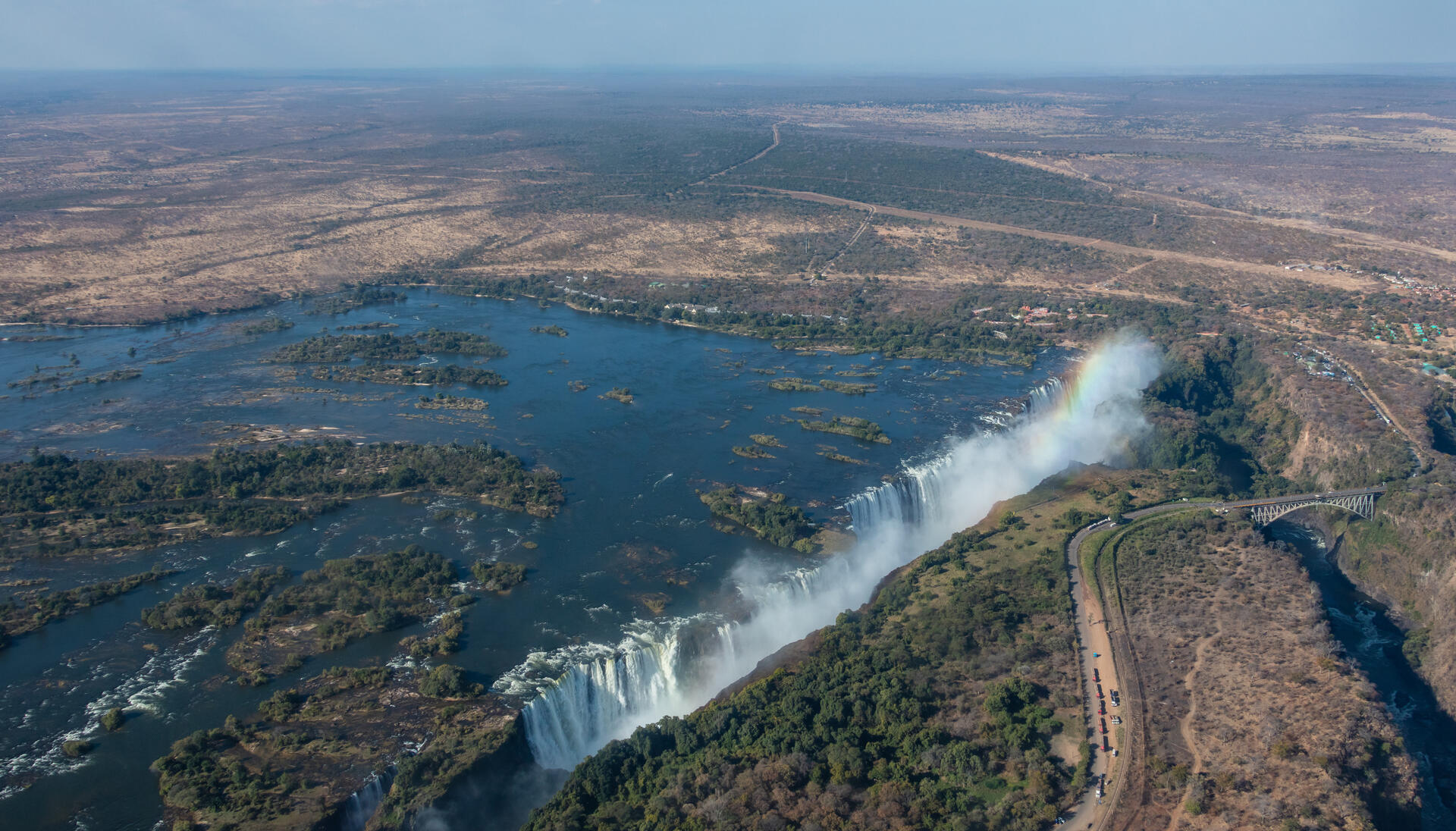
© Diego Delso, CC BY-SA 4.0 Resized from original. (This derivative is under the same CC BY-SA license.)
World Heritage Research
Discover scientific research and academic studies that deepen our understanding of Mosi-oa-Tunya / Victoria Falls from its history and significance to its conservation, management, and contemporary challenges.
-
Investigation of Anthrax Outbreak in Wildlife of Mosi-oa-Tunya National Park and Adjacent Communities-Livingstone District, Zambia, October-November 2025
An anthrax outbreak in Mosi-oa-Tunya National Park, Zambia, was confirmed through tissue sampling, revealing high case fatality rates (43.9%) among captive lions and delayed public health responses. The study used descriptive epidemiology, spatial mapping with QGIS, and structured questionnaires to assess knowledge and practices. Findings highlighted significant delays in detection, notification, and response, along with risky community behaviors such as handling contaminated meat. Recommendations include multisectoral engagement for safe carcass disposal to mitigate future outbreaks.
Sichalwe, M., Banda, H., Bwalya, G., Maata, L., Bowa, B., Hazyondo, M., Musalo, B., Chibale, C., Mulopa, P., Banda, D., & Sinyange, N. (2026). Investigation of Anthrax Outbreak in Wildlife of Mosi-oa-Tunya National Park and Adjacent Communities-Livingstone District, Zambia, October-November 2025. The Health Press Zambia, 10(1). https://doi.org/10.65715/thp.v10i1.49
View Publication Record | Read Publication -
Aesthetic Values, Transboundary River Protection, and the Zambezi River Basin
International water law principles, including equitable utilization and the no significant harm principle, can enhance the protection of the Zambezi River Basin by addressing its aesthetic cultural values. The study highlights the basin's global recognition for its natural beauty, exemplified by Mosi-oa-Tunya / Victoria Falls and Mana Pools National Park. Despite well-developed transboundary cooperation through the Southern African Development Community Treaty, threats from proposed dam development and mining pollution persist. Integrating sustainable development principles and protected areas conventions into legal frameworks offers a pathway to mitigate these risks while preserving the basin's aesthetic and ecological integrity.
Campbell, S. (2026). Aesthetic Values, Transboundary River Protection, and the Zambezi River Basin. Cultural Values and Transboundary River Protection under International Environmental Law, 137–154. https://doi.org/10.4324/9781003494836-10
View Publication Record | Read Publication -
High intragenotypic diversity, serogroup heterogeneity, and recombination of African swine fever virus strains circulating in sylvatic and domestic hosts
African swine fever virus (ASFV) exhibits high intragenotypic diversity, serogroup heterogeneity, and recombination among sylvatic and domestic hosts in Zambia. While genotype I viruses dominate in Mosi-oa-Tunya National Park, genotypes XII and XIV were detected in South Luangwa and Kafue National Parks, respectively, with lower ASFV detection rates in ticks compared to previous reports. Warthogs showed high seroprevalence but no detectable viral DNA. Genotype I viruses displayed marked heterogeneity, including multiple p54/CVR variants and seven CD2v lineages, suggesting recombination-driven diversification contributing to genotypes II, XII, and XIV. These findings underscore the need for broadly protective vaccines that account for intragenotypic diversity, antigenic heterogeneity, and recombination in endemic regions.
Chambaro, H. M., Fandamu, M., Blair, B., Sasaki, M., Qiu, Y., Muuka, G., Shawa, M., Chizimu, J., Osei-Bonsu, J., Mumba, C., Fandamu, P., Orba, Y., Lowe, J., Sawa, H., Ambagala, A., Muleya, W., & Simulundu, E. (2026). High intragenotypic diversity, serogroup heterogeneity, and recombination of African swine fever virus strains circulating in sylvatic and domestic hosts. Scientific Reports. https://doi.org/10.1038/s41598-026-64206-3
View Publication Record | Read Publication -
Post-COVID-19 Review: Challenges and Determinants of E-Learning Adoption with a Focus on Heritage-Based Curriculum in Victoria Falls Cluster, Hwange District Secondary Schools, Zimbabwe
A post-COVID-19 analysis of e-learning adoption in Victoria Falls Cluster schools in Zimbabwe reveals significant barriers hindering effective implementation, including inadequate teacher training, lack of resources, and negative attitudes from both teachers and students. The study, involving 85 respondents (5 head teachers, 65 teachers, and 201 students), highlights the need for a multi-stakeholder approach to address these challenges through in-service training, increased resource provision, and curriculum adjustments. Aligning with Education 5.0 principles, the research advocates for integrating indigenous knowledge and technology to foster self-reliance in education. This study provides critical insights into e-learning dynamics in resource-constrained settings, offering a foundation for future educational resilience.
Mutale, J. (2025). Post-COVID-19 Review: Challenges and Determinants of E-Learning Adoption with a Focus on Heritage-Based Curriculum in Victoria Falls Cluster, Hwange District Secondary Schools, Zimbabwe. International Journal of Research and Innovation in Social Science, IX(IIIS), 130–150. https://doi.org/10.47772/ijriss.2025.903sedu0011
View Publication Record | Read Publication -
The Challenges Of Integrating Sustainable Practices In Hotels And Lodges: A Case Study Of Victoria Falls
Hotels and lodges at Victoria Falls, Zimbabwe, face significant barriers to adopting sustainable practices despite the growing importance of green tourism. Key challenges include high costs for green technology, insufficient stakeholder support, limited financial resources, lack of awareness, inadequate infrastructure, and weak regulatory frameworks. The study highlights that while simple cost-effective measures like energy management, water conservation, and waste management are implemented, their effectiveness is hindered by these internal and external factors. Recommendations emphasize the need for stronger green tourism policies, guest education, and active stakeholder engagement to overcome these obstacles.
Rinomhota, A. (2025). The Challenges Of Integrating Sustainable Practices In Hotels And Lodges: A Case Study Of Victoria Falls. International Journal of Business & Management Studies, 06(02), 109–128. https://doi.org/10.56734/ijbms.v6n2a8
View Publication Record | Read Publication -
El árbol Mopane
The mopane tree (Colophospermun mopane) stands out in southern African ecosystems, particularly in Namibia, southern Zambia, and Botswana, due to its distinctive bilobed leaves resembling giraffe hooves. This species holds significant cultural and practical importance, with its leaves traditionally used by tribes like the Himba for wound healing and postpartum recovery, while its durable wood serves as fuel for sacred rituals and construction material. A study highlights these multifaceted uses, emphasizing the tree's ecological and anthropological significance in the Mosi-oa-Tunya / Victoria Falls region.
González Ferreira, C. (2025). El árbol Mopane. Encuentros En La Biología, 17(189). https://doi.org/10.24310/enbio.17.189.2025.21566
View Publication Record | Read Publication -
Tour guides as co-creators of memorable tourism experiences: Perceptions from tour guides at Victoria Falls, Zimbabwe
A study identifies thirteen core competencies that tour guides at Victoria Falls, Zimbabwe, perceive as essential for co-creating memorable tourism experiences (MTEs), including entertainment skills, flexibility, cultural knowledge, and emotional intelligence. These competencies vary across gender, marital status, and work experience, with male and single guides exhibiting a broader range of abilities. The findings highlight the need for targeted training programs to enhance tour guiding quality and destination competitiveness, offering practical insights for policy and capacity-building in tourism.
Hurombo, B., Mutanga, C. N., & Chiutsi, S. (2025). Tour guides as co-creators of memorable tourism experiences: Perceptions from tour guides at Victoria Falls, Zimbabwe. Journal of Human Resources in Hospitality & Tourism, 24(4), 692–720. https://doi.org/10.1080/15332845.2025.2531597
View Publication Record | Read Publication