World Heritage Identification Number: 1021
World Heritage since: 2001
Category: Cultural Heritage
WHE Type: Archaeological Sites
Transboundary Heritage: No
Endangered Heritage: No
Country: 🇧🇼 Botswana
Continent: Africa
UNESCO World Region: Africa
Map
Exploring the Cultural and Natural Significance of Tsodilo: A UNESCO World Heritage Site
The Tsodilo Hills, located in the Kalahari Desert of Botswana, Southern Africa, stand as a testament to the rich cultural history and natural beauty of this region. Inscribed as a UNESCO World Heritage Site (WHS) in 2001, Tsodilo is renowned for its extensive collection of rock art, earning it the nickname, "the Louvre of the Desert." This article aims to delve into the various aspects that make Tsodilo a unique and significant site.
More to come…UNESCO Description of the World Heritage Site
With one of the highest concentrations of rock art in the world, Tsodilo has been called the ''Louvre of the Desert''. Over 4,500 paintings are preserved in an area of only 10 km2 of the Kalahari Desert. The archaeological record of the area gives a chronological account of human activities and environmental changes over at least 100,000 years. Local communities in this hostile environment respect Tsodilo as a place of worship frequented by ancestral spirits.
UNESCO Justification of the World Heritage Site
Criterion (i): For many thousands of years the rocky outcrops of Tsodilo in the harsh landscape of the Kalahari Desert have been visited and settled by humans, who have left rich traces of their presence in the form of outstanding rock art.
Criterion (iii): Tsodilo is a site that has witnessed visits and settlement by successive human communities for many millennia.
Criterion (vi): The Tsodilo outcrops have immense symbolic and religious significance for the human communities who continue to survive in this hostile environment.
Encyclopedia Record: Tsodilo
The Tsodilo Hills are a UNESCO World Heritage Site (WHS), consisting of rock art, rock shelters, depressions, and caves in Botswana, Southern Africa.Additional Site Details
Area: 4,800 hectares
Number of Components: 1
(iii) — Unique or exceptional testimony to a cultural tradition
(vi) — Directly associated with events or living traditions
Coordinates: -18.75 , 21.73333333
Image
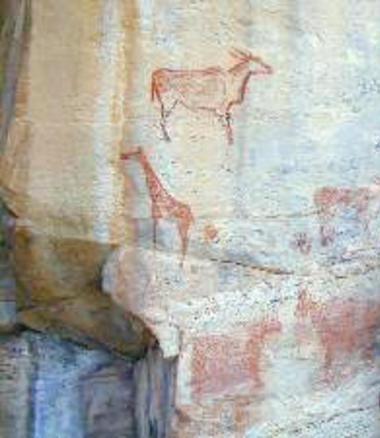
© cj Huo, CC BY-SA 1.0 Resized from original. (This derivative is under the same CC BY-SA license.)
World Heritage Research
Discover scientific research and academic studies that deepen our understanding of Tsodilo from its history and significance to its conservation, management, and contemporary challenges.
-
The relationship among naturally occurring radionuclides, geology, and geography: Tsodilo Hills, Botswana
High uranium concentrations, reaching up to 223 Bq/kg, were found in low-lying areas near Tsodilo Hills, Botswana, likely due to alluvial deposition from the hills themselves. This unique distribution pattern of naturally occurring radionuclides was mapped using in situ gamma ray surveys and GIS software, revealing a distinctive geographical relationship between uranium, potassium (258 Bq/kg), and thorium (31 Bq/kg) concentrations. The study suggests that uranium accumulation is primarily driven by sediment transport from the hills, with similar patterns observed along roads leading to the site.
Bezuidenhout, J. (2019). The relationship among naturally occurring radionuclides, geology, and geography: Tsodilo Hills, Botswana. Journal of Radiation Research and Applied Sciences, 12(1), 93–100. https://doi.org/10.1080/16878507.2019.1593717
View Publication Record | Read Publication -
Intangible Heritage and Tourism Development at the Tsodilo World Heritage Site
Heritage tourism at Tsodilo, Botswana, while economically beneficial, accelerates cultural change and may undermine the conservation aims of World Heritage status. The study finds that commodification through tourism transforms intangible heritage values, particularly for ethnic minorities, as communities are increasingly tied to self-reliance in a market economy. Using a case study approach, it analyzes the tension between heritage preservation (criterion vi) and the economic pressures of tourism development, examining how heritage management plans—modeled on community-based natural resource management (CBNRM)—reshape local identities and gender roles. The research highlights the political complexities of heritage conservation in Botswana, where national narratives of inclusion clash with the realities of ethnic marginalization and globalization.
Giraudo, R. F. (2012). Intangible Heritage and Tourism Development at the Tsodilo World Heritage Site. Azania: Archaeological Research in Africa, 47(1), 129–130. https://doi.org/10.1080/0067270x.2011.647953
View Publication Record | Read Publication