World Heritage Identification Number: 653
World Heritage since: 1993
Category: Natural Heritage
WHE Type: Natural Landscapes & Geographic Features
Transboundary Heritage: No
Endangered Heritage: No
Country: 🇵🇭 Philippines
Continent: Asia
UNESCO World Region: Asia and the Pacific
Map
Tubbataha Reefs Natural Park: A Biodiversity Haven in the Sulu Sea
The Tubbataha Reefs Natural Park, officially recognized by UNESCO as a World Heritage Site since 1993, is a remarkable testament to the rich biodiversity found in the heart of the Sulu Sea. Located approximately 150 kilometers southeast of Puerto Princesa, the capital of Palawan, this marine and bird sanctuary spans over 97,030 hectares, encompassing two substantial atolls – North and South Atolls – and the smaller Jessie Beazley Reef.
More to come…UNESCO Description of the World Heritage Site
The Tubbataha Reef Marine Park covers 96,828 ha, including the North and South Atolls and the Jessie Beazley Reef. It is a unique example of an atoll reef with a very high density of marine species; the North Islet serving as a nesting site for birds and marine turtles. The site is an excellent example of a pristine coral reef with a spectacular 100-m perpendicular wall, extensive lagoons and two coral islands.
UNESCO Justification of the World Heritage Site
Criterion (vii): Tubbataha Reefs Natural Park contains excellent examples of pristine reefs with a high diversity of marine life. The property includes extensive reef flats and perpendicular walls reaching over 100m depth, as well as large areas of deep sea. The remote and undisturbed character of the property and the continued presence of large marine fauna such as tiger sharks, cetaceans and turtles, and big schools of pelagic fishes such as barracuda and trevallies add to the aesthetic qualities of the property.
Criterion (ix): Tubbataha Reefs Natural Park lies in a unique position in the middle of the Sulu Sea and is one of the Philippines’ oldest ecosystems. It plays a key role in the process of reproduction, dispersal and colonization by marine organisms in the whole Sulu Sea system, and helps support fisheries outside its boundaries. The property is a natural laboratory for the study of ecological and biological processes, displaying the ongoing process of coral reef formation, and supporting a large number of marine species dependant on reef ecosystems. The presence of top predator species, such as tiger and hammerhead sharks, are indicators of the ecological balance of the property. The property also offers a demonstration site to study the responses of a natural reef system in relation to the impacts of climate change.
Criterion (x): Tubbataha Reefs Natural Park provides an important habitat for internationally threatened and endangered marine species. The property is located within the Coral Triangle, a global focus for coral biological diversity. The reefs of the property support 360 species of corals, almost 90% of all coral species in the Philippines. The reefs and seas of the property also support eleven species of cetaceans, eleven species of sharks, and an estimated 700 species of fishes, including the iconic and threatened Napoleon wrasse. The property supports the highest population densities known in the world for white tip reef sharks. Pelagic species such as jacks, tuna, barracuda, manta rays, whale sharks and different species of sharks also are common here and the property is a very important nesting, resting and juvenile development area for two species of endangered marine turtles: green turtles and hawksbill turtles. There are seven breeding species of seabirds and Bird Islet and South Islet are breeding grounds to seven resident and endangered breeding species of seabirds. The critically endangered Christmas Island Frigatebird is a regular visitor to the property.
Encyclopedia Record: Tubbataha Reef
The Tubbataha Natural Park, also known as the Tubbataha Reefs Natural Park, is a protected area of the Philippines located in the middle of the Sulu Sea. The marine and bird sanctuary consists of two huge atolls and the smaller Jessie Beazley Reef covering a total area of 97,030 hectares. It is located 150 kilometres (93 mi) southeast of Puerto Princesa, the capital of Palawan. The uninhabited islands and reefs are part of the island municipality of Cagayancillo, located roughly 130 kilometers (81 mi) to the northeast of the reef.Additional Site Details
Area: 96,828 hectares
Number of Components: 1
(ix) — Outstanding example representing ecological and biological processes
(x) — Contains most important habitats for biodiversity
Coordinates: 8.9533333333 , 119.8675
IUCN World Heritage Outlook
The 2025 Conservation Outlook on Tubbataha Reefs Natural Park reports the following assessment:
Source: International Union for Conservation of Nature (IUCN) · View assessment
Image
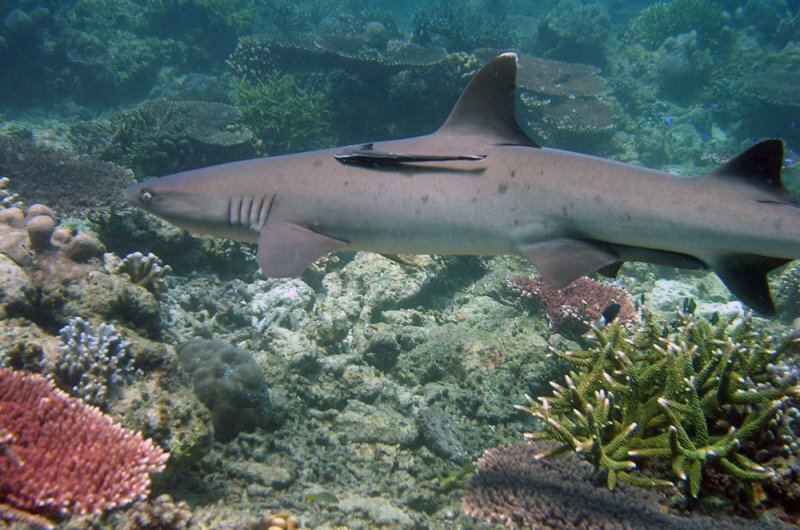
© Simon Hefti, Schweiz (de:User:Nikswieweg), CC BY-SA 3.0 Resized from original. (This derivative is under the same CC BY-SA license.)
World Heritage Research
Discover scientific research and academic studies that deepen our understanding of Tubbataha Reefs Natural Park from its history and significance to its conservation, management, and contemporary challenges.
-
Random Forest habitat suitability modeling for Acanthurus spp. in Philippine coral reefs: environmental drivers and climate projections
Climate change threatens to reduce suitable habitat for six ecologically vital surgeonfish species (Acanthurus spp.) in Philippine coral reefs by 25.4–36.1% by 2100, with thermal-induced coral cover loss as the primary driver. Using a Random Forest machine learning model trained on over 700 geo-referenced occurrence records per species and ten environmental predictors—including coral cover, depth, and rugosity—researchers identified Verde Island Passage, Tubbataha Reef, and Apo Island as critical conservation nodes. The study also pinpointed three unprotected high-overlap zones for potential new marine protected areas (MPAs), providing a spatial foundation for climate-adaptive reef fisheries management in the Indo-Pacific.
Perante, N. C. (2026). Modelado de idoneidad de hábitat mediante Bosque Aleatorio para Acanthurus spp. en arrecifes de coral filipinos: factores ambientales y proyecciones climáticas. Marine and Fishery Sciences (MAFIS), 39(4). https://doi.org/10.47193/mafis.39420260011003
View Publication Record | Read Publication -
Integrating Environmental, Social, and Governance (ESG) Framework in Marine Protected Area Management: A Comparative Document Analysis of Tubbataha and Apo Reefs Natural Parks
A comparative analysis of Tubbataha Reefs Natural Park (TRNP), a UNESCO World Heritage site, and Apo Reef Natural Park (ARNP), on UNESCO’s tentative list, reveals that integrating an Environmental, Social, and Governance (ESG) framework significantly enhances marine protected area (MPA) management. The study highlights TRNP's superior governance structure and social engagement as key factors in its effective conservation outcomes compared to ARNP. Using document analysis, researchers evaluated policy documents, management plans, and stakeholder reports from both sites, identifying gaps and best practices. This approach underscores the importance of a holistic ESG framework in achieving sustainable marine conservation, offering valuable insights for other MPAs globally.
Enriquez, J. R., & Gamboa, V. R. (2025). Integrating Environmental, Social, and Governance (ESG) Framework in Marine Protected Area Management: A Comparative Document Analysis of Tubbataha and Apo Reefs Natural Parks. Wsf11, 7. https://doi.org/10.3390/proceedings2025131007
View Publication Record | Read Publication -
Hybrid Financing for Marine Conservation: The Case of Tubbataha Reefs Natural Park, Palawan, Philippines
A hybrid financing model emerges as a promising solution for sustainable marine conservation, particularly for UNESCO World Heritage Sites facing complex funding challenges. The study on Tubbataha Reefs Natural Park (TRNP) in the Philippines highlights how combining traditional and digital finance mechanisms can address critical gaps in long-term protection of ecologically vital marine areas. By analyzing existing financing strategies, this research provides actionable recommendations to ensure TRNP's continued ecological health and resilience, offering a scalable approach for other marine protected areas globally.
Gamboa, V. R., & Enriquez, J. R. (2025). Hybrid Financing for Marine Conservation: The Case of Tubbataha Reefs Natural Park, Palawan, Philippines. Wsf11, 28. https://doi.org/10.3390/proceedings2025131028
View Publication Record | Read Publication -
Identification of SARS-CoV-2 3CLpro inhibitors from marine actinomycetes through integrated phylogeny-based metabolomics with functional screening and bioinformatic analysis
Researchers have identified promising SARS-CoV-2 3CLpro inhibitors from marine actinomycetes, with extracts from Tubbataha Reefs Natural Park and Nogas Island showing significant inhibitory effects. Among the 75 strains analyzed, 36% exhibited over 90% inhibition, and 27 demonstrated strong potency (IC₅₀ values: 2–8 µg/mL). Phylogenetic analysis linked antiviral activity to specific Streptomyces clades, while metabolomic profiling revealed shared bioactive compounds, including a bicyclic sesquiterpenoid and carbazole alkaloid. Molecular docking confirmed streptocarbazole C's strong binding affinity to the viral enzyme, suggesting potential for development as an antiviral agent. This study integrates phylogeny, metabolomics, and bioinformatics to advance natural product-based drug discovery.
Dalisay, D. S., Mateo, J. C., Teodosio, J. J. R., Jusa, L. M. S., Baladjay, D. M. S., de Guzman, L. S., Balida, L. A. P., & Jamal, J. A. (2025). Identification of SARS-CoV-2 3CLpro inhibitors from marine actinomycetes through integrated phylogeny-based metabolomics with functional screening and bioinformatic analysis. Scientific Reports, 15(1). https://doi.org/10.1038/s41598-025-25354-0
View Publication Record | Read Publication -
Socio-Ecological Analysis of Human Interactions with Aquatic Wildlife in Coastal Community Systems
Stricter protection in the Strictly Protected Area of Tubbataha Reefs Natural Park significantly enhances fish densities (35.7 CPUE) and coral health while reducing pollution, compared to the Sustainable Fishing Area and Buffer Zone. This finding, supported by ANOVA tests (p < 0.05), underscores the effectiveness of stringent conservation measures in preserving biodiversity and minimizing environmental degradation. The study integrates ecological data with social factors—such as livelihood strategies and governance—to identify key leverage points for sustainable management. It advocates for combining scientific data with local knowledge to develop policies that balance human well-being with wildlife conservation, offering a blueprint for place-based solutions in UNESCO World Heritage Sites.
Mahadevan, P., & K., K. (2025). Socio-Ecological Analysis of Human Interactions with Aquatic Wildlife in Coastal Community Systems. Journal of Animal Environment, 17(2), 419–429. https://doi.org/10.70102/aej.2025.17.2.39
View Publication Record | Read Publication -
Intact shallow and mesophotic assemblages of large carnivorous reef fishes underscore the importance of large and remote protected areas in the Coral Triangle
A study comparing marine protected areas (MPAs) in the Philippines reveals that mesophotic coral ecosystems (MCEs) serve as deep refugia for large carnivorous reef fishes, with abundances 2 to 10 times higher than shallow depths. The research analyzed baited remote underwater video data from Tubbataha Reefs Natural Park (TRNP), a fully no-take MPA since 1988, and Cagayancillo, a partially protected archipelago. While TRNP showed intact fish assemblages due to strict protection, Cagayancillo exhibited higher mesophotic abundances of groupers, jacks, and overall carnivorous fishes, suggesting MCEs mitigate fishing impacts. The findings underscore the need for MPAs to explicitly include mesophotic zones to safeguard vulnerable species like the endangered Cheilinus undulatus (humphead wrasse). This study highlights the critical role of large, remote protected areas in preserving biodiversity in the Coral Triangle.
Salvador, M. L., Utzurrum, J. A. T., Murray, R., Delijero, K., Conales, S. F., Bird, C. E., Gauthier, D. T., & Abesamis, R. A. (2024). Intact shallow and mesophotic assemblages of large carnivorous reef fishes underscore the importance of large and remote protected areas in the Coral Triangle. Aquatic Conservation: Marine and Freshwater Ecosystems, 34(2). Portico. https://doi.org/10.1002/aqc.4108
View Publication Record | Read Publication -
Recent Changes (2018–2022) in Benthic Cover in Tubbataha Reefs Natural Park, Sulu Sea, the Philippines
A recent study on Tubbataha Reefs Natural Park reveals significant changes in benthic cover from 2018 to 2022, marked by a decline in hard coral and an increase in sponges and cyanobacteria. While these shifts suggest potential nutrient enrichment (eutrophication), the data does not uniformly support this hypothesis, with only turf algae and cyanobacteria showing statistically significant changes. The study's findings are limited due to insufficient statistical power, indicating that other factors such as typhoon impacts may also contribute to reef condition changes. This research underscores the need for a more robust dataset to conclusively determine the drivers behind these ecological shifts.
Cadiz, M. M., Parr, R. A., Feliciano, G. N., Alarcon, R., Alaba, M. R., Pecson, M. J., & Licuanan, W. (2024). Recent Changes (2018–2022) in Benthic Cover in Tubbataha Reefs Natural Park, Sulu Sea, the Philippines. Philippine Journal of Science, 153(6B). https://doi.org/10.56899/153.6b.01
View Publication Record | Read Publication