World Heritage Identification Number: 1012
World Heritage since: 2000
Category: Natural Heritage
WHE Type: Protected Areas & National Parks
Transboundary Heritage: No
Endangered Heritage: No
Country: 🇲🇾 Malaysia
Continent: Asia
UNESCO World Region: Asia and the Pacific
Map
Kinabalu Park: A Biodiverse Haven in Borneo
Kinabalu Park, located in the state of Sabah on the northern tip of Borneo, is a veritable treasure trove of biodiversity. Established as one of the first national parks of Malaysia in 1964, it was subsequently recognized as a UNESCO World Heritage Site in 2000 due to its "outstanding universal values." This designation underscores the park's significance as one of the most important biological sites globally.
More to come…UNESCO Description of the World Heritage Site
Kinabalu Park, in the State of Sabah on the northern end of the island of Borneo, is dominated by Mount Kinabalu (4,095 m), the highest mountain between the Himalayas and New Guinea. It has a very wide range of habitats, from rich tropical lowland and hill rainforest to tropical mountain forest, sub-alpine forest and scrub on the higher elevations. It has been designated as a Centre of Plant Diversity for Southeast Asia and is exceptionally rich in species with examples of flora from the Himalayas, China, Australia, Malaysia, as well as pan-tropical flora.
UNESCO Justification of the World Heritage Site
Criterion (ix): Kinabalu Park has an exceptional array of naturally functioning ecosystems. A number of processes actively provide ideal conditions for the diverse biota, high endemism and rapid evolutionary rates. Several factors combine to influence these processes; (1) the great altitudinal and climatic gradient from tropical forest to alpine conditions; (2) steeply dissected topography causing effective geographical isolation over short distances; (3) the diverse geology with many localised edaphic conditions, particularly the ultramafic substrates; (4) the frequent climate oscillations influenced by El Niño events; and (5) geological history of the Malay archipelago and proximity to the much older Crocker Range.
Criterion (x): Floristically species-rich and identified as a globally important Centre of Plant Endemism, Kinabalu Park contains an estimated 5,000-6,000 vascular plant species including representatives from more than half the families of all flowering plants. The presence of 1,000 orchid species, 78 species of Ficus, and 60 species of ferns is indicative of the botanical richness of the property. The variety of Kinabalu’s habitats includes six vegetation zones, ranging from lowland rainforest to alpine scrub at 4,095m. Faunal diversity is also high and the property is an important centre for endemism. The majority of Borneo’s mammals, birds, amphibians and invertebrates (many threatened and vulnerable) are known to occur in the park including; 90 species of lowland mammal, 22 mammal species in the montane zone and 326 bird species.
Encyclopedia Record: Kinabalu Park
Kinabalu Park, established as one of the first national parks of Malaysia in 1964, is Malaysia's first World Heritage Site designated by UNESCO in December 2000 for its "outstanding universal values" and the role as one of the most important biological sites in the world with more than 4,500 species of flora and fauna, including 326 bird and around 100 mammal species, and over 110 land snail species.Additional Site Details
Area: 75,370 hectares
Number of Components: 1
(x) — Contains most important habitats for biodiversity
Coordinates: 6.25 , 116.5
IUCN World Heritage Outlook
The 2025 Conservation Outlook on Kinabalu Park reports the following assessment:
Source: International Union for Conservation of Nature (IUCN) · View assessment
Image
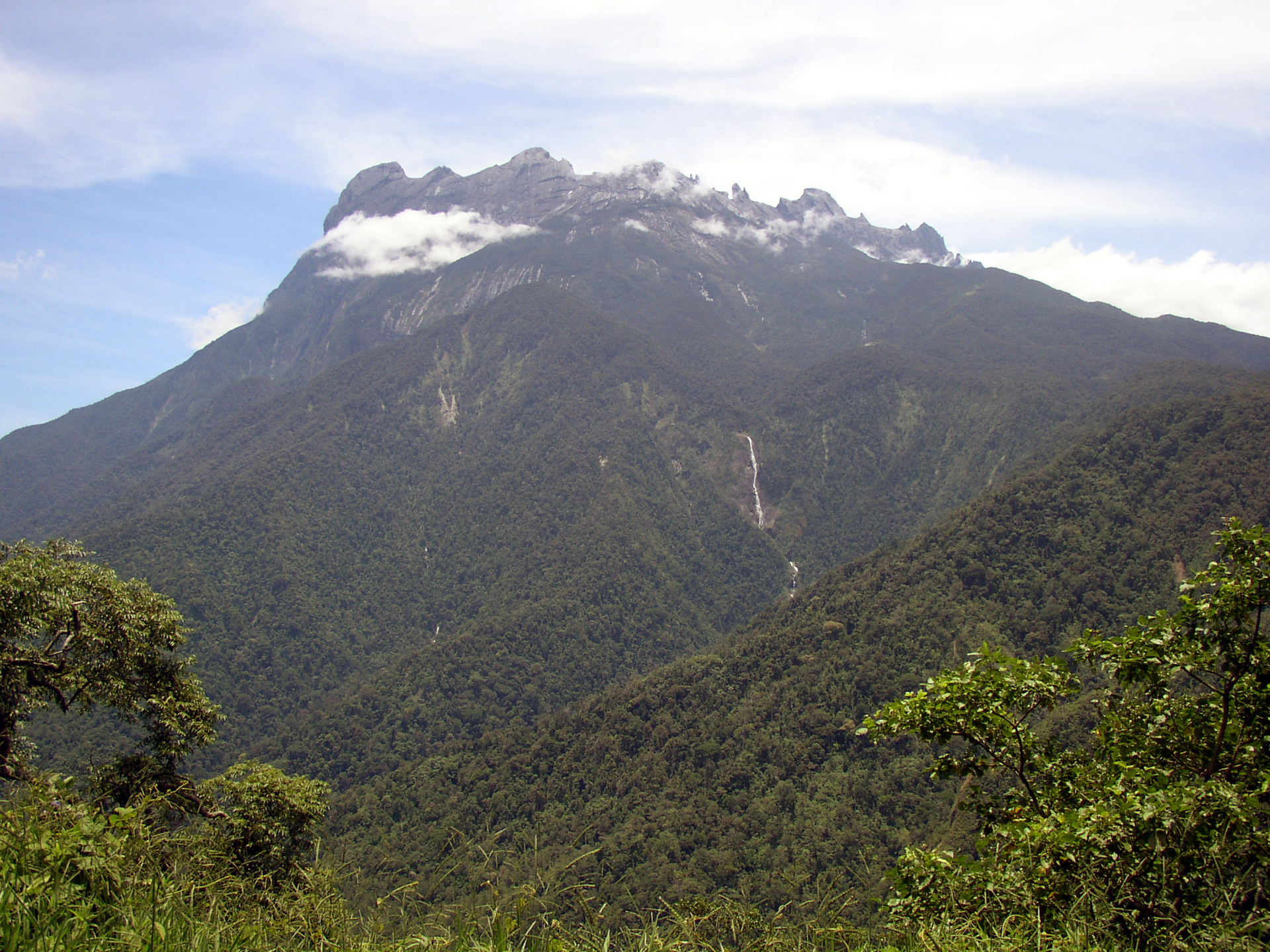
© NepGrower, CC BY-SA 3.0 Resized from original. (This derivative is under the same CC BY-SA license.)
World Heritage Research
Discover scientific research and academic studies that deepen our understanding of Kinabalu Park from its history and significance to its conservation, management, and contemporary challenges.
-
The Ecology and Conservation of Orchids in Ultramafic Habitats of Kinabalu Park, Sabah, Malaysia
Kinabalu Park, Sabah, Malaysia, hosts up to 340 orchid species in its ultramafic zones, characterized by high nickel and magnesium levels, low calcium, and poor nutrient retention. A notable discovery is the locally endemic Dendrobium maraiparense Wood and Chan, first described at Marai Parai, a site with the highest orchid density (136 species). The study highlights significant threats to these orchids, including excessive collection, illegal trade, poaching, and climate change, emphasizing the urgent need for stronger conservation measures. It advocates for in-situ and ex-situ conservation strategies, community education, and legal enforcement to protect orchid biodiversity and maintain ecological health. This analysis is based on a comprehensive review of existing scientific literature, including articles, books, journals, and herbarium records.
Razali, H. I., & Md.-Isa, S. F. (2026). The Ecology and Conservation of Orchids in Ultramafic Habitats of Kinabalu Park, Sabah, Malaysia. Pertanika Journal of Tropical Agricultural Science, 49(2). https://doi.org/10.47836/pjtas.49.2.18
View Publication Record | Read Publication -
Revisiting the Freshwater Ichthyofauna in Sayap Substation, Kinabalu Park: A Thirty-One-Year Update
A 31-year study of freshwater fish populations at Sayap Substation, Kinabalu Park, reveals significant shifts in community composition, with the dominant genus Parhomaloptera disappearing and being replaced by Glaniopsis and Protomyzon. The research, using electrofishing and environmental parameter collection, found that while Gastromyzontidae remains the most abundant family (96.7%), its subgenera have fluctuated, with Glaniopsis declining from 58.9% in 2007 to 30.6% in 2023. These changes coincide with rising water temperatures and total suspended solids, indicating potential ecological stress on the freshwater system. The study underscores the need for regular monitoring to address emerging threats and conserve biodiversity in Kinabalu Park's transition zone between sub-montane and lowland forests.
DULIPAT, J., & SOO, C. L. (2026). Revisiting the Freshwater Ichthyofauna in Sayap Substation, Kinabalu Park: A Thirty-One-Year Update. Journal of Tropical Biology & Conservation (JTBC), 23, 15–30. https://doi.org/10.51200/jtbc.v23i.6868
View Publication Record | Read Publication -
Mountain Guiding in Kinabalu Park: An Evaluation of Visitor Satisfaction
A study reveals that mountain guides in Kinabalu Park, Malaysia's tallest peak, develop critical professional and personal skills—such as communication, decision-making, problem-solving, and leadership—that significantly enhance visitor satisfaction. These skills improve the quality of climbing services, contributing to the park's growing appeal as a tourism destination. The research, based on qualitative interviews with guides, highlights how training and experience foster expertise that benefits both local employment and visitor experiences in this UNESCO-listed site.
Hiew, L. S. S., & Amirul, S. R. (2025). Mountain Guiding in Kinabalu Park: An Evaluation of Visitor Satisfaction. Asia-Pacific Journal of Futures in Education and Society, 4(1), 21–32. https://doi.org/10.58946/apjfes-4.1.p2
View Publication Record | Read Publication -
Effects of microclimate factors on the distribution of Araceae in Kinabalu Park, Sabah, Borneo, Malaysia
Araceae species in Kinabalu Park, Sabah, Borneo, show strong adaptability to microclimatic variations driven by complex topography. This study identified 88 Araceae species across seven areas, with Schismatoglottideae tribe and genus Schismatoglottis being most prevalent. Microclimate factors, particularly temperature (r²: 0.8898) and relative humidity (r²: -0.8764), significantly influenced species distribution, as revealed by Canonical Correspondence Analysis with an inertia value of 84.96%. Species turnover was low to moderate (Jaccard similarity index: 23.08-56.10%). The findings underscore the ecological significance of microhabitats in promoting Araceae diversity, emphasizing the need for conservation strategies that account for these environmental interactions.
WAHAB, R., & SAIBEH, K. (2025). Effects of microclimate factors on the distribution of Araceae in Kinabalu Park, Sabah, Borneo, Malaysia. Biodiversitas Journal of Biological Diversity, 26(7). https://doi.org/10.13057/biodiv/d260715
View Publication Record | Read Publication -
Tourist Satisfaction Dimension in Kinabalu Park, Sabah, Malaysia
A study on tourist satisfaction at Kinabalu Park, a UNESCO World Heritage Site in Sabah, Malaysia, reveals that 'scenery enjoyment' is the primary factor contributing to positive visitor experiences. The research employed Herzberg’s Critical Incident Technique (CIT) through in-depth interviews with mountain climbers, analyzing their recollections of exceptional moments—both satisfying and dissatisfying—to identify key satisfaction dimensions. Thematic analysis using Driver’s Recreation Experience Preference (REP) scale highlighted 'scenery enjoyment' alongside three other emerging domains that shape tourist satisfaction. This finding underscores the critical role of natural beauty in enhancing visitor experiences, offering valuable insights for developing responsible tourism frameworks at the site.
Talib, H., Mereng, T. A., & Chan, J. K. L. (2023). TOURIST SATISFACTION DIMENSION IN KINABALU PARK, SABAH, MALAYSIA. Borneo Science | the Journal of Science and Technology, 41(2). https://doi.org/10.51200/bsj.v41i2.4450
View Publication Record | Read Publication -
Fish Biodiversity and Water Quality of Tropical Forest Streams Adjacent to the Western Boundary of Kinabalu Park, Sabah
A study on the fish biodiversity and water quality of tropical forest streams adjacent to Kinabalu Park, Sabah, revealed that fish diversity and abundance decrease with elevation, while water quality remains generally good but is threatened by domestic impacts downstream. The three most abundant fish species were Tor tambra (34.4%), Barbodes sealei (19.5%), and Lobocheilos ovalis (12.4%). Tor tambra exhibited poor to fair condition, indicating potential health issues. Water quality metrics such as turbidity, orthophosphate, and ammoniacal nitrogen were higher near Podos village, with ammoniacal nitrogen classified as Class III by Malaysian standards. The study highlights the need for regular water quality monitoring in downstream rivers to mitigate domestic impacts on biodiversity and ecosystem integrity.
Soo, C., Mahsol, H., Jainih, L., Fikri, A., Chen, C., Kamal, N.,. (2022). Fish Biodiversity and Water Quality of Tropical Forest Streams Adjacent to the Western Boundary of Kinabalu Park, Sabah. Journal of Tropical Life Science, 12(2), 261–268. https://doi.org/10.11594/jtls.12.02.12
View Publication Record | Read Publication -
The mosses of Mount Tambuyukon, Kinabalu Park, Malaysian Borneo
Mount Tambuyukon, located within Kinabalu Park in Malaysian Borneo, sustains a rich and diverse moss flora. A 2008 study identified 103 species, two subspecies, and two varieties of mosses across 55 genera and 26 families, representing approximately 16.3% of Sabah's moss diversity and 13.9% of Borneo's. Notably, three species were recorded for the first time in Sabah: Acroporium aciphyllum, Garovaglia baeuerlenii, and Macromitrium angustifolium. The Sematophyllaceae family was the most diverse, with 13 taxa, followed by Leucobryaceae (11 taxa) and Dicranaceae/Orthotrichaceae (10 taxa each). This study highlights Mount Tambuyukon's ecological significance as a hotspot for rare and endemic moss species.
Suleiman, M., Repin, R., Rajian, N. J., & Kien-Thai, Y. (2022). The mosses of Mount Tambuyukon, Kinabalu Park, Malaysian Borneo. Journal of Tropical Biology & Conservation (JTBC), 19, 167–182. https://doi.org/10.51200/jtbc.v19i.3964
View Publication Record | Read Publication