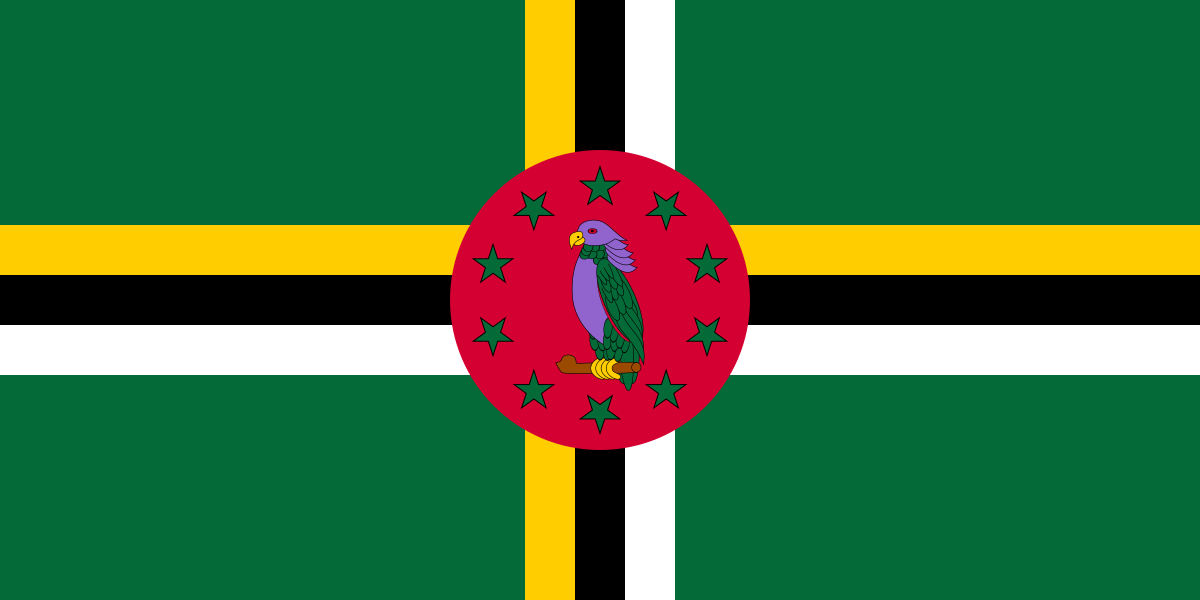
World Heritage Identification Number: 814
World Heritage since: 1997
Category: Natural Heritage
WHE Type: Protected Areas & National Parks
Transboundary Heritage: No
Endangered Heritage: No
Country: 🇩🇲 Dominica
Continent: Americas
UNESCO World Region: Latin America and the Caribbean
Map
Morne Trois Pitons National Park: A Volcanic Jewel in the Heart of Dominica
The Morne Trois Pitons National Park, nestled in the heart of Dominica, is a testament to the island nation's rich volcanic heritage and vibrant tropical ecosystems. Established in 1975, it was designated a UNESCO World Heritage Site in 1997, recognizing its exceptional natural beauty and scientific importance.
More to come…UNESCO Description of the World Heritage Site
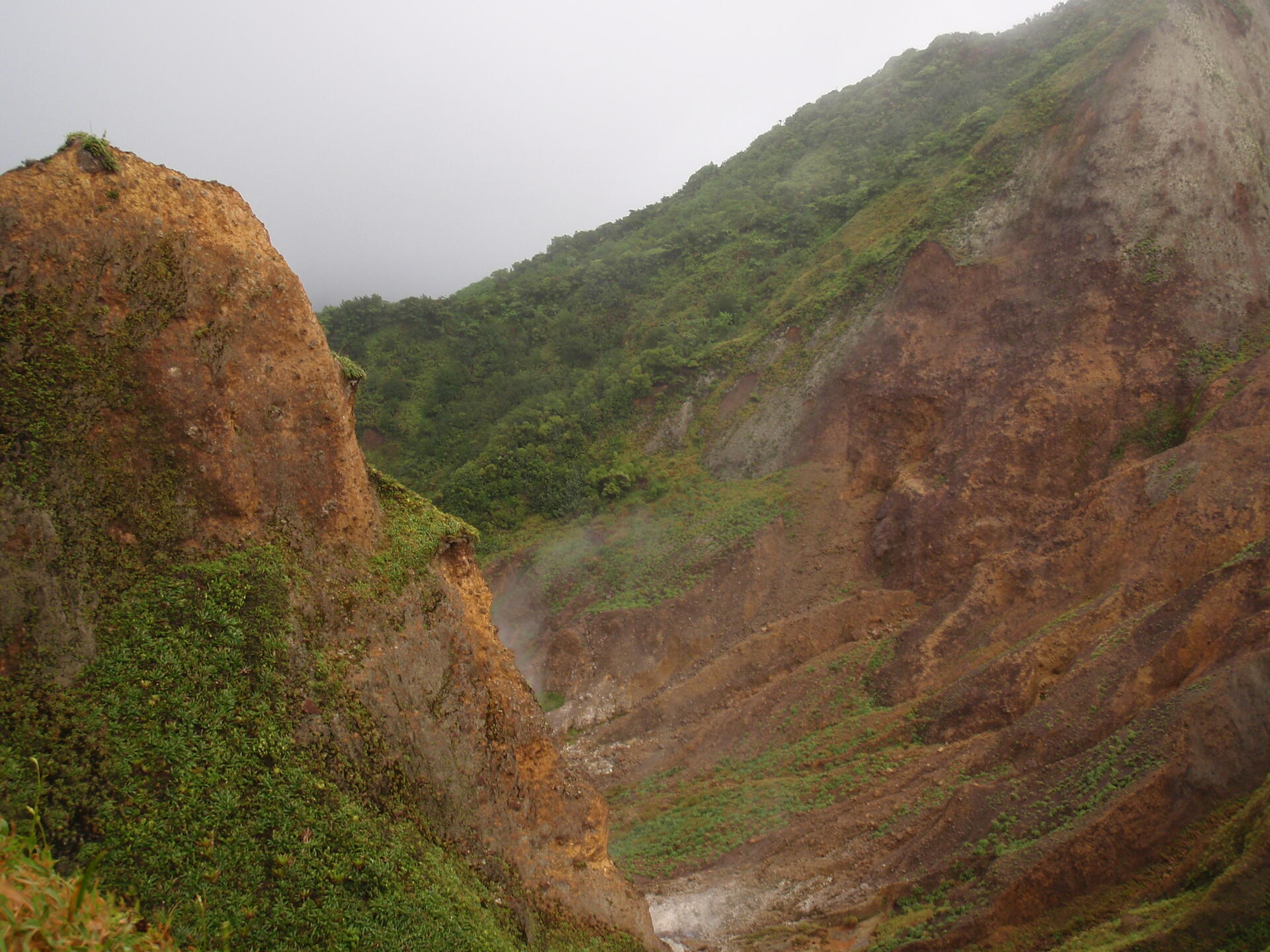
Luxuriant natural tropical forest blends with scenic volcanic features of great scientific interest in this national park centred on the 1,342-m-high volcano known as Morne Trois Pitons. With its precipitous slopes and deeply incised valleys, 50 fumaroles, hot springs, three freshwater lakes, a 'boiling lake' and five volcanoes, located on the park's nearly 7,000 ha, together with the richest biodiversity in the Lesser Antilles, Morne Trois Pitons National Park presents a rare combination of natural features of World Heritage value.
UNESCO Justification of the World Heritage Site
Criterion (viii): The property encompasses extraordinary and intact examples and arrays of geomorphologic features as a result of a series of volcanic eruptions. The distinctive geology and landforms of Morne Trois Pitons National Park are comprised of three major types of geological formations: volcanic piles, glacis slopes and soufrieres. The property displays a magnificent spectrum of volcanic activity in the form of streams of various colors interspersed with fumaroles, mud ponds and hot springs, including the massive Boiling Lake. Ongoing geo-morphological processes of reduction are taking place in a largely undisturbed setting of stunning scenic value and major scientific interest.
Criterion (x): Morne Trois Pitons National Park is home to one of the very rare largely intact forest areas remaining in the Insular Caribbean, a region recognized through various priority-setting exercises as a highly threatened biodiversity region and center of endemism of global importance. Along extreme altitudinal and micro-climatic gradients an impressive variety of forest types has evolved featuring a highly diverse flora with many endemic vascular plant species. There are also endemic reptiles and amphibians and a noteworthy number of bird species, including the Imperial Parrot and the vulnerable Red-Necked Parrot, which are endemic to Dominica. Much of the biological wealth remains to be documented and research is likely to reveal further biodiversity secrets.
Encyclopedia Record: Morne Trois Pitons National Park
Morne Trois Pitons National Park is a national park in Dominica established in July 1975, the first to be legally established in the country. It became a World Heritage Site in 1997. The park is named after its highest mountain, Morne Trois Pitons, meaning mountain of three peaks. The park is an area of significant volcanic activity. Features within the park include the Valley of Desolation, a region of boiling mud ponds and small geysers; the Boiling Lake; Titou Gorge; and Emerald Pool. The mountain is the second-highest peak in Dominica, being exceeded only by Morne Diablotins.Additional Site Details
Area: 6,857 hectares
Number of Components: 1
(x) — Contains most important habitats for biodiversity
Coordinates: 15.331113 , -61.30661
IUCN World Heritage Outlook
The 2025 Conservation Outlook on Morne Trois Pitons National Park reports the following assessment:
Source: International Union for Conservation of Nature (IUCN) · View assessment
World Heritage Research
Discover scientific research and academic studies that deepen our understanding of Morne Trois Pitons National Park from its history and significance to its conservation, management, and contemporary challenges.
-
Hurricane‐induced pollinator shifts in a tightly coadapted plant–hummingbird mutualism
A tightly coadapted plant-hummingbird mutualism in Dominica's Morne Trois Pitons National Park was disrupted by Hurricane Maria, leading to a shift from specialized pollination by the purple-throated carib (Eulampis jugularis) to a more generalized system involving other hummingbirds and the bananaquit (Coereba flaveola). The study found that while the purple-throated carib deposited the most pollen due to its morphological match with Heliconia flowers, other bird species also effectively pollinated Heliconia plants after the hurricane-induced population crash of the primary pollinator. This suggests that generalized pollinators can provide resilience in plant sexual reproduction following high-impact disturbances, challenging the notion that specialized mutualisms are evolutionary dead-ends. The research integrated bird visitation rates, pollen deposition data, and pollen transport analysis to quantify these shifts.
Schrøder, T. S. O., Gonçalves, F., Vollstädt, M. G. R., Zhang, T., Jensen, R. D., Tarazona‐Tubens, F. L., Kim, S., Galetti, M., Simmons, B. I., Kaiser‐Bunbury, C. N., Temeles, E. J., & Dalsgaard, B. (2024). Hurricane‐induced pollinator shifts in a tightly coadapted plant–hummingbird mutualism. New Phytologist, 244(1), 16–20. Portico. https://doi.org/10.1111/nph.19938
View Publication Record | Read Publication -
Site managers
In 2015, Jacqueline Andre assumed leadership as the head of the National Parks unit within Dominica's Forestry, Wildlife and Parks Division, overseeing the Morne Trois Pitons National Park—a UNESCO World Heritage site. Her role highlights the critical importance of dedicated site management in preserving such globally significant natural areas. The article provides an overview of her responsibilities, which include implementing conservation strategies to safeguard the park's unique biodiversity and geological features. By focusing on effective governance and sustainable practices, Andre's leadership exemplifies best practices for World Heritage Site management, ensuring long-term protection and conservation efforts.
(Ed.). (2021). Site managers. World Heritage Review, 2021(97), 38–43. https://doi.org/10.18356/27887138-2021-97-4
View Publication Record | Read Publication -
Hydrothermal eruptions at unstable crater lakes: Insights from the Boiling Lake, Dominica, Lesser Antilles
A study of the Boiling Lake in Dominica's Morne Trois Pitons National Park reveals that small hydrothermal eruptions and toxic gas emissions, previously thought non-eruptive, can occur during lake drainage events. The research demonstrates that the petrophysical state of crater wall materials—such as porosity, permeability, and alteration-related strength—controls the style and energy of these explosive events, as well as landslide risks. Using experimental simulations of decompression under slightly elevated pressure (mimicking post-drainage eruptions) and rapidly enhanced pressure (simulating landslide-induced overpressurization), scientists calculated ejection velocities to estimate potential debris impact areas. This work advances the understanding of hydrothermal eruption hazards at unstable crater lakes, offering critical insights for risk assessment in UNESCO World Heritage Sites.
Rott, S., Scheu, B., Montanaro, C., Mayer, K., Joseph, E. P., & Dingwell, D. B. (2019). Hydrothermal eruptions at unstable crater lakes: Insights from the Boiling Lake, Dominica, Lesser Antilles. Journal of Volcanology and Geothermal Research, 381, 101–118. https://doi.org/10.1016/j.jvolgeores.2019.05.020
View Publication Record | Read Publication