World Heritage Identification Number: 910
World Heritage since: 1999
Category: Cultural Heritage
WHE Type: Buildings & Architectural Ensembles
Transboundary Heritage: No
Endangered Heritage: No
Country: 🇰🇳 Saint Kitts and Nevis
Continent: Americas
UNESCO World Region: Latin America and the Caribbean
Map
Brimstone Hill Fortress National Park: A Testimony to Colonial Expansion and New Societies
The Brimstone Hill Fortress National Park, located on the island of St. Kitts in the Federation of St. Christopher and Nevis, stands as a remarkable testament to the intertwined histories of European colonial expansion, the African slave trade, and the emergence of new societies in the Caribbean. This UNESCO World Heritage Site, inscribed in 1999, is an exceptional example of 17th- and 18th-century military architecture in a Caribbean context.
More to come…UNESCO Description of the World Heritage Site
Brimstone Hill Fortress National Park is an outstanding, well-preserved example of 17th- and 18th-century military architecture in a Caribbean context. Designed by the British and built by African slave labour, the fortress is testimony to European colonial expansion, the African slave trade and the emergence of new societies in the Caribbean.
UNESCO Justification of the World Heritage Site
Criterion (iii): Brimstone Hill is an outstanding British fortress, built by slave labour to exact standards during a peak period of European colonial expansion in the Caribbean.
Criterion (iv): Because of its strategic layout and construction, Brimstone Hill Fortress is an exceptional and well preserved example of 17th and 18th century British military architecture.
Encyclopedia Record: Brimstone Hill Fortress National Park
Brimstone Hill Fortress National Park is a UNESCO World Heritage Site, a well-preserved fortress on a hill on the island of St. Kitts, in the Federation of St. Christopher and Nevis in the Eastern Caribbean. It was designed by British military engineers, and was built and maintained by enslaved Africans. It is one of the best preserved historical fortifications in the Americas.Additional Site Details
Area: 15.37 hectares
Number of Components: 1
(iv) — Outstanding example of a type of building or landscape
Coordinates: 17.34694 , -62.83722
Image
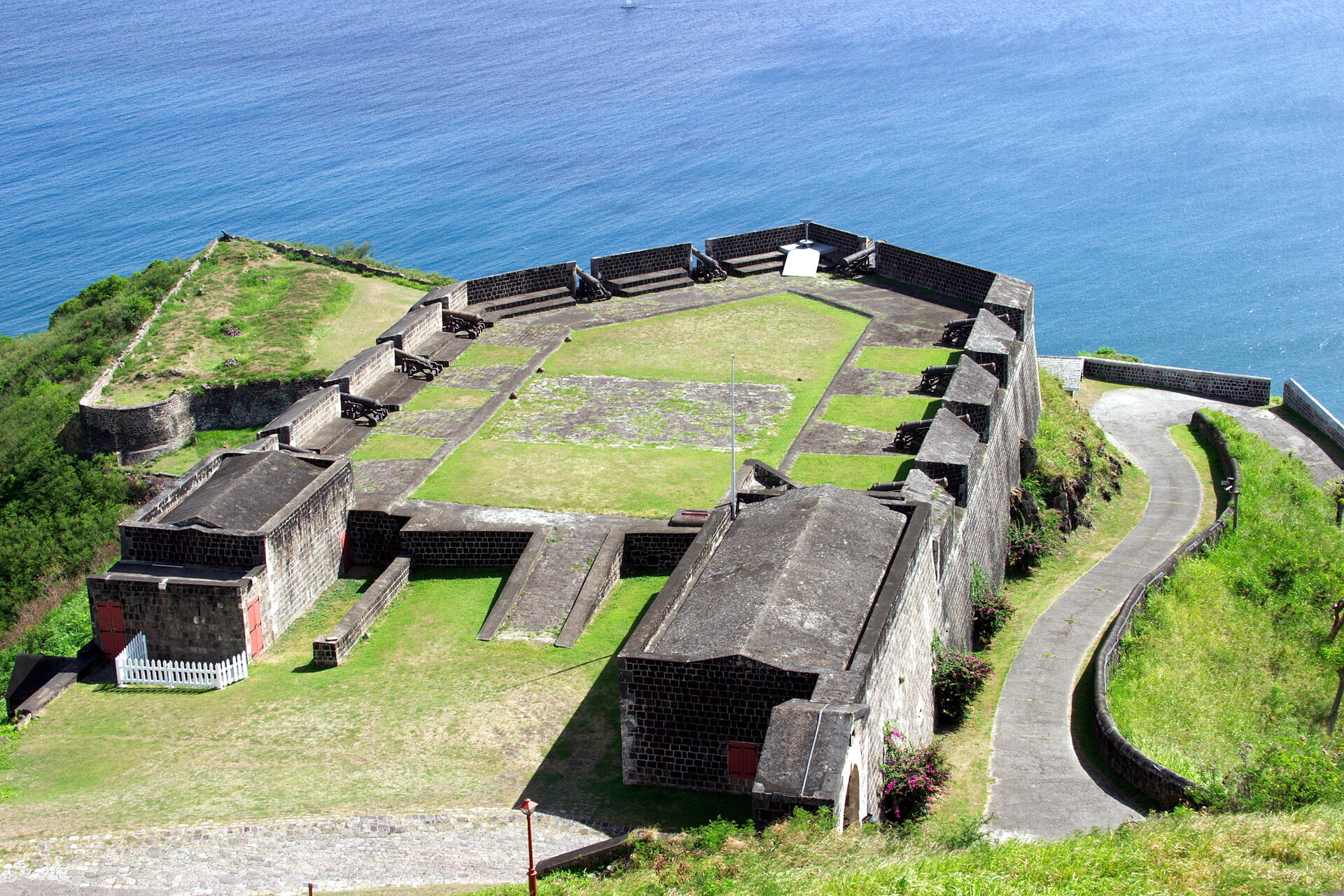
© Ukexpat, CC BY-SA 3.0 Resized from original. (This derivative is under the same CC BY-SA license.)
World Heritage Research
Discover scientific research and academic studies that deepen our understanding of Brimstone Hill Fortress National Park from its history and significance to its conservation, management, and contemporary challenges.
-
Photographic Records and Potential Impact of the Lime Swallowtail, Papilio demoleus (Lepidoptera, Papilionidae), in St. Kitts and Nevis
Photographic evidence confirms the presence of the invasive lime swallowtail butterfly, Papilio demoleus, on St. Kitts and Nevis, marking its first documented occurrence in the northern Lesser Antilles. Surveys from 2023 to 2026 identified two confirmed sightings—one at Brimstone Hill Fortress National Park (St. Kitts) and another in Charlestown (Nevis)—along with historical reports from Frigate Bay, St. Kitts, since 2020. While the butterfly's impact on local citrus cultivation remains minimal due to limited host plants, its establishment suggests potential risks to small-scale agriculture. The study highlights the need for continued monitoring to track its expansion and assess ecological consequences.
Liu, C.-W., Ward, T. J., & Lo, Y.-H. (2026). Photographic Records and Potential Impact of the Lime Swallowtail, Papilio demoleus (Lepidoptera, Papilionidae), in St. Kitts and Nevis. Caribbean Journal of Science, 56(1), 242–246. https://doi.org/10.18475/cjos.v56i1.a21
View Publication Record | Read Publication -
Agriculture and agrarian structures
Brimstone Hill Fortress National Park, a UNESCO World Heritage Site on St Kitts, reflects the island's deep agricultural legacy, particularly its dominance by sugar production. Though sugar now accounts for only 2% of foreign exchange earnings and employs 8% of the workforce, it still occupies 30% of agricultural land, illustrating its enduring impact on the landscape. The fortress offers a panoramic view of this heritage, with lush cane fields on coastal plains giving way to mixed cropping and pasture on steeper hillside landscapes, while remnants of forest cloak the volcanic Mt Liamuiga. This study highlights how historical economic shifts—from sugar to tourism—have reshaped St Kitts' economy but left a lasting imprint on its agrarian structures and natural environment.
(Ed.). (2015). Agriculture and agrarian structures. The Contemporary Caribbean, 123–166. https://doi.org/10.4324/9781315838144-15
View Publication Record | Read Publication