World Heritage Identification Number: 1000
World Heritage since: 2001
Category: Natural Heritage
WHE Type: Natural Landscapes & Geographic Features
Transboundary Heritage: No
Endangered Heritage: No
Country: 🇧🇷 Brazil
Continent: Americas
UNESCO World Region: Latin America and the Caribbean
Map
Fernando de Noronha and Atol das Rocas Reserves: A Marine Biodiversity Haven
The Brazilian Atlantic Islands, consisting of the Fernando de Noronha Archipelago and the Rocas Atoll, are two distinct yet interconnected marine reserves located off the northeastern coast of Brazil. Inscribed as a UNESCO World Heritage Site in 2001, these islands serve as a significant habitat for various marine species and seabirds, making them a crucial component of the South Atlantic's biodiversity.
More to come…UNESCO Description of the World Heritage Site
Peaks of the Southern Atlantic submarine ridge form the Fernando de Noronha Archipelago and Rocas Atoll off the coast of Brazil. They represent a large proportion of the island surface of the South Atlantic and their rich waters are extremely important for the breeding and feeding of tuna, shark, turtle and marine mammals. The islands are home to the largest concentration of tropical seabirds in the Western Atlantic. Baia de Golfinhos has an exceptional population of resident dolphin and at low tide the Rocas Atoll provides a spectacular seascape of lagoons and tidal pools teeming with fish.
UNESCO Justification of the World Heritage Site
Criterion (vii): Dolphin Bay is the only known place in the world with such a large population of resident dolphins. In addition, two of its beaches, Praia do Sancho and Praia do Leão, were elected as the most beautiful in Brazil. The Rocas Atoll has a spectacular seascape, especially at low tide when the exposed reef surrounding shallow lagoons and tidal pools forms a natural aquarium. Both sites also have exceptional underwater landscapes that have been recognised worldwide in specialized diving literature.
Criterion (ix): The Fernando de Noronha and Atol das Rocas represents over half the insular coastal waters of the Southern Atlantic Ocean. These highly productive waters provide feeding ground for species such as tuna, billfish, cetaceans, sharks and marine turtles as they migrate to the African coast. An oasis of marine life in relatively barren, open ocean, the islands play a key role in the process of reproduction, dispersal and colonization by marine organisms in the entire Tropical South Atlantic.
Criterion (x): The Fernando de Noronha and Rocas Atoll are key sites for the protection of biodiversity and endangered species in the Southern Atlantic. Providing a large proportion of the insular habitat of the South Atlantic, the site is essential for the maintenance of marine biodiversity. It is important for the conservation of threatened species of marine turtles, particularly the hawksbill turtle. The site accommodates the largest concentration of tropical seabirds to be found in the Western Atlantic Ocean and is a Global Centre of Bird Endemism. The site also contains the only remaining sample of the Insular Atlantic Forest and the only oceanic mangrove in the South Atlantic region.
Encyclopedia Record: Fernando de Noronha
Fernando de Noronha, officially the State District of Fernando de Noronha and formerly known as the Federal Territory of Fernando de Noronha until 1988, is an archipelago in the Atlantic Ocean, part of the state of Pernambuco, Brazil, and located 191 nautical miles off the Brazilian coast.Additional Site Details
Area: 43,270 hectares
Number of Components: 2
(ix) — Outstanding example representing ecological and biological processes
(x) — Contains most important habitats for biodiversity
Coordinates: -3.857944444 , -32.42511111
IUCN World Heritage Outlook
The 2025 Conservation Outlook on Brazilian Atlantic Islands: Fernando de Noronha and Atol das Rocas Reserves reports the following assessment:
Source: International Union for Conservation of Nature (IUCN) · View assessment
Image
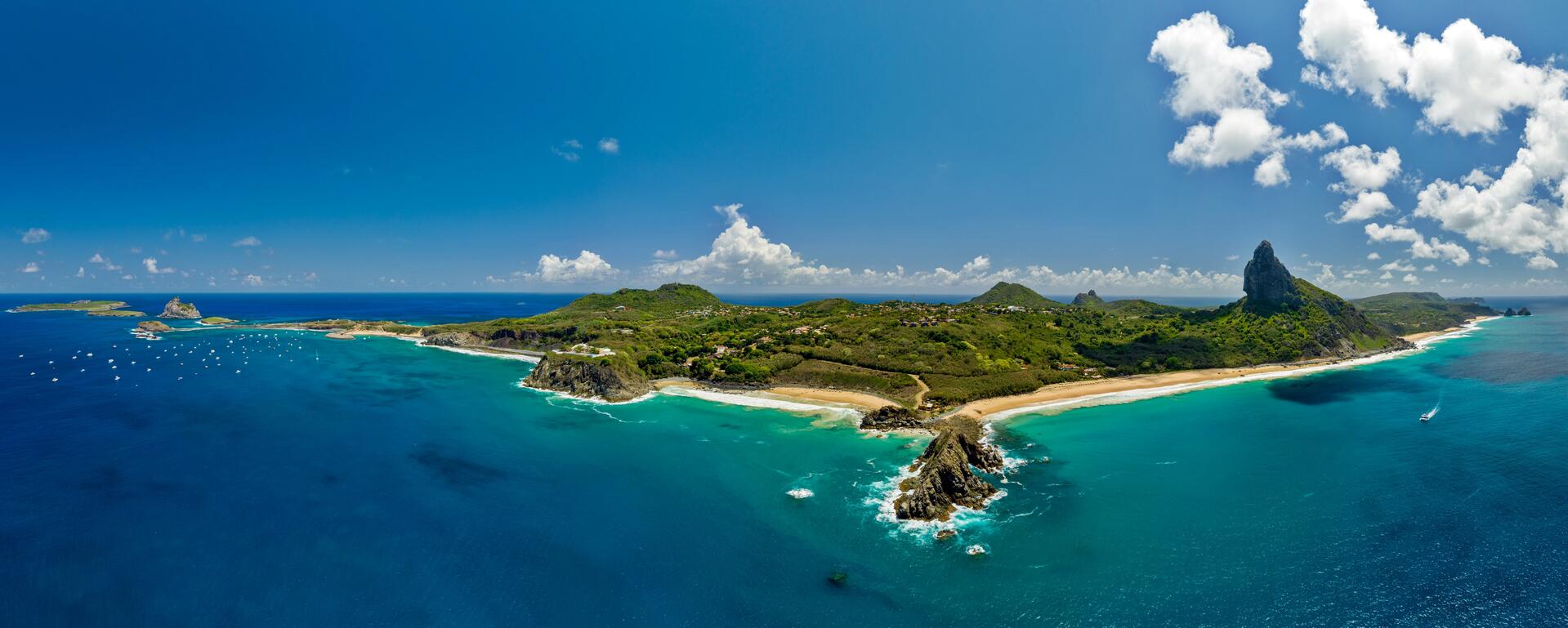
© Fernandoantoniofotos, CC BY-SA 4.0 Resized from original. (This derivative is under the same CC BY-SA license.)