World Heritage Identification Number: 1371
World Heritage since: 2011
Category: Cultural Heritage
WHE Type: Cultural Landscapes
Transboundary Heritage: No
Endangered Heritage: No
Country: 🇪🇸 Spain
Continent: Europe
UNESCO World Region: Europe and North America
Map
The Cultural Landscape of the Serra de Tramuntana: A Unique Blend of Nature and Human Ingenuity
The Cultural Landscape of the Serra de Tramuntana, situated along the rugged northwestern coast of the Balearic Island of Mallorca, stands as a testament to human resilience and ingenuity in the face of challenging environmental conditions. This World Heritage Site, inscribed by UNESCO in 2011, offers a captivating blend of natural beauty and cultural heritage that continues to intrigue visitors from around the globe.
More to come…UNESCO Description of the World Heritage Site
The Cultural Landscape of the Serra de Tramuntana located on a sheer-sided mountain range parallel to the north-western coast of the island of Mallorca. Millennia of agriculture in an environment with scarce resources has transformed the terrain and displays an articulated network of devices for the management of water revolving around farming units of feudal origins. The landscape is marked by agricultural terraces and inter-connected water works - including water mills - as well as dry stone constructions and farms.
UNESCO Justification of the World Heritage Site
Criterion (ii): The landscape of the Serra de Tramuntana eminently exemplifies the interchange between the Muslim and Christian cultures, which is representative of the Mediterranean area, in the combination of the Arabic water harvesting and management technology with the agricultural know-how and the territorial control system introduced by the Christian conquerors, who took over the island of Mallorca in 13th century AD. By this cultural interaction, a terraced agricultural landscape was created, featured by an articulated waterworks network, orchards, vegetable gardens and olive groves, which were earlier organised around small farm holdings, and later in large estates (posesiones) and which nowadays make up the physical and functional features of the Serra de Tramuntana.
Criterion (iv): The cultural landscape of the Serra de Tramuntana represents a spectacular, peculiar example of a terraced. farmed landscape which combines an interconnected and highly specialised system of waterworks for collecting and storing water, featuring qanats, that are underground channels to harvest and transport water, canals, ditches, storage basins, with a system of terraces supported by dry-stone walls so as to make possible the cultivation of vegetables as well as fruit and olive trees in the terraced plots and including a sophisticated drainage system to avoid soil erosion.
Criterion (v): The settlement pattern of the Tramuntana area bears significant witness to human adaptation to difficult environmental conditions, which has ingeniously made a region with scarce resources, both in term of land and water, suitable for farming and living. The feudal land subdivision system, applied to extreme orographic conditions, combined with the sophisticated waterworks technology of Arabic origins has resulted in complex farming units. Their land distribution and use pattern, comprising rocky areas on the tops of mountains, strips of woodland, slopes with terraces, extensive grazing land, fields for reaping, vineyards or fruit crops on flatter land, ensured over time the full exploitation of the existing resources. The Tramuntana area thus pays testimony to the continuous evolution of human settlement in a rugged and steep area of the island.
Encyclopedia Record: Serra de Tramuntana
The Serra de Tramuntana is a mountain range running southwest–northeast which forms the northern backbone of the Spanish island of Mallorca. It is also the name given to the comarca of the same area. On 27 June 2011, the Tramuntana Range was awarded World Heritage Status by UNESCO as an area of great physical and cultural significance.Additional Site Details
Area: 30,745 hectares
Number of Components: 1
(iv) — Outstanding example of a type of building or landscape
(v) — Outstanding example of traditional human settlement
Coordinates: 39.7308333333 , 2.6947222222
Image
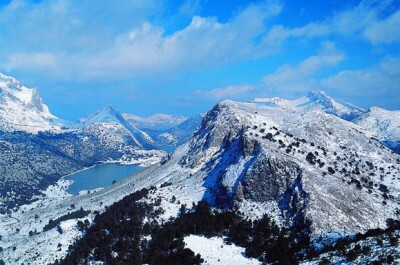
No machine-readable author provided. Cybertoni assumed (based on copyright claims)., Public domain
World Heritage Research
Discover scientific research and academic studies that deepen our understanding of Cultural Landscape of the Serra de Tramuntana from its history and significance to its conservation, management, and contemporary challenges.
-
Implications of illite X-ray diffraction characteristics and K–Ar dating for the tectonics of Mallorca (Spain)
A pre-tectonic thermal event from the early Cretaceous, marked by a K–Ar age of 133–140 Ma and palaeotemperatures of 180–200°C, was identified in the Serra de Tramuntana of Mallorca using illite X-ray diffraction (XRD) characteristics and dating. This event reflects an extremely high geothermal gradient at the end of Mesozoic extension, predating the Oligocene–Miocene Alpine orogeny that shaped the mountain range. The study analyzed 16 samples from two outcrops, employing XRD, microscopy, microanalysis, and K–Ar dating on clay fractions. Pure volcanic rock samples yielded consistent ages, while contaminated samples confirmed the Cretaceous origin of the thermal event. Maximum palaeotemperatures during later tectonic burial were estimated to be below 250°C, preserving Cretaceous illite XRD features that indicate conditions near the diagenesis/anchimetamorphism boundary.
Środoń, J., Szczerba, M., & Bojanowski, M. J. (2025). Implications of illite X-ray diffraction characteristics and K–Ar dating for the tectonics of Mallorca (Spain). Clay Minerals, 60(3), 259–272. https://doi.org/10.1180/clm.2025.10014
View Publication Record | Read Publication -
Dinámicas turísticas Pos-Covid en paisajes culturales insulares: estudio preliminar en Mallorca y Gran Canaria
Post-COVID tourism has significantly reshaped the economic, social, and cultural dynamics of UNESCO World Heritage Sites, particularly in insular cultural landscapes. A preliminary study focusing on Mallorca's Serra de Tramuntana and Gran Canaria's Risco Caído and Sacred Mountain Spaces reveals critical tensions between sustainability, tourism development, and heritage valorization. The research highlights the urgent need for strengthened local governance strategies and active community engagement to mitigate the impacts of post-pandemic tourism. Using statistical data analysis and qualitative thematic coding from stakeholder interviews, the study identifies patterns and discourses that underscore the complex interplay between tourism dynamics and heritage management in times of crisis.
Ojeda Naranjo, W. del P., Coll-Ramis, M. À., Rodriguez, M. del P., & Romero Martín, L. E. (2025). Dinámicas turísticas Pos-Covid en paisajes culturales insulares: estudio preliminar en Mallorca y Gran Canaria. Asociación Española de Geografía. https://doi.org/10.5281/ZENODO.20012423
View Publication Record | Read Publication -
The Interconnection between Climate Cycles and Geohazards in Urban Areas of the Tourist Island of Mallorca, Spain
A strong correlation exists between climate cycles and geohazards such as landslides and flash floods in Mallorca, Spain. The study identifies that the El Niño–Southern Oscillation (ENSO), North Atlantic Oscillation (NAO), Quasi-Biennial Oscillation (QBO), and sunspot activity significantly influence rainfall patterns, which in turn trigger these hazards. Spectral analysis techniques revealed that QBO, with its higher frequency, is particularly notable as it appears embedded within other cycles during periods of heightened ENSO, NAO, and sunspot values. The research also highlights that urban areas like Palma and Calvià, along with the central and eastern parts of the island, are highly vulnerable to intense rainfall and its consequences. This finding underscores the need for targeted risk management strategies in these regions.
Luque-Espinar, J. A., Mateos, R. M., Sarro, R., Reyes-Carmona, C., & Martínez-Corbella, M. (2024). The Interconnection between Climate Cycles and Geohazards in Urban Areas of the Tourist Island of Mallorca, Spain. Sustainability, 16(12), 4917. https://doi.org/10.3390/su16124917
View Publication Record | Read Publication -
S’Albufereta de Pollença (Mallorca): una introducció a la seva geomorfologia i l’evolució sedimentària recent
Recent sediment analysis of S’Albufereta de Pollença, a 400-hectare wetland in Mallorca’s Serra de Tramuntana, reveals that the Holocene sediment fill—ranging from 3 to 5 meters thick—was primarily driven by alluvial inputs from torrents rather than significant marine transgression. The study suggests minimal subsidence and indicates that the paleotopography from the last glacial period was largely refilled during the Holocene transgression, which did not exceed one meter above current sea levels. Researchers employed mechanical coring and geomorphological mapping to characterize the wetland’s morphology and sedimentary sub-environments, providing insights into its recent geological evolution.
Fornós, J. J., GÓMEZ-PUJOL, L., Cau-Ontiveros, M. A., & Mas-Florit, C. (2024). S’Albufereta de Pollença (Mallorca): an introduction to its geomorphology and recent sedimentary evolution. Cuadernos de Geografía de La Universitat de València, (112), 85–105. https://doi.org/10.7203/cguv.112.28843
View Publication Record | Read Publication -
First demographic assessment of the recently discovered subpopulation of the narrow endemic Femeniasia balearica from the Balearic Islands (Western Mediterranean)
A recently discovered subpopulation of the narrow endemic species Femeniasia balearica, located in the Serra de Tramuntana of Mallorca (Balearic Islands), shows promising demographic stability. The study, conducted by Rodríguez and Cursach (2024), geolocated 116 individuals and 96 seedlings using differential GPS, revealing that 86.7% of the adults are reproductive. This suggests a stable or growing population, though long-term monitoring is recommended to assess demographic trends. The research provides critical data for conservation efforts, particularly for this IUCN-listed Vulnerable species with isolated populations in the western Mediterranean.
Rodríguez, M., & Cursach, J. (2024). First demographic assessment of the recently discovered subpopulation of the narrow endemic Femeniasia balearica from the Balearic Islands (Western Mediterranean). Mediterranean Botany, Online first, 1–15. https://doi.org/10.5209/mbot.94857
View Publication Record | Read Publication -
Historia del Jardín Botánico Germà Macià en el Santuario de Lluc (Mallorca)
The Germà Macià Botanical Garden, located within the UNESCO-listed Cultural Landscape of Serra de Tramuntana on Mallorca, stands as a pivotal collection of 469 plant taxa, including 28 endemics unique to the Balearic Islands. Established in 1956 by Germà Macià, inspired by Padre Bonafé's work, this garden has become a cornerstone for both conservation and education. It collaborates with public entities to protect threatened species while engaging educational institutions and society to promote awareness of the archipelago's rich plant diversity. The garden's dual role in preserving native and global flora underscores its significance as a living repository and a catalyst for biodiversity conservation efforts.
ALCÁNTARA, M., CARDONA, C., LLOBERA, F., RODRIGUEZ, M., VELÁZQUEZ, Á., & CAPÓ, M. (2024). History of the Germà Macià Botanical Garden in Santuario de Lluc (Mallorca). Conservación Vegetal, (28), 8–10. https://doi.org/10.15366/cv2024.28.001
View Publication Record | Read Publication -
Tourism Music in Mallorca: From Mallorcastyle to the Serra de Tramuntana
A new form of Electronic Dance Music, 'Mallorcastyle,' reflects and perpetuates the debauched lifestyle associated with Germanic tourism in Mallorca, characterized by excessive alcohol consumption, nightlife, and heteropatriarchal sexual behaviors. However, some artists within this genre have expanded their representation to include Mallorca's natural landscapes, particularly the Serra de Tramuntana, leveraging Mediterranean imagery as a marketing tool. Conversely, counter-movements in music videos critique the Balearic tourism model, highlighting the labor conditions of local workers that enable the carefree experiences of tourists. This study analyzes these contrasting narratives through music video content, revealing the duality of tourism's impact on Mallorca's cultural and natural heritage.
Calbet, G. O., Mateu, T. M., & Cremades, I. B. (2023). Tourism Music in Mallorca: From Mallorcastyle to the Serra de Tramuntana. Global Journal of Human-Social Science, 1–20. DWT. https://doi.org/10.34257/gjhsshvol23is2pg1
View Publication Record | Read Publication