World Heritage Identification Number: 353
World Heritage since: 1987
Category: Cultural Heritage
WHE Type: Archaeological Sites
Transboundary Heritage: No
Endangered Heritage: No
Country: 🇺🇸 United States of America
Continent: Americas
UNESCO World Region: Europe and North America
Map
Exploring the Ancient Urban Ceremonial Centre: Chaco Culture
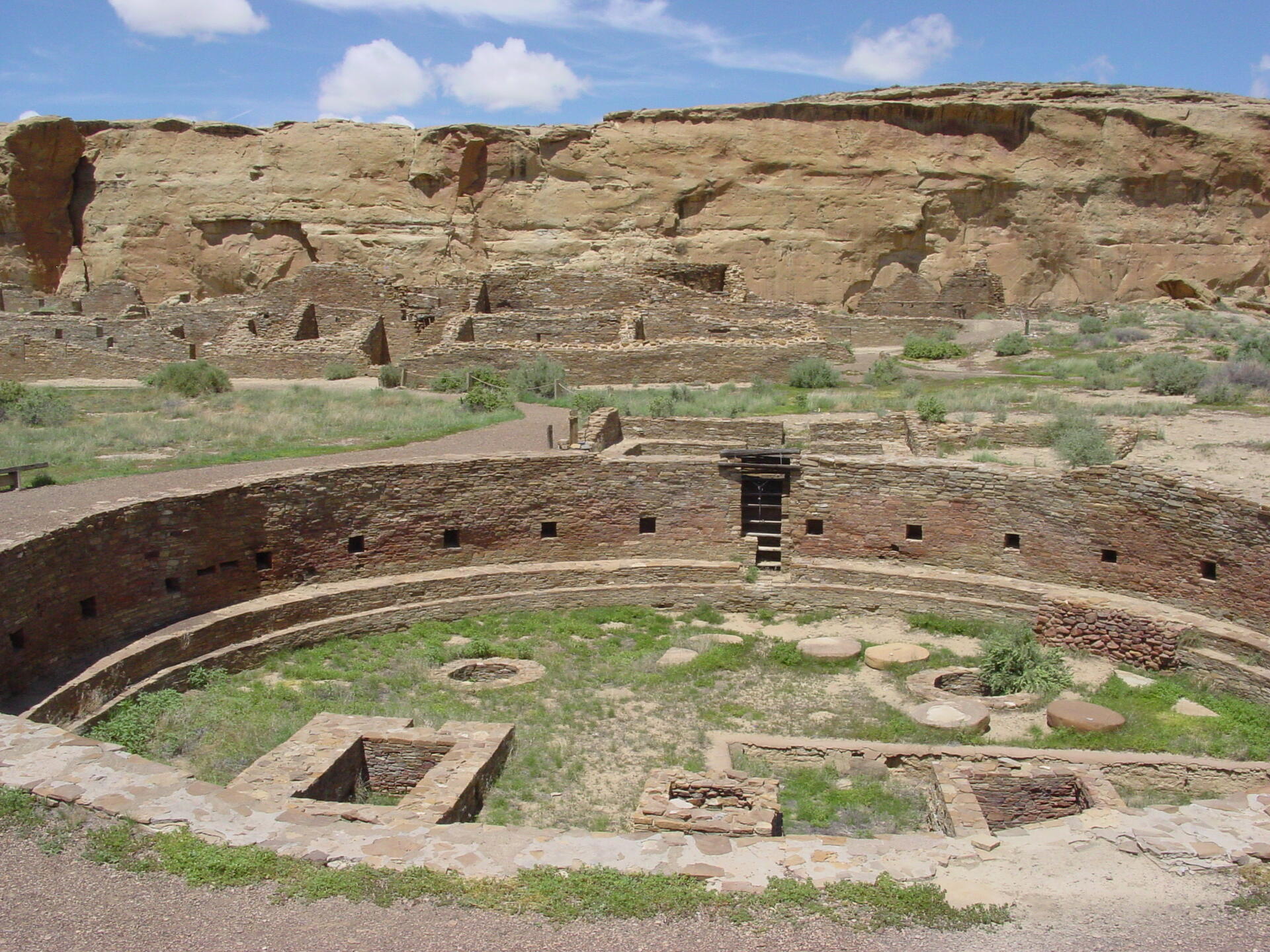
The Chaco Culture, inscribed as a UNESCO World Heritage Site in 1987, offers a unique glimpse into the rich history and architectural prowess of the ancestral Pueblo people who inhabited the southwestern United States from approximately 850 to 1250 AD. This extensive archaeological site, situated within the Chaco Culture National Historical Park, serves as a significant cultural and historical hub, showcasing monumental public and ceremonial structures that remain unparalleled in their design and construction.
More to come…UNESCO Description of the World Heritage Site
For over 2,000 years, Pueblo peoples occupied a vast region of the south-western United States. Chaco Canyon, a major centre of ancestral Pueblo culture between 850 and 1250, was a focus for ceremonials, trade and political activity for the prehistoric Four Corners area. Chaco is remarkable for its monumental public and ceremonial buildings and its distinctive architecture – it has an ancient urban ceremonial centre that is unlike anything constructed before or since. In addition to the Chaco Culture National Historical Park, the World Heritage property includes the Aztec Ruins National Monument and several smaller Chaco sites managed by the Bureau of Land Management.
UNESCO Justification of the World Heritage Site
Criterion (iii): The Chaco Canyon sites graphically illustrate the architectural and engineering achievements of the Chacoan people, who overcame the harshness of the environment of the southwestern United States to found a culture that dominated the area for more than four centuries.
Encyclopedia Record: Chaco Culture
Chaco Culture is a UNESCO World Heritage Site in the southwestern U.S. state of New Mexico.Additional Site Details
Area: 14,261 hectares
Number of Components: 10
Coordinates: 36.06377778 , -107.9708333
World Heritage Research
Discover scientific research and academic studies that deepen our understanding of Chaco Culture from its history and significance to its conservation, management, and contemporary challenges.
-
Chaco Culture National Historical Park: Paleontological site monitoring protocol
Chaco Culture National Historical Park (CHCU) is home to a rich array of Upper Cretaceous paleontological resources, with over 100 sites documented since 2005. A new monitoring protocol has been developed to effectively manage and track these valuable fossils, which are divided into twelve Paleontological Management Areas (PMAs). Each PMA includes multiple localities, prioritized based on factors such as stratigraphy, accessibility, and management needs. The protocol provides detailed guidance for field methods, site discovery protocols, and monitoring frequencies, with appendices offering editable forms for documentation. This structured approach aims to preserve and study CHCU's significant paleontological heritage while balancing conservation with scientific inquiry.
Varela, P. (2024). Chaco Culture National Historical Park: Paleontological site monitoring protocol (, Ed.). National Park Service. https://doi.org/10.36967/2304460
View Publication Record | Read Publication -
Water quality at Chaco Culture National Historical Park and the potential effects of hydrocarbon extraction
Groundwater in Chaco Culture National Historical Park, sourced from the Gallup Sandstone aquifer, is among the oldest and most geochemically evolved on record, with a median age of approximately 41,000 years. A comprehensive geochemical analysis revealed evidence suggesting mixing between aquifers and potential contamination by hydrocarbons, likely facilitated by numerous extraction boreholes. Key indicators include fractionated noble gases, trace hydrocarbon-related volatile organic compounds (VOCs) in the park’s main supply well, and major ion trends pointing to cross-aquifer mixing. While these findings hint at possible impacts from oil and gas extraction, further research is needed to distinguish between natural processes and anthropogenic influences.
Linhoff, B. S., Beisner, K. R., Hunt, A. G., & Shephard, Z. M. (2023). Water quality at Chaco Culture National Historical Park and the potential effects of hydrocarbon extraction. Journal of Hydrology: Regional Studies, 47, 101430. https://doi.org/10.1016/j.ejrh.2023.101430
View Publication Record | Read Publication -
“Not From Their Culture”: The Influence of Artisanal Promotion Agents in the Production and Commercialization of Indigenous Crafts in Chaco, Argentina
Artisanal promotion agents (APAs) significantly influence the production and commercialization of indigenous crafts in Chaco, Argentina, shaping decisions on colors, materials, and shapes without always making their cultural presumptions explicit. Through ethnographic fieldwork spanning six years, researchers observed that APAs use images and prototypes to communicate design suggestions, diversifying craft production while maximizing market appeal. Their influence is heterogeneous, with notable impact on shape choices but less obvious effects on color decisions. This study highlights the pivotal role of APAs in mediating cultural expressions through commercial systems, revealing how they manage both artistic diversity and economic strategies.
Perret, M. F. (2022). “Not From Their Culture”: The Influence of Artisanal Promotion Agents in the Production and Commercialization of Indigenous Crafts in Chaco, Argentina. The Journal of Modern Craft, 15(1), 43–54. https://doi.org/10.1080/17496772.2022.2048496
View Publication Record | Read Publication -
The deterioration of the Pueblo Bonito Great House in the Chaco Culture National Historical Park, New Mexico, USA
Ancestral Puebloan engineers at Pueblo Bonito, a UNESCO World Heritage Site in New Mexico, faced significant structural challenges due to annual precipitation of about 220 mm. Historical photographs from 1887 to the 1920s reveal that wood decay fungi caused rot in wetted roof and ceiling timbers, lintels, and wall support beams, leading to roof and wall collapse over decades. Water action on mud mortar also destabilized stone walls, while freezing ponded water caused blowouts. These time-dependent and independent events suggest that Pueblo Bonito's rooms may have had a lifespan of only decades, resulting in multiple build-repair-abandon cycles. The study retrospectively analyzed these photographs to attribute structural damages to identifiable agents present during the site's occupancy.
Short, H. L. (2022). The deterioration of the Pueblo Bonito Great House in the Chaco Culture National Historical Park, New Mexico, USA. Plos One, 17(4), e0266099. https://doi.org/10.1371/journal.pone.0266099
View Publication Record | Read Publication -
The dialectics of capital: learning from Gran Chaco
Capitalism's dynamic influence on socio-ecological systems is revealed through the Dialectical Socio-Ecological System (D-SES) framework, which integrates process ecology with historical materialism. This approach uncovers how capitalist dynamics, characterized by autocatalysis, centripetality, directionality, and autonomy, emerge from interactions within economic/material and cultural/institutional spheres. Applied to the Chaco Salteño region—a key agricultural frontier in South America—this framework demonstrates how capital-intensive agriculture attracts resources, fine-tunes production modes, and generates class frictions that could serve as leverage points for systemic transformation. The study highlights the need for critical scrutiny of capitalism to achieve sustainability in an era marked by global environmental changes.
Ceddia, M. G., Montani, R., & Mioni, W. (2022). The dialectics of capital: learning from Gran Chaco. Sustainability Science, 17(6), 2347–2362. https://doi.org/10.1007/s11625-022-01203-1
View Publication Record | Read Publication -
Revisiting and reframing ethnographic praxis. The return of visual collections from Gothenburg to the Argentine Chaco
This study reveals that ethnographic fieldwork, when applied to the return of visual collections from museums to Indigenous communities, can uncover deep social and cultural dynamics. By presenting century-old photographs and films to the Pilagá People in Argentina's Chaco region, the research demonstrates how such returns are embedded in complex historical relationships with anthropology. The findings highlight that prolonged ethnographic engagement is essential for understanding the multifaceted impacts of repatriation efforts. Additionally, it critiques traditional ethnographic practices, suggesting they have left lasting imprints on local perceptions of culture and memory, necessitating a reframing of field methods to incorporate critical perspectives.
Gustavsson, A. (2022). Revisiting and reframing ethnographic praxis. The return of visual collections from Gothenburg to the Argentine Chaco. International Journal of Heritage Studies, 28(11-12), 1242–1254. https://doi.org/10.1080/13527258.2022.2146154
View Publication Record | Read Publication -
Probabilities of designed locations of ceremonial foci: the Chaco Meridian, temple IV at Tikal, and a large-scale sacred Adena river landscape
Research reveals strong evidence that prehistoric cultures, such as those in Chaco Canyon and the Adena region, intentionally designed large-scale geometric patterns across landscapes. The study distinguishes between random alignments and intentional design by testing 26 prominent Adena mounds against river confluence points and mountain peaks, finding a high probability of deliberate surveying. Similar analyses at Tikal's Temple IV and Chaco Canyon's great kivas also suggest designed ceremonial foci. The approach involves modeling random point sets to compare the frequency of precise three-point alignments and right-angles, with results indicating intentional geometric planning in these ancient landscapes.
Doxtater, D. (2021). Probabilities of designed locations of ceremonial foci: the Chaco Meridian, temple IV at Tikal, and a large-scale sacred Adena river landscape. Time and Mind, 14(2), 283–326. https://doi.org/10.1080/1751696x.2021.1903178
View Publication Record | Read Publication