World Heritage Identification Number: 1035
World Heritage since: 2001
Category: Natural Heritage
WHE Type: Protected Areas & National Parks
Transboundary Heritage: No
Endangered Heritage: No
Country: 🇧🇷 Brazil
Continent: Americas
UNESCO World Region: Latin America and the Caribbean
Map
Cerrado Protected Areas: Chapada dos Veadeiros and Emas National Parks
The Cerrado Protected Areas, consisting of Chapada dos Veadeiros and Emas National Parks, are significant components of the Cerrado biome, a vast tropical savanna ecoregion located primarily in central Brazil. These protected areas were designated as a UNESCO World Heritage Site in 2001 due to their unique biodiversity and role as refuges for various plant and animal species throughout periods of climate change.
More to come…UNESCO Description of the World Heritage Site
The two sites included in the designation contain flora and fauna and key habitats that characterize the Cerrado – one of the world’s oldest and most diverse tropical ecosystems. For millennia, these sites have served as refuge for several species during periods of climate change and will be vital for maintaining the biodiversity of the Cerrado region during future climate fluctuations.
UNESCO Justification of the World Heritage Site
Criterion (ix): The current protected areas of the site played a key role for thousands of years in maintaining the biodiversity of the Cerrado ecoregion. Because of their central position and their altitudinal variation, they served as relatively stable refuges for species during climate changes that displaced the Cerrado along a north-south or east-west axis. This role of refuge for species continues. The climate marked by the two well-defined seasons (dry and wet), the recurrence of fires and the high concentration of aluminum, as well as the extremely acid and nutrient-deprived soil, have resulted in unique progressive adaptations in the flora and fauna.
Criterion (x): The site contains samples of all the key habitats that characterize the Cerrado ecoregion - one of the oldest tropical ecosystems of the Earth. It hosts more than 60% of all plant species and almost 80% of all vertebrate species observed in the Cerrado. All the endangered great mammals of the Cerrado are present, with the exception of the giant otter. In addition, the site is home to many rare small mammals and endemic birds of the Cerrado. Science continues to discover new species in this site.
Encyclopedia Record: Cerrado
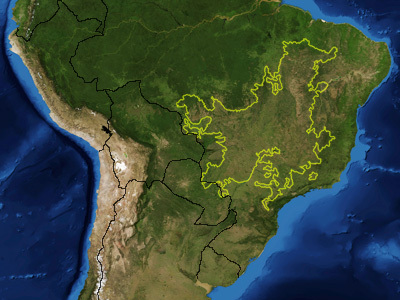
The Cerrado is a vast ecoregion of tropical savanna in central Brazil, being present in the states of Goiás, Mato Grosso do Sul, Mato Grosso, Tocantins, Maranhão, Piauí, Bahia, Minas Gerais, São Paulo, Paraná and the Federal District. The core areas of the Cerrado biome are the Brazilian highlands – the Planalto. The main habitat types of the Cerrado consist of forest savanna, wooded savanna, park savanna and gramineous-woody savanna. The Cerrado also includes savanna wetlands and gallery forests.Additional Site Details
Area: 381,430 hectares
Number of Components: 2
(x) — Contains most important habitats for biodiversity
Coordinates: -14.00569444 , -47.68461111
IUCN World Heritage Outlook
The 2025 Conservation Outlook on Cerrado Protected Areas: Chapada dos Veadeiros and Emas National Parks reports the following assessment:
Source: International Union for Conservation of Nature (IUCN) · View assessment
Image
Pfly, Public domain
World Heritage Research
Discover scientific research and academic studies that deepen our understanding of Cerrado Protected Areas: Chapada dos Veadeiros and Emas National Parks from its history and significance to its conservation, management, and contemporary challenges.
-
Effects of habitat fragmentation on species richness and community composition of medium- and large-sized mammals in sugarcane-dominated Cerrado landscapes, southwestern Goiás, Brazil
Mammal species richness and community composition in the Cerrado Protected Areas of Chapada dos Veadeiros and Emas National Parks, Brazil, are highly sensitive to habitat fragmentation caused by sugarcane expansion. The study found that landscape metrics—such as native habitat area, fragment isolation, and proximity to protected areas—explained 90.1% of species richness variation and 85.5% of compositional changes. Species diversity increased with more native habitat but declined with greater fragment isolation, while community structure was primarily shaped by inter-fragment distances and protection status. These findings highlight the profound impact of agricultural landscapes on mammal assemblages, favoring generalist and disturbance-tolerant species while reshaping ecological dynamics.
de Lima, C. A., Alves, E. N., Hannibal, W., & Rocha, E. C. (2026). Effects of habitat fragmentation on species richness and community composition of medium- and large-sized mammals in sugarcane-dominated Cerrado landscapes, southwestern Goiás, Brazil. Frontiers in Conservation Science, 7. https://doi.org/10.3389/fcosc.2026.1799392
View Publication Record | Read Publication -
Soil Macrofauna Diversity in Threatened Veredas in Two Protected Areas of the Brazilian Cerrado
Environmental degradation in veredas, hygrophilous communities of the Brazilian Cerrado, does not necessarily reduce soil macrofauna diversity but instead may favor certain functional groups, such as herbivores and detritivores, which adapt to altered conditions. This restructuring of communities, rather than a simple decline in biodiversity, was observed in a study comparing preserved (Almescla) and degraded (Peruaçu) veredas in northern Minas Gerais. Researchers analyzed soil macrofauna using pitfall traps across 24 plots per site, recording over 5000 arthropod individuals belonging to four classes, 20 orders, 89 families, and 396 morphospecies. Ants (Formicidae) were the most abundant group, influencing higher macrofauna occurrence in degraded areas due to their adaptability. The study underscores the importance of conservation efforts to maintain vegetation structure and litter deposition, ensuring the preservation of soil biodiversity in threatened ecosystems.
Alves, A. B., de Araújo, W. S., Costa, L. V. A., Gonçalves, M. F., Silva, S. C. O. e., Ruas, W. V. M., Nunes, Y. R. F., Veloso, R. B., & Veloso, M. d. D. M. (2026). Soil Macrofauna Diversity in Threatened Veredas in Two Protected Areas of the Brazilian Cerrado. Austral Ecology, 51(4). Portico. https://doi.org/10.1111/aec.70212
View Publication Record | Read Publication -
Temporal Changes in Vegetation Cover in Área de Proteção de Pouso Alto, Chapada dos Veadeiros - GO
Despite the establishment of the Área de Proteção Ambiental (APA) de Pouso Alto in 2001, vegetation loss in the Chapada dos Veadeiros region has not been effectively mitigated. A study analyzing land cover changes over 23 years found that 27.8% of the APA experienced alterations, with 16.6% occurring post-protection designation. Critically, the wilderness zone—intended to have stricter protections—showed nearly triple the vegetation loss in 2023 compared to 2000. The failure to implement a management plan has left priority conservation areas vulnerable, undermining the APA's role in landscape protection and connectivity. Researchers used MapBiomas classification data to compare land use between 2000 (pre-APA) and 2023, revealing persistent threats to biodiversity despite legal safeguards.
Theulen, V. (2026). Temporal Changes in Vegetation Cover in Área de Proteção de Pouso Alto, Chapada dos Veadeiros - GO. Revista Brasileira de Geografia Física, 19(01), 284–299. https://doi.org/10.26848/rbgf.v19.01.p284-299
View Publication Record | Read Publication -
Spatial and temporal variation in food resources shapes foraging of the Blue-and-yellow Macaw (Ara ararauna; Linnaeus, 1758) in a mosaic of Cerrado densities
Blue-and-yellow Macaws (Ara ararauna) rely on the spatial and temporal variation of food resources across different densities of Cerrado habitats for their survival. Research at Emas National Park, Brazil, revealed that three key food species—Anacardium humile, Caryocar brasiliense, and Ouratea spectabilis—vary significantly in abundance depending on Cerrado density, with open sites supporting higher numbers of macaws during the dry-to-wet season transition. Pouteria torta serves as a consistent seed source across all densities. The study highlights that conserving diverse Cerrado mosaics is critical for maintaining year-round food availability and sustaining macaw populations amid habitat loss.
Ragusa-Netto, J. (2026). Spatial and temporal variation in food resources shapes foraging of the Blue-and-yellow Macaw (Ara ararauna; Linnaeus, 1758) in a mosaic of Cerrado densities. Brazilian Journal of Biology, 86. https://doi.org/10.1590/1519-6984.303911
View Publication Record | Read Publication -
Immunological and reproductive effects of anthropized environments in Leptodactylus fuscus (Anura)
Anthropogenic disturbances in the Cerrado Protected Areas, specifically Chapada dos Veadeiros and Emas National Parks, significantly alter the immunological and reproductive systems of the frog Leptodactylus fuscus. Research indicates that exposure to agricultural (soybean and sugarcane) and urban environments leads to increased lymphocyte and neutrophil counts, reduced spleen white pulp, elevated red pulp, higher mast cell presence, and changes in melanin pigmentation. Additionally, frogs from highly disturbed areas show an expansion in the area occupied by spermatogonia, spermatocytes, spermatids, and spermatozoa, suggesting multi-systemic physiological adaptations or stress responses. This study highlights the potential of tissue biomarkers for monitoring wild populations under environmental stress, providing critical insights into the impacts of anthropogenic activities on native anuran communities.
Rezende, W. R., de Lacerda Valverde, B. S., de Souza Santos, L. R., Franco-Belussi, L., & De Oliveira, C. (2026). Immunological and reproductive effects of anthropized environments in Leptodactylus fuscus (Anura). Ecotoxicology, 35(7). https://doi.org/10.1007/s10646-026-03140-6
View Publication Record | Read Publication -
Verbenaceae in Emas National Park (Goiás state, Central Brazil), with a focus on chromatic variation in the corollas of Lippia filifolia
Researchers have uncovered a notable chromatic variation in the corollas of Lippia filifolia within Emas National Park, a UNESCO World Heritage Site in Brazil's Cerrado domain. Unlike specimens from other regions like the Espinhaço Range and Serra da Canastra, which exhibit yellow corollas, those found in Emas display an uncommon red coloration. This discovery contributes to the taxonomic and biogeographic understanding of Verbenaceae in the Brazilian Central Plateau. The study recorded 12 taxa belonging to three genera, including Lippia stachyoides var. guajajarana, which is endemic to the park. To support conservation efforts, the research provides a synopsis, photographs, and an identification key for the taxa occurring in this critical biodiversity region.
Cardoso, P. H., Renon, P., Costa, M. L., & De Morais, I. L. (2025). Verbenaceae in Emas National Park (Goiás state, Central Brazil), with a focus on chromatic variation in the corollas of Lippia filifolia. Webbia, 80(1), 107–120. https://doi.org/10.36253/jopt-16698
View Publication Record | Read Publication -
Spatiotemporal Analysis of Land Use and Cover Dynamics in Protected Areas of the Brazilian Cerrado
Protected areas within the Brazilian Cerrado, such as Chapada dos Veadeiros and Emas National Parks, exhibit significantly more constrained land use and cover dynamics compared to their buffer zones (BZs), with some parks like Templo dos Pilares showing extensive preserved vegetation. However, surrounding BZs face intense land use pressures, posing potential threats to biodiversity conservation in these protected areas. A spatiotemporal analysis of satellite imagery from 1985 to 2018 revealed that while NPA maintain stable land cover patterns, their BZs experience rapid transformations, highlighting the need for proactive management strategies to mitigate external pressures and safeguard long-term conservation efforts.
Torgeski, M. R., de Carvalho, E. M., dos Santos, A. M., Lemke, A. P., Fioratti, C. A. G., Stefanes, M., Silva, S. M., & Mussury, R. M. (2025). Spatiotemporal Analysis of Land Use and Cover Dynamics in Protected Areas of the Brazilian Cerrado. Scientifica, 2025(1). Portico. https://doi.org/10.1155/sci5/7984448
View Publication Record | Read Publication