World Heritage Identification Number: 721
World Heritage since: 1995
Category: Natural Heritage
WHE Type: Protected Areas & National Parks
Transboundary Heritage: No
Endangered Heritage: No
Country: 🇺🇸 United States of America
Continent: Americas
UNESCO World Region: Europe and North America
Map
Exploring the Subterranean Wonders of Carlsbad Caverns National Park
Carlsbad Caverns National Park, nestled within the Guadalupe Mountains of southeastern New Mexico, offers a captivating blend of geology, biology, and history. Established in 1930, this national park has since become renowned for its extensive network of over 80 recognized caves, each boasting unique mineral formations that have been sculpted by nature over millennia.
More to come…UNESCO Description of the World Heritage Site
This karst landscape in the state of New Mexico comprises over 80 recognized caves. They are outstanding not only for their size but also for the profusion, diversity and beauty of their mineral formations. Lechuguilla Cave stands out from the others, providing an underground laboratory where geological and biological processes can be studied in a pristine setting.
UNESCO Justification of the World Heritage Site
Criterion (vii): The park’s primary caves, Carlsbad and Lechuguilla, are well known for the abundance, diversity, and beauty of their decorative rock formations. Lechuguilla Cave exhibits rare and unique speleothems, including the largest accumulation of gypsum “chandeliers,” some of which extend more than six meters (18 feet) in length.
Criterion (viii): Carlsbad Caverns National Park is one of the few places in the world where on-going geologic processes are most apparent and rare speleothems continue to form, enabling scientists to study geological processes in a virtually undisturbed environment. These speleothems include helictites forming underwater, calcite and gypsum speleothems, and an astonishing collection of “biothems,” cave formations assisted in their formation by bacteria. Researchers can study both the Capitan reef’s inside through cave passages that penetrate in and through it as well as eroded canyon-exposed cross sections outside.
Encyclopedia Record: Carlsbad Caverns National Park
Carlsbad Caverns National Park is a national park of the United States in the Guadalupe Mountains of southeastern New Mexico. The primary attraction of the park is the show cave Carlsbad Cavern. Visitors can hike in on their own via the natural entrance or take an elevator from the visitor center.Additional Site Details
Area: 18,926 hectares
Number of Components: 1
(viii) — Outstanding example representing major earth stages
Coordinates: 32.16666667 , -104.3833333
IUCN World Heritage Outlook
The 2025 Conservation Outlook on Carlsbad Caverns National Park reports the following assessment:
Source: International Union for Conservation of Nature (IUCN) · View assessment
Image
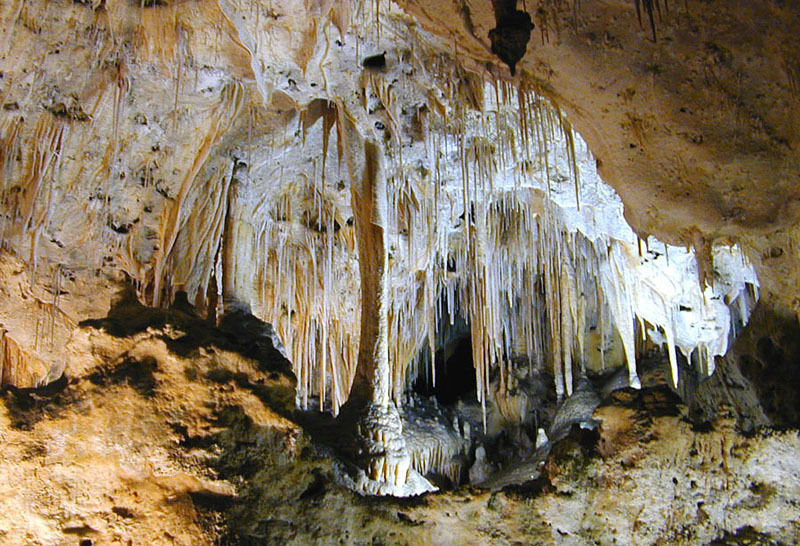
© Eric Guinther, User:Marshman, CC BY-SA 3.0 Resized from original. (This derivative is under the same CC BY-SA license.)
World Heritage Research
Discover scientific research and academic studies that deepen our understanding of Carlsbad Caverns National Park from its history and significance to its conservation, management, and contemporary challenges.
-
Geologic Map of the Carlsbad 30 x 60-Minute Quadrangle, Eddy and Otero Counties, New Mexico; and Culberson, Hudspeth, and Reeves Counties, Texas
A comprehensive geologic map of the Carlsbad 30x60-minute quadrangle, spanning parts of New Mexico and Texas, reveals the complex geological history and diverse landscapes of this region. This area, home to Carlsbad Caverns National Park, features significant Permian Basin sediments, late Cenozoic fluvial systems, and extensive eolian deposits on the Mescalero Plain. The map integrates decades of geologic data, highlighting the transition from the Guadalupe Mountains' shelf and reef sediments to the Rio Grande rift and Salt Basin. It also documents subsurface stratigraphy ranging from Permian through Cambrian-aged rocks, providing critical insights into the geological provinces that support major infrastructure for potash mining, oil, and gas extraction.
Krupnick, M. J., Askin, T., Allen, B. D., Gavel, M. M., & Polyak, V. J. (2026). Geologic Map of the Carlsbad 30 x 60-Minute Quadrangle, Eddy and Otero Counties, New Mexico; and Culberson, Hudspeth, and Reeves Counties, Texas (, Ed.). New Mexico Bureau of Geology and Mineral Resources. https://doi.org/10.58799/gm-82
View Publication Record | Read Publication -
Climate and Water Monitoring at Carlsbad Caverns National Park: Water Year 2024
In the third consecutive year of below-average rainfall, Carlsbad Caverns National Park's climate and water monitoring for Water Year 2024 revealed significant drought conditions, with temperatures also above normal. Notably, Oak Spring experienced a dramatic reduction in its springbrook length and complete dryness of its plunge pool, while Upper Lowe Ranch Spring remained wet year-round despite one orifice drying up during the study period. The research, conducted by the Chihuahuan Desert Inventory and Monitoring Network, assessed six springs through measurements of discharge, wetted extent, water quality, and environmental DNA (eDNA) sampling to track rare species, invasive species, and pathogens. While no target eDNA species were detected, invasive plants such as Rabbitsfoot grass and Lehmann lovegrass were observed for the first time at Iron Pipe Seep and three other springs, respectively. The study continues to build a baseline reference of natural water quality variance in New Mexico's diverse spring ecosystems.
Fahey, K., Raymond, K., & Hubbard, T. (2026). Climate and Water Monitoring at Carlsbad Caverns National Park: Water Year 2024 (, Ed.). National Park Service. https://doi.org/10.36967/2318793
View Publication Record | Read Publication -
Examining Ozone Production in the Permian Oil and Gas Basin Using Carlsbad Caverns National Park Measurements and Satellite Data
A study reveals that ozone production at Carlsbad Caverns National Park is highly sensitive to nitrogen oxide (NOx) emissions from the Permian Basin's oil and gas (O&G) activity, with satellite data confirming a parallel increase in regional NO2 levels. Analysis of 2021 measurements showed O&G emissions as the dominant source of volatile organic compounds (VOCs), alongside aged biomass burning smoke. Modeling indicated that reducing NOx emissions would more effectively decrease ozone levels than targeting VOCs, though both measures could mitigate exceedances of the National Ambient Air Quality Standard (NAAQS). Satellite observations also highlighted a decline in the formaldehyde-to-NO2 ratio, further supporting NOx-sensitive ozone production linked to O&G activity.
Marsavin, A., Pan, D., Zhou, Y., Pollack, I. B., Sullivan, A. P., Sive, B. C., Prenni, A. J., Schichtel, B., Fischer, E. V., & Collett, J. L. (2026). Examining Ozone Production in the Permian Oil and Gas Basin Using Carlsbad Caverns National Park Measurements and Satellite Data. ACS ES&T Air, 3(9), 2348–2365. https://doi.org/10.1021/acsestair.6c00159
View Publication Record | Read Publication -
Carlsbad Caverns National Park southwestern willow flycatcher surveys and intensive point count surveys at Rattlesnake Springs, 2022 and 2023: Final report
A critical survey of the endangered Southwestern Willow Flycatcher in Carlsbad Caverns National Park and adjacent Rattlesnake Springs Preserve yielded no detections in 2022 but recorded positive sightings in 2023, highlighting a potential recovery trend. In 2022, 165 standardized point counts using the USFWS protocol detected zero flycatchers, while intensive surveys identified 34 bird species. By contrast, 519 point counts in 2023 documented at least seven flycatchers across three survey dates, including likely pairs, alongside 61 total species. Conducted by trained Tucson Audubon staff under USFWS protocols, these surveys employed rigorous call-back and 10-minute intensive point count methods to assess biodiversity and track the flycatcher's presence in this UNESCO-listed site.
MacFarland, J. (2025). Carlsbad Caverns National Park southwestern willow flycatcher surveys and intensive point count surveys at Rattlesnake Springs, 2022 and 2023: Final report (, Ed.). National Park Service. https://doi.org/10.36967/2306229
View Publication Record | Read Publication -
National Park Service cave paleontology: 2002-2023
A groundbreaking inventory of paleontological resources within Carlsbad Caverns National Park, part of the National Park Service (NPS), has uncovered significant Permian fossils embedded in cavern bedrock and bones of Quaternary megafauna. This study builds on a 2001 NPS report by expanding documentation across multiple parks, including notable discoveries such as mummified Pleistocene–Holocene bats in Grand Canyon NP and an American cheetah skull from Rampart Cave. The research also highlights the use of photogrammetry to study in situ specimens, addressing challenges posed by cave environments. Additionally, it reassesses Quaternary fossils, particularly avifauna, and documents extinct or locally extirpated taxa, contributing to a broader understanding of paleontological resources across NPS units.
Santucci, V., Hodnett, J.-P., Seiser, P., Tweet, J., & Wood, J. “. (2025). National Park Service cave paleontology: 2002-2023. Journal of Cave and Karst Studies, 87(4), 108–116. https://doi.org/10.4311/2024pa0119
View Publication Record | Read Publication -
Summertime Ozone Production at Carlsbad Caverns National Park, New Mexico: Influence of Oil and Natural Gas Development
A significant rise in summertime ozone (O₃) levels at Carlsbad Caverns National Park, exceeding 70 ppbv, is linked to the rapid expansion of oil and natural gas (O&G) development in southeastern New Mexico. The study reveals that O₃ production is highly responsive to reductions in both nitrogen oxides (NOₓ) and O&G-related volatile organic compounds (VOCs), with NOₓ reductions proving most effective. Using a constrained F0AM box model, researchers analyzed VOC reactivity and radical budgets, demonstrating that morning O₃ levels are primarily controlled by local photochemistry, while afternoon levels become sensitive to NOₓ loss. A high-O₃ episode was found to be influenced by aged O&G emissions, as indicated by back-trajectory analysis and low i-/n-pentane ratios, suggesting significant nonlocal O₃ formation.
Marsavin, A., Pan, D., Pollack, I. B., Zhou, Y., Sullivan, A. P., Naimie, L. E., Benedict, K. B., Juncosa Calahoranno, J. F., Fischer, E. V., Prenni, A. J., Schichtel, B. A., Sive, B. C., & Collett, J. L. (2024). Summertime Ozone Production at Carlsbad Caverns National Park, New Mexico: Influence of Oil and Natural Gas Development. Journal of Geophysical Research: Atmospheres, 129(14). Portico. https://doi.org/10.1029/2024jd040877
View Publication Record | Read Publication -
Carlsbad Caverns National Park: Acoustic monitoring report, 2019
Carlsbad Caverns National Park exhibits exceptionally low ambient sound levels, with median daytime noise at 21.0 dB and nighttime noise at 20.1 dB, reflecting its quiet wilderness character. The study, conducted by the Natural Sounds and Night Skies Division from late October to mid-December 2019, found that higher noise thresholds (e.g., 35 dB) were exceeded less than 4% of the day and just 0.81% at night, with even louder levels (45 dB+) rarely detected. A geospatial sound model estimated existing ambient noise at 32.3 dBA and natural conditions at 29.8 dBA, indicating localized anthropogenic impacts. The research aimed to establish a baseline for evaluating potential acoustic disruptions from overflights.
Olstad, T., & Meyer, E. (2024). Carlsbad Caverns National Park: Acoustic monitoring report, 2019 (, Ed.). National Park Service. https://doi.org/10.36967/2305265
View Publication Record | Read Publication